The dollar does not need inflation to stay high forever to hold its ground. It needs inflation to stay high for a few more months. ING’s latest read on the US dollar outlook into 2027 rests on that timing: the currency stays firm while price pressures run above 3%, then loses its footing once a quirk in the energy data drags headline inflation back toward 2%.
Chris Turner of ING set out the view in a note published on 10 November 2026. He expects the dollar to stay well supported into early 2027 and to soften around spring.
The starting point is the US Dollar Index (DXY), which measures the dollar against a basket of major currencies and traded around 102 in early November. Futures markets also price a likely Federal Reserve rate hike in December. If you read the turn too early, you fight a currency that markets are still paying you to hold. If you read it too late, you hold through the repricing.
This piece gives you a working model of how inflation, Fed expectations and short-dated interest rates combine to move a currency. It also shows where ING’s call could hold, and where it could break.
Why are growth, inflation and the Fed holding the dollar up for now?
Start with growth. The Bureau of Economic Analysis (BEA) advance estimate, released on 29 October 2026, put third-quarter US GDP growth at a 3.4% annualised rate, up from 2.2% in Q2. An economy that is speeding up does not invite rate cuts.
Inflation adds the second layer. The personal consumption expenditures (PCE) price index, the Fed’s preferred inflation gauge, rose 3.7% year on year in September, with core PCE (which strips out food and energy) at 3.1%. October consumer price index (CPI) data is due on 10 November. Reuters’ poll expects 3.9% headline and about 2.8% core, but these are forecasts, not released figures.
The third layer is the Fed itself. The federal funds target range sits at 3.75%-4.00%. Futures put the odds of a December hike at roughly 85% and see a better-than-even chance of another as early as March 2027.
December hike pricing has firmed since October payrolls beat consensus by 100,000 jobs, and the same supply-driven energy inflation that supports the dollar is something a rate increase cannot directly fix, which is why a December hold would be the bigger surprise.
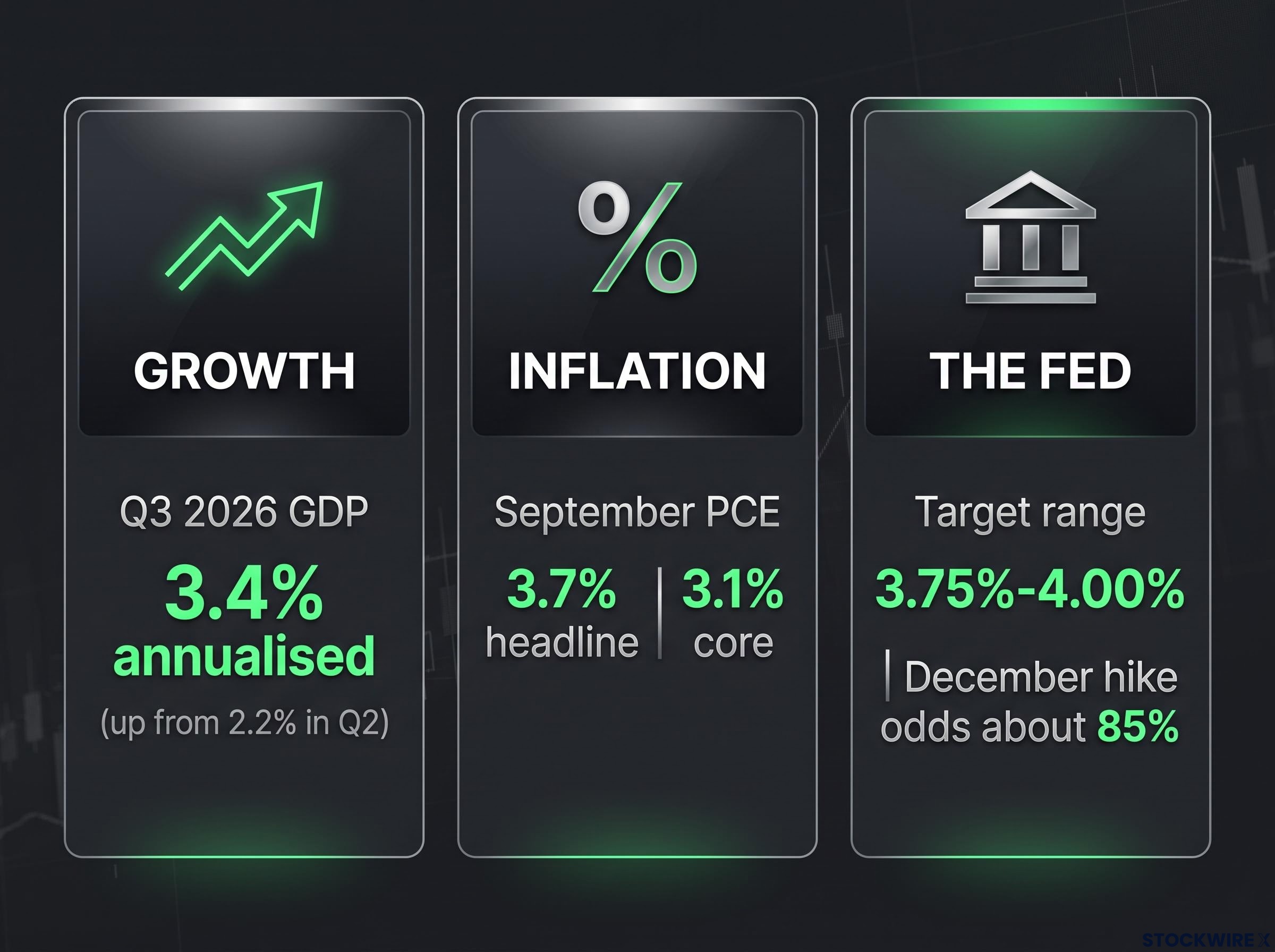
US dollar strength is supported by Q3 2026 GDP of 3.4%, September PCE headline inflation of 3.7%, and about 85% odds of a December Fed hike.
| Indicator | Latest reading | Why it supports the dollar |
|---|---|---|
| Q3 2026 GDP (BEA advance) | 3.4% annualised | Strong growth reduces pressure for rate cuts |
| September PCE | 3.7% headline, 3.1% core | Inflation well above the 2% target keeps policy tight |
| October CPI (consensus only) | 3.9% headline, about 2.8% core | Expected to confirm price pressure stays elevated |
| Fed funds range | 3.75%-4.00% | Already restrictive, with markets pricing more |
| December hike odds | About 85% | Lifts short-dated US yields against peers |
The hawkish tone is as much a pricing story as a policy one. Money markets are assigning a real probability to a drawn-out tightening cycle, and Fed speakers are giving them reasons to.
Governor Christopher Waller, 10 November 2026 Waller said he would back a 25 bp December hike even if October inflation cooled, and would consider 50 bp if inflation worsened.
ING’s October commentary judged this market pricing as somewhat too aggressive, yet still supportive of the dollar. When growth, inflation and Fed rhetoric all point the same way, the dollar is effectively being paid to be held. Betting against it in early 2027 means betting against the policy path itself.
When big ASX news breaks, our subscribers know first
How do inflation and rate expectations actually move a currency?
The dollar move you see on a screen is the last link in a chain. The Fed has not hiked yet, but the DXY already reflects the hike traders expect. To see why, follow the sequence ING uses:
- Higher inflation raises expected Fed rates. Markets price fewer cuts, more hikes or a longer period of tight policy.
- Expected tightening lifts short-dated Treasury yields. Two-year yields respond most closely to the expected policy path.
- Higher US yields raise the relative return on dollar assets. When US short-dated yields climb against German, Japanese or UK yields, capital moves toward the dollar.
- Falling inflation runs the chain in reverse. Hikes get priced out, short-dated yields drop and the dollar loses support, especially if foreign central banks stay restrictive.
This is why ING anchors its view on short-dated US rates and the expected rate differential, which is the gap between expected US rates and those abroad. The current Fed target is a snapshot. The currency trades the forecast.
What this tells you is that a shift in the inflation outlook can move the dollar before the Fed changes anything. A soft CPI print can weaken the currency on the day, even if the December hike still goes ahead.
Why the 2022 and 2025 episodes bracket today’s setup
In 2022, rapid Fed hikes pushed US short-dated yields up, and markets priced a steeper tightening path than in Europe or Japan. Widening expected rate differentials swamped any concern that the dollar looked expensive.
The year 2025 showed the other side. The dollar fell sharply as markets expected US growth and policy support to deteriorate, and Goldman Sachs still judged it about 15% overvalued afterwards.
The current episode blends both patterns. Strong data and hike pricing echo 2022, while the prospect of inflation falling and 2027 hikes disappearing echoes 2025. The Fed path is the swing factor.
What changes in spring 2027 when energy base effects fall out of inflation?
The spring turn comes down to arithmetic. Headline inflation compares today’s prices with prices twelve months earlier. If energy prices jumped during that earlier period, the comparison starts from a high base.
Once that high base rolls out of the 12-month window, the annual inflation rate can fall sharply, even if energy prices simply stop rising. Nothing about underlying demand needs to change. The number drops because the starting point moved.
The energy pressure behind the base effect is partly a refining story: a diesel supply deficit of 2-3 million barrels per day has pushed crack spreads to four to five times their historical norm, which crude benchmarks alone understate.
ING expects this mechanical decline to pull headline inflation back toward the Fed’s 2% target in Q2 2027, down from the above-3% readings behind its Q1 case. That weakens the argument for further hikes, short-dated US rates fall substantially, and the dollar loses its rate support around spring.
- Q4 2026: DXY near 102, inflation above 3%, a December hike largely priced. Dollar supported.
- Q1 2027: Fed keeps a hawkish tone, growth holds up, markets price the chance of prolonged tightening. Dollar stays firm.
- Q2 2027: Energy base effects drop out, headline inflation moves toward 2%, short-dated yields fall. Dollar softer.
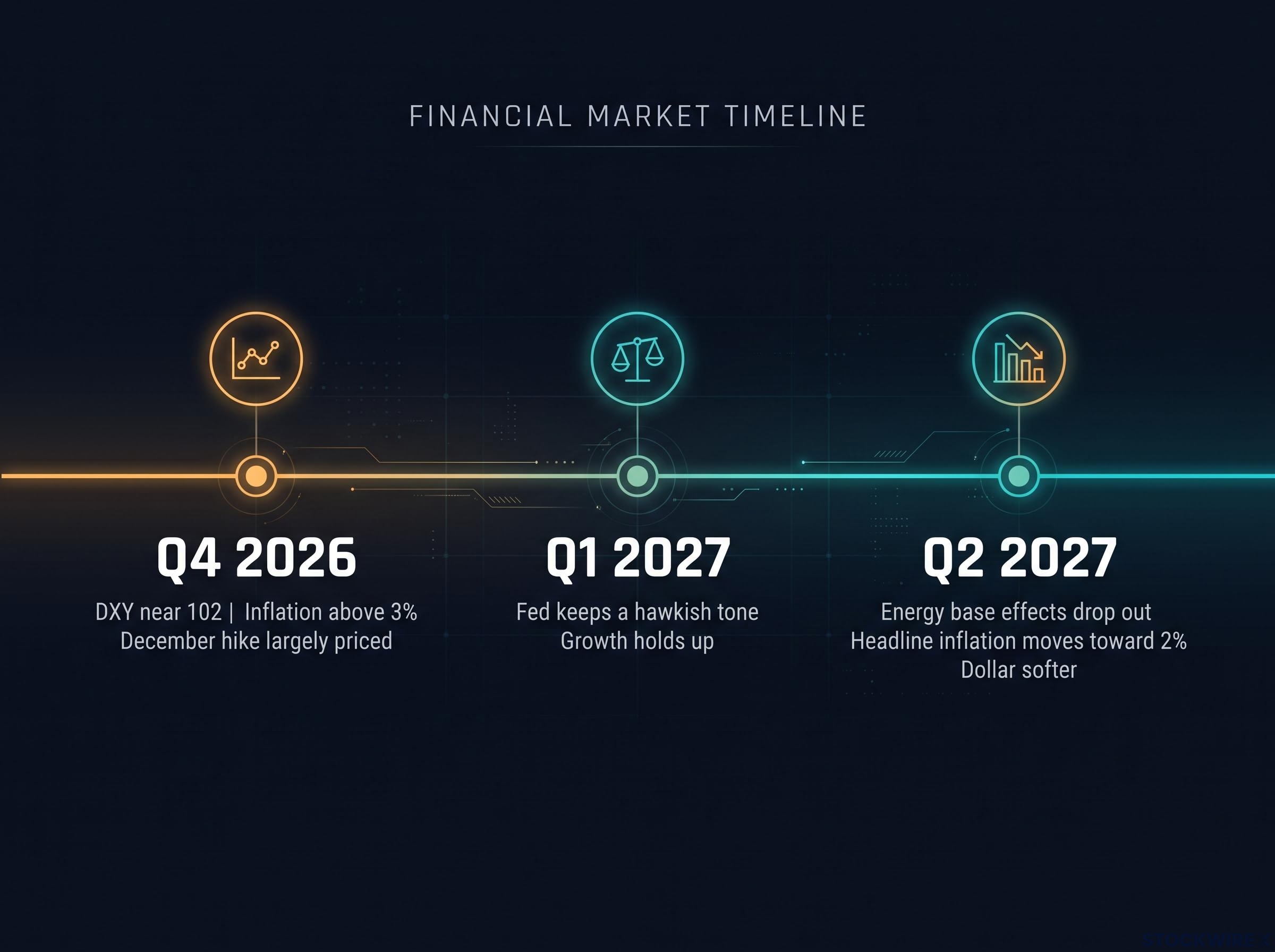
ING expects the dollar to be supported in Q4 2026 with inflation above 3% and DXY near 102, but softer by Q2 2027 as inflation moves toward 2%.
Chris Turner, ING Turner’s base case is a dollar that stays well supported in the near term and weakens later, with the turn arriving around spring 2027.
ING’s 10 November note gave no specific EUR/USD or GBP/USD targets, so the call is about direction and timing rather than levels. Because the turn hinges on a calendar effect in the data, you can track the date in advance rather than guess it. It also helps you separate a mechanical drop in inflation from a genuine cooling in prices. Markets may reprice before the data confirm either one.
How do other forecasters and the main risks stress-test ING’s timeline?
Most major houses agree that the dollar eventually weakens. They split on when, and by how much.
MUFG‘s November FX outlook is more bearish than ING and expects the move to start sooner, as inflation falls faster than markets expect. J.P. Morgan Asset Management sits closest to ING, though it leans on relative central-bank policy and a 2027 slowdown. Morgan Stanley is the clearest dissenter.
| Institution | Dollar view | Key timing | Relation to ING |
|---|---|---|---|
| MUFG | DXY 101.98 Q4 2026, 100.14 Q1 2027, 98.55 Q2 2027, 97.03 Q3 2027 | Decline under way from Q1 2027 | More bearish, earlier repricing |
| J.P. Morgan Global Research | Structurally bearish; near-term outlook upgraded on 3 November | Fed hike expected in Q3 2027, risks tilted earlier | Agrees on near-term support, eventual decline |
| Morgan Stanley | Reported DXY 102 by end-2026, 104 by mid-2027; EUR/USD toward 1.10 | Strength extends into mid-2027 | Clearest disagreement |
| Goldman Sachs | About 15% overvalued; further depreciation expected | Longer-term valuation horizon | Structurally bearish; allows cyclical strength if labour market weakens |
| J.P. Morgan Asset Management | December hike, then a hold; 2027 growth below 2% | Renewed weakness in 2027 | Close to ING’s spring thesis |
A spring turn on one side and a mid-2027 high on the other tells you that the direction is less contested than the timing. That gap is a reason to size any position for timing uncertainty, not just for the expected move.
Risks that could extend or shorten the dollar’s run
Risks that extend dollar strength:
- Persistent inflation, given Waller’s willingness to hike in December regardless and to go 50 bp if inflation worsens
- Strong growth, with 3.4% Q3 GDP able to delay the fall in yields
- Heavy Treasury supply, with J.P. Morgan Asset Management putting the fiscal-year deficit near $2 trillion
- Safe-haven buying during geopolitical or market stress
- Tariffs keeping goods inflation elevated, though J.P. Morgan estimates them at roughly 7.5% of goods imports in Q4 2026, down from 11.5% in Q4 2025
Risks that bring weakness forward:
- A sharper US slowdown that pulls Fed cuts forward, which Goldman warns could deepen depreciation
- Foreign investors raising hedge ratios on US holdings, amplifying a move that starts with lower yields
- Political friction and a possible prolonged 2027 government shutdown, flagged in ING’s 4 November commentary
Tariffs and safe-haven flows can cut either way. Tariffs can lift inflation or hit growth, and haven demand can hold the dollar up even as rate expectations fall.
What to watch before the dollar’s spring turn arrives
The framework is simple to state. Growth and a hawkish Fed hold the dollar up now, and falling inflation and lower short-dated rates are expected to wear that support away later.
Your watch list follows from that chain:
- The October CPI print and later releases
- The December Federal Open Market Committee (FOMC) decision and its rate projections
- How much March 2027 hike pricing survives
- US two-year yields against German and UK equivalents
- Energy price trends heading into the base-effect window
The October CPI result had not been released at the time of writing, so check it against the 3.9% headline and 2.8% core consensus. Most forecasters already agree on direction. The judgement left to you is whether spring is too early, too late or about right.
Investors tracking where the next turn could show up on charts can use our deep-dive into Dollar Index support and resistance, which maps the 200-day EMA band and the levels that flipped to resistance.
Past performance does not guarantee future results. Financial projections are subject to market conditions and various risk factors. These statements are speculative and subject to change based on market developments.
This article is for informational purposes only and should not be considered financial advice. Investors should conduct their own research and consult with financial professionals before making investment decisions.