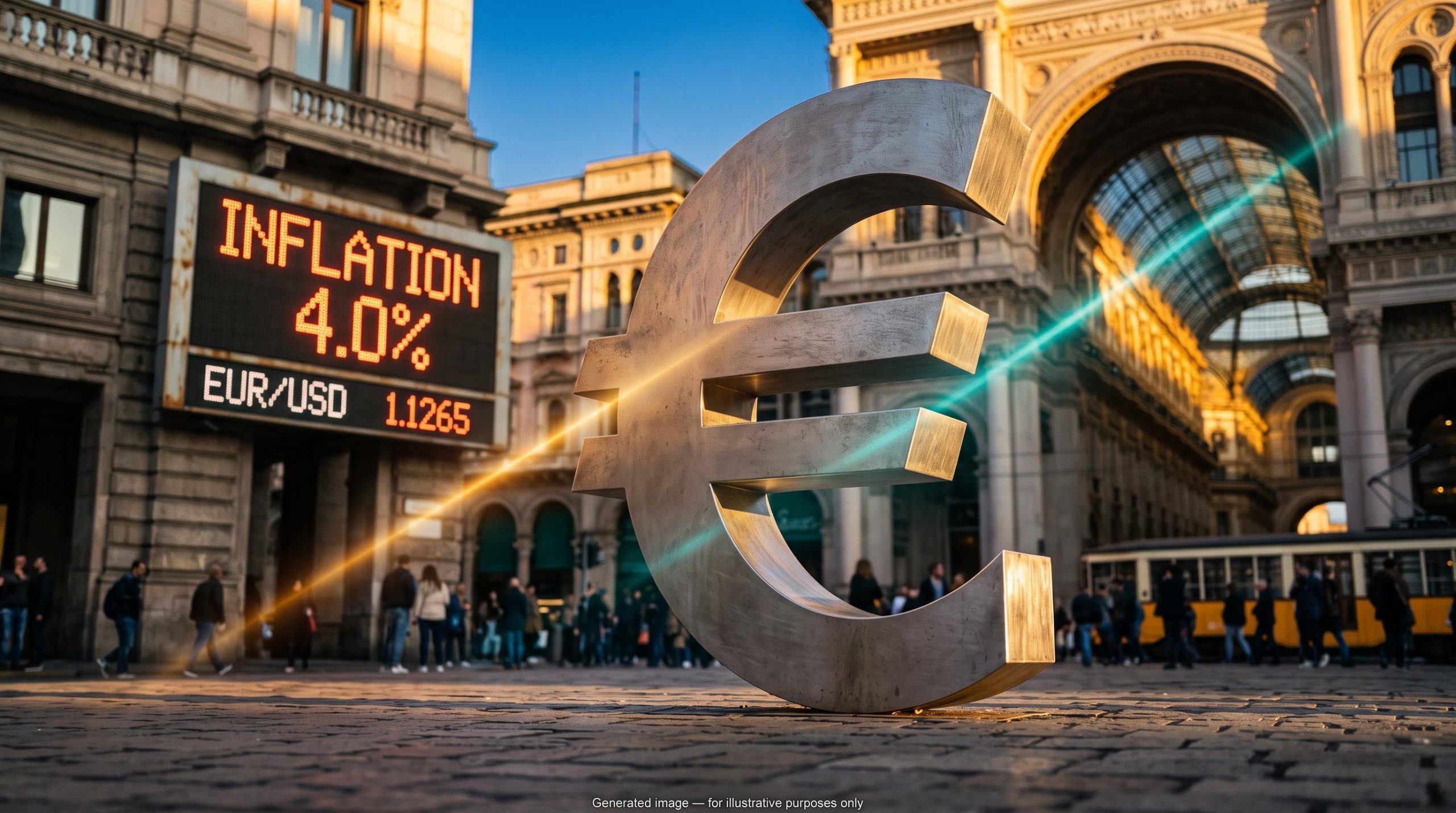
European Central Bank (ECB) President Christine Lagarde says two forces are hitting the euro area at once and pulling in opposite directions. An energy cost shock is dragging on growth, while an artificial intelligence (AI) investment boom is lifting demand. Both arrive with inflation at 4.0%, double the ECB’s 2% target.
Lagarde made the remarks in Milan on Thursday 5 November 2026, at a financial-literacy conference. The ECB has held its deposit rate at 2.50%, and the euro barely moved on the day.
The muted reaction matters for anyone watching ECB policy and the euro outlook. Here is how to read Lagarde’s signal, how it reaches the currency, and which releases matter before the December meeting.
Why can’t Lagarde tell a supply shock from a demand shock?
Lagarde described the two forces as “pulling in opposite directions.” She called separating supply-driven shocks from demand-driven ones “very difficult.”
“The current situation is made hard by the energy shock and AI pulling in opposite directions.”
The two forces leave similar traces in the data, but they work in very different ways:
- Energy shock: pushes prices up and pulls real incomes and output down.
- AI investment: lifts demand and investment now, with any productivity gains arriving later.
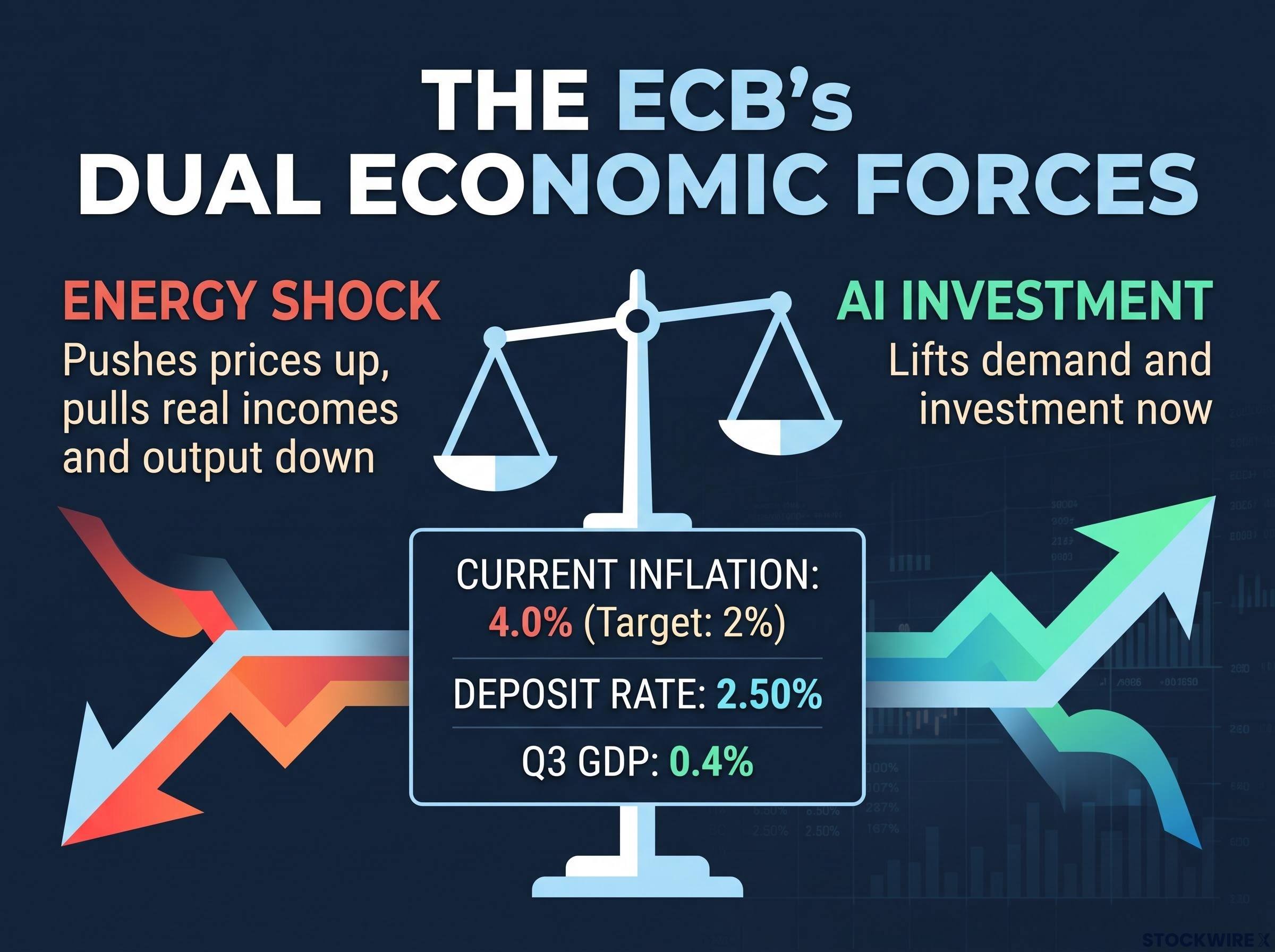
Both can show up as the same mix of rising prices and uneven growth. Eurostat’s October flash estimate put the Harmonised Index of Consumer Prices (HICP), the euro area’s headline inflation measure, at 4.0% year on year, up from 3.8% in September. Third-quarter GDP rose 0.4% quarter on quarter in the preliminary flash released on 30 October.
Neither figure tells the ECB which force is in charge.
That is why Lagarde warned against using interest rates “like a hammer.” She still said it is “still necessary to apply tools to avoid inflation running away” through wage demands and drifting expectations. She also said she did not expect US tariffs to be revisited right away.
Her line that there will be “many indicators between now and December” is the real tell. When a central bank cannot diagnose its inflation, its language turns conditional. You should read each phrase as a clue to which data would move her.
The Governing Council’s unanimous hold at its previous meeting still included a discussion of tightening, which helps explain why Lagarde’s conditional language leaves a December move open rather than closing the door on one.
How do ECB rates, QE and QT reach the euro, and what did the currency do?
That conditional tone shows up most clearly on the currency screen.
How the policy tools transmit
The ECB’s mandate is price stability, defined as inflation near 2%. Rates work through yield differentials, which are the gaps between returns available in different currencies. Higher euro-area rates generally support the euro.
Quantitative easing (QE) means creating money to buy bonds, which tends to weaken the currency. Quantitative tightening (QT) reverses that by letting bond holdings shrink, and it is usually euro-positive.
The ECB’s current QT is passive. Reinvestments under the Asset Purchase Programme (APP) ended in July 2023, and those under the Pandemic Emergency Purchase Programme (PEPP) ended at the close of 2024. The ECB’s Economic Bulletin 6/2026 reported Eurosystem monetary-policy holdings down about €150 billion over the review period.
The ECB monetary policy decision of 29 October confirmed that the Asset Purchase Programme and Pandemic Emergency Purchase Programme portfolios are shrinking at a measured, predictable pace, so passive QT is a settled background feature rather than a live policy lever.
How the euro traded on the day
EUR/USD sat near 1.1265 on Thursday, according to GO Markets and FXStreet. That is near the top of a one-month range of roughly 1.1110-1.1270. The same report linked lower oil prices and lower US yields to easing inflation fears.
| Pair | Change on 5 November |
|---|---|
| EUR/USD | -0.11% |
| EUR/GBP | -0.05% |
| EUR/JPY | -0.48% |
| EUR/CHF | -0.29% |
| EUR/CAD | +0.17% |
| EUR/NZD | +0.23% |
| EUR/AUD | +0.73% |
The euro gained against the commodity currencies but slipped against the dollar, yen and franc. That split tells you the market is weighing hopes of a rate hike against growth and US-rate risks rather than backing one ECB path.
History shows why a hawkish tone alone guarantees nothing. In 2022, the euro fell to parity with the dollar even as the ECB raised rates. Europe’s energy vulnerability and more aggressive tightening by the US Federal Reserve outweighed the ECB’s moves.
Which releases before December could settle the ECB’s next move?
If tone cannot move the euro, data can. Each upcoming release has a specific job in answering the supply-versus-demand question.
| Date | Release | What it helps settle |
|---|---|---|
| 13 November | Q3 GDP and employment estimate | Whether the labour market is tight enough to fuel wage demands |
| 18 November | October HICP, full data | Whether inflation is spreading beyond energy into services |
| 23-24 November (approximate) | Flash PMIs | Whether activity is weakening, or AI-linked demand is holding up |
| 25 November | Governing Council non-monetary-policy meeting | No rate decision; watch for officials’ commentary |
| 1 December | November flash HICP | Whether price pressure is persisting or fading |
Flash PMIs are purchasing managers’ indices, which are monthly business surveys that give an early read on activity. The data can support two readings:
- Hawkish: Inflation at 4.0% is far above target, and if it spreads into wages and services, Lagarde’s “tools” remark leaves a December hike possible.
- Dovish: Energy is already eroding real incomes and investment, so further hikes could cut activity without easing the energy constraint.
Services inflation and the employment detail matter more than the headline number. Those figures show whether the energy shock is becoming embedded in wages and prices, which is the condition Lagarde says would justify action.
Everything feeds into the 16-17 December monetary-policy meeting, with the press conference on 17 December.
Economist expectations had already shifted toward December, with a large majority of surveyed forecasters pencilling in a quarter-point increase and a growing number seeing the deposit rate peaking higher than 2.75%.
What the signal changes for the euro, and what to track into December
Lagarde has kept every option open. Until the data picks a side, the euro’s direction will depend more on releases and US yields than on ECB rhetoric.
The 1.1110-1.1270 range is your benchmark. A sustained break above or below it would suggest the market has started pricing a decisive policy shift.
The decision point is narrow: whether wage and services data show energy costs spreading through the economy. That is the trigger Lagarde has pointed to, and it is the one to watch through to 17 December.
The ECB inflation forecasts published in September already pushed the overshoot into 2027 and 2028, and a second upward revision in December would put the temporary-shock view under real strain.
This article is for informational purposes only and should not be considered financial advice. Investors should conduct their own research and consult with financial professionals before making investment decisions.