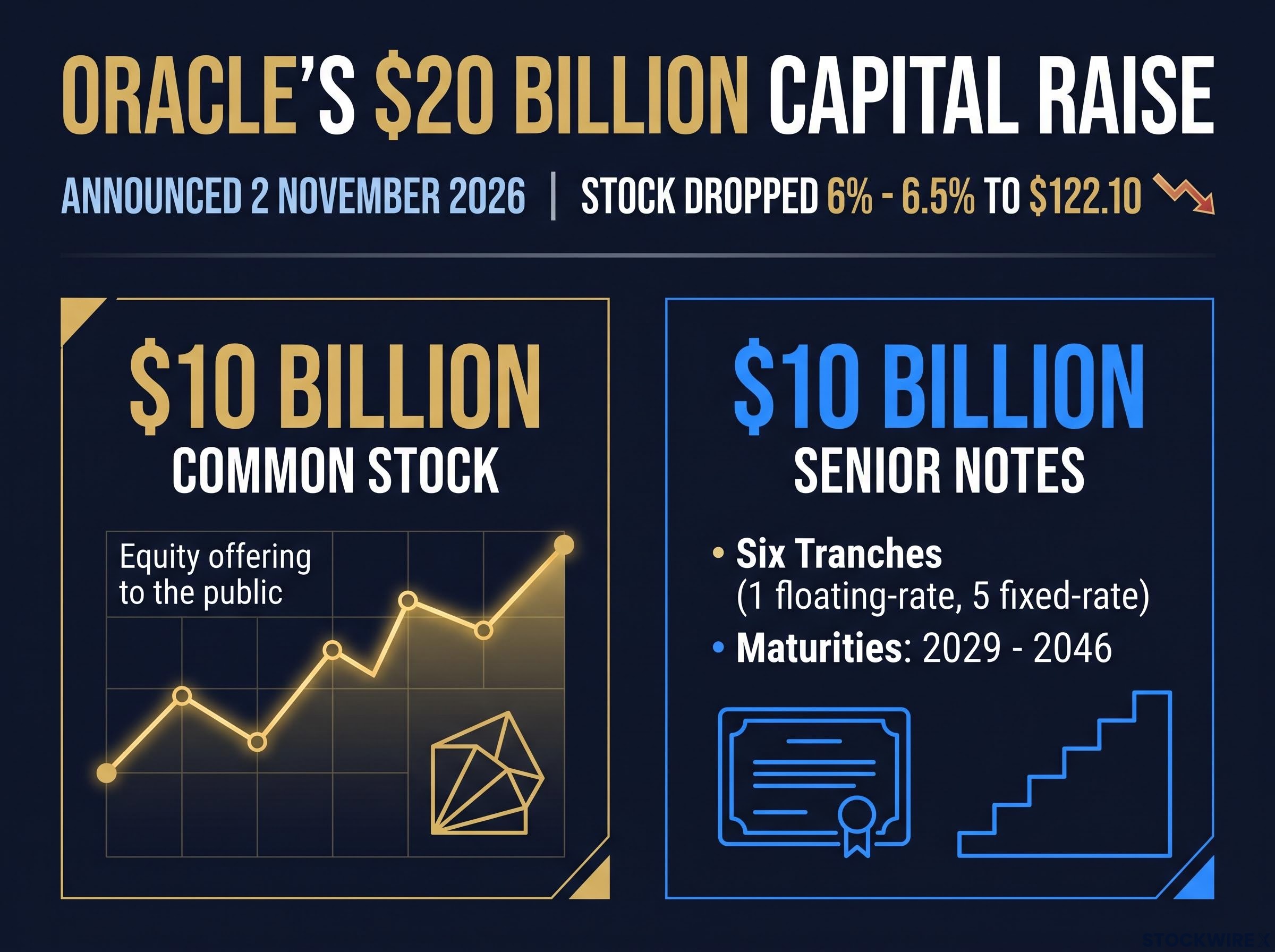
Oracle shares fell about 6% on Monday, 2 November 2026, after the company set out a $20 billion capital raise split evenly between new stock and senior notes. Barron’s put the decline at 6.5% to $122.10, while Reuters reported an earlier 4% premarket drop, so intraday figures vary by source.
The fall extended a rough year. Reuters reported the stock was already down about 33% in 2026 before the announcement.
The sell-off tests whether even the largest AI spenders can fund their data centre build-outs without punishing shareholders. The same day, Marvell announced an all-stock deal for Lumentum, and both stocks slipped.
Here is what the reaction tells you: why the mix of debt and equity matters as much as the headline size, which AI infrastructure names look stretched, and which still look comfortable.
Why did investors sell Oracle on a half-equity raise?
On paper, an equity-heavy raise should have calmed nerves. Selling stock adds no interest bill and no repayment date.
The market saw it differently. The package comprises $10 billion of common stock and $10 billion of senior notes in six tranches maturing between 2029 and 2046, one floating-rate and five fixed-rate. Final pricing, share count and discount were not yet available.
Each half carries its own cost. Debt keeps ownership intact but adds interest and refinancing risk. Equity avoids repayment but dilutes holders, and selling shares after a steep fall means giving away more of the company for each dollar raised.
| Component | Amount | Benefit | Cost to Oracle | What the market is watching |
|---|---|---|---|---|
| Common stock | $10B | No mandatory repayment | Dilution of ownership and earnings per share | Final issue price and discount |
| Senior notes | $10B | No immediate dilution | Interest expense and refinancing risk | Coupons across six tranches, BBB- rating |
The credit backdrop explains why borrowing is getting dearer. S&P cut Oracle to BBB- in July 2026, one notch above speculative grade (often called junk), citing rising capex, an uncertain path to profitability, competition and high customer concentration. Capex, or capital expenditure, is money spent on long-lived assets such as data centres.
Oracle’s five-year credit default swap (CDS), the annual cost of insuring its debt against default, sits near 295 basis points, according to CNBC. Its 2032 notes yielded about 7.24% in mid-October, per Yahoo Finance.
Oracle is not alone in turning to capital markets. AI data centre financing now spans multi-billion dollar stock sales, widening AI bond spreads and Goldman’s forecast of sharply higher hyperscaler debt issuance in 2027.
The scale of spending is the core of the problem. Oracle guided fiscal 2027 capex to $90-95 billion, against S&P’s previous $60 billion forecast. The company has said further capital-markets funding across FY2027-FY2030 will be limited to $20 billion, on top of a completed $20 billion at-the-market equity raise. Oracle’s latest total debt figure was not available.
What you should take from the sell-off: the market read this raise as proof the build-out cannot be funded from Oracle’s own cash. The dilution lands now; any return sits years away.
What the FY2029 cash-flow target has to prove
Oracle says capex should peak in fiscal 2027-2028, supporting at least $30 billion of positive free cash flow in fiscal 2029.
That target depends on spending actually stepping down in fiscal 2029. Until it does, shareholders are funding the gap.
When big ASX news breaks, our subscribers know first
How does Oracle’s funding position differ from Google and Meta?
The contrast is in who pays the bill. Alphabet‘s Google and Meta fund much of their AI investment from large advertising cash flows and sizeable cash balances.
Oracle’s expansion is more infrastructure-intensive and leans on outside customers plus debt and equity markets. In the market commentary that framed Monday’s moves, Brent Kachuba of SpotGamma and the show’s hosts discussed the view that Oracle may need to spend to survive, while Google and Meta could be fine in the short term without that spending.
| Company | Primary funding source | Credit signal | Dependence on outside capital |
|---|---|---|---|
| Oracle | External customers, debt and equity markets | BBB-, CDS near 295bp | High: $20B raise announced |
| Google and Meta | Advertising cash flows and cash balances | Far stronger cash generation | Lower: much funded internally |
The spending itself is enormous across the board. Reuters reported Alphabet, Meta, Microsoft and Amazon were projected to spend well over $700 billion in 2026, and Moody’s estimated the five largest US hyperscalers plus CoreWeave could approach $1 trillion of capex in 2027.
J.P. Morgan’s AI capex estimate Global AI capex could reach $900 billion in 2026 and $5.5 trillion by 2030, according to J.P. Morgan (via Reuters).
These forecasts are speculative and subject to change based on market developments and company performance. Corporate commitment keeps rising even as investor scepticism about returns persists, though sustained spending plans suggest demand is not purely speculative.
Vital Knowledge research suggests AI capital spending is approaching 90% of hyperscaler cash flows in aggregate, which helps explain why even the best-funded spenders are leaning more on outside capital than the headline cash balances imply.
For you, the point is that “AI spender” is not one risk category. The same capex line carries very different balance-sheet consequences depending on who pays for it.
What do neo-cloud credit signals say about the wider AI build-out?
The sharpest stress sits further down the chain. Neo-clouds are AI cloud firms that borrow heavily to buy graphics processing units (GPUs) and build data centres, and CoreWeave is the market’s proxy for them.
Its 2032 bond yielded about 14.9% after topping 15% in October, per CNBC. Its five-year CDS was about 1,082 basis points on 19 October, with Insurance Journal recording a peak near 1,195bp on 15 October, and Morningstar reported the 9.625% 2032 note trading below 80 cents on the dollar.
The pressure builds in five steps:
- Heavy borrowing: neo-clouds take on debt for GPUs and data centre capacity.
- Few customers: revenue depends on a small number of large AI buyers.
- Fixed versus fluid: debt service is fixed, while chip generations and utilisation change quickly.
- Customer pullback: delays, in-house chips or cut commitments leave expensive idle capacity.
- Refinancing squeeze: new money gets harder to raise just as debt matures.
Reuters added project delays, power and component bottlenecks, and in-house chip efforts at Microsoft and Meta to the list of pressures. Citigroup high-yield analysts wrote that October’s sell-off exposed tenant-specific risk, and Moody’s flagged AI-related loans concentrated in 2027-2029 maturities.
The Nasdaq lagged the S&P 500 as these worries resurfaced, although sources conflict on Monday’s levels. Charles Schwab data showed the S&P at 7,580.07, down 1.82%, and the Nasdaq at 25,436.99, down 2.86%, while other coverage described a modest rebound.
Three readings of the same data
- Structural warning: debt investors doubt leveraged AI infrastructure can earn more than its financing costs.
- Cyclical risk-off: higher rates and profit-taking after a big rally, with compute demand intact.
- Durable demand: continued hyperscaler spending suggests demand is real, even if individual financing structures prove fragile.
Whichever reading you favour, credit markets are pricing leverage and customer concentration, not AI demand itself. Stress in one corner does not automatically mean stress at every spender.
Citi’s data centre forecast of 370 GW by 2031, more than triple its earlier projection, supports the durable-demand reading, though Microsoft CEO Satya Nadella has warned of a potential industry-wide overbuild.
Why did Marvell and Lumentum both fall on an all-stock deal?
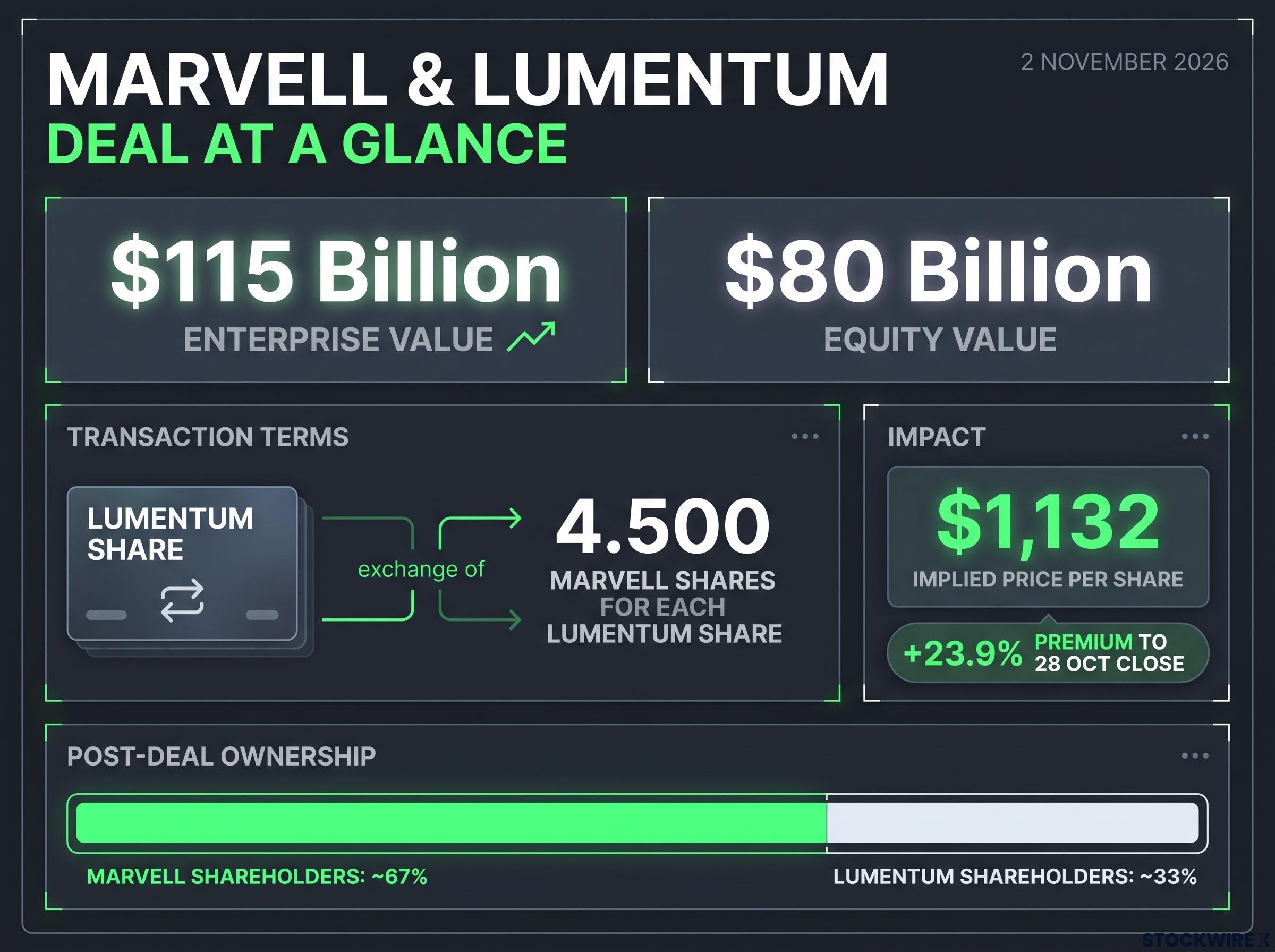
Marvell’s deal mirrors Oracle’s problem from another angle. Announced on 2 November 2026 in a Marvell 8-K filing, the terms are:
- About $115 billion enterprise value and about $80 billion equity value
- 4.500 Marvell shares for each Lumentum share
- An implied price of about $1,132 per Lumentum share
Deal at a glance A 23.9% premium to Lumentum’s unaffected 28 October close, leaving Marvell holders with about 67% of the combined company and Lumentum holders with about 33%.
Reuters reported premarket falls of about 0.7% for Marvell and 1.5% for Lumentum, with other reports showing larger intraday moves. All pointed the same way.
Paying in stock avoids debt markets and can make sense when the acquirer’s shares carry a premium valuation. Markets have still tended to punish large premiums plus execution risk, and when the acquirer’s shares fall, the effective cost rises.
Avoiding debt does not remove the cost of a deal. It moves it onto existing shareholders through dilution and valuation exposure.
Three signals to watch as the Oracle pricing and AI financing story develops
Financing structure, credit rating and cash generation now separate AI spenders in the market’s eyes. Three items you can check:
- Final pricing: the discount on Oracle’s stock and the coupons on its six note tranches.
- Rating stability: whether Oracle holds BBB-, its last rung above speculative grade.
- Neo-cloud credit: further moves in CoreWeave’s bond yields and CDS.
The bottom line: Oracle’s two-part raise aims to preserve investment-grade access while funding one of the market’s most capital-intensive builds.
This article is for informational purposes only and should not be considered financial advice. Investors should conduct their own research and consult with financial professionals before making investment decisions.