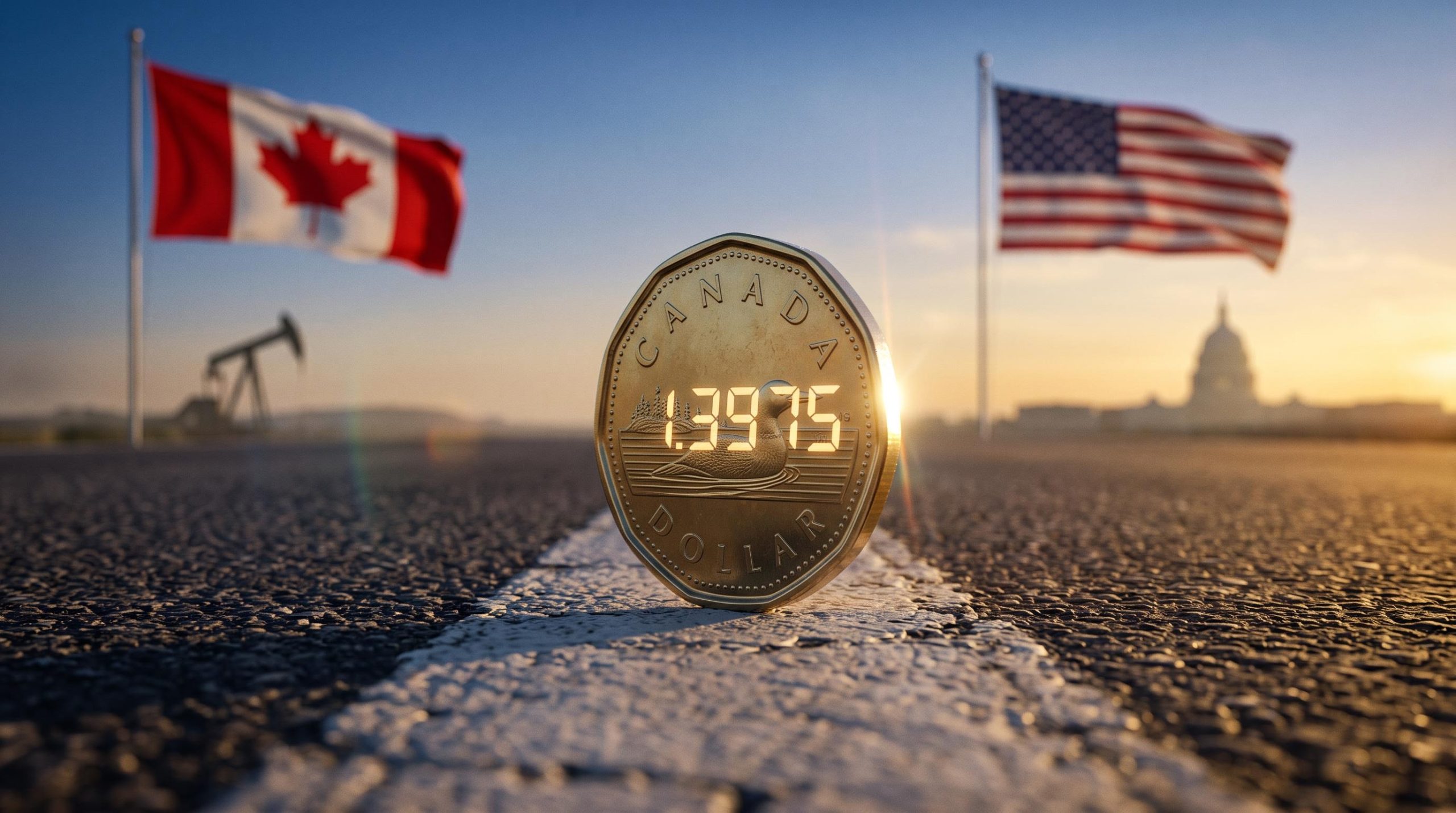
USD/CAD closed in on the US midterms at 1.3975, almost exactly where it has spent weeks, even after the Bank of Canada raised rates, oil swung from US$104.95 to roughly US$99, and American voters prepared to reshuffle Congress. The flat chart hides how much is happening underneath it, and the USD/CAD forecast for the next 6-12 months depends on what is happening there.
Markets have already settled on an answer to the election. Kalshi and Polymarket both price a Democratic sweep near 73%, which leaves little room for that result to move anything. The outcomes that could matter sit in the Senate count, in US-Iran diplomacy and in the gap between two central banks heading in unusual directions.
The next scheduled test comes on Friday, when the US and Canada both release jobs reports.
This piece sets out which driver matters on which timescale: the vote for days, the Federal Reserve and oil for months. Knowing that order helps you judge when a headline deserves a position change and when it is just noise.
What are markets pricing going into November 3?
The price snapshot
Start with the currency pair itself. USD/CAD touched 1.3941 last Friday, its lowest level since 16 September, then drifted back to 1.3975 on Monday. A move that small suggests nothing is happening. The other three gauges show otherwise.
| Measure | Level (2 November) | Driver |
|---|---|---|
| USD/CAD | 1.3975 | Weaker dollar and falling crude offsetting each other |
| US Dollar Index (DXY) | 101.67 | Safe-haven demand, capped by lower Treasury yields |
| WTI crude | US$99.3-US$99.7 | Iranian-Qatari talks aimed at ending the war with Iran |
| US 10-year Treasury yield | 4.912% | Inflation and fiscal worries, tempered by haven buying |
The DXY tracks the US dollar against a basket of major currencies. Reuters and Baystreet put WTI at roughly US$99.3-US$99.7, while FXStreet reported a figure near US$96. The gap most likely reflects prices taken at different points in a fast-moving session.
Oil has whipsawed for a week. A tanker attack in the Strait of Hormuz on 30 October pushed WTI to settle at US$104.12, and then three days of Iranian-Qatari talks pulled it back below US$100.
Oil’s sensitivity to Gulf diplomacy also reflects how far OPEC pricing power has eroded, with the cartel now controlling only about 27-28% of global supply and the market far more fragmented than older investor frameworks assume.
So two large forces are cancelling each other out. Cheaper oil should hurt the Canadian dollar, because Canada is a major crude exporter. A softer US dollar pulls the pair the other way, and on Monday the two moves offset each other almost exactly.
What prediction markets imply
These odds come from traders betting real money, so they are market-implied probabilities rather than opinion polls.
| Market (2 November) | House (Dem) | Senate (Dem) | Dem sweep |
|---|---|---|---|
| Polymarket | ~95% | ~74% | 73% |
| Kalshi | ~91% | ~69% | 73% |
The House looks settled. The Senate does not. Kalshi gives a Democratic House with a Republican Senate 24% and a Republican sweep 7%.
That changes how you should read Wednesday’s results. A Democratic sweep is close to fully priced, so it is unlikely to move your positions much. A Republican Senate hold is the result that could force a repricing.
When big ASX news breaks, our subscribers know first
How do election outcomes transmit to yields, the dollar and equities?
Before you can judge a surprise, you need the transmission chain. Expectations about government borrowing move Treasury yields, which are the interest rates the US government pays on its bonds. Higher yields widen the return advantage of holding dollars over other currencies, and that advantage tends to pull the dollar up.
| Outcome | Treasury yields | Dollar | Equities |
|---|---|---|---|
| Democratic sweep | Lower long-term yields as fiscal risk premium shrinks | May rise first as policy risks recede; lower yields could erode it later | Good for bonds; less so for tax-cut and deregulation sectors |
| Republican Senate, Democratic House | May stay elevated on continued deficit scope | Higher yields support it first; deficits may weigh later | Helps deregulation sectors; funding fights remain |
| Republican sweep | Growth and yield expectations lift | Initially supportive; deficit and inflation effects negative later | Positive for cyclicals; higher yields could squeeze tech |
Every row in the table runs in two stages, and in most cases the second stage points the opposite way to the first.
Brown Brothers Harriman (BBH) expects any dollar reaction to be modest and short-lived, with Treasuries likely to react more. A Bloomberg survey conducted between 2 and 17 October found more than half of respondents expected yields to fall over the next year after a Democratic sweep. Professionals broadly see a Democratic sweep as better for bonds and Republican control as relatively better for stocks.
Karl Schamotta of Corpay spells out how the first reaction can turn into its opposite over time:
Corpay’s view on hedging A clean Republican hold could first support the dollar through higher yields. Over time, deficit-financed policy, institutional pressure and foreign-policy risk could push investors to raise longer-term currency hedge ratios, meaning they protect more of their dollar holdings against a fall.
Schamotta also argues that Democratic gains could lift the dollar in the short term by easing fiscal, trade and foreign-policy concerns.
If you are trading the vote, the first-day move is a poor guide to where the dollar sits six months later. Treat the initial reaction as a hypothesis to test, not a conclusion to act on.
Why do oil and diverging central banks hold USD/CAD near 1.40?
Once the votes are counted, the pair goes back to the forces that set its level day to day. Four components do most of the work:
- Rate differential: the gap between US and Canadian interest rates
- Relative growth: which economy is expanding faster
- Oil terms of trade: what crude prices mean for Canada’s export income
- Risk sentiment: whether investors are seeking safety or taking risk
The rate and growth gap
The two central banks are moving in an unusual combination. On 28 October, the Fed voted 10-2 to hold its target range at 3.75%-4.00%, following a hike in September. On the same day, the BoC raised its overnight rate by 25 basis points to 2.50%, its first increase since July 2023. Governor Tiff Macklem warned that higher energy prices risked spreading into broader inflation.
The Bank of Canada raised its overnight rate even though CPI-trim sat at 1.8% and CPI-median at 1.9%, with the case resting on rising business and consumer inflation expectations rather than damage already done.
The BoC is tightening, yet it remains far below the Fed. CME FedWatch puts the odds of another US hike on 9 December at about 70.9%, down from about 85% just after the meeting. Another snapshot cited 74%, and the difference reflects when each reading was taken.
| Measure | United States | Canada |
|---|---|---|
| Policy rate | 3.75%-4.00% | 2.50% |
| Manufacturing PMI (October) | 55.5 (ISM) | 49.6 (S&P Global) |
| New orders | 55.5 | 46.5 |
A purchasing managers’ index (PMI) surveys factory activity, and any reading below 50 signals contraction. US production hit 59.0, its highest since November 2021, while Prices Paid sat at 75.2. Canada slipped below 50 for the first time in 2026. On both rates and growth, the advantage sits with the US dollar.
Two oil scenarios
Oil can push the pair in either direction. If diplomacy collapses, oil rises, Canada’s export income improves and both central banks stay hawkish. A risk-off scramble for safety can still lift the US dollar in that case. If a settlement holds, oil loses support for the Canadian dollar, but lower inflation could also pull US yields down and narrow the dollar’s rate advantage.
For you, this means falling oil is not automatically bad for the Canadian dollar or good for the US dollar. The direction depends on whether the drop reflects peace or weakening demand.
Why growth and Fed policy outweigh the vote over 6-12 months
The durable drivers
Over a longer horizon, the election starts to matter less.
BBH’s horizon view Over six to twelve months, growth and Fed policy matter more than the vote, because together they set the discount rate for virtually all assets.
Four drivers carry that weight:
- Inflation and the Fed’s reaction function: with roughly 70-74% odds of a December hike, moves driven by the election are vulnerable to reversal.
- Relative growth: a US PMI of 55.5 against Canada’s 49.6 supports the US dollar.
- Fiscal sustainability: no election outcome removes the deficit problem.
- Oil and geopolitics: US-Iran talks can move oil, inflation expectations and the timing of rate cuts.
The historical record supports a patient view:
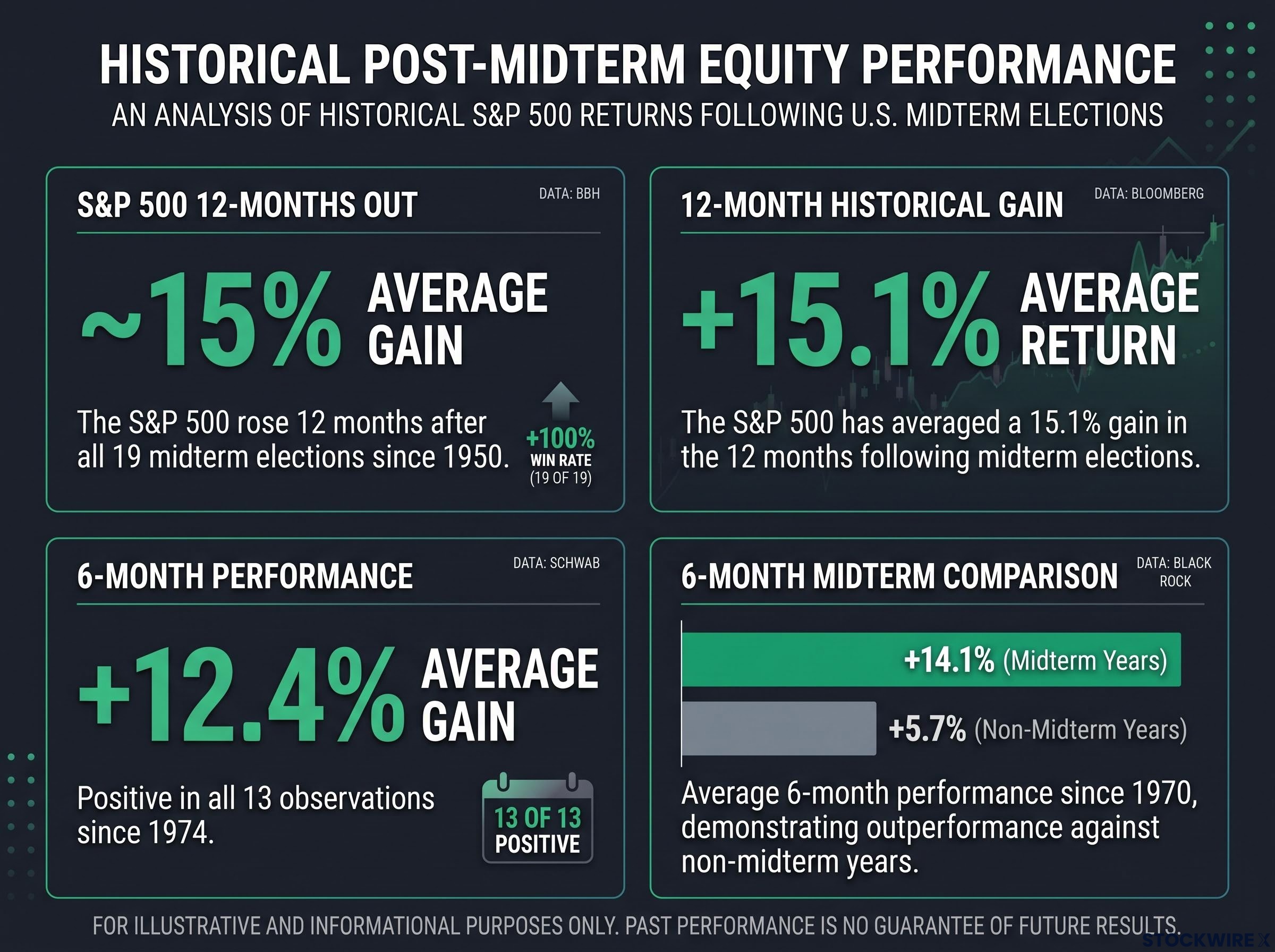
- BBH: the S&P 500 rose in the 12 months after all 19 midterms since 1950, averaging about 15%
- Bloomberg data analysis: an average 12-month gain of 15.1%
- Schwab: an average six-month gain of 12.4%, positive in all 13 observations since 1974
- BlackRock: a six-month average of 14.1% since 1970, against 5.7% in non-midterm years
Past performance does not guarantee future results. Financial projections are subject to market conditions and various risk factors.
What could break the pattern
The sample is small, and those rallies often coincided with falling inflation or approaching rate cuts. Some strategists see high 2026 valuations as a test. Treasury yields have already eased from multi-year highs during an AI-driven tech sell-off, a sign that equity stress can overwhelm election effects.
There are other threats. A collapse in talks, as the 30 October tanker attack showed, could bring back the oil risk premium. A hawkish Fed surprise could lift USD/CAD whatever the result. Raymond James points to a funding deadline beyond 12 December and a debt ceiling expected to bind in 2027.
The Fed rate hike outlook remains divided, with most officials still pencilling in another increase this year while futures pricing has swung with each data release, which explains why December odds near 70% can fade quickly.
Treat the post-midterm rally as a tailwind, not a guarantee. Keep the Fed path and oil headlines at the centre of any USD/CAD view.
Reading the USD/CAD forecast after the vote: what to watch next
The order of importance is fairly clear. The election may set the tone for a few sessions, especially if the Senate surprises. The Fed’s path and the price of oil are what will hold USD/CAD near 1.40 or move it away over the coming months.
Your near-term watch list:
- Friday’s jobs reports: the US and Canadian releases test the growth gap directly
- 9 December Fed meeting: whether hike odds near 70% firm up or fade
- US-Iran talks: the swing factor for oil and inflation
- 12 December funding deadline: the first fiscal flashpoint after the vote
If the Senate delivers the result markets have not priced, decide in advance whether you will act on the first move or wait for the data to confirm it. On the evidence here, the first move will not settle where the pair goes over the following months.
These statements are speculative and subject to change based on market developments and company performance.
This article is for informational purposes only and should not be considered financial advice. Investors should conduct their own research and consult with financial professionals before making investment decisions.