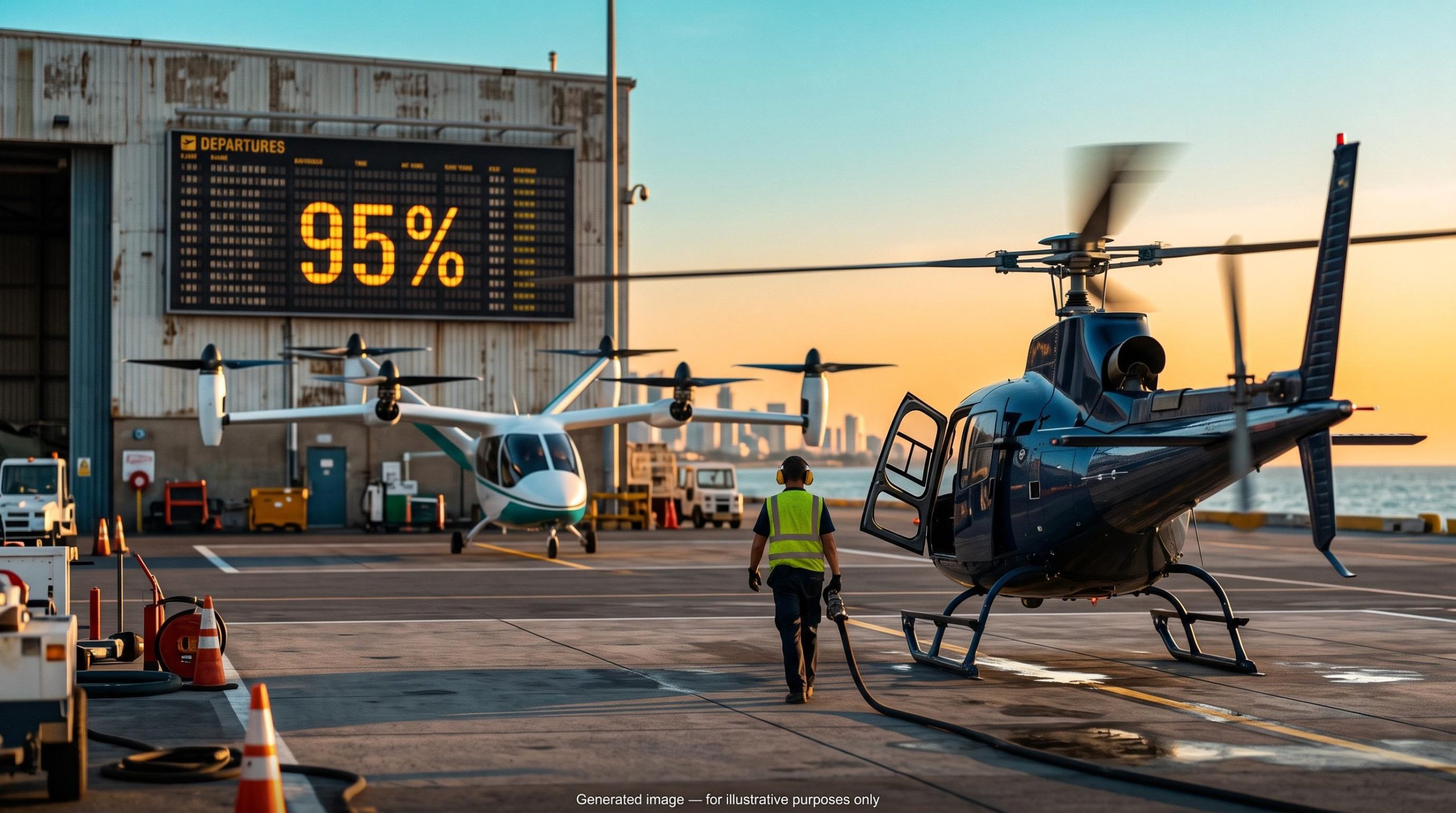
Joby Aviation has guided to roughly $120M of revenue for 2026. About 95% of it is expected to come from Blade, a helicopter charter business Joby acquired, rather than from its own certified electric aircraft.
That gap matters. eVTOL stocks, shares in companies building electric vertical take-off and landing aircraft, are often judged on revenue growth as though it signals flying-car traction. For the sector’s leaders, the headline figures mostly measure something else.
The cost of that confusion has been high. eVTOL stocks are down nearly 65% on average over roughly the past year. Meanwhile, the White House eVTOL Integration Pilot Program (eIPP) has put passenger-carrying flights in the news this autumn. If you treat demonstration flights as proof of a working business, you risk paying a growth price for a story that has not yet earned it.
Here is a way to separate real eVTOL exposure from adjacent businesses, along with the milestones that would genuinely change the picture.
What went wrong for eVTOL stocks, and what the Lilium collapse taught investors
The four pressures
Most of these companies reached the market in the early 2020s through SPACs. A SPAC, or special purpose acquisition company, is a listed shell that merges with a private business to take it public, often with ambitious forecasts attached. From there, the decline followed a sequence:
- Certification delays defer revenue. An aircraft can fly in public and still be barred from ordinary commercial service.
- Cash burn forces financing. Companies must raise capital before sales scale, and new shares or strategic equity deals dilute existing holders.
- The SPAC forecasts age badly. As production and revenue schedules slipped, the growth premium drained away.
- Early revenue gets discounted. Charter and airport income is real, but the market discounts it when valuing an aircraft platform.
Each step feeds the next. A delay lengthens the cash runway required, financing dilutes the equity, and credibility thins with every missed date.
Cash runway is the variable that separates survivors from casualties in this sector, because every certification delay lengthens the period a company must fund before sales scale, and new equity raised to bridge it dilutes existing holders.
Lilium and the other casualties
Lilium shows where that sequence can end. It listed via SPAC in 2021. Its German operating subsidiaries filed for insolvency in October 2024, and regular proceedings followed in March 2025.
Technology survived; shareholders did not Lilium’s market capitalisation now sits around $31,000. Archer separately bought about 300 Lilium patent assets for roughly €18M: a patent-asset purchase, not an acquisition of Lilium’s equity or operating company.
Volocopter made real certification progress but ran short of capital. Vertical Aerospace issued production and launch forecasts well ahead of certification and stable funding.
The lesson for you is blunt. A strong product tells you little about whether shareholders survive. Cash runway and certification evidence count for far more than the original SPAC deck.
When big ASX news breaks, our subscribers know first
Joby, Archer and BETA: what the revenue actually comes from
That failure pattern is the right filter for the three survivors. Applied line by line, their headline numbers look rather different.
Joby
Joby secured exclusive air-taxi rights in Dubai, but the commercial launch it planned for earlier this year did not happen. Its revenue base, however, keeps growing. H1 2026 revenue reached $63M, and of Q2’s $38.6M, $36.2M came from Blade, according to shareholder materials dated 5 August 2026. Joby then raised full-year guidance to $115M-$125M.
On 11 August 2026, Joby agreed to buy defence-technology company Resonant Sciences for about $500M. Closing is expected in H1 2027, so none of that business appears in reported revenue yet. It is a fallback line of business, not flight income.
Archer
Archer’s Q2 2026 revenue of $5.0M came primarily from Hawthorne Airport in Los Angeles: fuel, hangar leasing and fixed-base operator (FBO) services, the ground handling an airport provides to aircraft. None of it came from certified Midnight eVTOL flights.
On 10 August 2026, Archer agreed to acquire three Boeing subsidiaries: Wisk (autonomous eVTOL development), Insitu (surveillance drones) and SkyGrid (airspace software). Archer says Insitu is profitable with more than $200M in annual revenue. The Hart-Scott-Rodino antitrust waiting period expired on 24 September, but other conditions remain, and closing is expected by the end of 2026.
BETA
BETA skipped the SPAC route and listed through a traditional IPO in November 2025. Cash stood at $1.4795B on 30 June 2026, up from $174.5M a year earlier, according to Q2 results released 12 August 2026. Its FY2025 10-K, dated 9 March 2026, showed a $745.9M net loss and $267.8M of cash used in operations.
Its revenue comes from aircraft development and manufacturing, not passenger services. The prospectus backlog of 331 aircraft (131 firm, 200 options) refers to its conventional take-off CTOL product, not firm A250 eVTOL orders.
BETA’s diversification into cargo, charging and component supply, including electric motors for Embraer’s Eve, explains why its revenue profile looks different from passenger-focused rivals and why its development-stage label deserves nuance.
| Company | Headline revenue or cash figure | Where it comes from | Pure eVTOL exposure? |
|---|---|---|---|
| Joby | $38.6M Q2 2026 revenue | About 94% Blade charter | No |
| Archer | $5.0M Q2 2026 revenue | Hawthorne Airport operations | No |
| BETA | $1.4795B cash (30 June 2026) | IPO proceeds; development and manufacturing revenue | Development stage |
Read together, the message is plain. Revenue growth here mostly measures charter, airport and defence businesses, so you should not take it as evidence that eVTOL unit economics work.
How to separate real eVTOL exposure from adjacent businesses
If headline revenue cannot answer the question, you need a different tool. The most useful one sorts every revenue line into an exposure type and asks what to measure, not what to believe.
| Exposure type | Examples | What to measure |
|---|---|---|
| Pure eVTOL platform | Joby S4, Archer Midnight, BETA A250 | Certification stage, production rate, firm orders, utilisation, maintenance cost |
| Defence and autonomy | Joby-Resonant; Archer-Wisk, Insitu | Government contracts, recurring revenue, profitability, backlog quality |
| Charter and distribution | Joby’s Blade | Passenger volume, gross margin, repeat demand |
| Airport and FBO | Archer’s Hawthorne | Fuel, hangar and FBO margins, traffic, cash generation |
| Manufacturing and components | BETA aircraft, batteries, charging | Yield, production certification, warranty exposure, option conversion |
| Airspace and software | SkyGrid | Recurring software revenue, regulatory acceptance |
Only the first row tests the flying-car thesis directly. Every other category can be a perfectly good business, but you should value it as a charter operator, an airport or a defence contractor.
Valuing the defence assets now being bought means reading defence contractor backlogs by funded versus unfunded work and book-to-bill ratio, not by headline revenue alone, since quality of contracts decides how durable that income is.
The metric that eventually decides the pure-platform row is contribution margin per flight. That is the revenue from a single flight minus the direct costs of operating it. Labour is the biggest swing factor in that calculation.
Why autonomy sits at the centre Studies cited in the research suggest the pilot is the main cost to eliminate. Early eIPP flights are generally piloted, with autonomy evaluated separately, so current operations do not yet test the economics most bulls rely on.
This is why Archer’s Wisk and SkyGrid assets matter more than their revenue suggests. They are a bet on removing the pilot from the cost line.
Before you value any of these companies as flying-car businesses, ask one question. What share of revenue would still exist if no eVTOL ever carried a fare-paying passenger? For Joby and Archer today, the answer is nearly all of it.
What the eVTOL Integration Pilot Program does and does not change
The screen also helps with the loudest headlines of the past two months. Real passengers are now flying in eVTOLs across the US, and the federal government is backing it.
The programme drew more than 30 proposals. Eight projects were selected on 9 March 2026, spanning 26 states at announcement and 28 in FAA materials updated 22 October 2026. Lead projects include Texas, Utah, Florida, North Carolina, New Mexico’s Albuquerque and the Port Authority of New York and New Jersey. Operations have rolled out steadily:
- First public operations began at Perot Field Fort Worth Alliance Airport in Texas, involving BETA and Joby.
- North Carolina launched in late September.
- New Mexico became the sixth location, according to FAA announcements on 2 October.
- Florida followed as the seventh, per FAA announcements from 27-31 October 2026.
BETA delivered the most visible first. On 20 October, its ALIA A250 flew about 34 nautical miles from Plattsburgh, New York to Burlington, Vermont in 20 minutes. A day later the FAA granted it the first Special Airworthiness Market Survey Certificate issued to an eVTOL.
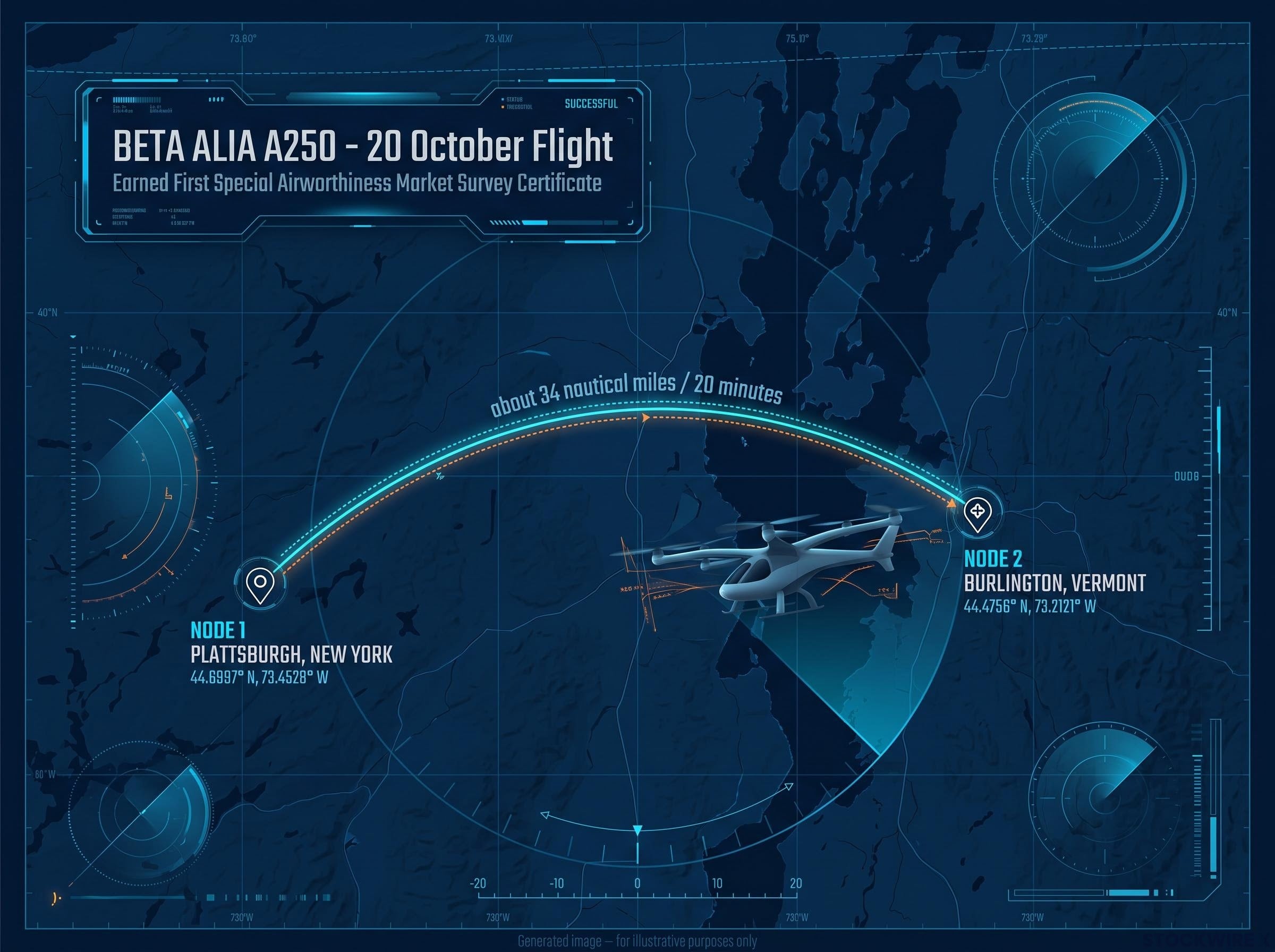
What the certificate allows BETA can fly operators, prospective customers and others for market survey and familiarisation. It does not authorise ordinary commercial passenger service, and Aviation Week (22 October 2026) describes the programme as testing operational concepts, not a substitute for type certification.
Type certification is the FAA’s formal approval that an aircraft design meets safety standards for regular service. None of the three has it.
The bullish case still holds weight. Federal support gives these companies operating data and lets states and airports write procedures before certification arrives. Joby participates in the Texas, Florida, North Carolina, Utah and New York and New Jersey projects, and management says it is on track for first paying customers this year. As of late October 2026, none had been established.
Treat eIPP milestones as evidence of operating progress and good optics, not as proof of revenue. The signal worth watching is the first fare-paying flight.
Federal support has precedent elsewhere in aerospace, where regulatory breakthroughs often arrive well ahead of the certification, funding and engine milestones that actually put a paying passenger on board.
The milestones that decide whether eVTOL stocks earn a re-rating
Strip away the demonstrations, and the evidence reduces to a short list. As of 2 November 2026, these are the milestones that would change the verdict:
- FAA type certification for a passenger eVTOL.
- Production certification, meaning approval to build that aircraft at scale.
- A first paid commercial passenger operation.
- Repeatable utilisation, with aircraft flying often enough to spread fixed costs.
- Positive contribution margin per flight.
- Workable pilot or autonomy economics.
- Cash runway to reach all of the above without destructive dilution.
Against those milestones, the risks line up clearly:
- Certification: demonstration authority and commercial authority remain separate, as BETA’s certificate shows.
- Capital intensity and dilution: BETA’s $745.9M 2025 loss, Boeing’s equity stake in Archer and Joby’s cash-funded Resonant deal all point to heavy funding needs.
- Pilot cost and autonomy: piloted service carries crew expense, while autonomy adds software and certification risk.
- Unit economics: Joby’s Q2 revenue was about 94% Blade and Archer’s came mainly from Hawthorne, so neither tests eVTOL economics.
The question extends beyond the US. European operators answer to EASA, the European Union Aviation Safety Agency, and Dubai’s planned air-taxi launch remains a marker for whether any operator can run a service abroad.
Your decision rule should rest on evidence of repeatable commercial operations, not the count of demonstrations or partnerships. Until that evidence arrives, any position you consider is best sized as speculative.
What to watch before treating eVTOL stocks as more than a speculation
Each leader now holds a different piece of the puzzle. Joby has the largest reported revenue base through Blade. Archer is turning into a diversified aerospace and defence platform. BETA holds the cash and the first market-survey certificate, yet none of them has proven a profitable passenger business.
The next verifiable tests arrive soon. Archer expects its Boeing deal to close by the end of 2026, and Joby hopes for Dubai passenger flights by year-end. Fare-paying eIPP flights and the Resonant Sciences closing, expected in H1 2027, follow.
When those events land, ask whether they prove repeatable paid service or simply add another adjacent business. That distinction should drive how you weigh this sector.
This article is for informational purposes only and should not be considered financial advice. Investors should conduct their own research and consult with financial professionals before making investment decisions.