

Westpac publishes 2026 Risk Factors ahead of investor decisions
Westpac Banking Corporation released its Westpac 2026 Risk Factors on 2 November 2026, giving investors and potential investors further information on its current and emerging risks and the potential consequences if those risks materialise.
The document sits alongside the 2026 Annual Report and is current as of its publication date, although its relevance may be affected by subsequent developments. For investors weighing the bank’s earnings and dividend outlook, it sets out the factors the company says could affect its performance and the price of its securities.
When big ASX news breaks, our subscribers know first
The biggest risks Westpac has flagged
The document covers a broad set of risks, from geopolitical events and litigation to competition and data quality. Three themes stand out for investors: regulation and financial crime, cyber and operational exposure, and economic, funding and capital conditions.
Regulatory, financial crime and conduct
Westpac states that the Australian anti-money laundering and counter-terrorism financing (AML/CTF) reforms, due to their scale and complexity, require a multi-year implementation plan. The Government has introduced transitional rules, including the deferral of initial customer due diligence requirements until 31 March 2029.
Westpac states it is not yet fully compliant with the full reforms, and that there is a risk its implementation plan or timeframes will not be adequate. In certain jurisdictions (e.g. the Pacific region), financial crime risks are elevated beyond the Group’s risk appetite, requiring an action plan to return within appetite.
On the prudential side, APRA can require, and has required, Westpac to hold additional capital or liquidity through an overlay. Westpac also lists a long set of regulators it responds to, including APRA, ASIC, the ATO, the ACCC and AUSTRAC.
Cyber, technology and operational risk
Westpac flags the increasing use of AI to accelerate and scale cyberattacks as one factor heightening information security risk. It also notes that legacy systems and projects such as its UNITE program may heighten the risk of technology failure, and that such projects may not be completed on time or deliver the expected benefits.
Westpac’s AI adoption is already well advanced internally, with a large share of staff using AI tools daily, which sits alongside the cyber exposure created when the same technology is used to accelerate attacks.
On scams, the banking sector was designated as a regulated sector under the Scams Prevention Framework in May 2026. Sector-specific codes and rules, expected to apply from 31 March 2027, will impose mandatory obligations backed by civil penalties.
Westpac also highlights cash-in-transit exposure. The risk is exacerbated until at least late February 2027, as it currently provides the majority of commercial cash required for the industry under an arrangement with a key industry participant.
Economy, funding and capital
Westpac states its business is substantially dependent on the Australian and New Zealand economies, and that it relies on deposits and global funding markets. A downgrade to its credit ratings could adversely affect its cost of funds, liquidity and access to capital markets.
On capital, the document notes that distribution constraints could affect future dividends and Additional Tier 1 (AT1) distributions, noting APRA’s phasing out of AT1 capital instruments effective 1 January 2027. It also cites the changes to negative gearing and the capital gains tax discount announced in the 2026-27 Australian Federal Budget, and APRA’s limits on high debt-to-income residential mortgage lending activated from 1 February 2026.
Capital position has recently been supported by the RAMS mortgage portfolio sale, which lifted the CET1 ratio by about 23 basis points and adds context to how distribution constraints could play out.
| Risk theme | What Westpac flags | Potential impact |
|---|---|---|
| Financial crime | Multi-year AML/CTF implementation; not yet fully compliant with the full reforms | Significant financial penalties, reputational damage and litigation risk |
| Cyber and technology | AI-accelerated cyberattacks; legacy systems; UNITE program | Service disruption, remediation costs, regulatory action |
| Fraud and scams | Scams Prevention Framework codes and rules expected to apply from **31 March 2027** | Civil penalties, reimbursement or compensation payments, operational costs |
| Cash-in-transit | Risk exacerbated until at least late February 2027 | Delays accessing cash, reduced cash availability, increased costs |
| Funding and credit ratings | Reliance on deposits and global funding markets | Higher funding costs, constrained liquidity and lending |
| Capital adequacy | Distribution constraints; AT1 phase-out effective **1 January 2027** | Could affect future dividends and distributions on AT1 instruments |
Why risk disclosure matters for bank investors
A risk factors document sets out the events and conditions a company believes could harm its business. Banks publish one so that investors and potential investors can weigh those risks before buying or continuing to hold securities.
For a bank, funding, capital adequacy and regulatory overlays can influence dividends and share value. Westpac states that if risks materialise, the price of its securities or the level of dividends may decline.
Investors can watch several areas flagged in the document:
- Credit ratings and any change in outlook
- Capital buffers and distribution constraints
- Regulatory actions, including capital or liquidity overlays
- Economic conditions in Australia and New Zealand
Key dates flagged in the 2026 Risk Factors
The document names the following forward-looking dates:
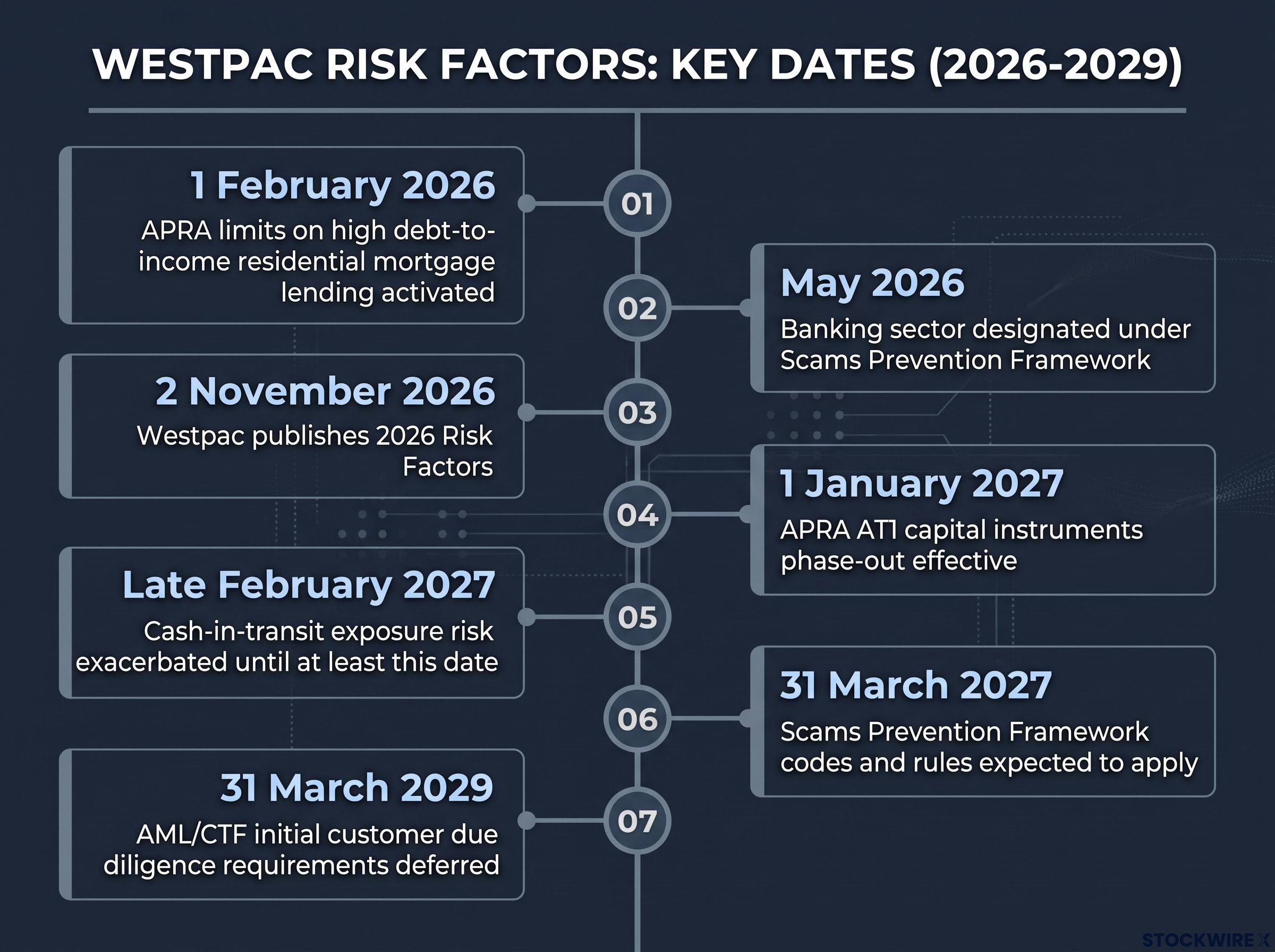
- 1 January 2027: AT1 capital instruments phase-out effective (APRA).
- Until at least late February 2027: Cash-in-transit exposure risk exacerbated.
- From 31 March 2027: Scams Prevention Framework sector-specific codes and rules expected to apply.
- Until 31 March 2029: AML/CTF initial customer due diligence requirements deferred under transitional rules.
APRA’s lending limits were activated from 1 February 2026, and the banking sector was designated under the Scams Prevention Framework in May 2026.
What investors should take from the update
The disclosure sets out the factors that could influence Westpac’s performance, alongside its stated focus on remediation, implementation plans and engagement with regulators. Further detail is available in the 2026 Annual Report.
The document is dated 2 November 2026. Except as required by law, Westpac assumes no obligation to revise or update any forward-looking statements contained in it.
Don’t Miss the Next Financials Move Before the Market Does
Get FREE breaking ASX news on banks, fintech and other non-resource sectors delivered within minutes of release, complete with in-depth analysis. Join 20,000+ subscribers already staying ahead of the market. Click the “Free Alerts” button at Big News Blast to receive alerts the moment market-moving announcements land.