
Westpac 2026 Sustainability Report lands with $46.5bn sustainable lending and a $100bn housing target
Westpac Banking Corporation lodged its Westpac 2026 Sustainability Report with the ASX on 2 November 2026, covering the year ended 30 September 2026. The report combines voluntary disclosures with mandatory Climate Statements prepared under AASB S2 and the Corporations Act 2001 (Cth), which management describes as the first year of mandatory climate disclosure.
Sustainable lending rose $7.1bn or 18% to $46.5bn, while Scope 1 and 2 emissions were 86% below the 2021 baseline. Cumulative sustainable bond facilitation reached $32.0bn.
The report ties sustainability to growth, deeper customer relationships and a disciplined approach to risk management. The letter to shareholders frames climate transition, housing affordability and regional prosperity as the three focus areas of the strategy.
Anthony Miller, Chief Executive Officer, and Fiona Wild, Chief Corporate Affairs and Sustainability Officer
“Financing the climate transition, new housing supply and regional businesses creates opportunities for growth while deepening relationships with customers who are making long-term decisions.”
When big ASX news breaks, our subscribers know first
Sustainable finance and climate transition progress
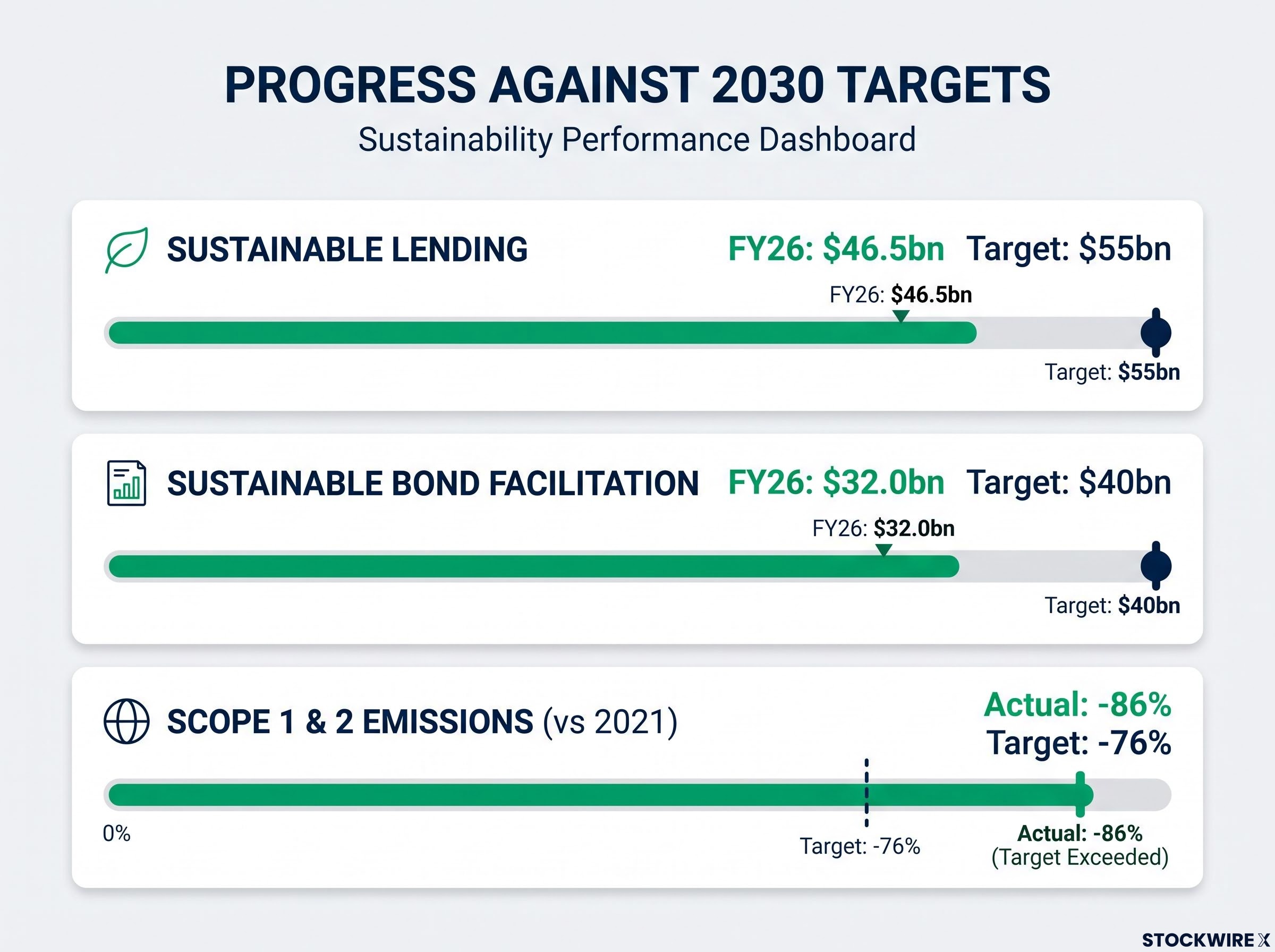
Progress against 2030 targets
Westpac measures sustainable finance against two targets: $55bn in sustainable lending at 30 September 2030, and $40bn in sustainable bonds facilitated between 1 October 2021 and 30 September 2030. Scope 1 and 2 emissions are measured against a 76% reduction target from the 2021 baseline.
| Metric | FY26 | FY25 | 2030 target |
|---|---|---|---|
| Sustainable lending | $46.5bn | $39.4bn | $55bn by 30 September 2030 |
| Sustainable bond facilitation (cumulative from 1 October 2021) | $32.0bn | $22.3bn | $40bn by 30 September 2030 |
| Scope 1 and 2 emissions vs 2021 baseline | -86% | -89% | -76% |
Cumulative bond facilitation rose $9.7bn or 43% during the year. Westpac cited its involvement in major government green issuances, including the Australian Office of Financial Management’s $7.5bn Green treasury bond.
Scope 1 and 2 emissions remained below the 2030 target level, with the report pointing to renewable electricity sourcing and fleet electrification as drivers.
Renewables leadership
Westpac states it remains the largest financier to renewable projects in Australia, based on IJGlobal and Westpac Research data for 1 October 2025 to 30 September 2026. Lending to renewable energy generation increased by $0.8bn to $6.7bn, and renewables represent 92% of lending in the Australian and New Zealand electricity generation sector portfolio.
Westpac acted as a joint green loan coordinator to help Vena Energy secure approximately $1.4bn in green financing facilities for solar and battery energy storage assets.
The report also records growth in fossil fuel related lending. Oil and gas value chain lending increased by $0.2bn to $1.8bn for upstream activities and by $0.4bn to $5.2bn for downstream activities.
Customers’ absolute financed Scope 1 and 2 emissions were estimated at 30.8MtCO2-e, up 7% from FY25. Westpac attributes the increase primarily to changes in lending exposure and portfolio composition, the mix of customers within emissions-intensive sectors, and periodic updates to emissions factors and other inputs.
Housing and regional growth strategy
Westpac set a new target to finance $100 billion by 2030 to help increase the supply of homes in Australia. This includes social and affordable housing, opportunities for renters and access pathways to home ownership. The target measures eligible gross new lending from FY2026 to FY2030, and target achievement is subject to assumptions and dependencies including customer demand, economic conditions, government policy and Westpac’s credit standards.
In regional Australia, the bank extended its moratorium on regional branch closures to 2030. More than $18 million is being invested over the next few years in regional branch and business banking centre upgrades.
Proof points in the report include:
- Mission Australia: Westpac marked 100 years as the banking partner of Mission Australia.
- Erben: Westpac acted as sole lender to Erben’s new development in Perth, described as Western Australia’s largest purpose-built student accommodation project.
- Community banking pilot: the service was rolled out to a further 14 regional communities in New South Wales, Queensland and Victoria.
- Moree: the Regional Service Centre has provided more than $300 million in lending to local commercial and agribusiness customers since opening.
Management says financing new housing supply and regional businesses creates opportunities for growth while deepening customer relationships.
Westpac’s 1H26 results showed a $3.5 billion net profit excluding notable items and a CET1 ratio of 12.4%, a capital position that underpins the bank’s capacity to keep funding sustainable lending and housing growth.
What climate risk means for a bank, and why Westpac says it is resilient
Climate risk in a bank’s loan book
Physical risk refers to damage from events such as floods and bushfires, which can affect customers’ cash flows and the value of property held as security. Transition risk refers to the effects of policy, technology and market shifts as the economy moves to net-zero, which can reduce some customers’ ability to repay loans.
Timing matters for lenders. Westpac says most lending and funding for business and institutional customers has a contractual or behavioural duration of less than five years, so credit settings, pricing and portfolio mix can be reset as facilities renew.
Key resilience findings
Management does not expect climate-related risks and opportunities to have a material financial effect across time horizons. Westpac assessed its strategy and business model as resilient to the identified risks and opportunities.
Key figures from the Climate Statements:
- 5.2% of Total Committed Exposure (TCE) was assessed as having heightened physical climate risk.
- 0.8% of TCE was assessed as having heightened transition risk.
- The expected credit loss overlay is $71 million (2025: $71 million), which Westpac describes as a prudent management buffer and not actual climate-related credit losses.
- Green lending under the Sustainable Finance Framework represented $22.4bn of TCE.
KPMG provided independent assurance over certain climate-related disclosures under the Corporations Act 2001 (Cth) and limited assurance over certain additional sustainability disclosures. The disclosures subject to assurance are identified in the assurance reports.
Next steps flagged in the report
The report sets out several forward-looking commitments:
- Sector target review: financed emissions sector targets will be reviewed during FY27.
- Human Rights Grievance Mechanism pilot: the pilot runs for two years from May 2026 to May 2028.
- Third-party technology supplier review: a third-party review of how responsible sourcing and human rights frameworks apply to important technology supplier relationships in Australia will be commissioned during FY27, with a summary of findings and actions provided, as appropriate, in the FY27 reporting suite.
- Sustainable finance targets: $55bn in lending and $40bn in bond facilitation by 30 September 2030.
- Housing target and branch moratorium: both run to 2030.
For readers wanting to see how operational execution supports these growth ambitions, our full explainer on Westpac’s AI and digital strategy covers the 72% daily staff AI adoption, the 80% digital origination of quality sales and the engineering productivity gains reported in September 2026.
Get Financials News Before the Market Moves
Join 20,000+ investors receiving FREE breaking ASX news within minutes of release, complete with in-depth analysis and the full announcement. Click the “Free Alerts” button at Big News Blast to get the next banking and finance update the moment it breaks, ahead of the crowd.