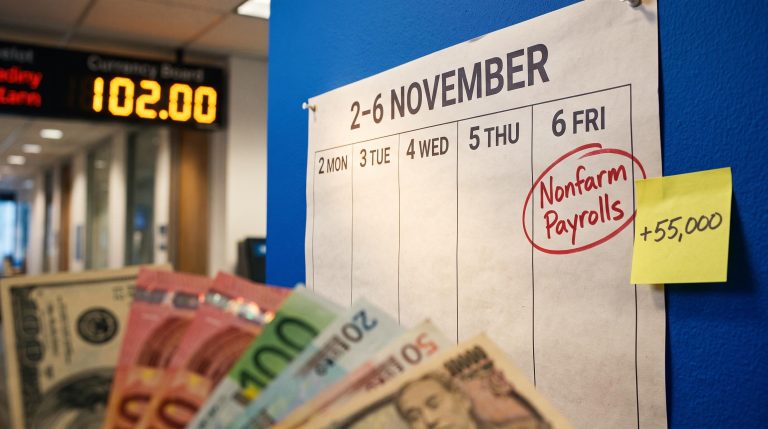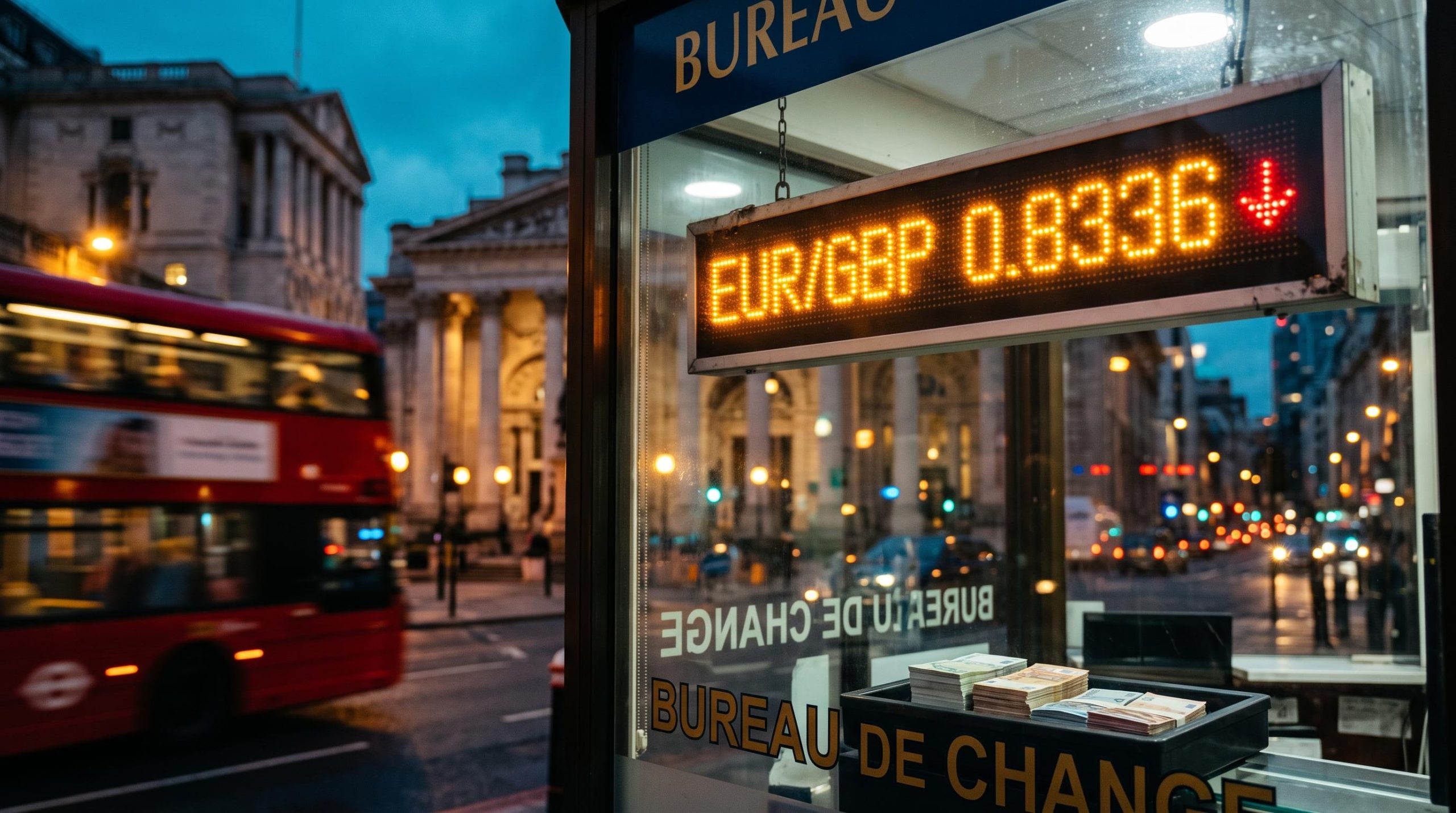
The euro slid to 0.8336 against the pound on Friday 30 October 2026, its lowest level in 19 months. That leaves EUR/GBP on track for a 3.15% fall across a five-week downtrend. The pound has done this before the Bank of England (BoE) has moved interest rates at all.
Markets are pricing a 25 basis point hike at the 5 November meeting, taking Bank Rate from 3.75% to 4.00%. A basis point is one hundredth of a percentage point, so 25bp equals 0.25%.
That matters to anyone holding euros or pounds: holiday cash, invoices priced in euros or income earned in the EU. Each move in the cross changes what that money is worth.
This piece covers how rate expectations, euro-area data and chart levels combine to set the near-term EUR/GBP forecast. It also covers which prices and events deserve your attention between now and the decision.
Why is the pound outrunning the euro before the BoE has even moved?
Futures markets almost fully reflect a hike next week, and sterling rose against almost every major currency yesterday.
| Currency pair | GBP move on 30 October |
|---|---|
| GBP/USD | +0.40% |
| GBP/AUD | +0.28% |
| GBP/EUR | +0.20% |
| GBP/CAD | +0.13% |
| GBP/NZD | +0.10% |
| GBP/JPY | +0.02% |
| GBP/CHF | 0.00% |
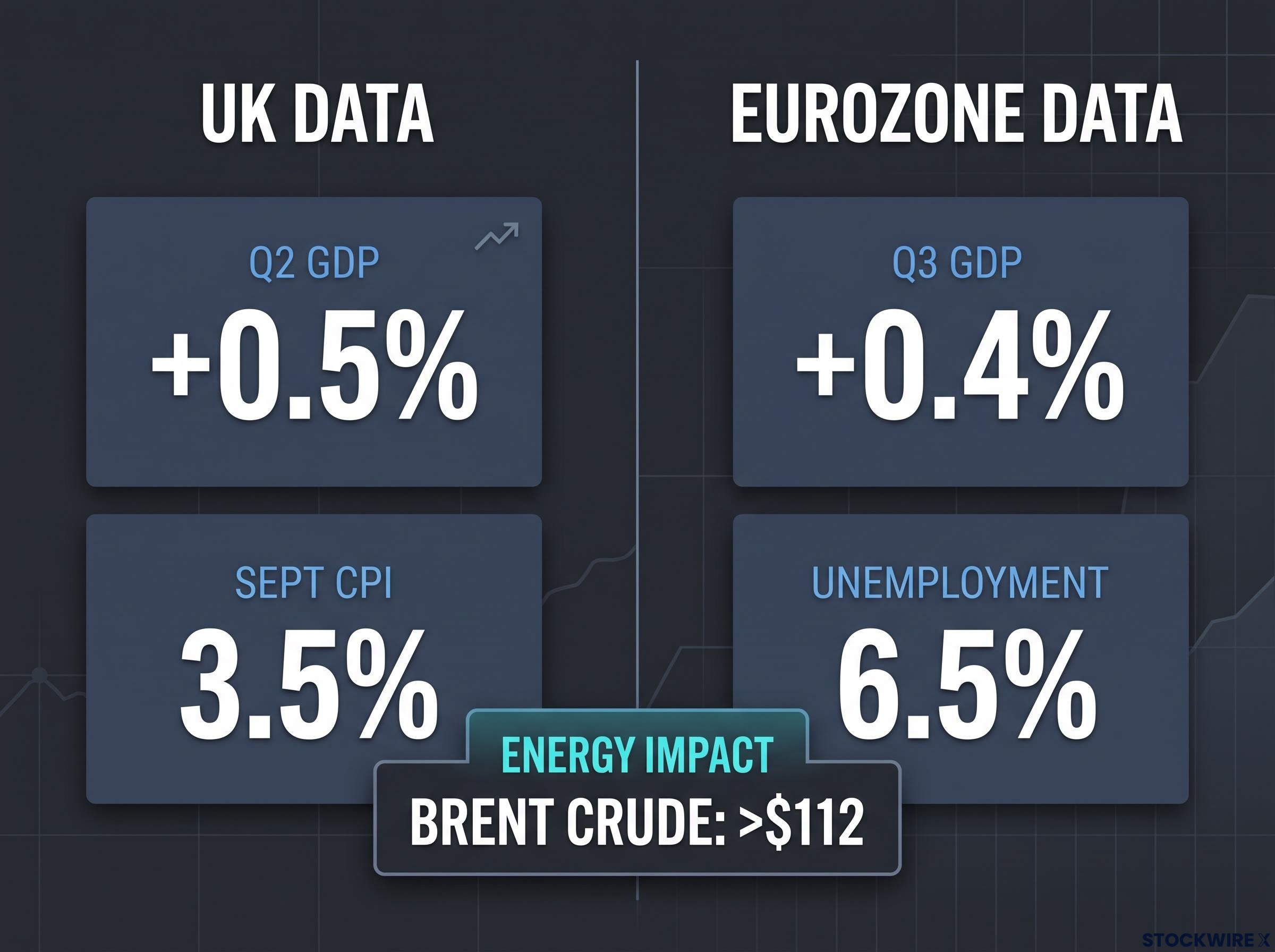
The logic starts with inflation. UK CPI was reported at 3.5% in September, up from 3.1% in August and well above the 2% target. The ONS also reportedly revised Q2 growth up to 0.5% quarter on quarter.
Persistent inflation in a growing economy points to higher UK rates. Higher expected rates make gilts and UK cash more rewarding than comparable euro assets, and that draws money into sterling.
Sterling is the fourth most traded currency globally, and Bank of England rate decisions, inflation data and political risk premiums all feed into its price, which helps explain why a priced-in hike can still move the pound.
This is pricing, not reaction. On 20 October, reports put the hike probability at 96% and EUR/GBP slipped to 0.8382, then its lowest since May 2025.
ING‘s Chris Turner describes the move as sterling strength and euro weakness acting together. French fiscal and political concerns are weighing on the euro, and the European Central Bank (ECB) faces a harder trade-off between inflation and growth.
Because the hike is already in the price, read the sterling gain as a bet on what the BoE says next week, not on the 25bp itself.
What ING and BBH say about how much is priced
In mid-October, ING’s Francesco Pesole set a 0.84-0.85 range for the pair, with a downside bias. However, ING sees the roughly 100bp of BoE tightening priced by July 2027 as too hawkish.
On 21 October, BBH made a similar point. It treated the hike to 4.00% as largely assured but argued that the swaps curve priced too much further tightening. The swaps curve is the set of market rates that shows where traders expect policy to sit over time.
Does the Eurozone data give the euro a lifeline?
The euro did get one genuinely good number this week.
Eurozone Q3 GDP: 0.4% quarter on quarter, double the 0.2% forecast
Growth slowed from 0.6% the quarter before, but it still beat expectations. Germany also beat expectations, while France shrank when economists had forecast modest growth.
The other releases cancelled out much of that gain:
- GDP 0.4% vs 0.2% expected: this offered brief support but was not enough to change ECB expectations.
- Unemployment 6.5% vs 6.4% expected: this pointed to a softer labour market. Sources differ on whether the rate rose or held steady from August.
- Brent crude above $112, with some reports near $114: this raises inflation and weighs on growth at the same time.
Oil is the double bind. Pricier energy pushes up European inflation, which would usually argue for higher rates. It also squeezes consumers and industry, which argues against them.
The UK and eurozone divergence extends beyond rates: UK growth has beaten consensus while the euro area faces re-accelerating inflation and weak output, limiting the ECB’s room to respond.
The ECB reportedly held rates in late October and stressed both sides of that energy shock. For you, the point is that a stronger headline number matters less to the currency when the central bank has no clear path to higher rates.
What do the chart levels say about the next move in EUR/GBP?
The chart shows the same picture as the fundamentals. EUR/GBP is trading in a descending channel, a pattern of lower highs and lower lows between two parallel falling lines. Momentum on the 4-hour chart supports the bearish view.
The Relative Strength Index (RSI) sits near 32. RSI is a 0-100 gauge of recent price momentum, and readings below 30 are considered oversold. A pause is possible, but analysts do not treat RSI alone as a sign the trend has turned. FXStreet’s technical section was written with help from an AI tool.
| Level | Price | Type | Why it matters |
|---|---|---|---|
| Weekly high | Just above 0.8400 | Resistance | A move back here would challenge the downtrend |
| Wednesday’s high | 0.8385 | Resistance | This is the next hurdle above the channel |
| Channel top | 0.8360 | Resistance | A hold above it would suggest a pause |
| Thursday’s low | 0.8345 | Support | This is the first level to give way |
| Late March 2025 lows | 0.8315-0.8330 | Support | It matches ING’s 0.8315 target |
| Channel bottom | Around 0.8300 | Support | This is the lower edge of the trend |
ING has described a 0.8360-0.8430 range, with possible downside toward 0.8315. That view assumes the 28 October Budget does not trigger a major gilt shock.
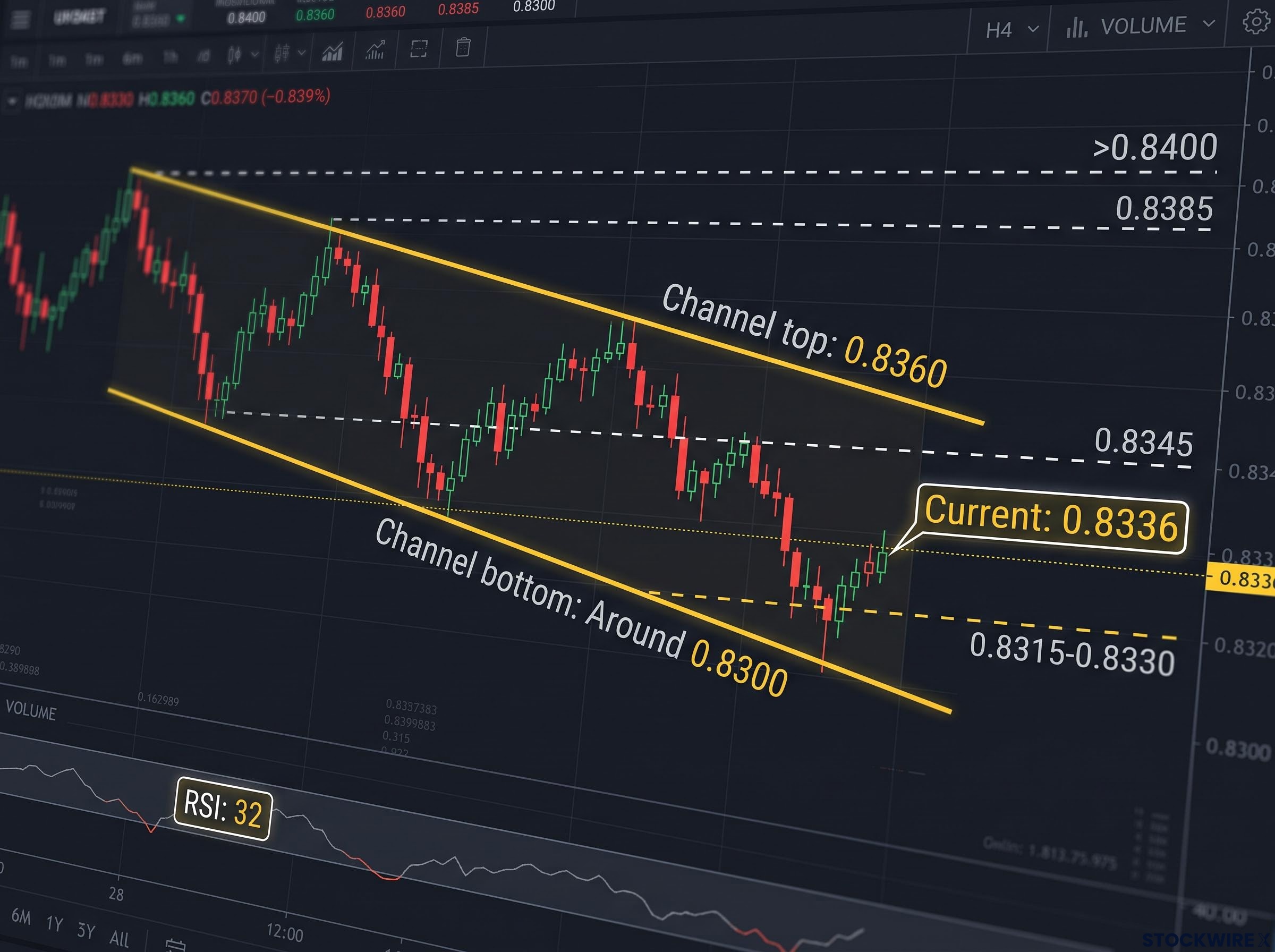
If you track this pair, these levels turn the BoE meeting into a test. A hold above resistance would suggest the sterling move is pausing, while a break lower would extend it.
Where the forecast could change
Rabobank‘s 2026 outlook offers a counterpoint. It expects BoE cuts toward a policy rate of about 3.25%, which would allow a gradual EUR/GBP recovery.
Three things could reverse the move:
- A BoE that under-delivers: cautious guidance against hawkish pricing could prompt sterling profit-taking.
- A UK growth or fiscal shock: a slowdown or gilt volatility could erode sterling’s yield advantage.
- A firmer ECB: a more forceful response to oil would narrow the rate gap.
Reading the 5 November decision through three lenses
On decision day, three checks matter. First, see what the BoE signals beyond 4.00%. Second, watch whether the ECB leans toward fighting inflation or protecting growth as oil stays high. Third, see whether EUR/GBP breaks out of the 0.8315-0.8360 band.
Sterling’s gains so far have come from pricing ahead of the event. That means the guidance carries more weight than the hike itself. The answer arrives on 5 November.
For readers wanting to prepare for 5 November, our dedicated guide to reading Bank of England rate decisions explains how OIS pricing and vote splits shape market reactions.
This article is for informational purposes only and should not be considered financial advice. Investors should conduct their own research and consult with financial professionals before making investment decisions.