All four major banks now expect the Reserve Bank of Australia to lift the cash rate by 25 basis points to 4.85% on 3 November. NAB and CBA abandoned their pause calls after the Australian Bureau of Statistics (ABS) released hotter-than-expected inflation data on 28 October.
The shift happened fast. Market pricing for an RBA rate hike jumped to about 80% from roughly 56% earlier in the week, only five weeks after the 29 September increase to 4.60%.
Here is why the data tipped the banks, what the RBA’s thinking on labour market slack means, and how a 4.85% cash rate could flow through to your mortgage, your savings and the ASX.
Why did four banks converge on a November RBA rate hike?
Until this week, the big four were split two-to-two. Westpac and ANZ already had November pencilled in. Within hours of the CPI release, NAB and CBA joined them.
NAB’s Sally Auld, Gareth Spence and Taylor Nugent offered the clearest explanation. Trimmed mean inflation came in above the RBA’s August forecast, and they expect the November Statement on Monetary Policy (SMP) to revise underlying inflation higher. They see a pause after November, but not a declaration that tightening is over.
CBA’s Belinda Allen went further and said a cash rate above 5% cannot be ruled out. At 4.85%, the cash rate would sit about 150 basis points above the RBA’s neutral estimate of roughly 3.4%. The neutral rate is the level that neither speeds up nor slows down the economy.
CBA’s view carries weight partly because of its scale: the bank reported a CBA record profit of $11.0bn cash NPAT for FY26, with a loan loss rate of just 8bps.
| Institution | Position | Core reasoning |
|---|---|---|
| NAB | Hike to 4.85% (changed view) | Trimmed mean above RBA forecast; NAIRU likely revised up |
| CBA | Hike to 4.85% (changed view) | Demand needs restraining; above 5% possible |
| Westpac | Hike | Sticky underlying inflation, energy-cost risks |
| ANZ | Hike to 4.85% | 1.0% trimmed mean strengthens tightening case |
| VanEck | Sceptical of near-certainty | RBA may wait to assess September move |
| Global X | Pressure for a hike rising | Underlying inflation concerning; surcharge price resets |
The real argument is not about whether inflation is too high. It is about whether the RBA should follow September’s move immediately.
The counterargument Russel Chesler of VanEck argued the RBA could wait to see how the 29 September hike works through, and that markets may be overreacting in pricing a hike as near-certain.
Marc Jocum of Global X ETFs takes the other side, saying the inflation outcome raises pressure for a hike. With every major bank aligned, you should treat a hike as the base case. The dissent tells you the outcome still rests on RBA judgement, not arithmetic.
When big ASX news breaks, our subscribers know first
What does the RBA’s labour market reassessment and NAIRU change?
Unemployment has climbed to 4.7%, its highest since late 2021 and 60 basis points above the start of the year. Yet Governor Michele Bullock said the labour market “seems a little tighter than we had previously judged.”
That looks like a contradiction. It is not.
What is NAIRU, and why does it matter here?
NAIRU stands for the non-accelerating inflation rate of unemployment. It is the jobless rate at which inflation holds steady. If unemployment sits above it, there is spare capacity; if it sits below, there is not.
NAB expects the November SMP to lift the RBA staff’s NAIRU estimate. The RBA has also pointed to weak productivity and domestic capacity pressures. The logic runs in three links:
- Tighter capacity: the economy has less room to grow without pushing up prices.
- Higher NAIRU: 4.7% unemployment delivers less disinflation than the RBA once assumed.
- Longer restrictive policy: unemployment must stay higher for longer, or rates must rise further, to return inflation to target by early 2028.
The August SMP already had underlying inflation above 3% until around mid-2027. A rising jobless rate does not guarantee relief on rates. If the RBA believes there is less slack, you should expect it to tolerate more labour market pain before easing.
The November Statement on Monetary Policy will be read closely for NAIRU and inflation revisions, much as RBA statement signals on tightening bias drove positioning in rate-sensitive equities and the Australian dollar in August.
How did fuel, travel and fruit shape the September CPI?
The headline surprise came largely from the petrol bowser and the holiday booking.
| Measure | Result | Expected | Comment |
|---|---|---|---|
| Q3 headline CPI | 1.3% q/q, 3.9% y/y | NAB 1.2% q/q, 3.9% y/y | Near forecasts |
| Q3 trimmed mean | 1.0% q/q, 3.7% y/y | Consensus 1.0% q/q, 3.6% y/y | RBA August forecast about 0.8% q/q |
| September monthly CPI | 4.3% y/y | 4.2% y/y | Fuel and travel led |
The ABS monthly trimmed mean series shows 3.6% annually (3.59%), slightly below the quarterly 3.66%. The two series are measured differently, so the gap is not an error. September’s monthly drivers included:
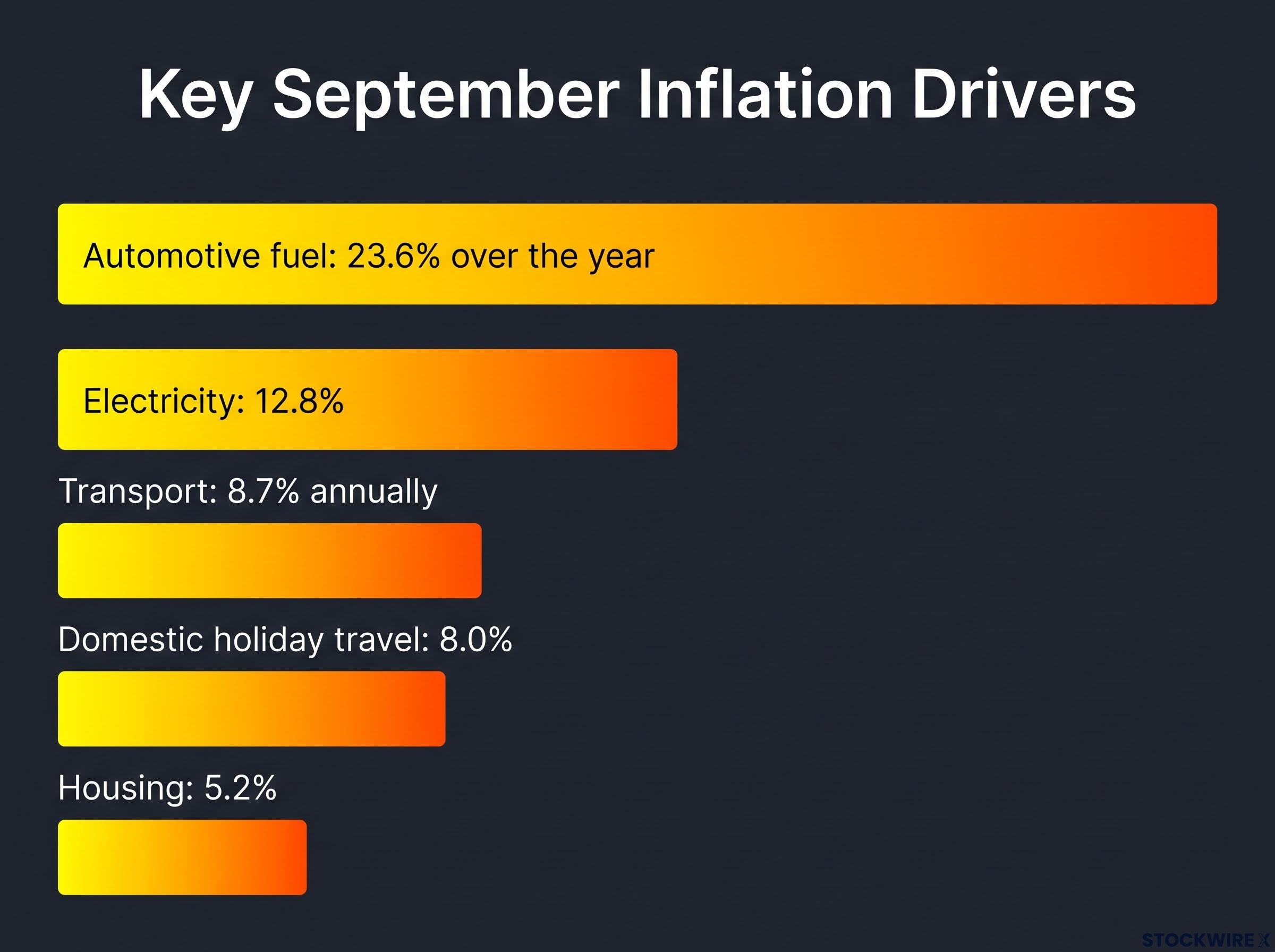
- Automotive fuel: up 9.4% in the month and 23.6% over the year.
- Domestic holiday travel and accommodation: up 8.0% on school holidays and major sporting events.
- Recreation and culture: up 3.8%, with transport up 8.7% annually.
- Fruit: rising more than normal seasonal patterns.
Signal or noise? What the trimmed mean strips out
The trimmed mean removes the biggest price moves each period, which excluded fuel this time. Travel and fruit stayed in. Grocery prices excluding fruit and vegetables rose only 2.2%, and market services excluding rents rose just 0.15% in the month.
The breadth is harder to dismiss. Almost 60% of the basket is running above 3.5% annualised. Services inflation sits at 4.1%, non-tradables at 4.5%, housing at 5.2%, and electricity jumped 12.8% after rebates ended.
The fuel spike may wash out if oil falls. The breadth tells you the RBA is looking past petrol to services and housing costs that hit your budget more persistently.
What would 4.85% mean for borrowers, savers and the ASX, and what comes next?
A move to 4.85% would land unevenly across households and portfolios.
| Area | Likely implication of 4.85% |
|---|---|
| Mortgage holders | Higher variable repayments; less room for discretionary spending |
| Fixed-rate borrowers | No immediate change; refinancing risk rises at rollover |
| Savers | Higher deposit returns where banks pass the rise on |
| Banks | Possible early margin support; weaker credit growth and arrears risk |
| Property | Lower borrowing capacity weighs on prices and transactions |
| Retail | Negative for discretionary spending |
| ASX | Higher discount rates weigh on long-duration growth stocks, REITs and leveraged firms |
| Exporters | Possibly more resilient if commodities and the AUD offset |
| AUD | Could find support if the hike was not fully priced |
If you hold a variable mortgage, another quarter-point rise would lift repayments again within weeks.
For lenders, a higher cash rate cuts both ways: net interest margins may get early support, but the bank earnings season showed guidance on deposit competition and bad debts matters more to share prices than headline profit.
The risks to the hike case
The September hike has barely taken effect, and household stress is building. A reversal in fuel and travel prices would pull headline inflation lower. Unlike the 2023 cycle, the RBA is now responding to renewed inflation after an easing phase, with unemployment already higher.
The next test: October CPI on 25 November
October’s data will be messy. Card no-surcharge rules began on 1 October 2026, and while surcharges are not directly in the CPI, merchants folding them into listed prices could lift the figure. NAB also expects fuel to rise a further 7%.
- 3 November: RBA cash rate decision.
- The following week: November SMP, with NAIRU and inflation revisions.
- 25 November: ABS October monthly CPI.
That last release will show whether 4.85% is a final step or a staging point toward 5%.
Past performance does not guarantee future results. Forecasts are subject to market conditions and may change based on economic developments.
What the November call settles, and what it leaves open
The case for a hike rests on the RBA seeing less slack and sticky underlying inflation, not on petrol alone. The trade-off is plain: act again to keep inflation expectations anchored, or hold back to spare stretched households and a slowing economy.
Three dates will define the answer: the 3 November decision, the SMP’s revisions to NAIRU and inflation, and the 25 November CPI.
This article is for informational purposes only and should not be considered financial advice. Investors should conduct their own research and consult with financial professionals before making investment decisions.