
Complete tumour clearance in gastric cancer study lifts ALA-105
Arovella Therapeutics (ASX: ALA) reports that ALA-105, its Claudin 18.2 (CLDN18.2)-targeted CAR-iNKT cell therapy, led to complete tumour clearance in five of seven (71%) animals in an advanced gastric cancer model, versus 0% survival for the control groups.
In a smaller sub-group treated with IL-12-armoured CAR-iNKT cells, tumours were eliminated in all treated animals, with 100% survival over the 60-day study. The study was conducted at the University of North Carolina under Professor Gianpietro Dotti.
The Board supports advancing the ALA-105 program to at-scale manufacturing and requesting formal FDA engagement, a step that moves the asset towards the clinic.
Key highlights:
- Five of seven (71%) animals treated with CLDN18.2-targeted CAR-iNKT cells survived with no sign of tumours after 60 days
- All control animals succumbed to tumours within 30-50 days
- IL-12-armoured cells eliminated tumours in all treated animals in a small sub-group
- Data will be presented at the upcoming Consortium for iNKT Research and Therapy (CiRT) meeting
When big ASX news breaks, our subscribers know first
How the study results stacked up
Survival and tumour control by group
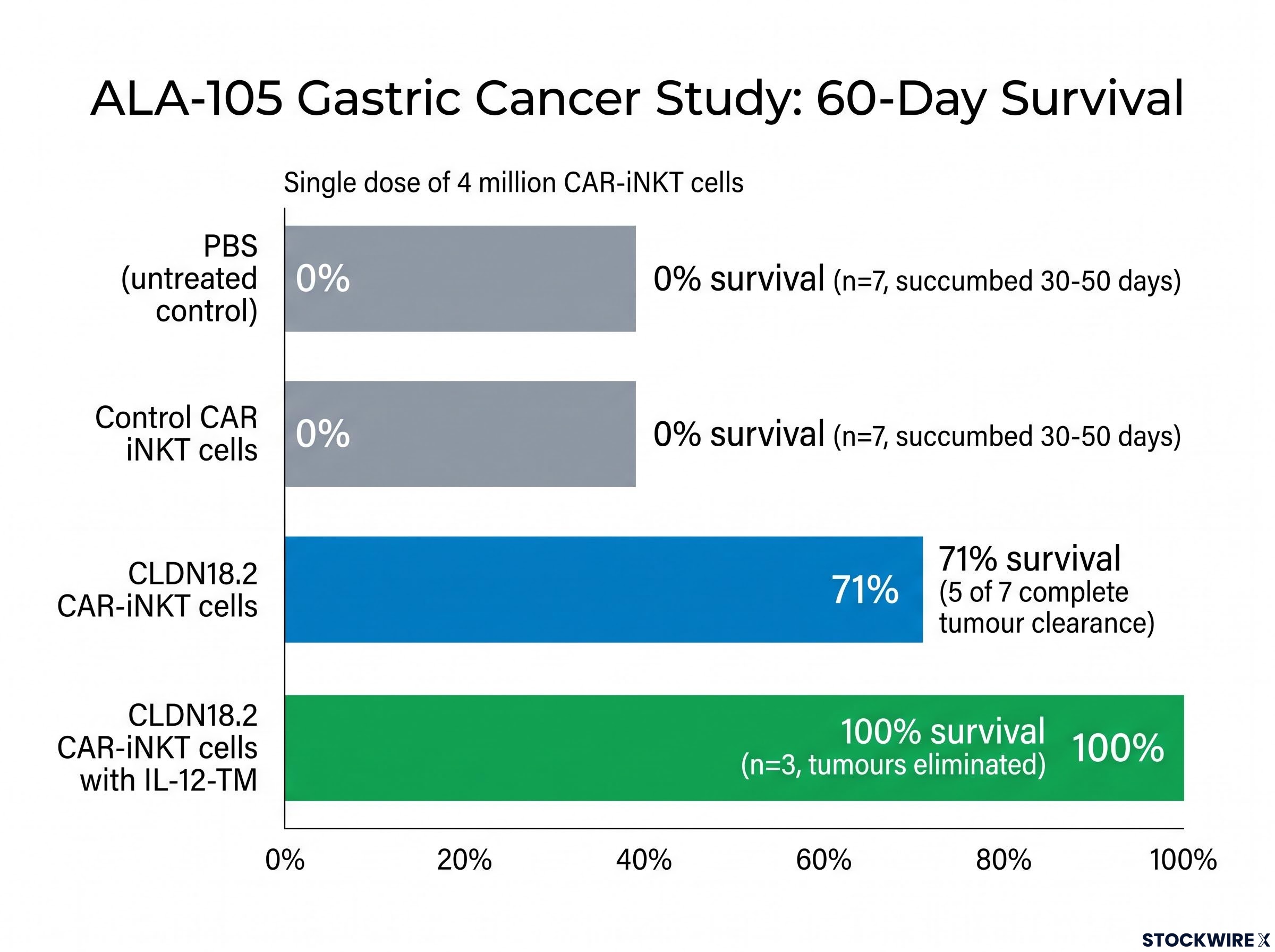
Four treatment groups were evaluated. Animals in each group received a single dose of 4 million CAR-iNKT cells, except the saline control group, which received PBS.
| Group | Animals | Outcome | Survival at 60 days |
|---|---|---|---|
| PBS (untreated control) | **n=7** | Succumbed to tumours within 30-50 days | **0%** |
| Control CAR iNKT cells | **n=7** | Succumbed to tumours within 30-50 days; tumour growth delayed versus untreated controls | **0%** |
| CLDN18.2 CAR-iNKT cells | **n=7** | Complete tumour clearance in **5 of 7** animals | **71%** (5 of 7) |
| CLDN18.2 CAR-iNKT cells with IL-12-TM | **n=3** | Tumours eliminated in all treated animals | **100%** |
The IL-12-TM group was small, so the result is encouraging rather than definitive.
Natural iNKT activity
The study also showed that iNKT cells carrying a control CAR, which targets a protein not present on the tumour cells, delayed gastric tumour growth compared with untreated controls. The activity is believed to be driven, at least in part, by natural tumour recognition pathways such as NKG2D-mediated targeting.
This supports the underlying biology of the iNKT platform.
Model design
- NUGC4-CLDN18.2 gastric cancer model in NSG mice
- CLDN18.2-positive tumour cells introduced into the peritoneal cavity
- Treatment with iNKT cell therapies four days later
- Tumour burden monitored with IVIS imaging, and overall survival assessed
- Animals monitored for 60 days post treatment
Management and Board see compelling validation
Acting CEO Dr Nicole van der Weerden linked the in vivo data to earlier laboratory work.
That earlier laboratory work included a serial tumour challenge assay at the University of North Carolina, where IL-12-TM armoured cells sustained tumour control through all four rounds against pancreatic and gastric cell lines.
Dr Nicole van der Weerden, Acting CEO
“These results provide compelling in vivo validation of our CLDN18.2 CAR-iNKT program…”
She added that the findings are “…consistent with the strong in vitro efficacy we reported earlier this year and further strengthen our confidence.”
Chairman Mr David Williams pointed to the decision to engage the regulator sooner.
David Williams, Chairman
“…The results are so compelling that we have resolved to speed up a formal approach to the FDA.”
Why CLDN18.2 and membrane-tethered IL-12 matter
iNKT cells are invariant natural killer T cells, a type of immune cell. A CAR (Chimeric Antigen Receptor) is a modification that can be introduced into immune cells so they target cancer cells.
CLDN18.2 is a tumour-associated protein expressed in a high proportion of gastric cancers and a subset of pancreatic cancers. ALA-105 combines a CLDN18.2-directed CAR with the innate tumour-recognition properties of iNKT cells, and is designed to selectively recognise and eliminate CLDN18.2-expressing cancer cells.
It is an allogeneic therapy, meaning it can be given from a healthy donor to a patient. Solid tumours are described by Arovella as difficult-to-treat, with substantial unmet need.
Arovella’s armouring technology, licensed from the University of North Carolina at Chapel Hill, produces the cytokine interleukin-12 attached to the cell membrane (IL-12-TM). This concentrates its immune-stimulatory effects at the engineered cell surface, enhancing local anti-tumour activity while aiming to limit the systemic exposure associated with freely secreted IL-12.
The CLDN18.2 technology is licensed from Sparx Group, and the iNKT platform is licensed from Imperial College London.
What happens next for Arovella
The announcement sets out the following next steps:
- Data presentation at the upcoming CiRT meeting, hosted by the University of Pennsylvania.
- Progressing ALA-105 to at-scale manufacturing, which the Board supports.
- Requesting formal FDA engagement early in the new year, with seeking FDA feedback on the proposed clinical pathway among the upcoming priorities.
- Continued evaluation of both unarmoured and IL-12-TM-armoured constructs, which will guide ALA-105’s clinical development strategy.
The CiRT meeting brings together leading physicians, scientists and companies focused on advancing iNKT-based therapies. The University of Pennsylvania is where the pioneering clinical studies that led to the first FDA-approved CAR-T therapy, Kymriah, were conducted.
Arovella intends to highlight progress in its first-in-human clinical trial and solid tumour programs at the meeting.
First patient dosing in the SAPPHIRE study of ALA-101 has put the CAR-iNKT platform into first-in-human testing at The Alfred, with initial data due early in CY2027.
For investors, the study adds in vivo data to Arovella’s solid tumour pipeline, alongside ALA-101, which has had its Investigational New Drug application accepted by the US FDA.
Don’t Miss the Next Biotech Breakthrough
Join 20,000+ investors getting FREE breaking ASX news delivered to their inbox within minutes of release, complete with in-depth analysis. Click the “Free Alerts” button at Big News Blast to receive healthcare and biotech updates the moment market-moving news breaks.