
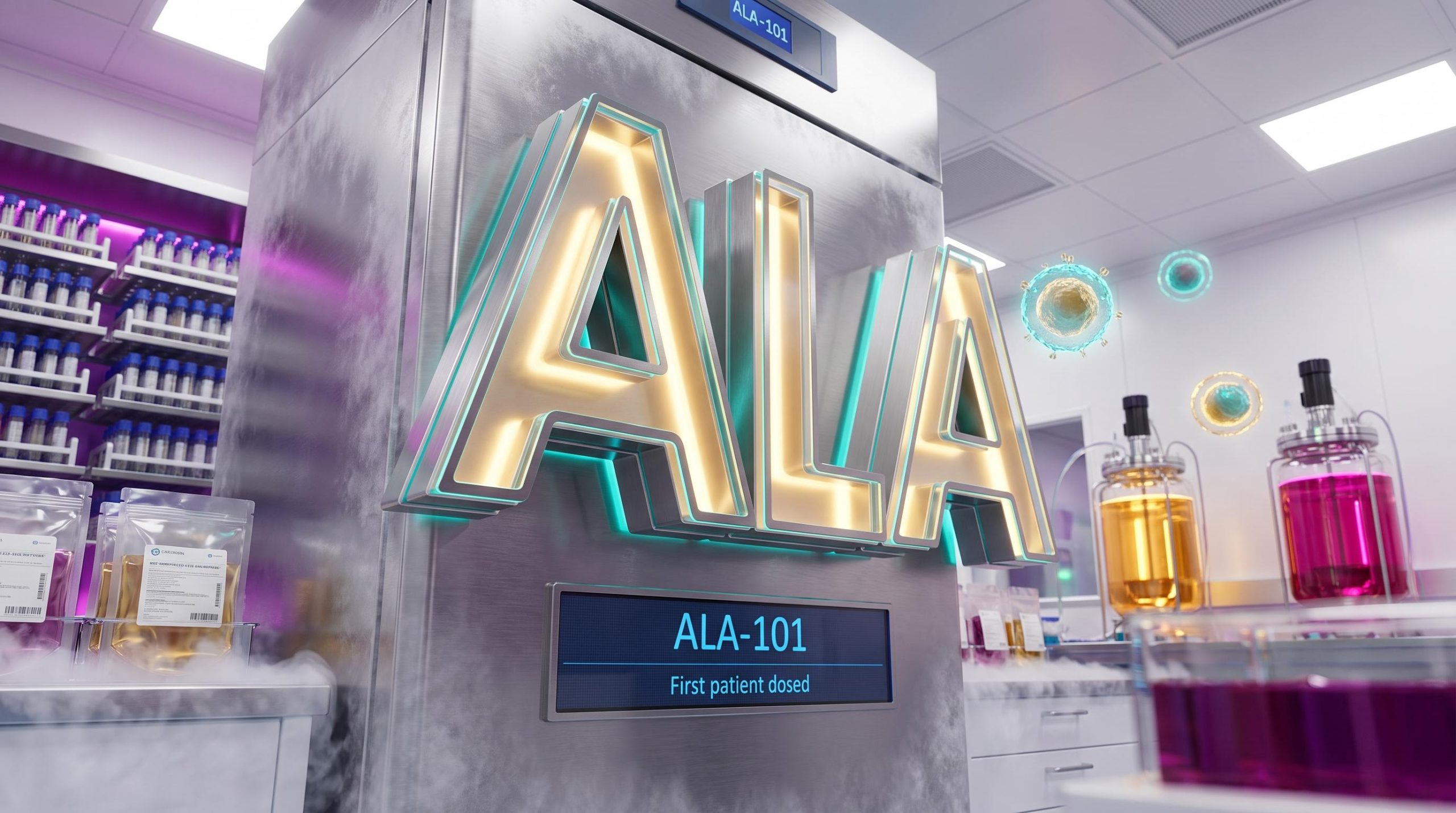
First patient dosed in Arovella’s ALA-101 phase 1 trial
Arovella Therapeutics (ASX: ALA) has announced that the first patient dosed in the SAPPHIRE study (ALA-101-001; NCT07518329), its first-in-human phase 1 trial of ALA-101. The release is dated 27 October 2026.
ALA-101 is Arovella’s allogeneic off-the-shelf CD19 CAR-iNKT cell therapy. The open-label, multi-centre, dose-escalation and expansion trial is evaluating it in patients with relapsed or refractory CD19-positive non-Hodgkin lymphoma and leukaemia.
The patient received ALA-101 following standard lymphodepleting chemotherapy at The Alfred, under the supervision of Dr Salvatore (Sam) Fiorenza. The dosing moves the asset into human data generation, with the trial set to evaluate safety, tolerability, pharmacology and preliminary efficacy.
Dr Nicole van der Weerden, Acting Chief Executive Officer
“Dosing the first patient is a milestone and the culmination of several years of focused scientific, manufacturing, regulatory and clinical development…”
When big ASX news breaks, our subscribers know first
Why an off-the-shelf cell therapy matters
CAR-T therapy involves introducing a Chimeric Antigen Receptor into immune cells so they can target cancer cells. Current autologous treatment requires a patient’s own cells, which Chairman David Williams described as a process that is “costly and time-consuming”.
ALA-101 takes a different approach. It uses healthy donor-derived iNKT cells that can be manufactured in advance and supplied when needed. “Allogeneic” means the therapy can be given from a healthy donor to a patient.
ALA-101 consists of CAR19-iNKT cells modified to produce a CAR that targets CD19, an antigen found on the surface of numerous cancer types. The iNKT cells also contain an invariant T cell receptor (iTCR) that targets glycolipid bound CD1d, another antigen found on the surface of several cancer types.
David Williams, Chairman
“Our killer T cell technology licenced from Imperial College London is a game changer. Our treatment is manufactured and sitting on a shelf ready for use, derived from healthy donors…”
The clinical rationale was outlined by the Lead Investigator.
Dr Sam Fiorenza, Lead Investigator
“Despite advances in treatment, many patients either relapse following standard therapies or are unable to access currently available autologous CAR-T therapies…”
Inside the SAPPHIRE trial design
The trial incorporates several design features intended to support adaptive dose selection:
- Open-label, multi-centre, dose-escalation and expansion trial
- Backfill Bayesian Optimal Interval (BF-BOIN) design to enable adaptive dose escalation
- Staggered dosing during dose escalation, in accordance with regulatory requirements as part of IND approval, to ensure adequate safety review between patients
- Backfill enrolment commencing only once a dose level has been reviewed and confirmed acceptable from a safety perspective
- A single dose of ALA-101 in the initial dose escalation part
The initial dose escalation part will assess safety, tolerability, pharmacokinetics, pharmacodynamics and preliminary efficacy. The BF-BOIN design is intended to allow efficient allocation of participants to dose levels with an acceptable emerging safety profile.
Generating additional data at dose levels with acceptable safety profiles is intended to provide a robust basis for selecting the most appropriate dose to advance into a phase 2 study. It also provides flexibility to expand enrolment in specific disease subtypes based on emerging data.
| Trial part | Purpose |
|---|---|
| Dose escalation | Assess safety, tolerability, pharmacokinetics, pharmacodynamics and preliminary efficacy of a single dose of ALA-101 |
| Dose expansion/backfill | Further characterise safety, tolerability, pharmacokinetics, pharmacodynamics and preliminary efficacy, and support selection of the dose to advance into a phase 2 study |
Platform potential beyond blood cancers
Dr van der Weerden said the trial will provide important insights into the safety, expansion, persistence and B cell-depleting activity of ALA-101. She said it will also support development of Arovella’s broader CAR-iNKT platform across blood cancers, solid tumours and autoimmune diseases.
ALA-101 has had its Investigational New Drug application (IND) accepted by the US FDA. Arovella is also expanding into solid tumour treatment through its CLDN18.2-targeting technology licensed from Sparx Group, and will incorporate its IL-12-TM technology into its solid tumour programs.
The CLDN18.2 preclinical data showed kill rates above 97% in pancreatic and 82% in gastric cancer cell lines, with IL-12-TM armouring sustaining tumour control through four serial challenge rounds.
What happens next for ALA-101
Three steps follow from the trial design:
- Dose escalation continues, with dosing staggered in accordance with regulatory requirements as part of IND approval to ensure adequate safety review between patients.
- Initial data from the trial are expected to be available early in CY2027.
- Backfill enrolment will commence only once a dose level has been reviewed and confirmed acceptable from a safety perspective.
Clinical batch supply underpins the pace of enrolment, with two released batches covering dose escalation and a third due by end December to support all 46 phase 1 patients across five hospital sites.
Don’t Miss the Next Biotech Breakthrough
Join 20,000+ investors getting FREE breaking ASX news delivered to their inbox within minutes of release, complete with in-depth analysis. Click the “Free Alerts” button at Big News Blast to receive healthcare and biotech updates the moment market-moving announcements land.