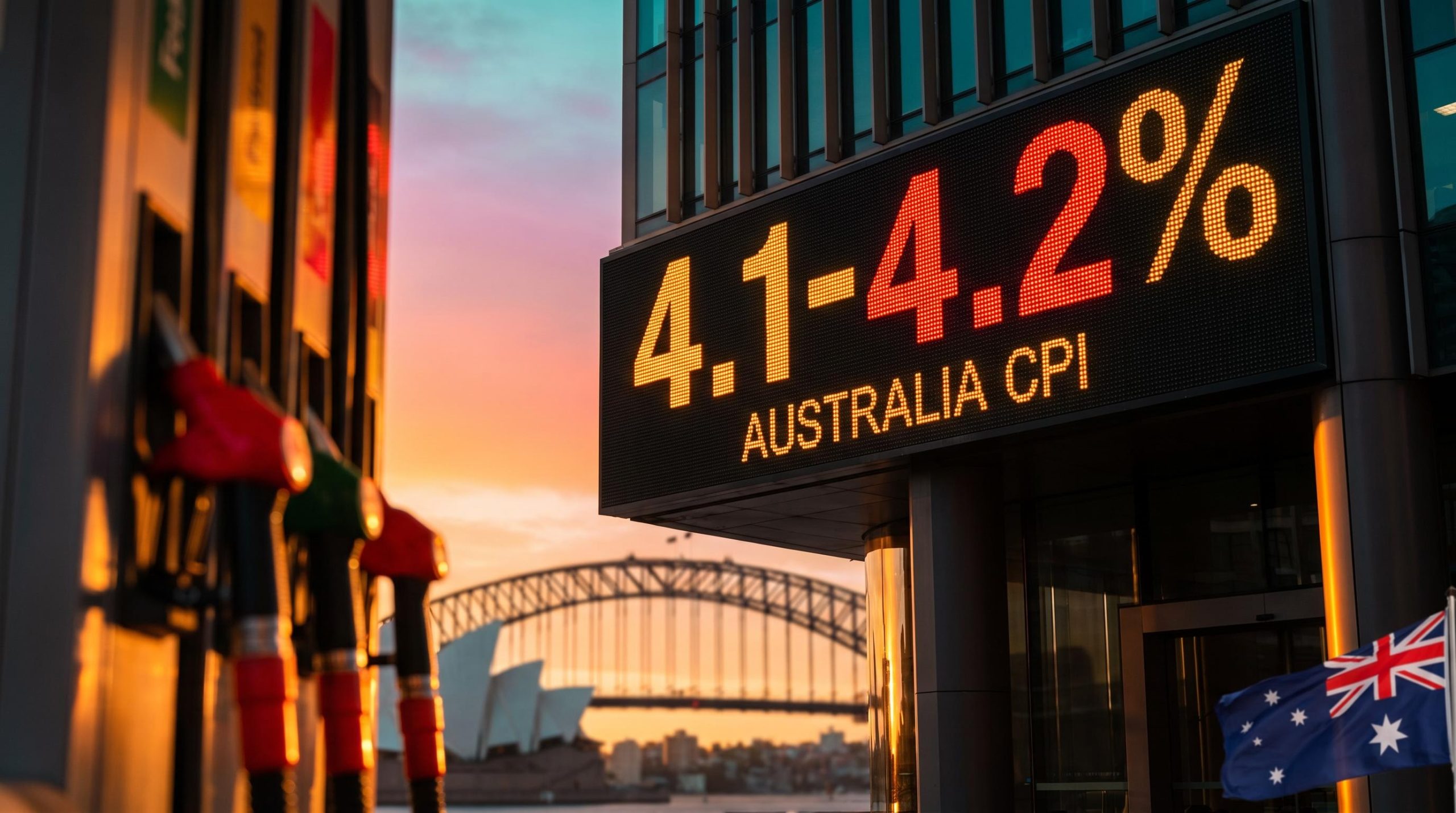
Australia’s September consumer price index (CPI) lands on Wednesday, with forecasters expecting annual headline inflation of 4.1-4.2%. The release comes less than a month after the Reserve Bank of Australia (RBA) lifted the cash rate to 4.60%, and with the Australian dollar sitting just above US$0.7000, the print could decide which way the currency breaks.
The Australian Bureau of Statistics (ABS) publishes at 00:30 GMT on 28 October, which is Wednesday 29 October in Australian time. The CPI is the last major inflation reading before the RBA’s next meeting.
It also arrives in the middle of the US Federal Reserve’s 27-28 October meeting. Mortgage repayments, Australian dollar exposure and gold positions all move on these two decisions.
Here is what the forecasts say, which numbers would change the RBA’s thinking, and where AUD/USD could go from there.
What do forecasters expect from the September CPI, and which numbers matter most?
The major banks expect inflation to pick up after fuel drove August higher. Automotive fuel prices jumped 14.8% that month, according to ABS figures reported by Reuters.
| Measure | Westpac | CBA/ANZ/NAB or consensus | August actual |
|---|---|---|---|
| Monthly headline CPI | 0.62% | About 0.7% (consensus) | 0.4% |
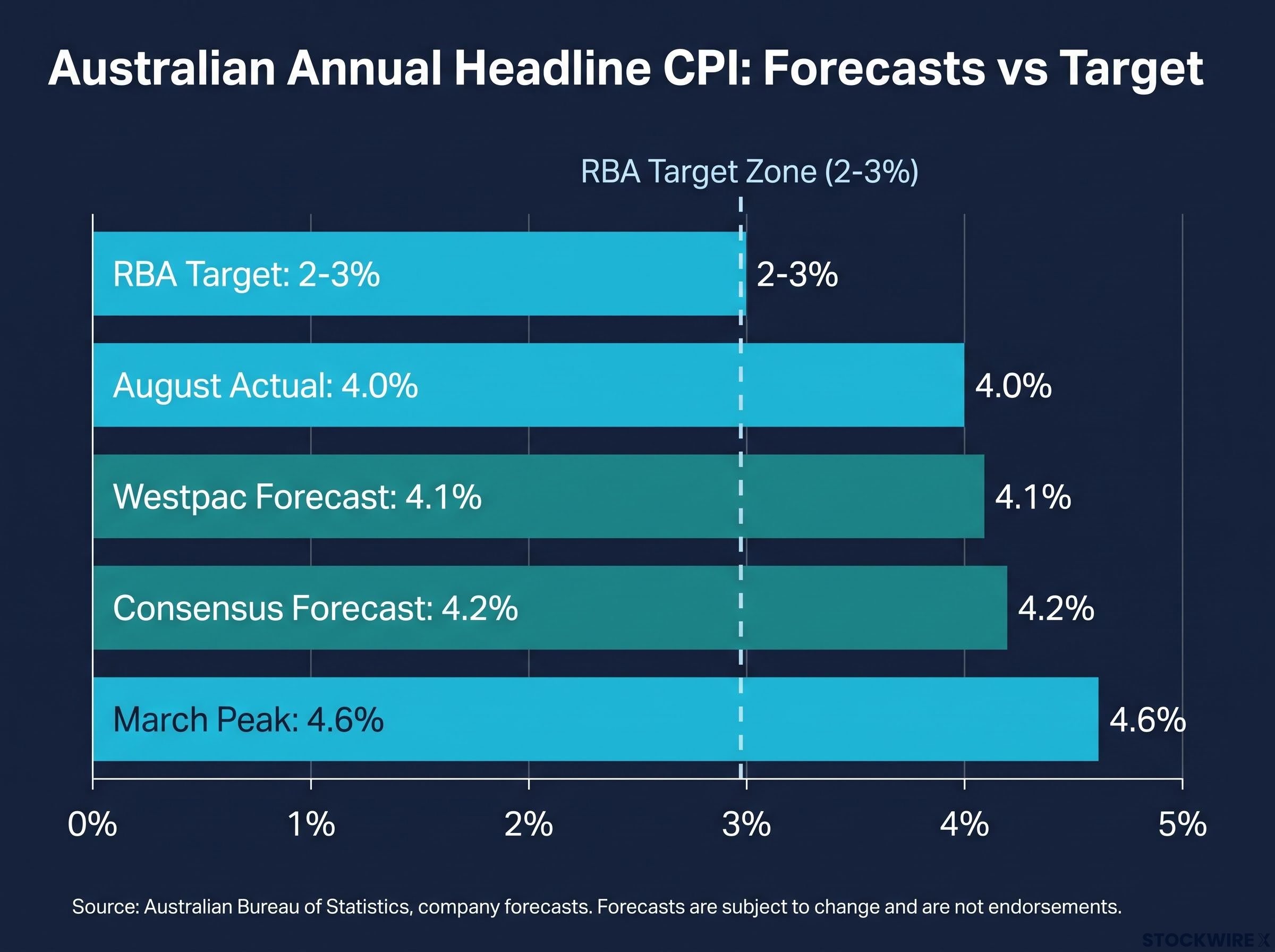
| Annual headline CPI | 4.1% | 4.2% (CBA, consensus) | 4.0% |
| Quarterly trimmed mean | 0.9% | 1.0% (CBA, ANZ, NAB) | n/a |
| Annual trimmed mean | 3.5% | 3.6% (CBA, ANZ, NAB) | 3.6% |
Headline inflation peaked at 4.6% in March. CBA’s separate 3.9% annual estimate reflects a different reporting convention, not a contradiction.
Target versus forecast: The RBA aims for inflation of 2-3%. Forecasters expect headline CPI of 4.1-4.2%.
The RBA’s preferred gauge is the trimmed mean, which averages the middle 70% of price changes in the CPI basket. It removes:
- The largest price rises in the period
- The largest price falls in the period
- One-off swings that distort the headline figure
The real contest sits in a single decimal point. Westpac expects 0.9% for the quarter; CBA, ANZ and NAB all expect 1.0%, which would exceed the RBA’s August forecast of 0.8%.
A 1.0% result would tell you price pressure is spreading beyond fuel. Treat that number as more important than the headline.
The trimmed mean has been trending upward since its mid-2025 trough, and that rising underlying rate is why a fuel-led headline cannot be read in isolation.
Does a hotter print force the RBA’s hand after the hike to 4.6%?
The RBA unanimously raised the cash rate by 25 basis points to 4.60% on 29 September, its fifth hike of 2026. The statement left the door open to “increasing the cash rate target further if needed”, and the minutes judged excess demand greater than previously assessed.
The September decision followed a run of consecutive tightening moves that began in January, and the Board has repeatedly kept full optionality on whether another hike follows.
The case for another hike
- Fuel, Middle East disruption, sticky market services, weak productivity and rising rents are all pushing prices higher.
- ANZ expects a November hike, and Citi’s Faraz Syed has flagged a possible peak near 4.85%.
- RBA officials have sounded hawkish through October.
RBA Deputy Governor Andrew Hauser described the inflation outlook as “materially worse”, while Assistant Governor Sarah Hunter said the bank was “not quite yet” finished.
The case for a pause
- Unemployment rose to 4.7% in September, a five-year high, as employment fell by 39,300.
- Earlier hikes may not have fully fed through yet, and falling house prices could slow spending further.
- CBA’s baseline is a hold, with the CPI’s makeup deciding the outcome.
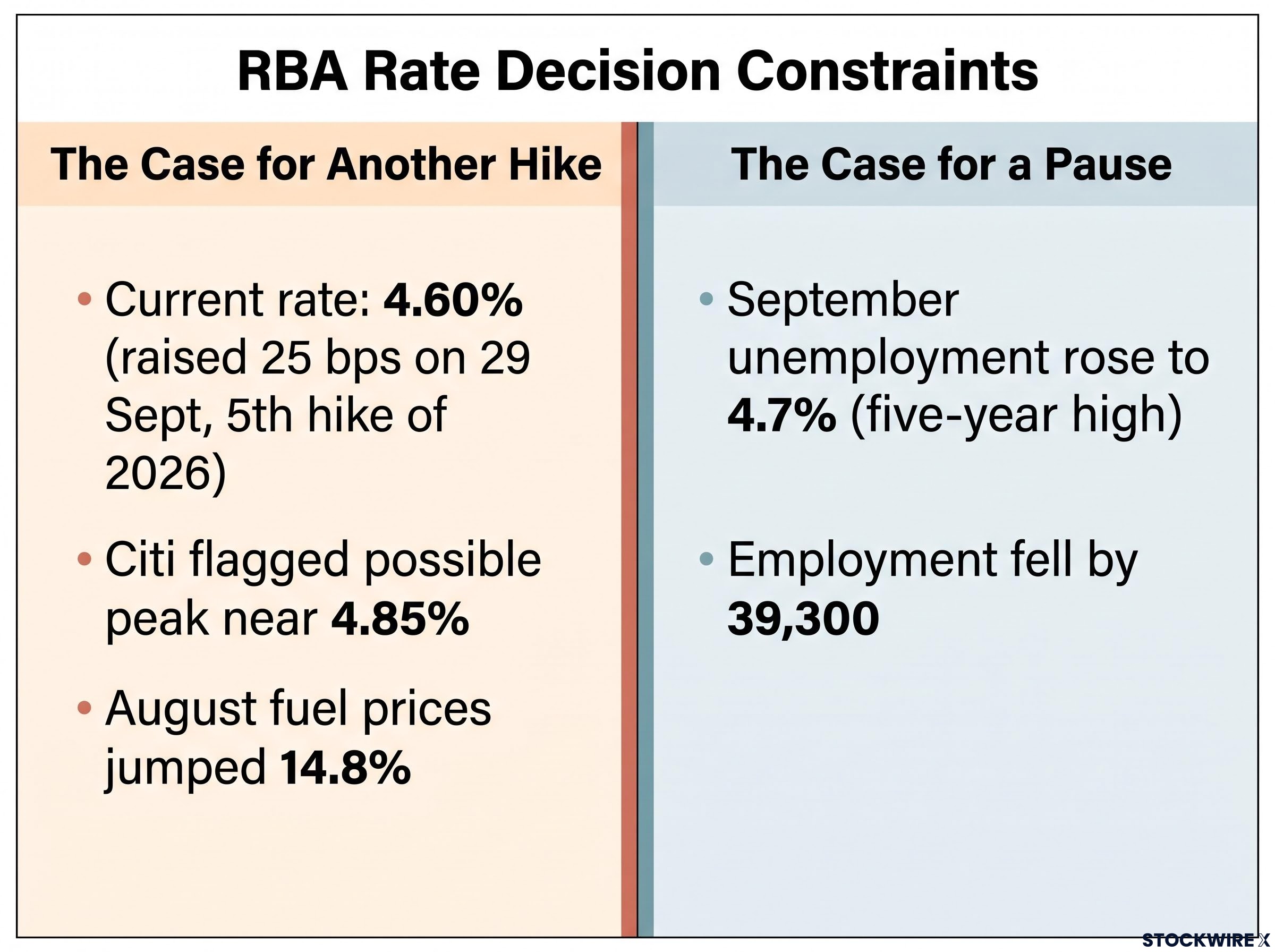
The thresholds are clear. Headline above roughly 4.2% or quarterly trimmed mean above 1.0% would strengthen the case for a November hike; a weak headline with softer services points to a pause.
For mortgage holders, that distinction is the one to watch. A hot trimmed mean raises the odds of another 25 basis point repayment increase, while a fuel-only surge suggests the RBA may hold.
Where could AUD/USD and gold go from 0.7000 after the CPI print?
AUD/USD trades around 0.7025-0.7030, after touching 0.7013 on 21 October following Hauser’s comments. Higher rates tend to draw capital inflows, which supports a currency.
| Scenario | CPI outcome | AUD/USD reaction | Key level |
|---|---|---|---|
| Hot | 4.2% or higher; above 4.6% adds a near-term boost | Rises on November hike pricing | 0.7070, then about 0.7130 |
| In line | 4.1-4.2% headline, 0.9-1.0% trimmed mean | Holds near 0.7000, driven by the Fed | 0.7000 |
| Soft | Below 4% | Falls as hike bets cool | 0.6930/50, then 0.6880 |
FXStreet Chief Analyst Valeria Bednarik notes buyers stepping in on dips near 0.7000, with the 100-day moving average at 0.7030 acting as overhead resistance.
Then comes the twist. The Fed is expected to hold this week, but markets price about a 78% chance of a December hike, per the ABC, and Chair Kevin Warsh gives little forward guidance. A hawkish Fed could strengthen the US dollar and cap AUD/USD even after a hot Australian print.
Relative rates, not RBA tone alone, tend to steer the currency, which is why a hot Australian print can still be overwhelmed by US Treasury yields and a hawkish Fed.
Gold shows the same tension. It fell about 4% over the week to a three-month low below US$4,000/oz (ABC, 26 October), because:
- Higher bond yields raise the cost of holding a metal that pays no income
- A stronger US dollar makes gold dearer for foreign buyers
- Tighter policy expectations reduce gold’s appeal as an inflation hedge
If you hold AUD exposure or gold, read the CPI and the Fed together. Either one can cancel out the other.
What the print changes for the RBA, and what it leaves to the Fed
The CPI’s makeup will set the RBA’s November path. The Fed will decide how much of that reaches AUD/USD.
Three variables matter once the data lands: whether services and the trimmed mean clear the 1.0% line, any follow-up commentary from RBA officials, and the Fed’s tone on a December hike. Mortgage holders should focus on the core figure, while currency and gold holders need the US decision before drawing conclusions.
These statements are speculative and subject to change based on market developments. Past performance does not guarantee future results.
This article is for informational purposes only and should not be considered financial advice. Investors should conduct their own research and consult with financial professionals before making investment decisions.