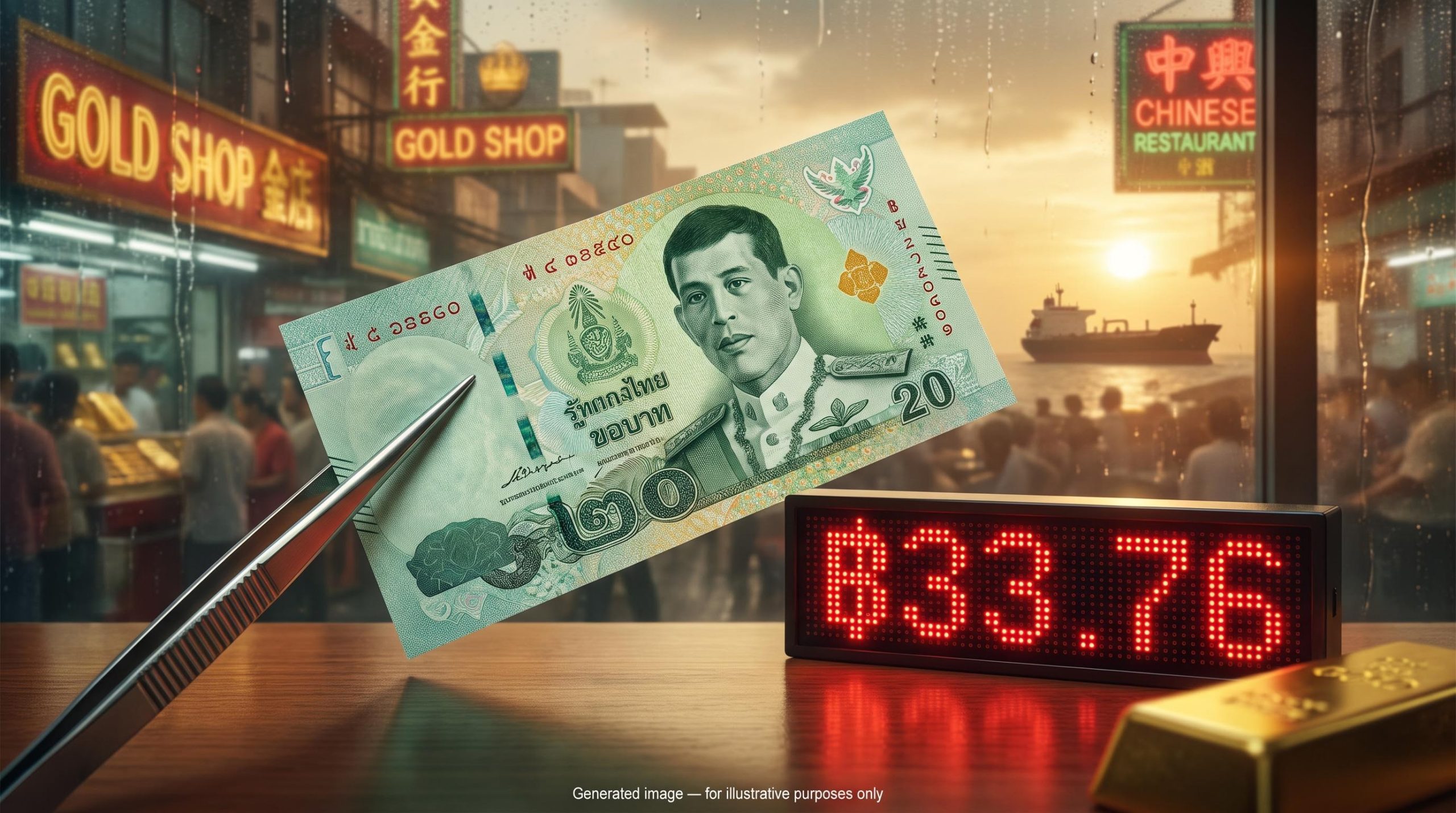
The baht slid to about ฿33.76 per US dollar on 27 October, just shy of its three-month low of ฿33.73. That happened in a week when foreign investors were buying Thai stocks and bonds. If portfolio inflows were enough to protect an emerging-market currency, the Thai baht outlook would look brighter than it does.
The pressure is coming from elsewhere. Brent crude is trading above $115 a barrel, gold has slipped below $4,000 an ounce, and the US dollar has firmed.
The Bank of Thailand (BoT) is also in focus. Sources disagree on the exact timing of this week’s policy decision, but expectations for a hold at 1.00% are close to unanimous.
The useful question is which of these forces actually moves the currency. Drawing on OCBC‘s view and forecasts from Kasikorn Research Center and a Reuters economist poll, here is a framework for ranking them.
Why is the baht weakening when foreigners are buying Thai assets?
Foreign money flowed into Thai markets in the third week of October. Over 19-22 October, foreigners were net buyers of ฿3.014 billion in equities and added ฿9.804 billion in bonds, according to Pattaya Mail. The baht still weakened.
| Item | Figure | Date | Source |
|---|---|---|---|
| Latest USD/THB | ฿33.76 | 27 October open | Money & Banking Magazine |
| Three-month low | ฿33.73 | 22 October | Pattaya Mail |
| Previous close | ฿33.74 | 22 October | Money & Banking Magazine |
| Week-earlier level | ฿33.50 | About 15 October | Pattaya Mail |
| Expected range | ฿33.30-฿33.80 | 26-30 October | Kasikorn Research Center |
The contradiction weakens once you separate buying a Thai asset from buying baht. A foreign fund can hedge its currency exposure through forwards or swaps, contracts that lock in a future exchange rate, which offsets much of the baht demand its purchase created. Thai residents may also be buying overseas assets at the same time.
The flows themselves were unstable. Buying clustered in a few days, then alternated between stocks and bonds. A 26 October report from Khaohoon International showed equity net buying of about ฿3.53 billion alongside a negative bond line, though that figure has not been independently verified.
OCBC’s diagnosis Strategists Sim Moh Siong and Christopher Wong attribute the baht’s weakness to three forces: elevated oil prices, softer gold and a stronger US dollar.
None of these three relates to portfolio flows. A headline inflow number tells you little about a currency’s direction until you check trade, hedging and dollar conditions alongside it.
When big ASX news breaks, our subscribers know first
How oil, gold and the dollar hit Thailand’s external position
OCBC’s three forces work through separate channels, but they are all pushing in the same direction.
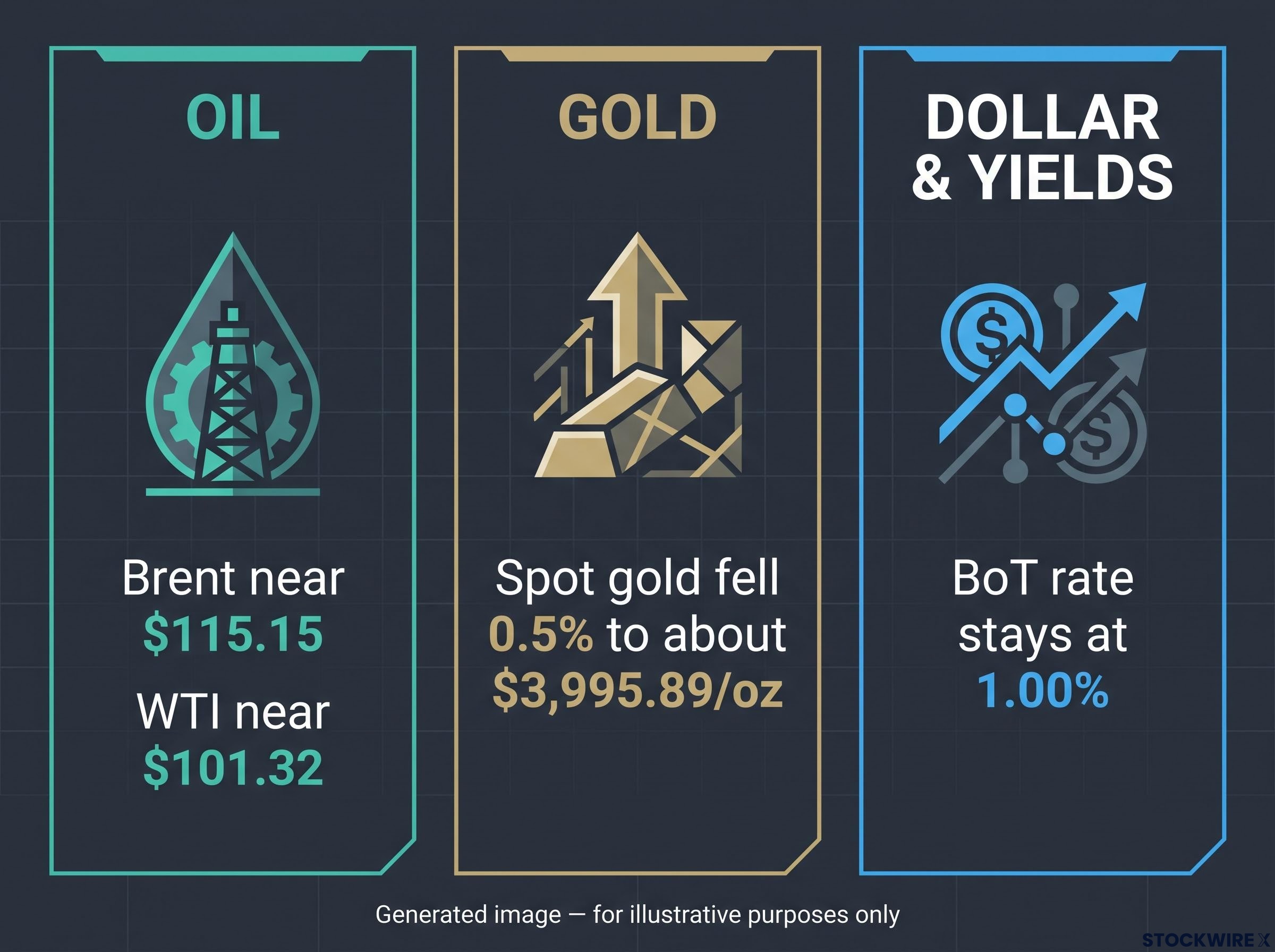
- Oil: Thailand must sell baht for dollars to pay for imported energy. Brent sat near $115.15 and WTI near $101.32 on 27 October.
- Gold: Dealer flows through Bangkok’s gold trade create large baht transactions. Spot gold fell 0.5% to about $3,995.89/oz.
- Dollar: Higher US yields pull capital towards dollar assets, while the BoT’s rate stays at 1.00%.
The oil import bill
Thailand is a net energy importer, which means it buys more fuel from abroad than it sells. When crude prices rise, importers need more dollars, so they sell more baht. That steady selling pushes the currency down.
The same mechanism is visible in the rupee under oil pressure, where heavy crude import dependence and a Hormuz disruption have overwhelmed record central bank intervention, a useful comparison for how far an energy import bill can drive a currency.
The import bill is already large. Kasikorn reports that September imports jumped 50.4% year-on-year to a record $44.2956 billion, with fuel strongly affected by higher prices.
The trade data is less clear-cut than that figure suggests.
A conflict in the September numbers ttb Analytics reported a customs trade deficit of about $5.86 billion. Kasikorn described a narrower customs deficit and a balance-of-payments trade surplus after adjustments. The gap likely reflects different periods and accounting bases.
The cushion is real but thin. August’s current account surplus of $2.4 billion gives Thailand some room, although an import bill growing at this pace could erode it quickly.
The gold channel
Thailand is a major regional gold-trading centre. When gold rallies, dealer activity tends to support the baht. When it falls, that support disappears, which is why a slide in bullion matters well beyond commodity markets.
A firmer dollar and thin yield support
Oil-driven inflation has lifted US Treasury yields and reinforced expectations of further Federal Reserve tightening. In Reuters poll commentary, SMBC‘s Jeff Ng named the baht among currencies vulnerable to oil eroding current-account buffers. MUFG pointed to the little rate support a 1% policy rate offers. Both remarks have not been independently verified.
Together, these channels show that the baht’s vulnerability is structural to its energy and gold exposure. You need to track oil and gold, not just central bank decisions.
What the Bank of Thailand’s stance means for the baht
If the trade channels are working against the baht, the obvious question is whether the central bank can lean against them. The evidence suggests it is not inclined to.
Deputy Governor Piti has signalled that the BoT has room to keep policy accommodative, meaning it can hold rates low, despite pricier energy. Growth is soft: real GDP rose 1.9% in Q2, and the 2026 outlook is about 2.3%. Inflation, however, climbed to 2.82% in September from 2.53% in August.
The BoT policy statements describe an accommodative stance aimed at supporting recovery, while acknowledging that energy costs are lifting projected inflation, which leaves the central bank little room to offer the baht rate support.
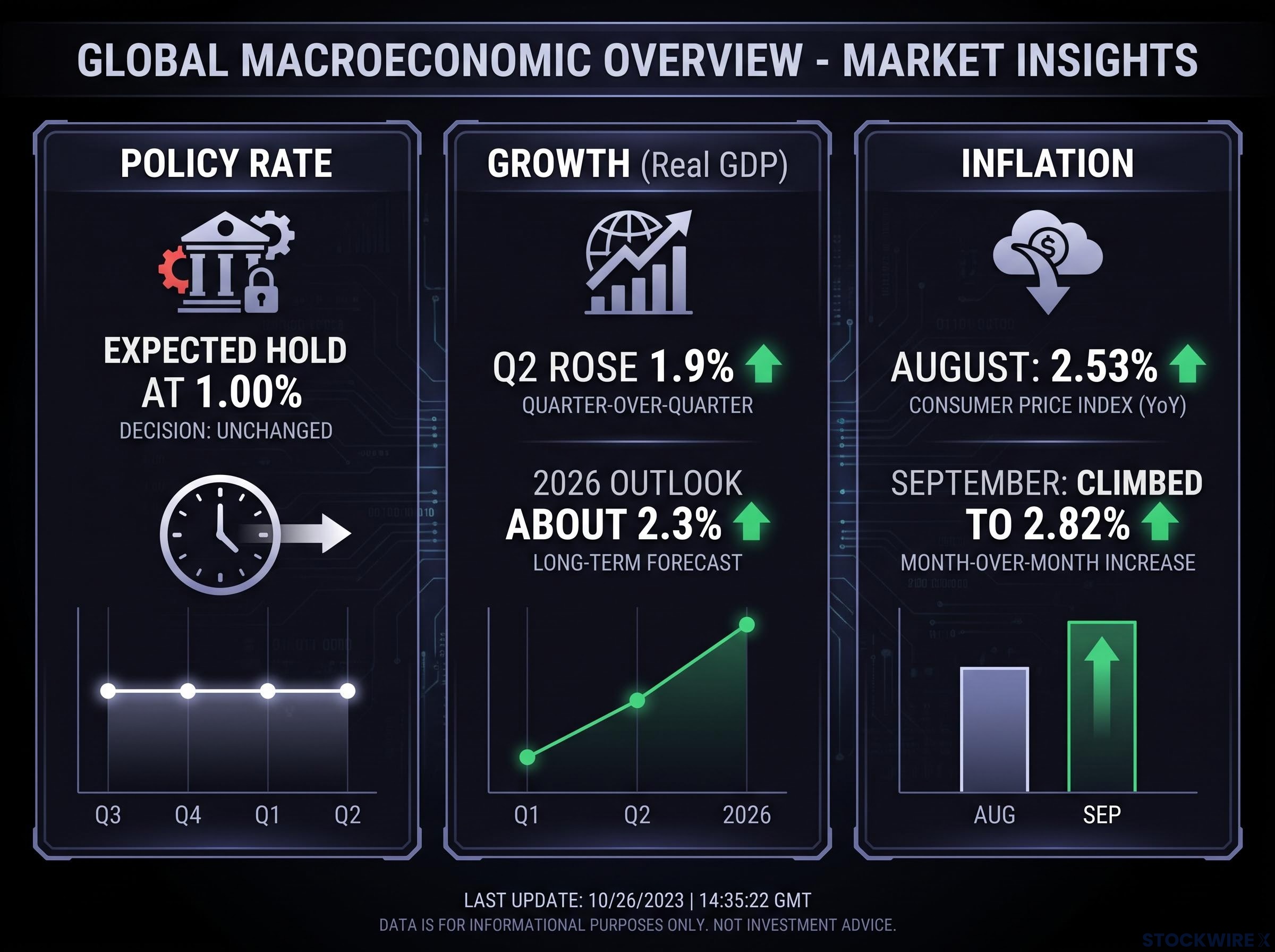
All 26 economists in the Reuters poll expected a hold at 1.00%, and most see no change through 2027. Thai PBS reported a hold on 27 October, while the poll anticipated a decision on 28 October, so treat the exact timing with caution.
| View | Core argument | Baht implication |
|---|---|---|
| Dovish-growth | Weak growth of 1.9% argues for staying accommodative | Limited rate support; exposed when US yields rise |
| Cautious-hold | CPI of 2.82% and oil above $100 argue against easing | Avoids a further negative signal; could stabilise the currency |
| Structural-vulnerability | Energy dependence, low yields and resident outflows | Underperformance even with positive inflows |
| Cyclical-reversal | Oil, dollar or gold headwinds could fade | Possible rebound from weak levels |
There are still reasons not to turn aggressively bearish:
- August’s $2.4 billion current account surplus
- Net foreign buying during 19-22 October
- A hold that avoids sending a fresh dovish signal
None of these views offers the baht an easy lift. Because a hold is already priced in, watch the BoT’s tone on energy-driven inflation rather than the decision itself.
What the technicals and the next few weeks suggest
With policy unlikely to change, the chart and the wider scenario map carry more weight.
Reading the chart
OCBC sees a possible double-top in USD/THB, a pattern in which price fails twice near the same high, which can signal exhaustion. Daily momentum, the speed of recent moves, is flat. The Relative Strength Index (RSI), a gauge of whether buying has run too far, has risen.
OCBC’s short-term read Consolidation near recent highs is likely in the short run, with nearby support levels in view.
OCBC’s wider view, which has not been independently verified, is for a moderate dollar rally into year-end and an eventual, gradual and volatile easing in oil. Spot is already near the weak end of Kasikorn’s ฿33.30-฿33.80 range.
This is not a new story. KBank reported the baht weakening past ฿33.50 in September, and OCBC described it near a 15-month low in July, according to lightly verified reports. Bearish positioning in the Indian rupee and Philippine peso points to a regional, cyclical pattern rather than a Thailand-only problem.
What could change the picture
The reversal triggers map directly onto the drivers already covered:
- Lower oil prices, which would shrink the import bill
- A softer US dollar
- Lower US Treasury yields
- Renewed gold strength, which OCBC warns could otherwise add volatility if gold keeps falling
- Continued foreign bond inflows
Treat the current level as a zone to monitor for breakout signals, not a reason to chase the move in either direction. Past performance does not guarantee future results, and forecasts are subject to change with market conditions.
Investors weighing wider exposure can read our deep-dive into Asian currency vulnerabilities, which shows how options-based hedging has replaced static hedge ratios at major managers.
Weighing the baht’s drivers before the next policy signal
The baht’s slide reflects oil, gold and dollar pressure more than portfolio flows, and the BoT is offering little to offset it. That gives you a clear order for checking the drivers.
Start with the import bill, then the direction of gold. Next, look at the US yield backdrop, and finally the BoT’s tone on inflation.
Two variables would most change the near-term picture: a sustained drop in oil, or a rebound in gold. Either would ease pressure faster than any rate decision.
This article is for informational purposes only and should not be considered financial advice. Investors should conduct their own research and consult with financial professionals before making investment decisions.