Sterling is sliding into a Budget that, by Scotiabank‘s reckoning, should barely move it. If Chancellor John Healey delivers a fiscally credible package on Wednesday 28 October, the bank’s strategists see the outcome as neutral for the pound at worst. So why has the GBP/USD exchange rate already slipped, and what does the near-term forecast look like from here?
The answer sits in the market’s nerves, not its conviction. Scotiabank strategists Shaun Osborne and Eric Theoret wrote on 27 October that wariness ahead of the Budget explains part of sterling’s weakness against the US dollar. Overnight implied volatility has firmed, and spot has slipped below minor technical support at 1.3350/55.
That combination leaves the pound with what they call a soft undertone heading into tomorrow.
Here is the map you need: which levels the market is watching, why credibility matters more than the headline headroom number, and where the real risks to the near-term outlook sit.
Why is sterling slipping into the Budget, and which levels matter now?
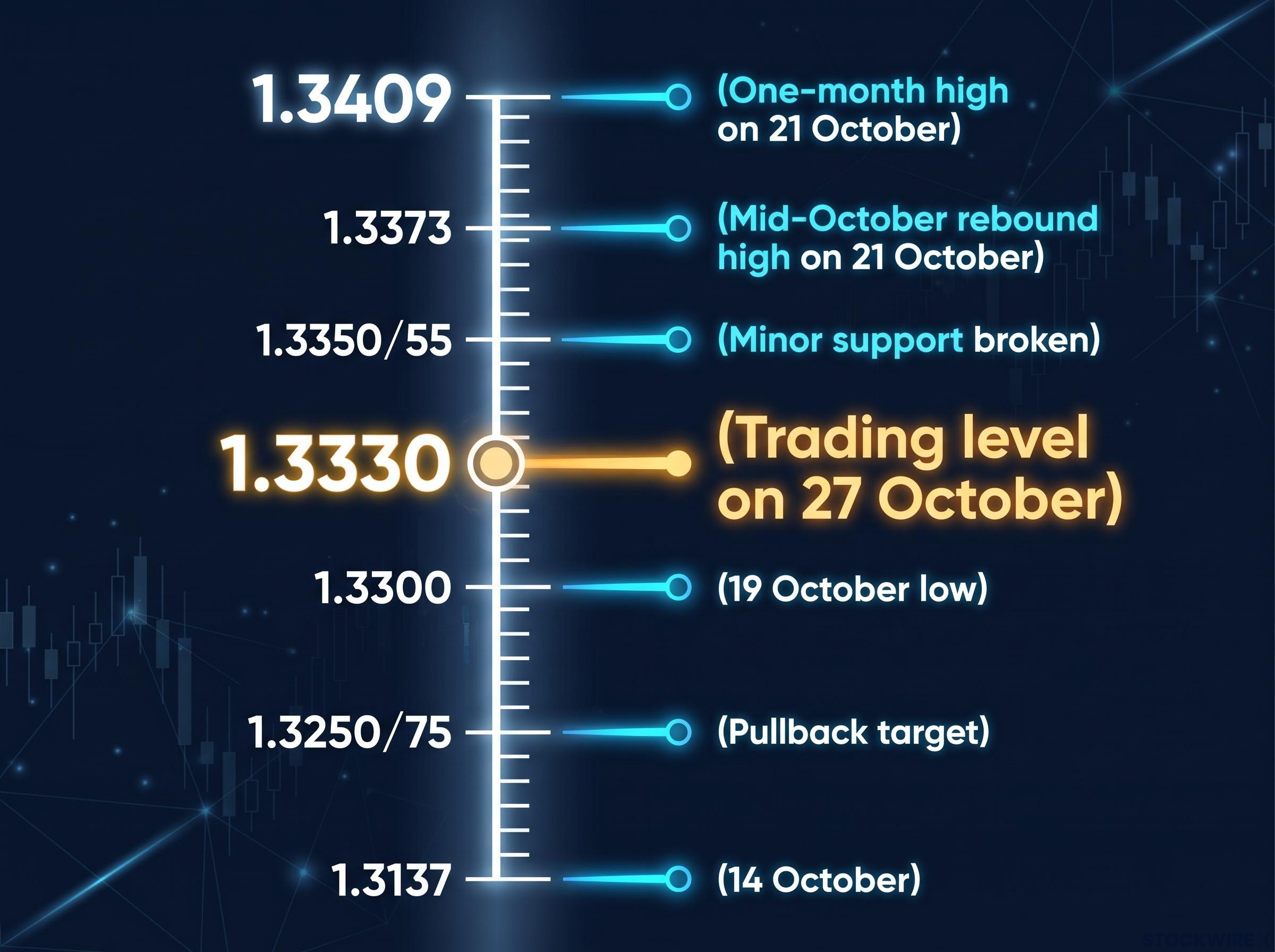
On a trader’s screen, cable (market shorthand for GBP/USD) was trading around 1.3330 on 27 October, according to ForexTraders. That leaves it just under the 1.3350/55 zone it failed to hold, and within sight of the 19 October low near 1.3300.
The move matters because of what came before it. Admiral Markets data shows the pair rallied from 1.3137 on 14 October to about 1.3373 by 21 October, touching a one-month high of 1.3409. Scotiabank’s next downside marker, 1.3250/75, would give back more of that rebound.
| Level | Significance | Source of view |
|---|---|---|
| 1.3373 | Mid-October rebound high (21 October) | Admiral Markets |
| 1.3350/55 | Minor support now broken; first level to recover | Scotiabank |
| 1.3300 | 19 October low, now exposed | Scotiabank |
| 1.3250/75 | Possible pullback target, deeper retracement of rebound | Scotiabank |
Zoom out and the picture looks less dramatic. The pair has traded roughly between 1.314 and 1.382 in 2026, so the current drift sits comfortably inside the year’s range. Scotiabank also expects limited declines to draw in buyers hunting for bargains.
Scotiabank’s base case Osborne and Theoret argue that a Budget seen as fiscally credible should leave sterling largely unaffected, framing it as neutral for GBP at worst.
For you, that makes these levels decision zones for the next day or two, not statements about what sterling is worth. A Budget surprise or a sharp dollar move could invalidate any of them within hours.
Reading the volatility signal
Implied volatility is the market’s estimate of how much a currency will swing, derived from what traders pay for options. Scotiabank flags that overnight implied volatility rose ahead of the announcement.
Convera adds the context that keeps this in proportion. One-week implied volatility is higher but still below its long-run median.
Options buyers are paying up for Budget insurance, not betting on a crisis. That distinction tells you the market is cautious, not positioned for a repeat of 2022.
When big ASX news breaks, our subscribers know first
How do budgets and fiscal credibility move a currency?
That caution only makes sense once you see how a Budget reaches the exchange rate. The chain runs roughly like this:
- Borrowing expectations shift. Unfunded tax cuts or spending rises imply more government debt and more gilts (UK government bonds) for investors to absorb.
- Gilt yields adjust. Investors demand compensation for that supply, including a country-specific fiscal risk premium and extra yield on longer maturities.
- Debt costs eat into headroom. Higher yields raise interest bills, shrinking the fiscal buffer and potentially feeding a loop of worse forecasts.
- The Bank of England reacts. A looser Budget can lift inflation and push markets to price a higher Bank Rate.
- Capital flows decide. Foreign investors weigh gilt yields against the risk of currency losses and fiscal stress before committing money.
Yields are already elevated. The 10-year gilt yield sat around 5.35-5.43% on 26-27 October, according to Morningstar and Vantage Markets, after peaking at 5.53% on 8 October, its highest since 2007, per ForexTraders. Reuters and Admiral Markets reported the 30-year yield moved above 6% in early October for the first time since 1998.
The stakes compound quickly. The Institute for Fiscal Studies (IFS) estimates a sustained one-percentage-point rise in borrowing costs could add about £14bn to debt-interest spending in 2029-30.
The Bank of England channel forks. Bank Rate stands at 3.75%, held by a 6-3 vote on 17 September. A future hike read as a sign of strength can support sterling through wider UK-US rate gaps, but one read as a response to fiscal stress can weaken it.
The direction of yields alone is a poor guide for you. What matters is whether higher yields reflect stronger growth or a rising risk premium.
A cleaner read on domestic credibility than absolute yield levels is the UK-Germany gilt spread, which strips out global bond moves and isolates the premium investors attach specifically to UK fiscal risk.
Cyclical versus structural pressures
Not every pressure on gilts is a UK fiscal verdict. It helps to sort them:
- Cyclical: energy prices, current inflation, global bond repricing, short-term growth and the immediate Bank Rate path.
- Structural: the debt stock, weak productivity, pension-fund demand for long-dated gilts, fiscal-rule credibility and the ability to control spending.
The IFS notes UK long-term yields have risen broadly alongside other major economies, implying a substantial global component. The International Monetary Fund (IMF) argues the 2022 episode left gilts more sensitive to fiscal surprises and global shocks, which is why the structural column carries extra weight.
What did September 2022 teach markets, and how is this Budget different?
That sensitivity has a specific origin. In September 2022, the government announced large borrowing-funded tax cuts without a fully costed medium-term plan or an Office for Budget Responsibility (OBR) forecast. The consequences cascaded:
- gilt yields surged;
- sterling fell sharply;
- pension funds faced collateral and liquidity stress;
- the Bank of England stepped in temporarily to buy long-dated gilts;
- the government reversed much of the package.
The safeguards built since then have changed the baseline. Fiscal events now carry OBR scrutiny and explicit rules: day-to-day spending must be covered by tax revenue, and debt must fall as a share of GDP by the end of the Parliament, per Reuters. The IMF’s 2025 assessment said these framework changes enhanced credibility.
Yet tolerance for ambiguity is lower, not higher. With yields near multi-decade highs, a smaller misstep could cause a larger repricing.
The numbers markets are weighing this week show how thin the margin is.
| Source | Headroom estimate | Basis |
|---|---|---|
| Reuters (March figure) | £23.6bn | Spring position, current-budget rule |
| Reuters poll | £10-12bn | Before new measures |
| Reuters economists | £15-16bn (median) | After measures |
| MUFG | ~£14bn | After measures |
| Deutsche Bank | £15.7bn | Modest tax rises and efficiency savings |
ING expects about £5-6bn of tax rises. Borrowing is forecast near £126bn (3.9% of GDP), while dealer estimates put gilt issuance this year around £250bn, down from about £304bn in 2025-26. Reuters warns another 30bp rise in yields and Bank Rate could cut headroom by roughly £5bn.
The fiscal headroom estimates in circulation hinge on wage growth and debt interest costs, and ING calculates that stronger pay forecasts alone could add about £10bn, which is why dealers disagree so widely on the final figure.
The headline headroom number matters less to you than whether the package shows a believable path on spending. That is what separates a calm outcome from a 2022 repeat.
Where do the banks disagree, and what could prove the forecast wrong?
On the surface, the banks agree: credibility matters. The fault line is whether this Budget can deliver enough of it to re-rate sterling higher.
| Institution | View | Key reasoning |
|---|---|---|
| Scotiabank (27 Oct) | Neutral if credible | Risk premium weighing now; dips likely to attract buyers |
| ABN AMRO (26 Oct) | Positive surprise possible | Headroom could reach £18-24bn |
| Goldman Sachs, Morgan Stanley, MUFG (reported 27 Oct) | More bearish on cable | Fiscal gains largely priced in; asymmetric downside |
| ING, Commerzbank (reported 27 Oct) | Constructive versus the euro | GBP/USD constrained by the US dollar |
The ING and Commerzbank view deserves attention. Even a well-received Budget may lift sterling more against the euro than the dollar, because cable answers to US forces too.
Global macro forces such as inflation dynamics, rate-cut expectations and term premia have driven UK yields in step with Treasuries and Bunds this year, which helps explain why the pound’s reaction to domestic news can be muted.
The IFS sets the bar. Rule compliance will not convince without credible spending totals and clarity on the ceiling the government intends to observe.
What could invalidate the call
- Credibility already priced in: if £14-16bn of headroom is expected, delivering it may bring no upside.
- Fragile headroom: a better figure built on temporary measures or optimistic growth assumptions may be questioned.
- Outside forces: dollar strength or a global risk shock could override UK-specific news.
- Dip-buying assumptions: buying near 1.3300 assumes the Budget removes fiscal risk, and a persistent global bond sell-off could undercut that.
Treat a neutral Budget as the base case. A failure on spending credibility is the main route to a break below 1.3300 toward 1.3250/75.
These views are speculative and subject to change as the Budget details emerge and markets react. Past performance does not guarantee future results.
What a credible Budget changes for sterling, and what it leaves alone
A credible package would remove the tail risk of a 2022-style shock. It would not, on most bank views, hand sterling a bullish catalyst, which leaves the pre-event technical bias soft.
When the details land tomorrow, four things deserve your attention:
- the spending-control detail, especially any clear ceiling;
- the headroom figure against the £14-16bn expectation;
- how gilts react in the first hours;
- whether 1.3350/55 is recovered or 1.3300 gives way.
Judge the outcome by credibility rather than headlines, and treat every level as conditional on what the market hears.
This article is for informational purposes only and should not be considered financial advice. Investors should conduct their own research and consult with financial professionals before making investment decisions.