
EUR/USD has now fallen for five straight sessions, trading near 1.1145 on 27 October 2026. On paper, the euro should have support. The European Central Bank (ECB) is still in a tightening cycle, and markets expect another hike before year-end. The signal shaping this EUR/USD forecast is coming from somewhere else: the French bond market.
This week, three forces meet. Worries over French public finances have pushed borrowing costs to levels not seen in over a decade. The US Dollar Index (DXY), which measures the dollar against a basket of major currencies, has climbed back toward 102.20. The Federal Reserve decides on Wednesday and the ECB on Thursday.
Both central banks are expected to hold. The decisions themselves are unlikely to move the pair; the guidance around them will.
Here is a working framework for judging how fiscal stress and central bank language combine to move a major currency pair, along with the specific levels and triggers that matter over the coming days.
Why is EUR/USD sliding for a fifth straight session?
The screen shows a modest daily loss. EUR/USD was down 0.22% on Tuesday, sitting in the lower half of a recent range of roughly 1.1100-1.1270. ING has flagged 1.1180 as vulnerable support and 1.1250-1.1270 as the ceiling.
Look beyond the dollar, though, and the picture changes. The euro fell against almost every major currency on Tuesday:
- EUR/AUD: -0.54%
- EUR/NZD: -0.60%
- EUR/USD: -0.22%
- EUR/CHF: -0.15%
That spread of losses points to two separate forces pulling in the same direction.
Cross-checking the euro against the Australian dollar, pound and yen is the cleanest way to separate euro-specific stress from broad dollar strength, since a pure dollar move would not push EUR/AUD down by half a percent.
The first is the dollar. The DXY slipped to 101.45 last week, its weakest level since 1 October, then recovered as the artificial intelligence (AI) worries that dominated markets faded and attention swung back to the Fed. US data gave that rebound real support. Conference Board consumer confidence rose to 91.7 in October against 81 expected, and durable goods orders jumped 1.8% in September versus a 0.6% forecast.
Not everything was strong. Orders excluding transportation slightly missed, and the ADP four-week average for job gains slipped to 16.8K from 17.5K. Inflation, however, has kept both central banks on alert.
| Economy | September reading | Prior (August) | Source |
|---|---|---|---|
| Euro area HICP | 3.8% y/y | 3.2% | Eurostat |
| US CPI | 3.7% y/y | 3.4% | BLS |
| US core CPI | 2.6% y/y | Not provided | BLS |
The second force is euro-specific: French fiscal risk. Because the euro is also losing ground to the Australian and New Zealand dollars, this is not only a dollar story. A softer Fed on Wednesday may not be enough to repair the pair on its own.
When big ASX news breaks, our subscribers know first
What are markets pricing from the Fed and ECB, and what could change it?
Both decisions look close to settled. The Fed’s target range sits at 3.75%-4.00% after a September hike, its first since 2023, driven partly by Middle East energy costs. A hold is priced at about 90.6%, and BBH puts the odds of an October hike near 10%.
The ECB’s deposit rate is 2.50% after a cumulative 50 bps of hikes this year, and a Thursday hold is also expected.
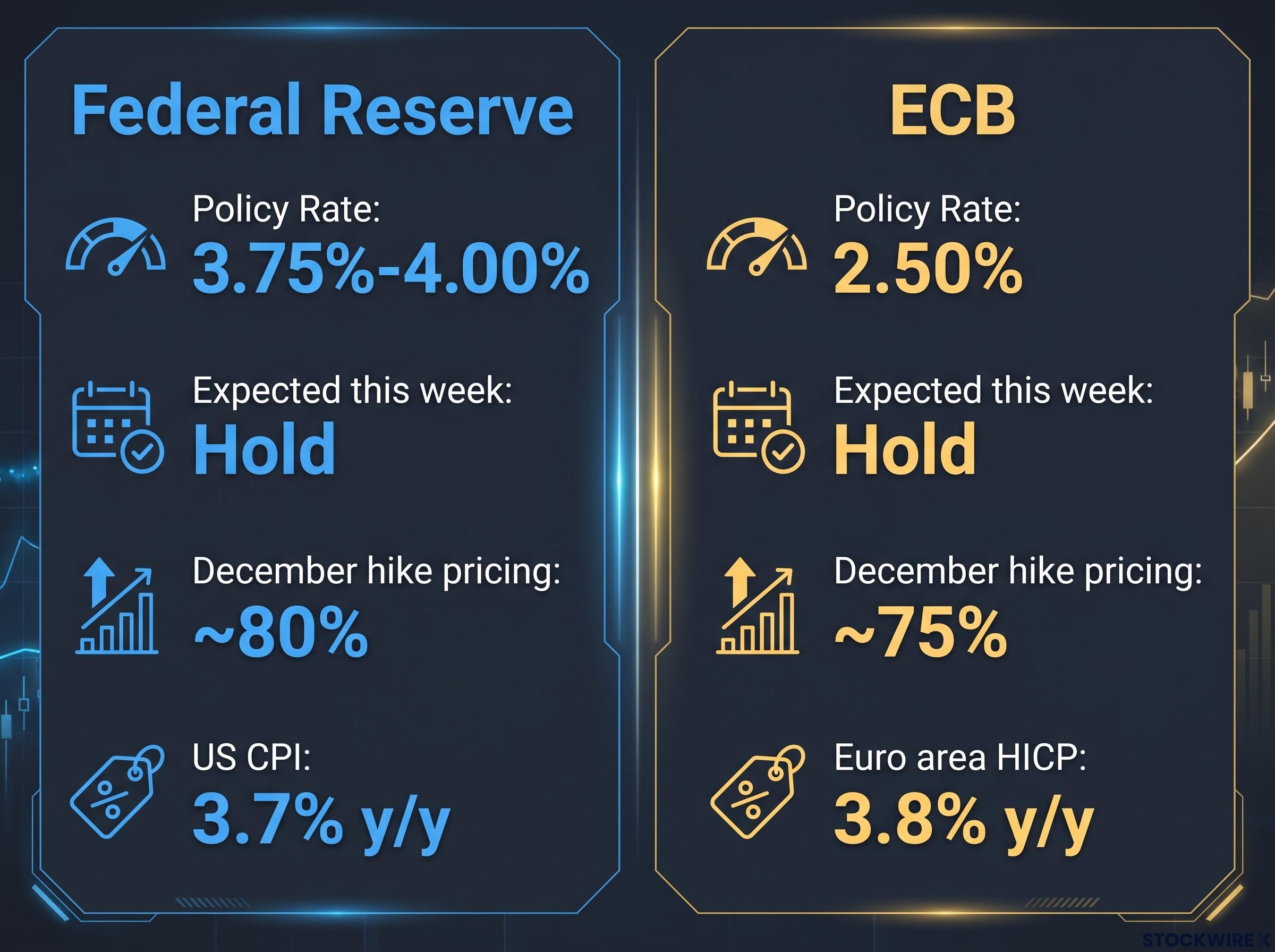
| Central bank | Policy rate | Expected this week | December hike pricing |
|---|---|---|---|
| Federal Reserve | 3.75%-4.00% | Hold (Wednesday) | About 80% (reports range 79%-88%) |
| ECB | 2.50% | Hold (Thursday) | About 75% to 2.75% (BBH: 75%-78%) |
The Fed figure deserves a caveat. CME FedWatch shows roughly 80%, while other reports place it between about 81% and 88%, depending on timing and contract reading. Either way, the market already expects Chair Kevin Warsh to keep December alive, which leaves little room for a hawkish surprise.
The ECB story is less secure. BBH argues that contained underlying inflation lets policymakers wait, while resilient activity keeps December firmly possible. MUFG says the bond sell-off has made an October hike less likely, though it still expects moves in December and early 2027.
French bonds take centre stage BBH expects French bond turmoil to dominate President Christine Lagarde’s press conference, with any assurance on limiting contagion likely to support the euro.
The asymmetry is the point. A hawkish Fed hold merely confirms what is priced. A softer ECB could quickly drain the euro’s carry support, meaning the extra return from holding the higher-yielding side of the pair. Disappointment, not confirmation, is what is most likely to move EUR/USD this week, so read the statements for shifts in December language rather than the headline decision.
How does French fiscal stress reach EUR/USD?
A budget dispute in Paris can move a global currency pair through a chain of cause and effect. Once you see the chain, you can apply it to other fiscal stress stories.
What the OAT-Bund spread measures
An OAT is a French government bond, and a Bund is a German one. The OAT-Bund spread is the extra yield investors demand to hold French debt instead of German debt. A wider spread means investors want more compensation for the risk of lending to France.
The French bond spread has become the market’s main gauge of fiscal credibility, and its drivers include a deficit near 5.5% of GDP and a growing pool of corporate bonds yielding less than government debt.
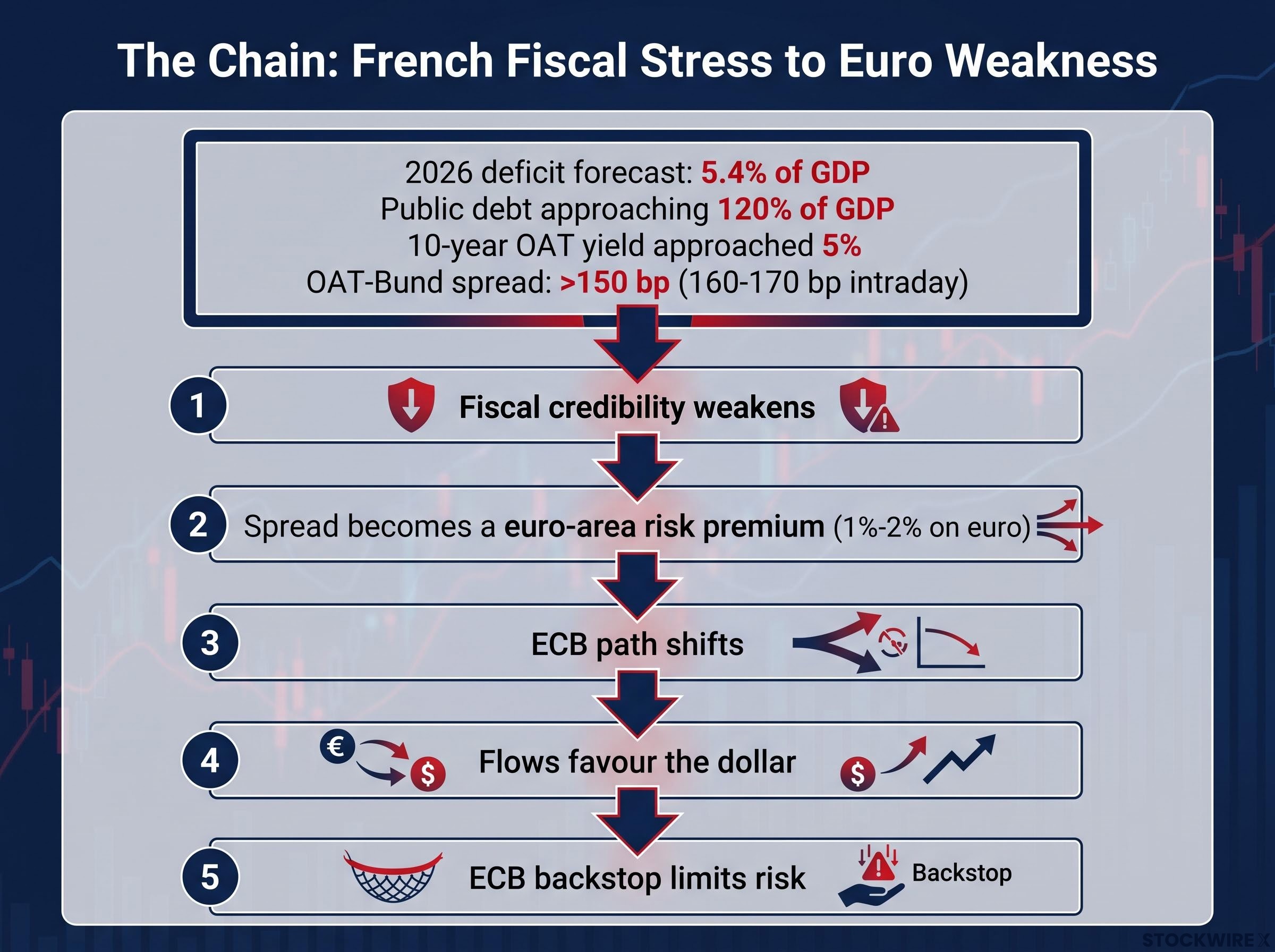
That gap has pushed above 150 bp, with intraday readings around 160-170 bp, the widest close since January 2012, according to JPMorgan. The 10-year OAT yield has approached 5%. The fiscal backdrop explains the pressure:
- 2026 deficit forecast revised to 5.4% of GDP, above the prior 5.0% target (Fitch)
- Goldman Sachs scenario of 6.4% of GDP if budget wrangling drags on
- Public debt approaching 120% of GDP
- Moody’s held Aa3 with a negative outlook; Fitch and S&P rate France A+
- The lower house rejected the social security budget bill at first reading
From there, the mechanism runs in five steps:
- Fiscal credibility weakens, and investors demand more yield on French debt.
- The spread becomes a euro-area risk premium, because France is a core sovereign and a major bond market. ING estimates that premium at 1%-2% on the euro.
- The ECB path shifts, as higher yields tighten financial conditions and put the December hike in question.
- Flows favour the dollar, with investors seeking liquidity in Treasuries.
- The ECB backstop limits, but does not remove, the risk.
Where the ECB backstop stops
The Transmission Protection Instrument (TPI) is the ECB’s tool for countering disorderly bond market moves in individual countries. It comes with conditions, is politically sensitive, and does not trigger automatic French bond buying. JPMorgan expects any support to arrive indirectly, through the policy stance or adjustments to quantitative tightening, and views the episode as serious but not yet a 2011-12 style crisis.
The implication for you: a hawkish ECB is a weaker shield than it appears. Higher French yields can undo the very hikes the market is counting on.
Which levels and scenarios define the EUR/USD forecast from here?
The institutions tracking the pair largely agree that a French risk premium exists. Where they differ is on how long it lasts.
Analyst views compared
| Institution | Level or range | Key reasoning |
|---|---|---|
| BBH | Toward 1.1000 | French stress can overwhelm ECB tightening support |
| ING | 1.10-1.15 over 3-6 months | US rate support and French debt keep real-rate gaps against the euro |
| MUFG | 1.08-1.14 (fiscal drift) | Bond sell-off reduces near-term ECB hike odds |
| Commerzbank | Stable near term, downside risk | A credible French budget solution looks unlikely |
ING’s Francesco Pesole has also flagged a possible test of 1.1100, potentially 1.1000. BBH draws a comparison with Italy’s 2018 budget clash, suggesting a spread near 250 bp could put EUR/USD around 1.1000. Treat that analogue cautiously, as it has not been independently verified, and the same applies to comparisons with France’s 2024 spread episode.
The levels are clear: support at 1.1180, then 1.1100, then 1.1000, with resistance at 1.1250-1.1270. The 1.1100-1.1180 band is the decision zone this week. A break below it would make BBH’s 1.1000 call far more credible.
For readers weighing whether the slide is stretched, our detailed coverage of EUR/USD oversold signals shows why an RSI reading of 36 can coexist with a bearish trend.
Triggers to watch
Upside triggers:
- Fed: a dovish hold that plays down December, or a DXY break below 101.45
- ECB: an explicit commitment to limit sovereign fragmentation
- France: budget progress that narrows the spread
- Energy: easing Middle East risk
Downside triggers:
- Fed: a hawkish hold with a clear December signal
- ECB: softer guidance or a pause
- France: spread widening beyond 160-170 bp, budget failure or use of Article 49.3, a constitutional tool that lets the government pass a bill without a vote
- Energy: a shock hitting euro-area growth
Parliamentary budget votes were scheduled for 20 October and 27 October, and Allianz expects adoption by year-end.
These scenarios are speculative and subject to change based on market and political developments.
What this week’s decisions can change, and what they cannot
The near-term path looks bearish to rangebound. French fiscal risk caps the benefit of a hawkish ECB, while US inflation and Fed pricing keep the dollar supported. Watch 1.1100, then 1.1000, on the downside; a credible French budget settlement or a dovish Fed remain the clearest routes to a reversal.
Your best read comes from combining signals. Wednesday’s Fed language, Thursday’s ECB comments on fragmentation and the OAT-Bund spread tell one story together, and a misleading one in isolation.
Analyst forecasts describe scenarios, not guarantees. Past performance does not guarantee future results, and projections are subject to market conditions and various risk factors.
This article is for informational purposes only and should not be considered financial advice. Investors should conduct their own research and consult with financial professionals before making investment decisions.