
The October euro area purchasing managers’ survey came in soft, and the usual reaction is to assume a weaker euro follows. EUR/USD did slip to just below 1.12 after the composite PMI fell to 51.9 against a 52.7 consensus. For the EUR/USD outlook, though, the miss itself is the smaller story.
What matters more is whether the miss changes the expected path of interest rates. That is the signal most readers are likely to misread this week.
Three central bank decisions arrive in three days: the Federal Reserve on Wednesday, the European Central Bank (ECB) on Thursday and the Bank of Japan (BoJ) on Friday. US and euro area GDP figures land in the same window.
The coming days will test which force drives the pair next: weak survey data or the policy gap between the US and Europe.
Here is how survey data, central bank policy and scheduled releases fit together, and which signals deserve your attention before the next move.
Why did a modest PMI miss move the EUR/USD outlook?
The HCOB/S&P Global flash purchasing managers’ indices (PMIs), published on 23 October 2026, missed on every line. A PMI is a monthly survey of company purchasing managers that tracks whether business activity is growing or shrinking.
| Indicator | October flash | Consensus | September |
|---|---|---|---|
| Composite | 51.9 | 52.7 | 53.1 |
| Manufacturing | 52.4 | 52.8 | 52.9 |
| Services | 51.7 | 52.5 | 53.0 |
Every reading still sits above 50, the line between expansion and contraction. The composite is at its weakest since June, and services slowed most. Reuters reportedly linked the slowdown to higher energy-related costs and renewed contraction in France, though that detail has not been independently confirmed.
The market-moving content of any PMI print sits in the consensus surprise rather than the absolute level, which explains why a composite of 51.9 against 52.7 pushed EUR/USD lower even though activity is still expanding.
The gap with the US looks wider still. The US flash composite reportedly reached 57.6, and S&P Global’s Chris Williamson is reported to have said the euro area reading points to roughly 0.3% quarterly growth: slower, but not recession.
Danske Bank draws a measured conclusion from this.
Danske Bank’s view (via FXStreet, 26 October 2026) Strategists see EUR/USD pausing around 1.12 and expect a slow, gradual drift lower, citing the weaker October PMIs and softer euro area growth relative to the US. The original Danske note was not accessible; this view comes from FXStreet’s secondary reporting.
The speed of reversal is worth remembering. September’s composite jumped to 53.1 and supported the euro. One month later, the signal flipped.
What this tells you is that growth is cooling, not breaking. Treat the miss as a nudge on the euro, not a trigger for a large move.
When big ASX news breaks, our subscribers know first
How PMIs, rates and growth differentials combine to move a currency
Why should a survey about factories and offices move an exchange rate? The answer runs through interest rates.
- Survey: The PMI shows whether companies report more or less activity.
- Growth outlook: Traders adjust expectations for GDP, the total output of the economy.
- Central bank expectations: Weaker growth can mean fewer rate hikes; stronger growth can mean more.
- Rate differentials and currency: The rate differential is the gap between interest rates in two economies. Capital tends to flow toward the higher-yielding currency, moving EUR/USD.
The survey itself is only the first link. The currency reacts to what the data implies about the ECB and the Fed.
Over multi-month horizons the rate differential between the ECB and the Fed is the most powerful fundamental driver of the pair, and markets price where rates are expected to go, not where they sit today.
When a miss matters and when it does not
| Event | Surprise | EUR/USD implication |
|---|---|---|
| September 2026 PMI | Composite 53.1 vs 51.7 consensus | Supported the euro and ECB tightening expectations |
| October 2026 PMI | Composite 51.9 vs 52.7 consensus | Pushed EUR/USD below 1.1200 |
A miss on its own may do little if markets still expect the ECB to keep tightening. A miss that arrives alongside weak GDP, softer services and contained underlying inflation is far more likely to produce lasting euro weakness.
PMIs are also surveys, not national accounts. The swing from 53.1 to 51.9 in a single month shows how noisy one reading can be.
Before you react to any release, ask one question first: does this change what the ECB and the Fed will do?
Why is the ECB tightening step by step, and what does that mean for the euro?
That question leads straight to the ECB’s dilemma. The bank raised its deposit rate by 25 basis points to 2.50% in September, its second hike of 2026, and a December move is increasingly anticipated. Energy is pushing it in two directions at once.
- Higher headline inflation from energy argues for tightening.
- Energy-driven demand destruction weakens growth and may reduce the tightening required.
- Second-round effects, where higher costs feed into wages and broader prices, remain limited.
- Higher sovereign and long-term yields are already tightening financial conditions.
Chief economist Philip Lane captured the tension on 5 October, arguing the energy shock creates both upside inflation and downside growth risks. The PMI price data supports a cautious approach: services input and output prices eased slightly, while manufacturing input costs rose faster with output price growth steady.
Morgan Stanley expects no October hike, citing little second-round evidence and tightening already delivered via long-term yields. ABN AMRO argues resilient underlying growth, softening activity and limited second-round effects allow gradual tightening.
Cyclical brakes versus structural pressures
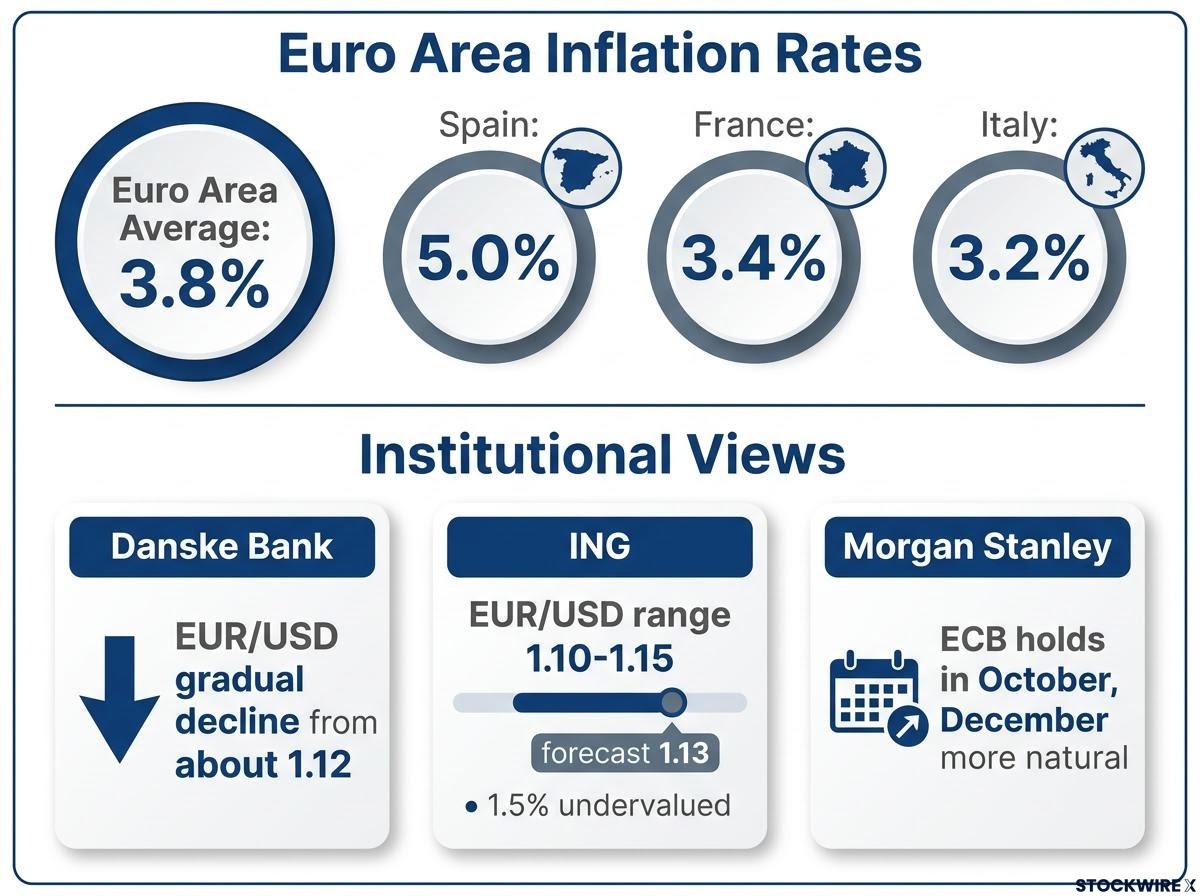
Euro area inflation stands at 3.8%, with Spain at 5.0%, France 3.4% and Italy 3.2%. Weaker demand, softer services and higher borrowing costs act as cyclical brakes. Labour market tightness, fiscal spending, supply constraints and energy vulnerability could keep inflation above target for longer.
| Source | View | Reasoning |
|---|---|---|
| Danske Bank | Gradual decline from about 1.12 | Weak PMIs; softer growth impulse versus the US |
| ING | Range 1.10-1.15; forecast about 1.13 | Euro about 1.5% undervalued; French fiscal risk could push toward 1.110 |
| Morgan Stanley | ECB holds in October; December more natural | Limited energy pass-through; higher long-term yields |
ING’s Francesco Pesole notes that a December hike is largely priced. For you, that asymmetry matters: delivery adds little upside for the euro, while dropping the hike would hurt.
An economist poll shows 64 of 73 respondents expecting a December ECB hike to 2.75%, which is why the move is treated as largely priced.
What could break the slow-drift view this week?
That asymmetry sets up a compressed three days.
| Date | Event | Expectation | EUR/USD relevance |
|---|---|---|---|
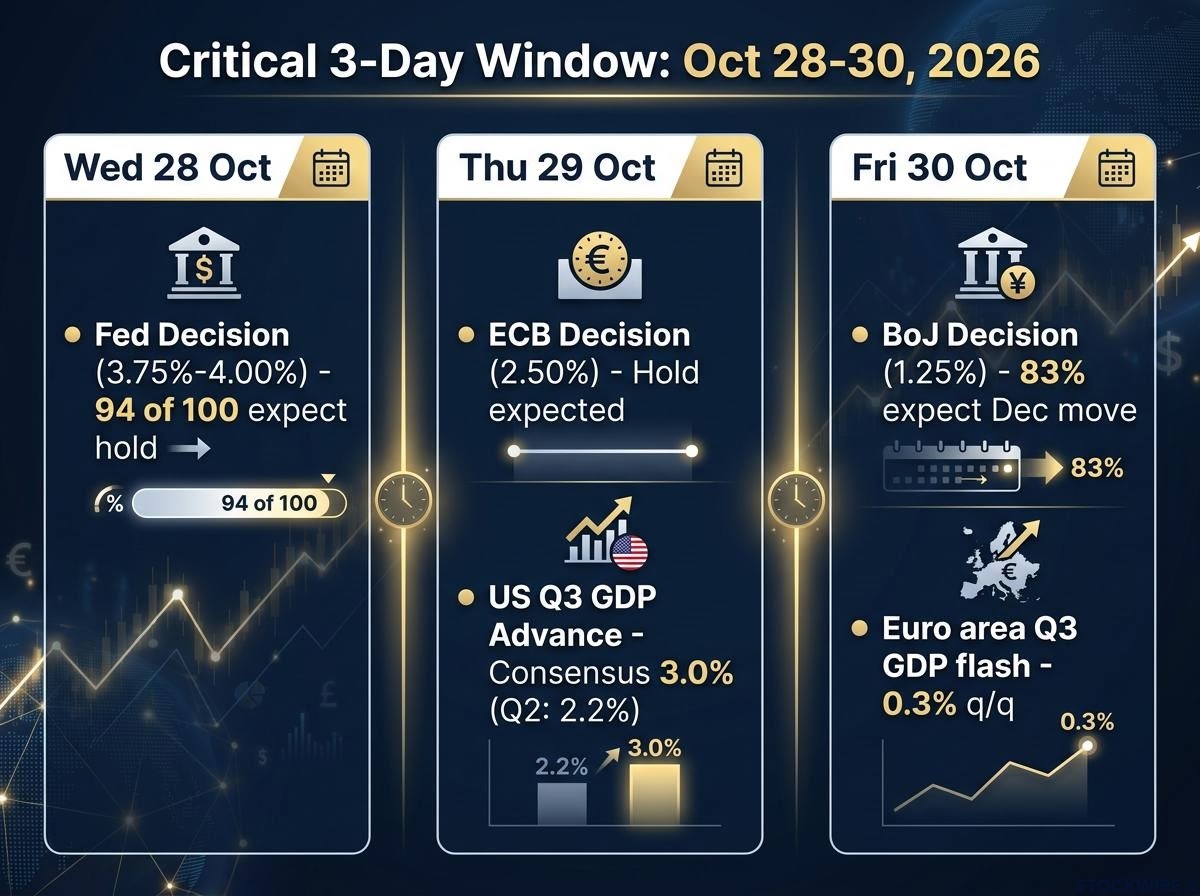
| Wed 28 Oct | Fed decision (3.75%-4.00%) | Hold; 94 of 100 economists in Reuters poll | Surprise hike would pressure the pair |
| Thu 29 Oct | ECB decision (2.50%) | Hold; stocktaking meeting | December guidance is the signal |
| Thu 29 Oct | US Q3 GDP advance | Consensus 3.0%; BNP Paribas 3.7%; GDPNow 3.5% (Q2 2.2%) | Upside surprise supports the dollar |
| Fri 30 Oct | BoJ decision (1.25%) | Hold; Bloomberg survey: 83% expect December | Surprise hike could unwind carry trades |
| Fri 30 Oct | Euro area Q3 GDP flash; national inflation | 0.3% q/q (BNP Paribas nowcast); inflation consensus not found | Weak print confirms the drift |
BNP Paribas warns that Ireland distorted the prior euro area quarter, so comparisons need care. Markets reportedly see a possible December BoJ move to 1.50%, though that is unconfirmed. Euro area flash inflation follows on 4 November.
A carry trade means borrowing in a low-rate currency such as the yen to invest in higher-yielding assets; a sudden yen rally can force those positions to close and ripple into EUR/USD.
Would support the drift lower
- A US GDP beat paired with a weak euro area print
- Higher Treasury yields lifting the dollar even without a Fed hike
- Persistent French fiscal stress or softer ECB December guidance
Would challenge it
- A firm signal for a December ECB hike
- French fiscal stabilisation, giving ING’s undervaluation case room to work
- Evidence that euro area growth is again beating pessimistic forecasts
Repricing risk A market positioned for a December ECB hike and a Fed hold is exposed if Thursday or Friday data shifts either assumption.
If all three banks hold, relative growth, French fiscal risk and bond yields may matter more than the decisions. Watch for the specific pairing of strong US GDP and weak euro area GDP: that combination could turn a slow drift into something faster.
What the PMI miss changes for EUR/USD, and what it does not
The October miss supports a gradual drift lower, but it does not decide the pace. The policy path, the two GDP releases and French fiscal risk determine whether the decline stays gradual.
Danske’s view is a base case reported second-hand, not a settled forecast. ING’s 1.10-1.15 range shows how wide reasonable views remain.
Three signals should update your view by Friday: the ECB’s December guidance on Thursday, the gap between US and euro area GDP, and whether national inflation figures show energy feeding into broader prices.
Investors exploring how rate paths drive currencies will find our deep-dive into central bank divergence useful, with the 2022 move in EUR/USD below parity as its worked example.
Past performance does not guarantee future results. Financial projections are subject to market conditions and various risk factors. This article is for informational purposes only and should not be considered financial advice. Investors should conduct their own research and consult with financial professionals before making investment decisions.