SKS Technologies grew underlying profit 93.2% in FY26. Its shares still fell hard in October, because over 2026 its price-to-earnings (P/E) ratio, the share price divided by a year’s earnings per share, had climbed from about 25x to about 47x before the drop.
That gap matters. Australia’s data centre contractors, including SKS Technologies, Southern Cross Electrical Engineering (SXE), NRW Holdings and GenusPlus Group, mostly rallied more than 150% from 2025. Most then gave back 20-30% in a matter of weeks after four negative events in October 2026.
The risk for you runs both ways. If you treat a multiple reset as a demand collapse, you may sell good businesses near a low. If you treat a real demand problem as a discount, you may buy into falling earnings.
Here is a side-by-side view of earnings, multiples and FY27 guidance, so you can judge which reading fits the evidence.
Why did contractor valuations outrun earnings?
Start with the profits, because they hold up. Five of the seven companies in the Market Index comparison grew underlying NPAT (net profit after tax, adjusted for one-off items) by more than 20% in FY26.
| Company | FY24 NPAT growth | FY25 NPAT growth | FY26 NPAT growth |
|---|---|---|---|
| SKS | +1145.3% | +112.1% | +93.2% |
| GenusPlus (GNP) | 38.7% | 76.7% | 44.5% |
| NRW (NWH) | 18.6% | 2.7% | 43.6% |
| SRG Global (SRG) | 26.7% | 51.4% | 39.8% |
| SXE | 9% | 44.7% | 24.3% |
| Service Stream (SSM) | 36.4% | 36.7% | 18.4% |
| GR Engineering | n/a | n/a | 14% |
Source: company reports, TradingView and Market Index (26 October 2026).
The earnings mix changed too. SXE’s infrastructure segment produced 50% of FY26 revenue, up from 18.8% in FY22, as data centre work took a larger share of the business.
Behind the rally sat a broad thesis: ASX-listed electrical infrastructure stocks were seen as picks-and-shovels beneficiaries of a multi-year buildout, with data centres, renewables and grid upgrades all driving demand at once.
The price moved faster still.
SKS valuation shift P/E of about 25x at the start of 2026, about 40x at the peak, and about 47x in early October.
When a multiple nearly doubles, the share price is paying for years of growth that has not happened yet. A flawless result does not protect you. Any doubt about how long that growth lasts hits the price first, which is why this looks like good earnings priced for perfection rather than weak earnings.
When big ASX news breaks, our subscribers know first
What did the four October shocks actually say about demand?
The doubt arrived in four steps, each with a different trigger.
| Date | Event | Core issue | Type of risk |
|---|---|---|---|
| 8-9 Oct | Firmus withdraws ASX IPO (about $7.1bn) | Valuation, capital structure, customer concentration, limited built capacity | Capital markets |
| 13 Oct | AirTrunk postpones Singapore REIT IPO (about US$1.5bn) | Market conditions; pushed into early 2027 | Capital markets |
| 15-16 Oct | CoreWeave credit stress | Capacity to service about US$50bn of debt | Credit |
| 21 Oct | NextDC cuts FY27 guidance | Grid power delay at M3 Melbourne | Physical timing |
Firmus’s withdrawal is dated 8 October in the original source and 9 October by Reuters and CNBC, most likely a time-zone difference. The company said the terms on offer did not reflect its outlook and it will seek private capital.
CoreWeave’s shares fell 15% as its credit default swap spreads, the cost of insuring its debt against default, jumped above 1,000 basis points (10% a year). Yet the worry was debt servicing, not a lack of customers. CoreWeave said its backlog exceeded its debt, and Reuters reported US$104.2bn of backlog at the end of Q2.
Hyperscaler capex of roughly $720-$745 billion in 2026 is increasingly debt-funded, with free cash flow compressing at major spenders, so the CoreWeave scare touches a funding question that runs well beyond one borrower.
Read in order, the first three events concern the price and availability of money. Only the fourth touches physical delivery, and it is about power, not demand.
The market sold all four anyway. SXE is down 33% since 5 October and has risen in only 3 of the last 15 sessions, with no bounce of note. What this tells you is that capital costs are being repriced, which hits contractor multiples first and their order books only if funding actually fails.
How does a NextDC guidance cut reach its contractors?
What changed at NextDC
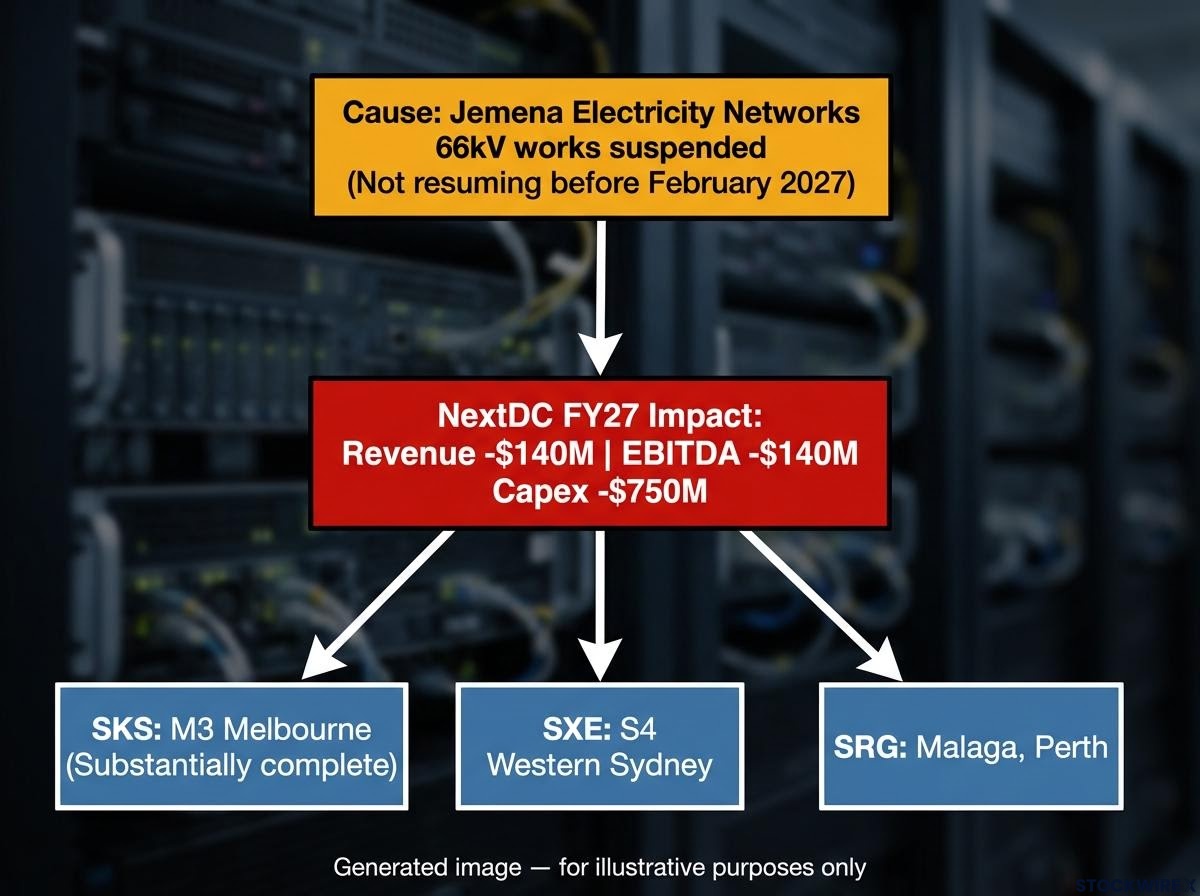
NextDC’s cut was large. Jemena Electricity Networks suspended parts of its 66kV network works in September amid community opposition, safety concerns and unresolved approvals, and they are not expected to resume before February 2027. The next grid supply increase at M3 shifts into FY28.
| Measure | Previous | Revised | Change |
|---|---|---|---|
| Net revenue | $615-640M | $475-500M | About $140M removed |
| Underlying EBITDA | $385-410M | $245-265M | About $140M removed |
| Capex | $5.25-5.75B | $4.5-5.0B | -$750M |
EBITDA is earnings before interest, tax, depreciation and amortisation, a rough gauge of operating profit. The contracts were removed because NextDC could not reliably estimate when power, delivery and billing would happen, not because customers walked away.
Who is exposed, and how
That makes the channel to contractors a timing question. What matters is where each contractor’s work sits.
| Contractor | NextDC-linked project | Stage or exposure | Direct FY27 risk |
|---|---|---|---|
| SKS | M3 Melbourne (within $60M of new contracts) | Substantially complete; no other material NextDC work | Limited; guidance reaffirmed 23 Oct 2026 |
| SXE | S4 Western Sydney (within $150M of awards, 15 June 2026) | Different campus from M3 | Mainly sentiment and tender timing |
| SRG | Malaga, Perth (within $850M contract, June 2025) | Different campus from M3 | Mainly sentiment and tender timing |
| NRW, GNP, SSM | No verified contract located | Indirect | Sentiment only |
The company most closely linked to M3 is the one least affected, because its work is already done. When you assess a contractor, check which campus, which project stage and which customer sit behind its backlog. That decides the earnings exposure, not the sector label.
What is supply-chain timing risk, and why can it move earnings with demand intact?
Picture a finished office tower that cannot open because the power company has not connected it. The tenants still want the space. Nobody can move in, and nobody pays rent yet.
Contractors face the same problem. They typically earn revenue through progress claims, which are invoices for work completed at set stages, and many contracts tie later payments to milestones:
- Contract signed and added to backlog
- Physical build
- Energisation, when the site is connected to grid power
- Commissioning, when systems are tested and handed over
- Billing and revenue recognition
Backlog, or order book, is the value of work contracted but not yet performed. It is a promise of future revenue, and its timing depends on site readiness, power and approvals. NextDC is still building M3’s data halls, but the dependent capacity will be delivered and billed later.
Key idea Timing can shift earnings even with demand intact.
For a contractor working at a delayed stage, that can mean slower progress claims, deferred revenue and slower backlog conversion. Power, approvals and transformers can become the binding limit even when customers want the capacity.
Power and planning approvals are the binding constraints on Australian data centre growth, and with a forecast supply gap of 0.7-1.7 GW by 2028, execution on grid connections will shape who earns the economic rents.
Scale makes this matter. GenusPlus reports an order book of about $2.2bn, and SXE expects data centre revenue of about $120M to triple in FY27. A headline backlog tells you what is contracted, not when it will be earned, so your timing assumptions deserve as much scrutiny as the dollar total.
Do FY27 guidance numbers justify the pullback as a buying opportunity?
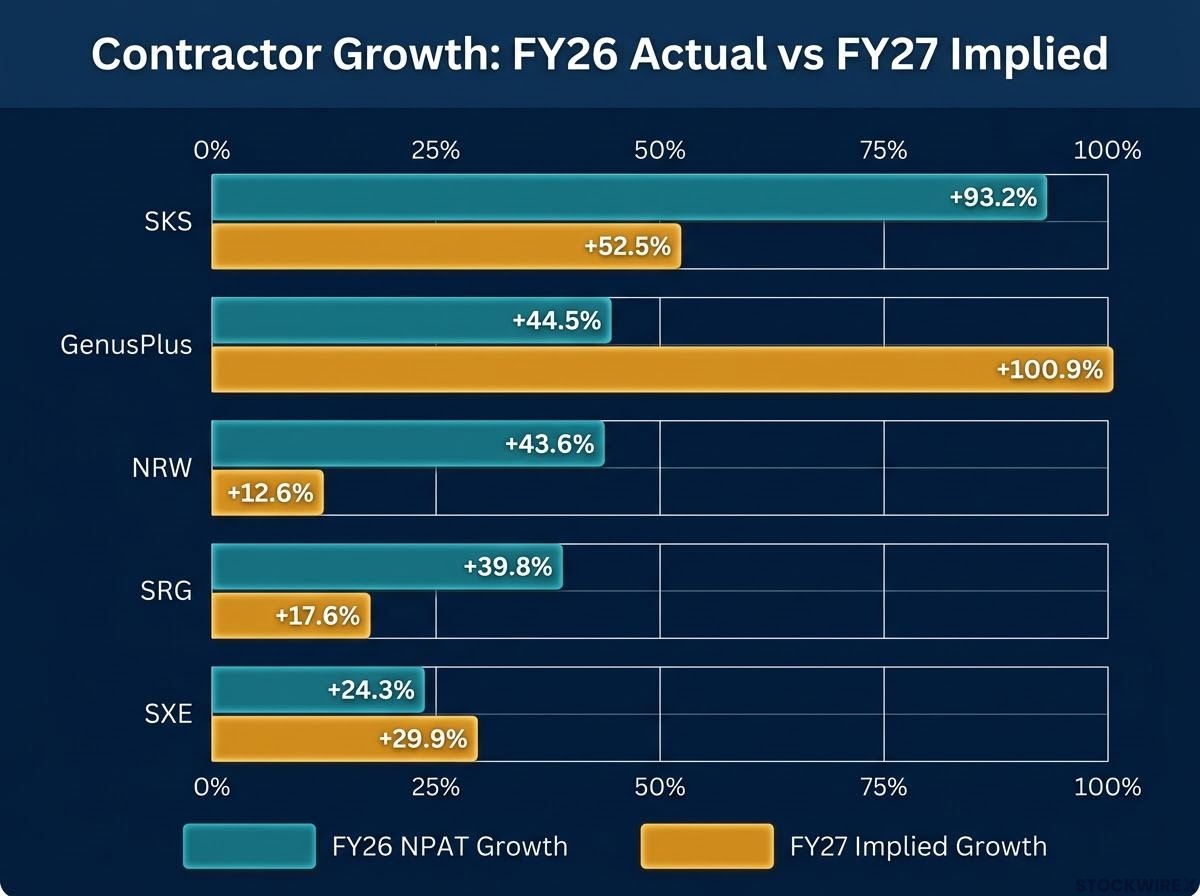
Against all of this, guidance from the August reporting season still points sharply higher.
| Company | FY26 actual (metric) | FY27 guidance | Implied growth | NextDC exposure |
|---|---|---|---|---|
| GenusPlus | EBITDA $100.8M | $200-205M | +100.9% | None verified |
| SKS | PBT $39.35M | About $60M (revenue about $500M) | +52.5% | M3, substantially complete |
| SXE | Underlying EBITDA $77M | At least $100M | +29.9% | S4 |
| SRG | EBITDA $170.1M | $195-205M | +17.6% | Malaga |
| NRW | Underlying EBITA $288.6M | $320-330M | +12.6% | None verified |
| Service Stream | NPAT growth 18.4% | Not located | n/a | None verified |
PBT is profit before tax; EBITA excludes interest, tax and amortisation. Among wider peers, GNG implies 69.8% growth and TEA 76.4%.
The case for a buying opportunity
If the buildout holds, a 20-30% fall is a discount on businesses guiding to 13% to 100% growth. SXE’s data centre revenue is expected to triple, and GenusPlus also draws growth from its Railtrain and MPK businesses. SKS traded at $6.89 in the 14 October table, still 71.8% up for the year; SXE was $4.55, up 81.2%.
The case for a valuation reset
No contractor has revised guidance since the October events, but unchanged guidance proves management confidence, not that the market’s funding and timing doubts are resolved. Current P/E figures beyond SKS were not located, so you cannot yet confirm how cheap the others have become. No quantified Australian contractor de-rating precedent was found either; the clearest evidence is SKS’s own multiple expansion.
Investors weighing the bear case will find our full explainer on data centre oversupply risk, which tests how a $150 billion construction wave could pressure pricing even if AI demand holds.
Risks that cut across both
- AI-capex sustainability, tested by CoreWeave’s debt load
- Credit and financing stress, even with large backlogs
- Customer concentration and disclosure gaps
- Margin pressure from aggressive bidding and cost overruns
- Power and grid constraints, as M3 shows
Past performance does not guarantee future results. Guidance figures are company forecasts and remain subject to market conditions and execution risk.
Weighing the reset against the opportunity: what to check before the next guidance update
The evidence points to a repricing of multiples, financing and timing risk, not a confirmed demand collapse. NextDC’s M3 problem removed about $140M from its own FY27 revenue and EBITDA, yet SKS reaffirmed guidance and no peer has cut.
The signals that would shift the balance:
- Contractor guidance updates, especially any downgrade
- Evidence the share prices have stabilised
- Jemena’s works resuming, not expected before February 2027
- AirTrunk reopening its IPO window in early 2027
- CoreWeave’s credit spreads easing or widening
Kerry Sun at Market Index suggests waiting for signs of a bottom, warning valuations could fall further. Let those events, not the price chart, decide which reading you act on.
This article is for informational purposes only and should not be considered financial advice. Investors should conduct their own research and consult with financial professionals before making investment decisions.