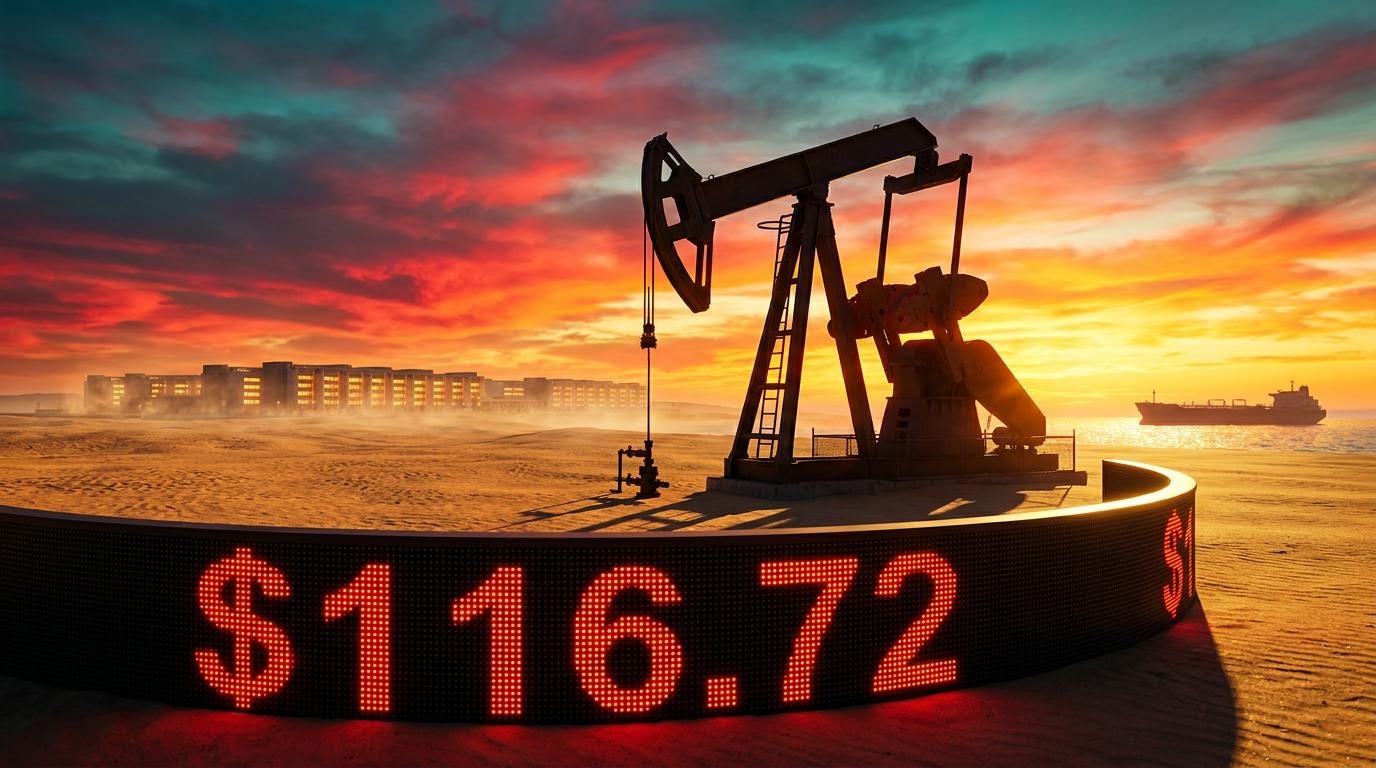
Tech’s Friday bounce did not survive the closing bell. The Nasdaq Composite ended down 0.2% at 25,955.34 after trading higher at midday, the Dow Jones Industrial Average fell 1.2% to 52,215.16, and Brent crude settled near $116.72 a barrel, its highest level since June 2022.
The fade came a day after doubts about financing the AI buildout knocked the Nasdaq down 2.6% on Thursday, its worst session since June. Those AI stocks selloff worries are now running into an oil shock and a Federal Reserve that markets expect to raise rates again in December.
Treat those as three separate headlines and you risk missing how each one feeds the others, and how together they lean on the same pressure point in your tech holdings.
Here is how the cost of capital, crude oil and the Fed connect, and which signals will show whether the squeeze is easing or tightening.
Why did the Friday rebound fade while the Dow slid?
At 12:09 ET, Friday looked like a repair job. The Nasdaq was up 0.27% at 26,079.72, the S&P 500 was off just 0.13% at 7,653.46, and the Dow was down 0.93% at 52,375.52, dragged by oil and fears of wider conflict in the Middle East.
The afternoon took that apart.
Tech gave back its gains and slipped into the red, while selling in economically sensitive Dow stocks deepened. By the close, all three major indices had fallen, and the week’s tally showed Thursday’s damage still largely in place.
| Index | Friday close | Friday move | Weekly move |
|---|---|---|---|
| Dow Jones Industrial Average | 52,215.16 | -652.82 points (-1.2%) | +0.4% |
| S&P 500 | 7,623.68 | -39.75 points (-0.5%) | -0.5% |
| Nasdaq Composite | 25,955.34 | -53.52 points (-0.2%) | -0.7% |
Thursday’s session set the tone. The S&P 500 fell 1.2%, and Meta Platforms dropped about 7%, its biggest one-day fall since July. Friday’s split was only relative: tech stabilised, but it did not recover.
A rebound that cannot hold through the close tells you buyers are not yet ready to call Thursday an overreaction. One up-tick in tech is not the all-clear.
When big ASX news breaks, our subscribers know first
How does scarce AI capital turn into dilution risk at Meta?
Meta’s share structure
The sharpest single trigger came from Meta. The company plans to create publicly traded Class C shares that carry no voting rights, distributing one for every existing Class A and Class B share, effectively a two-for-one split.
Meta has said the new shares could be used to raise capital, pay employees, fund acquisitions and partly finance its AI ambitions. Because the new class carries no votes, CEO Mark Zuckerberg keeps control while gaining a fresh way to issue equity.
Investors read it as a dilution warning. Dilution means new shares spread the company’s earnings across more owners, shrinking each existing holder’s slice.
The timing sharpened that reading. Meta’s third-quarter revenue rose 26% to $64.6 billion, and diluted earnings per share were $3.83, or $7.40 excluding a $9.89 billion legal-settlement charge. Yet the company also reported its first cash outflow in more than a decade as AI infrastructure spending climbed, with higher borrowing costs expected.
Meta’s negative free cash flow of $2.12 billion in the third quarter, against a positive $10.63 billion a year earlier, is the clearest sign that the market now asks who pays for AI before it pays back.
The wider financing squeeze
Meta’s move fits a broader strain. Nvidia CEO Jensen Huang has framed the problem bluntly.
Jensen Huang, Nvidia CEO (via CNBC) Capital is scarce for the AI buildout, and demand for it exceeds the supply available.
Yardeni Research calls it an emerging “AI credit crunch”, driven by four mechanisms:
- Major AI infrastructure companies have shifted from abundant free cash flow toward negative free cash flow
- Debt and outside capital increasingly fill that gap
- Higher borrowing costs raise the return needed to justify each investment
- Tighter financing could expose projects whose revenue does not cover their cost of capital
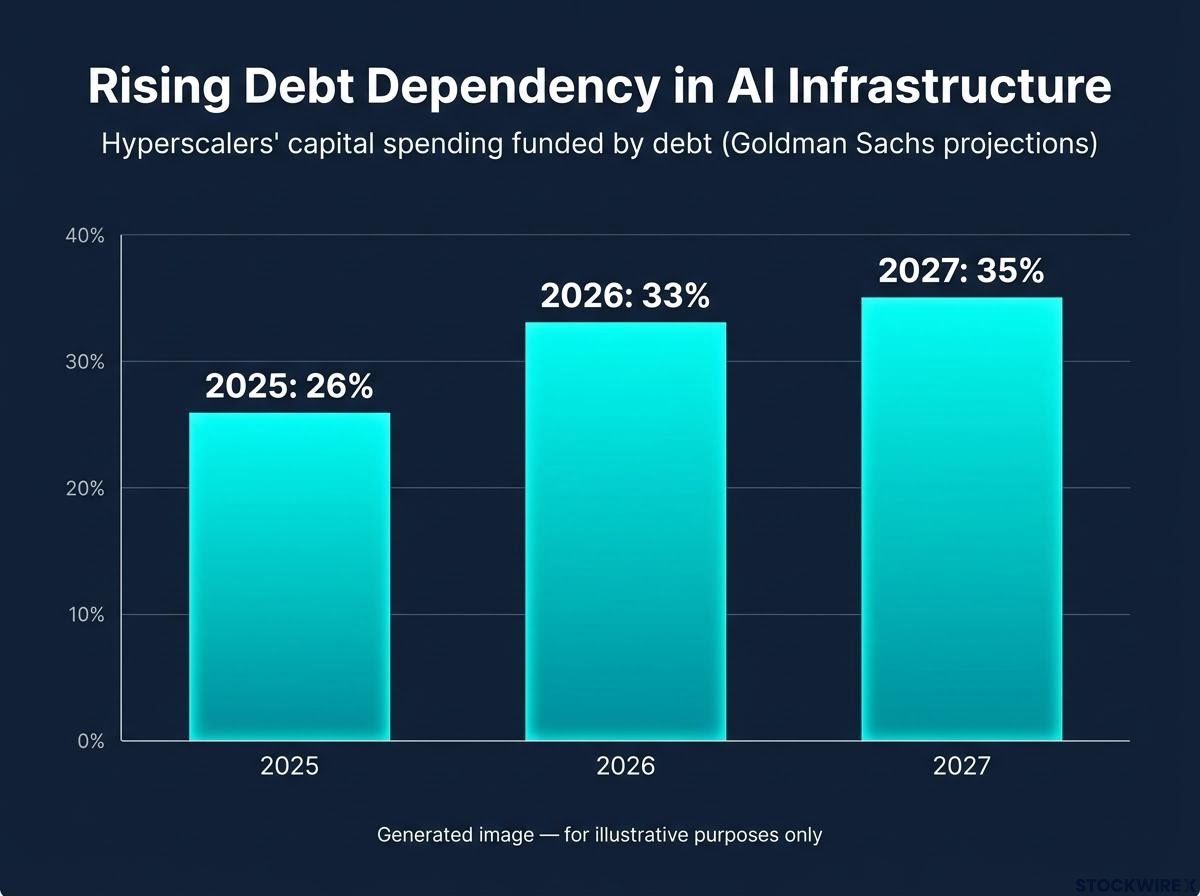
Citing Goldman Sachs, Yardeni noted hyperscalers (the largest cloud operators) funded about 26% of capital spending with debt in 2025, a share expected to reach about 33% in 2026 and 35% by 2027. Yardeni also argues the tightening could prove healthy, trimming over-investment while the strongest firms keep access to funding. Vital Knowledge sees room for a short-term bounce but a lasting era of less accommodating capital markets.
If the biggest AI spenders need outside money, existing shareholders may be the ones who pay for it.
Oil at $116, yields near 5% and a Fed that may not be done
The financing squeeze has a macro engine, and it starts with crude.
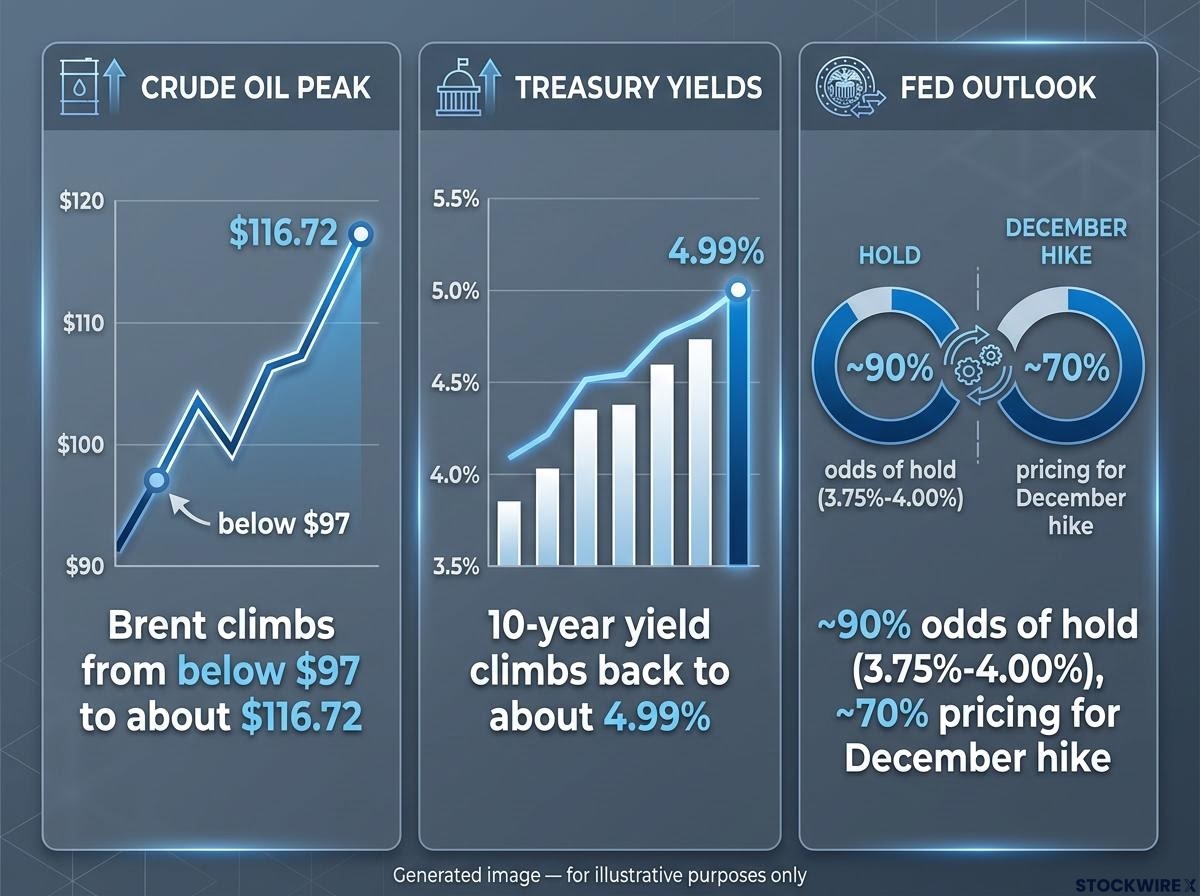
- Oil rises. Brent climbed from below $97 at the start of October to about $116.72, up 3.1% on Friday, according to the Associated Press. Saxo Bank pointed to attacks on Saudi infrastructure, alongside the Iran-related conflict, while MFS said Gulf shipping costs have risen roughly sevenfold.
- Inflation fears lift yields. Higher Treasury yields raise the cost of capital, so every new data centre must clear a higher return.
- Credit spreads widen. A credit spread is the extra interest a company pays over government debt, and wider spreads make borrowing dearer for hyperscalers.
- Equity becomes the alternative. Firms that want to avoid debt costs can issue shares instead, which brings dilution.
Treasuries have been pulled both ways. Thursday’s flight to safety cut the 10-year yield by about 19 basis points to 4.95%, its largest one-day decline since March 2023. On Friday it climbed back to about 4.99% from 4.96%, while the two-year traded near 4.67%.
The scale behind that shift is large: the five biggest hyperscalers are on pace to spend over $1 trillion on infrastructure, an AI bond market problem that pushes Treasury yields toward 5% as reserves are converted into data centres.
France added pressure. BlackRock said the French government-bond selloff shows how country-specific fiscal weakness can amplify wider market stress.
The Fed’s December problem
The Fed raised rates in September for the first time since 2023. CME FedWatch shows about 90% odds of a hold at next week’s meeting, keeping the target range at 3.75%-4.00%, but roughly 70% pricing for a December hike. TD Securities expects the same pattern: a pause, not an end to tightening.
Bank of America strategists led by Michael Hartnett warn that hyperscaler spreads above roughly 200 basis points could trigger broader deleveraging. They say relief would likely require one of the following:
- A geopolitical development that lowers oil prices
- Stabilisation in French government bonds
- A meaningful cut in AI capital spending
That is the key link for your portfolio: oil and the Fed reach AI stocks through financing costs, not just petrol prices.
What does Western Digital’s reaction say about AI winners?
By any normal measure, Western Digital delivered. Its fiscal first quarter of 2027, reported on 22 October, showed AI storage demand running hot.
| Metric | Result |
|---|---|
| Revenue | $4.381B (+55% YoY) |
| GAAP diluted EPS | $4.63 |
| Non-GAAP diluted EPS | $4.64 |
| Fiscal Q2 non-GAAP revenue guidance | About $5.1B (±$100M) |
| Fiscal Q2 EPS guidance | $5.80 (±$0.20) |
The shares fell anyway. Investing.com reported a drop of more than 1% in early Friday trading, while another market report put the regular-session fall at about 6.4%, with a further 4.9% after hours. The gap likely reflects different measurement points.
The reasons for selling into a beat included:
- Shares had already gained more than 86% year to date
- Strong results were not enough without accelerating growth or margins
- Storage firms face capacity cycles and the risk of eventual overbuilding
- Higher rates reduce the value of long-duration growth stocks
Real AI earnings are no longer enough on their own. Memory and storage names benefit from the buildout, but that does not make them automatically safe holdings.
What the AI stocks selloff changes, and what it does not
AI demand and earnings remain strong. What changed this week is that the cost and availability of capital now decide who benefits.
Signs the squeeze is easing would include falling Brent, stable French bonds, hyperscaler spreads holding below about 200 basis points and a softer December outlook after next week’s Fed meeting. Further equity issuance or widening spreads would point the other way.
Whether this is the healthy reset Yardeni describes or the deleveraging risk Bank of America flags remains unresolved. These statements are speculative and subject to change based on market developments and company performance.
Investors exploring how debt markets view these names will find our deep-dive into Big Tech credit risk, which details the roughly $1.1 trillion of off-balance-sheet lease obligations.
This article is for informational purposes only and should not be considered financial advice. Investors should conduct their own research and consult with financial professionals before making investment decisions.