
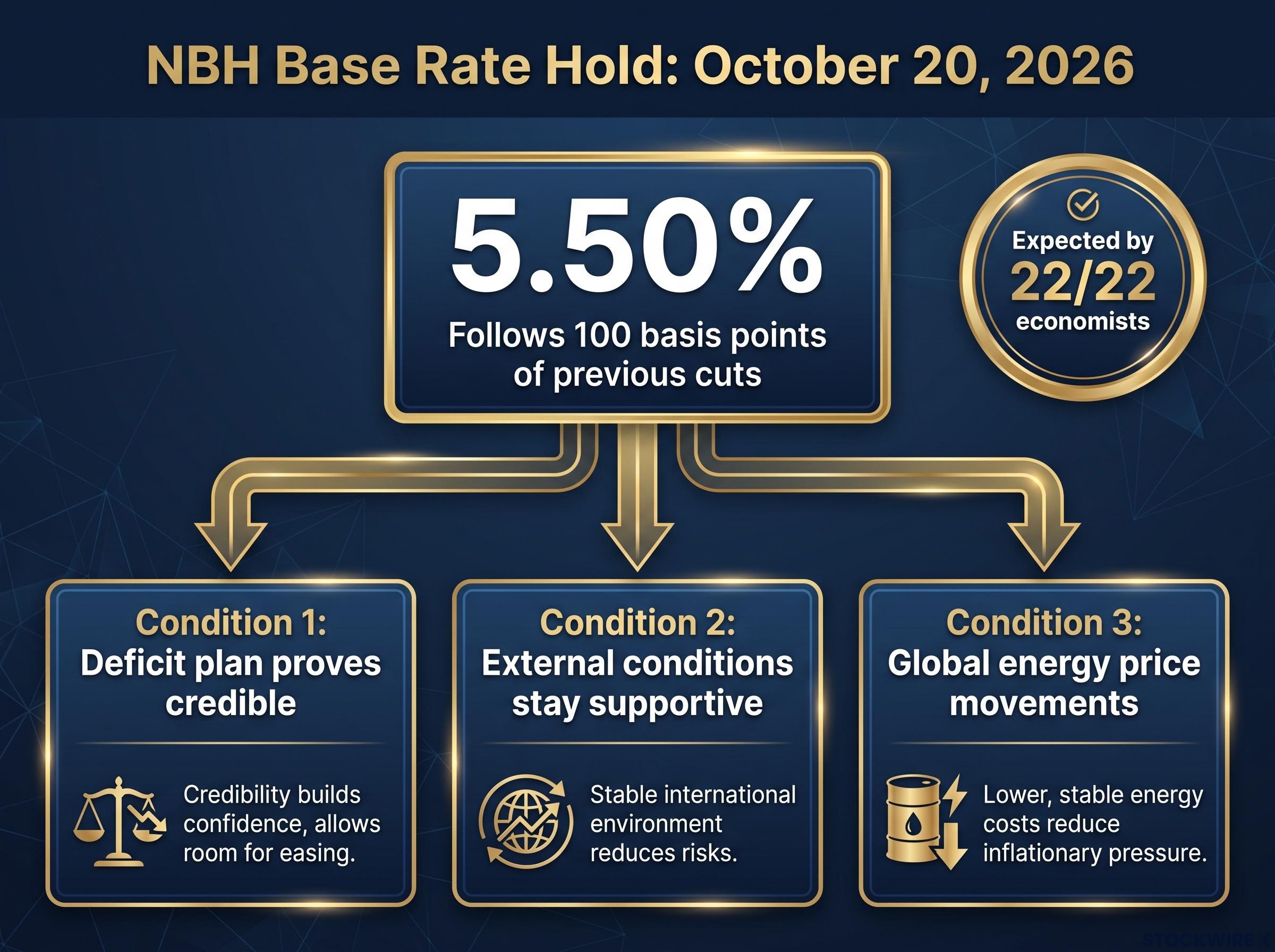
The National Bank of Hungary (NBH) held its base rate at 5.50% on 20 October 2026. The decision came a day after the government released a 2027 budget targeting a deficit of 4.9% of GDP, down from an estimated 7.5% this year. ING says markets had already priced in much of that good news.
That leaves holders of forint assets with an awkward tension. A fiscal plan broadly in line with forecasts has arrived, yet the trades built in anticipation of it are crowded. When everyone is already positioned for good news, confirmation can trigger selling rather than gains.
Reuters described the target as a major credibility test for Prime Minister Péter Magyar‘s government. The longer-term goal is a deficit below 3% by 2030, tied to its euro-adoption ambitions.
Here is what the budget, the rate hold and ING’s positioning call mean for your forint and Hungarian bond exposure.
Why did the NBH hold at 5.50% after the budget landed?
The decision surprised no one. Bloomberg reported that all 22 economists it surveyed expected no change, and the outcome matched ING’s call that the central bank would “play it safe” while it assessed the budget and the market reaction.
The hold was a deliberate pause, not a loss of appetite for easing. The NBH had said that seeing the fiscal plan was a precondition for further cuts, and ING judged more cuts premature until that plan proves credible. The IMF has said the rate, after 100 basis points of cuts to 5.50%, is close to neutral. A neutral rate is one that neither stimulates nor restrains the economy.
The NBH’s cautious stance also reflects its lower inflation target of 2.5% from 2028, set while the bank forecasts 2027 inflation near 3.1%, which narrows the room for easing even if the budget delivers.
The door remains open, however.
Year-end cut still possible MNB vice-president Zoltán Kurali said another cut could come before year-end if external conditions are favourable and the government delivers a credible deficit-reduction plan consistent with its euro objective.
The NBH is weighing three conditions:
- Whether the deficit plan proves credible in its detail and delivery
- Whether external conditions stay supportive
- Where global energy prices move, which ING flagged as a constraint on any easing guidance
A hold paired with a conditional opening tells you the next move depends on budget delivery and energy prices. If you are positioned for lower Hungarian rates, those bets are not yet imminent.
When big ASX news breaks, our subscribers know first
Is the good news already in the price? ING on crowded HUF positioning
The budget delivered, and the market barely moved. ING notes that EUR/HUF briefly hit new lows after the release but closed the day roughly flat.
ING’s Frantisek Taborsky points to two crowded trades: long-end Hungarian government bonds and long Hungarian 5y5y swaps against the euro. A 5y5y swap is a five-year interest-rate swap starting five years from now, so it reflects where investors expect policy rates to sit further into the future.
| Indicator | Level or move | Source and date |
|---|---|---|
| EUR/HUF | 362.600, up 0.340% | TradingKey, 20 October 2026 |
| Long-end bonds and 5y5y EUR swaps | At or near lows | ING, 15 October 2026 |
| Regional 10-year yields | Rose marginally on release day | FXStreet, 20 October 2026 |
The mechanism behind ING’s caution runs in three steps:
- Investors bought Hungarian duration and forint exposure ahead of the consolidation, compressing risk premiums and yields.
- The 4.9% target confirmed what was expected, so it added little new information.
- Profit-taking could follow, with bond sales lifting yields and lower forint exposure weakening the currency.
The risk extends beyond Hungary. The trade forms part of a wider Central and Eastern European (CEE) convergence bet, so an unwind could spill over to regional peers even if Hungary’s fundamentals keep improving. Profit-taking has already lifted yields at times, leaving Hungary lagging other CEE markets.
Because the convergence trade spans the region, the broader CEE currency outlook matters here: US yields near 5% and TTF gas at three-year highs could hit the koruna and zloty alongside the forint.
ING expects a possibly larger correction “sooner or later” but remains structurally bullish. If you hold or are considering Hungarian duration, entry timing and position size matter more right now than the fiscal direction, which ING still sees as positive.
How Hungary plans to cut the deficit from 7.5% to 4.9%
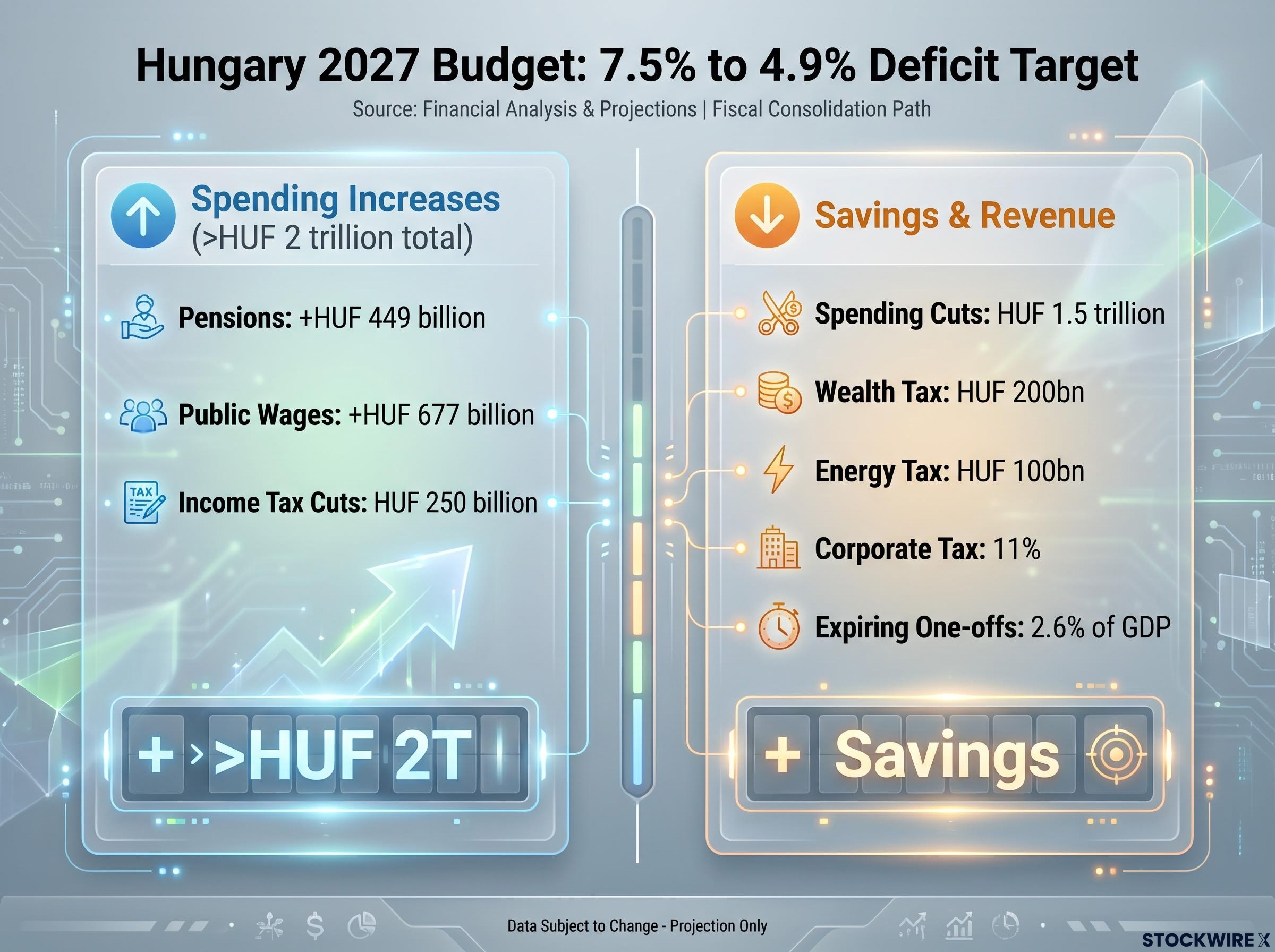
The government lists four levers: trimming wasteful spending, lowering interest costs, unwinding pre-election spending and adding new taxes. The arithmetic shows where the target has support and where it relies on execution. The 4.9% goal also sits below the Reuters poll median of 5.3%.
Where the money goes
The budget carries more than HUF 2 trillion in new spending, according to Reuters. Pensions rise by HUF 449 billion and public-sector wages by HUF 677 billion, while the family allowance is doubled.
Tax relief adds to the bill. Xinhua reported that personal income tax on the minimum wage falls from 15% to 9%, and broader income-tax cuts covering more than 2 million people cost about HUF 250 billion.
Where the savings come from
Against that spending, the government identifies about HUF 1.5 trillion in cuts, alongside procurement reform and changes to tax exemptions. New revenue fills more of the gap.
| Measure | Figure | Direction | Source |
|---|---|---|---|
| Wealth tax (1% above HUF 1bn, 1.5% above HUF 100bn) | HUF 200bn | Revenue | Reuters |
| Energy-company taxation | HUF 100bn extra | Revenue | Reuters |
| Corporate tax, turnover above €500m | Up 2 points to 11% | Revenue | Reuters |
| Expiring one-off spending | About 2.6% of GDP | Saving | OTP |
That last line does much of the work. OTP Global Markets estimates that roughly 2.6% of GDP in one-off spending drops out in 2027, which covers a large share of the gap between 7.5% and 4.9% without any new decisions. The government’s own growth and debt assumptions were not found in available reporting.
Because so much of the improvement comes from expiring one-offs, you can treat the target as more mechanically supported than the headline suggests. It still depends on the announced cuts being delivered.
Is 4.9% believable? Where forecasters disagree
ING calls the target ambitious but achievable, while warning that it is “by no means automatic”. Other forecasters sit higher.
| Forecaster | 2027 deficit | Basis |
|---|---|---|
| Government | 4.9% | Budget target |
| OTP Bank | About 5.2% | One-offs expiring offset new tax exemptions |
| Reuters poll | 5.3% | Analyst median |
| European Commission (reported) | 5.8% | Spring 2026, pre-budget policies |
| Fitch (reported) | 5.8% | Rating agency projection |
The Commission’s spring forecast reportedly puts the 2026 deficit at 6.2% and debt at 76.8% of GDP by end-2027. Fitch is reported to see 7.3% this year and debt of 76.2%. These figures have not been independently confirmed, and no S&P Global or Moody’s assessment of the target was found.
The IMF reportedly supports consolidation if it is credible, detailed, front-loaded and growth-friendly. The forecasters agree on the direction; the dispute is over execution and timing.
The IMF deficit warning, which framed euro adoption as a medium-term reform anchor and not a shortcut for the forint, explains why the 4.9% target is being tested against much higher external estimates.
Key risks include:
- Delivering large cuts alongside pension, wage and tax commitments
- Growth drag if public demand and investment fall quickly
- Inflation from wage pressure, reportedly flagged by the IMF
- Energy-price volatility limiting NBH room to cut
The spread between 4.9% and 5.8% is the gap to watch. Data trending toward the lower end strengthens the case for tighter risk premiums, while a drift toward the upper end leaves crowded positions more exposed.
These projections are forward-looking and subject to change based on market and policy developments. Past performance does not guarantee future results.
What the budget changes for HUF assets, and what it does not
The fiscal direction has improved, positioning remains stretched, and the NBH is waiting for proof before it eases again. Those three facts can pull your returns in different directions over the next few months.
Three variables matter most:
- The detail and delivery of the announced spending cuts
- Global energy prices and their effect on NBH room
- Signs of profit-taking in long-end bonds and 5y5y swaps
ING expects a correction yet stays structurally bullish. That points to a decision about timing rather than direction: whether to hold through a possible shakeout or wait for better entry levels.
This article is for informational purposes only and should not be considered financial advice. Investors should conduct their own research and consult with financial professionals before making investment decisions.