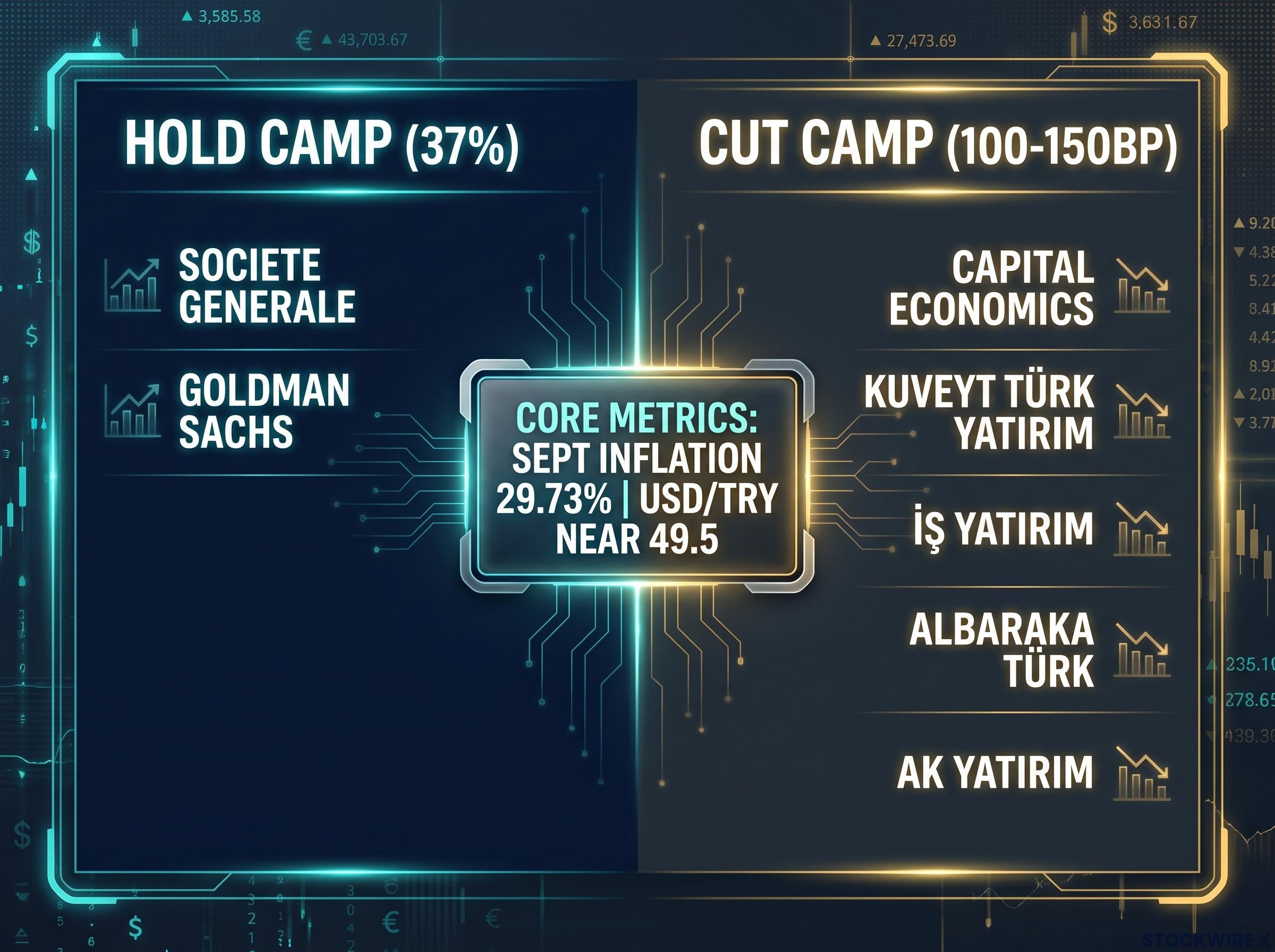
Most forecasters expect Turkey’s central bank to cut its policy rate from 37% to 36% on Thursday, yet Societe Generale and Goldman Sachs both expect a hold. Both camps agree that inflation improved: September consumer prices rose 29.73%, below the 30.3% forecast. They disagree on whether easing is safe while the lira trades near 49.5 per dollar.
That disagreement is the signal worth watching ahead of the Turkey central bank rate decision. The 22 October meeting is the first since MSCI froze selected changes to Turkish indexes on 15 October.
The timing matters. A single rate move now affects the currency, the country’s reserves and foreign access to Turkish equities at the same time.
Read this decision as a test of the lira and of the central bank’s credibility, not just as a number. Here is a framework for weighing the outcome, the logic behind each camp’s call, and the signals that should shape your view of Turkish assets.
Why are forecasters split between a hold at 37% and a cut to 36%?
The Central Bank of the Republic of Turkey (CBRT) held its one-week repo rate, its main policy rate, at 37% on 10 September. Annual inflation then fell from 31.51% in August to 29.73% in September. The CBRT Market Participants Survey, reported by Hürriyet Daily News on 16 October, puts the consensus at 36%.
The case for easing
The cut camp includes Capital Economics, Kuveyt Türk Yatırım, İş Yatırım, Albaraka Türk and Ak Yatırım. Their argument is straightforward. Underlying inflation is improving, domestic demand is weakening, and September’s figure came in below the Bloomberg consensus.
İş Yatırım estimates underlying monthly inflation at around 1.7%. Ak Yatırım goes further and suggests a cut of up to 150 basis points could be possible, subject to reserve and dollarisation constraints.
The case for caution
The hold camp reads the same data differently. Disinflation is moving slowly. Expectations remain stubbornly high, with year-end inflation seen at 29.63% and the 12-month-ahead figure at 23.89%, while the lira sits at record lows and reserves have fallen.
The hold camp’s caution is easier to understand once you recognise that the CBRT already delivered 300bp of effective easing in January through liquidity normalisation, so five straight holds reflect credibility management rather than inaction.
Goldman Sachs, 7 October: The bank said a cut remains possible, but the gap between market pricing and its own forecast is unusually large.
| Institution | Call | Core reasoning |
|---|---|---|
| Societe Generale | Hold at 37% | Slow disinflation, sticky expectations |
| Goldman Sachs | Hold at 37% | Too early for a new easing cycle |
| Capital Economics | 100bp cut | Cuts expected to begin in October |
| Kuveyt Türk Yatırım | 100bp cut | Improving underlying inflation; 200bp by year-end |
| İş Yatırım | 100bp cut | Underlying inflation near 1.7%, weak demand |
| Albaraka Türk | 100bp cut | Improving inflation, weak demand |
| Ak Yatırım | Up to 150bp | Outlook may permit more, subject to reserves |
A split this wide tells you the market has already priced in a cut. A hold would therefore be a genuine surprise, so treat the outcome as a risk event rather than a formality.
When big ASX news breaks, our subscribers know first
Why is the governor tolerating a record-low lira?
The hold camp’s worry about the lira raises an obvious question: why has the central bank let it fall? According to Bloomberg, Governor Fatih Karahan told investors in Bangkok on 14 October that the slide is deliberate, intended to head off a larger depreciation later. USD/TRY traded near 49.5 on 19 October, after an intraday record of about 49.35 on 8 October.
Karahan’s reasoning rests on four points:
- A controlled adjustment now may prevent a disorderly devaluation later.
- Exchange-rate pass-through to inflation has weakened.
- A weaker currency supports competitiveness and exports.
- Weak demand limits how much depreciation feeds into consumer prices.
Real exchange rates and pass-through, simply explained
The real exchange rate is a currency’s value after adjusting for differences in inflation between countries. Pass-through is the share of a currency’s fall that shows up in domestic prices.
Here is a simple illustration. If Turkish prices rise 30% in a year but the lira falls only 20% against the dollar, Turkish goods become dearer for foreign buyers. The lira has strengthened in real terms even as it weakened on screen, so letting it slide faster protects exporters.
The catch is that this works only while expectations stay anchored. If households and businesses start expecting more inflation, pass-through rises and depreciation turns into faster price growth. The CBRT says policy works through demand, exchange-rate and expectations channels, and Anadolu Agency reported Karahan’s pledge to keep policy tight and tighten further if the outlook worsens.
Reading the three reserve figures
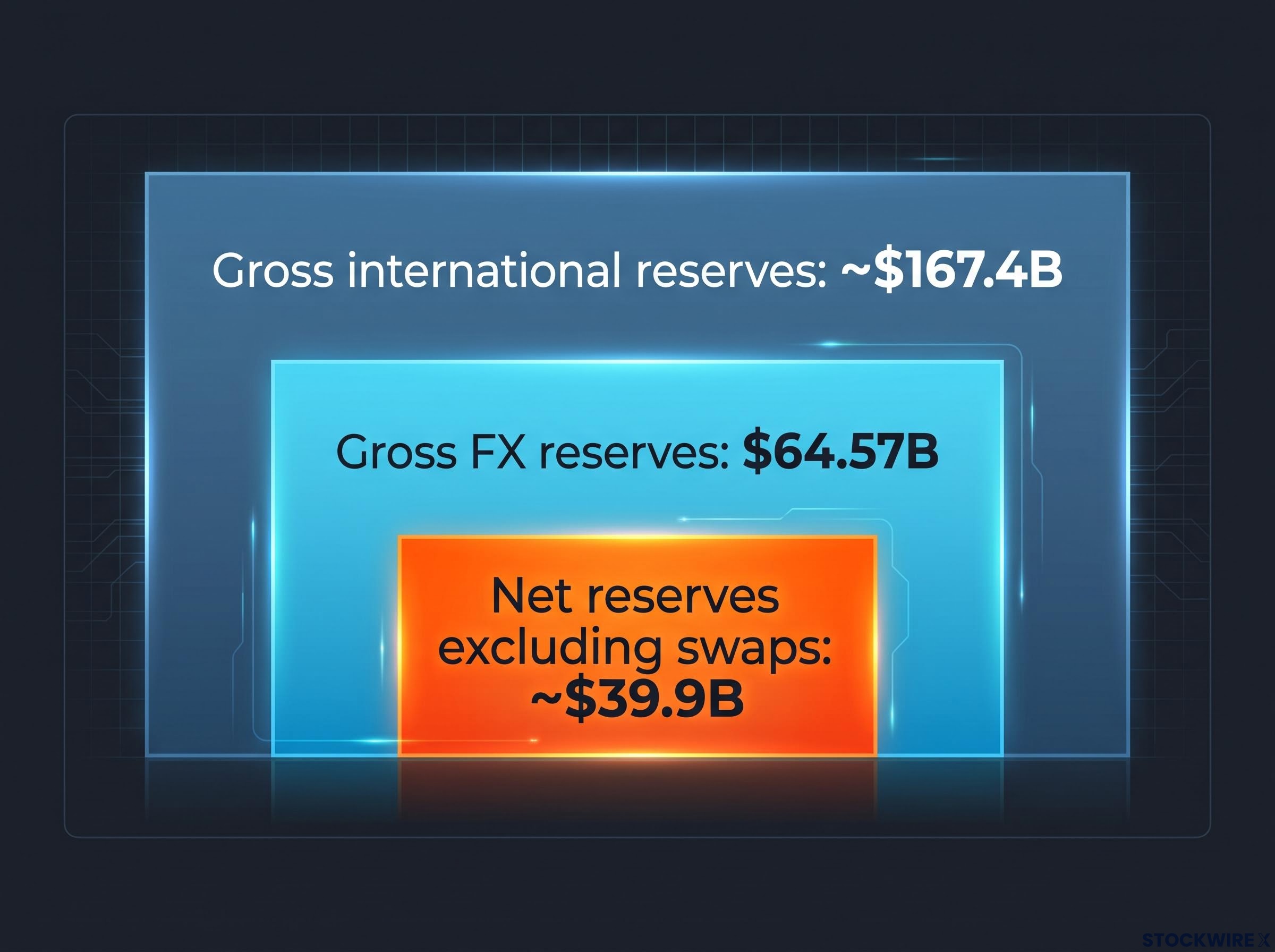
Reserves are the buffer behind this strategy, and three different figures circulate. They measure different things, so they do not contradict each other.
| Measure | What it includes | Figure |
|---|---|---|
| Gross international reserves | Broadest measure (week to 2 October) | ~$167.4B |
| Gross FX reserves | Foreign currency component (9 October) | $64.57B |
| Net reserves excluding swaps | Strips out swap arrangements (week to 25 September) | ~$39.9B |
The narrowest figure is the closest guide to firepower the central bank can actually use. For you as a holder of lira assets, this makes a cut more dangerous, because the currency strategy depends on credibility that easing could dent.
Research on emerging market currency stress suggests reserve buffers are among the strongest defences, with a one-standard-deviation rise in reserves cutting crisis probability by roughly 8%, which is why the net figure carries so much weight.
How does the MSCI freeze turn a rate call into an equity-access question?
On 15 October, MSCI froze selected changes to Turkish indexes until further notice. The move followed a crisis in Turkish investment funds and concerns about possible coordinated trading. MSCI flagged market integrity and transparency over free float (the share of a company’s stock available for public trading), not low prices.
The freeze covers:
- Increases in Foreign Inclusion Factors, the share of a stock’s value available to foreign investors
- Increases in share counts
- New additions to the MSCI Turkey Investable Market Index
- Upward moves between size segments
Markets reacted quickly. The BIST 100 closed at 11,721.72 on 16 October, down 2.89% that day and about 22.9% below its May record of 15,204.92.
Turkey remains an Emerging Market, though, and the freeze is a warning rather than a verdict.
The deadline to watch: If sufficient progress is not evident by June 2027, MSCI may consult on moving Turkey to Frontier or Standalone status.
Precedents show what reclassification can cost:
| Case | MSCI action | Relevance |
|---|---|---|
| Argentina, 2021 | Emerging to Standalone | Formally reduced benchmark integration |
| Pakistan, 2021 | Emerging to Frontier | Liquidity and investability can trigger moves |
| Russia, 2022 | Emerging to Standalone | Major dislocation when access broke down |
| Nigeria, 2024 | Frontier to Standalone | Repatriation problems drove the change |
The damage in these cases came through lower benchmark weights and fewer passive inflows, not overnight collapse. For an equity investor, Thursday’s decision matters less for corporate earnings than for whether passive foreign money keeps arriving.
MSCI’s free float concerns are not unique to Ankara: Indonesia’s standalone proposal this month triggered an 8% equity drop and a trading halt, showing how quickly index classification worries can hit local markets.
How could the 22 October decision ripple through rates, the lira and stocks?
Combine the rate, currency and index risks, and a chain of consequences comes into view:
- Lower rates reduce returns on lira assets.
- That raises incentives to switch into dollars or hedge.
- Lira weakness lifts inflation risk and prompts more reserve intervention.
- Reserve losses erode confidence.
- The fund crisis and MSCI freeze weaken equity inflows.
- Turkey then depends more on bond carry trades and short-term foreign capital.
Two scenarios
A 100bp cut could prove manageable if markets read it as a one-off and inflation and reserves stabilise. The danger lies in a cut read as the start of a broader easing cycle before credibility is restored, which would accelerate every link above. The CBRT also appears to be separating targeted liquidity support for funds from the headline rate, which gives it a way to ease stress without cutting.
Lessons from 2018 and 2021
Turkey has seen this chain run before. The 2018 lira crisis showed that tolerating depreciation works only while expectations and reserves hold. In 2021, large cuts amid high inflation produced a severe lira sell-off, an inflation surge and emergency measures.
Signposts to watch after the meeting:
- The reserve trend, especially the net measure
- USD/TRY relative to 49.5
- Language in post-meeting guidance about future cuts
- Any further MSCI communications
The rate number on Thursday matters less than the guidance that comes with it, so read the signalling before you reposition.
What the decision settles, and what stays open into 2027
Improving inflation supports a cut. The lira near 49.5, thinner usable reserves and MSCI’s freeze argue for care, and Thursday’s decision resolves only part of that tension.
The bigger tests come later: the CBRT meetings that follow and MSCI’s June 2027 progress deadline. A cut paired with firm guidance and stable reserves would ease the classification worry. A cut followed by lira weakness and further reserve losses would sharpen it.
Your decision point is the guidance language combined with the net reserve figure. If both hold steady, the cut camp’s view gains weight. If either slips, the caution camp’s warnings deserve priority in how you size Turkish exposure.
For readers holding EM funds, our detailed coverage of EM index methodology explains why two funds can own entirely different countries depending on the provider.
Past performance does not guarantee future results. Financial projections are subject to market conditions and various risk factors. Forward-looking statements are speculative and subject to change based on market developments.
This article is for informational purposes only and should not be considered financial advice. Investors should conduct their own research and consult with financial professionals before making investment decisions.