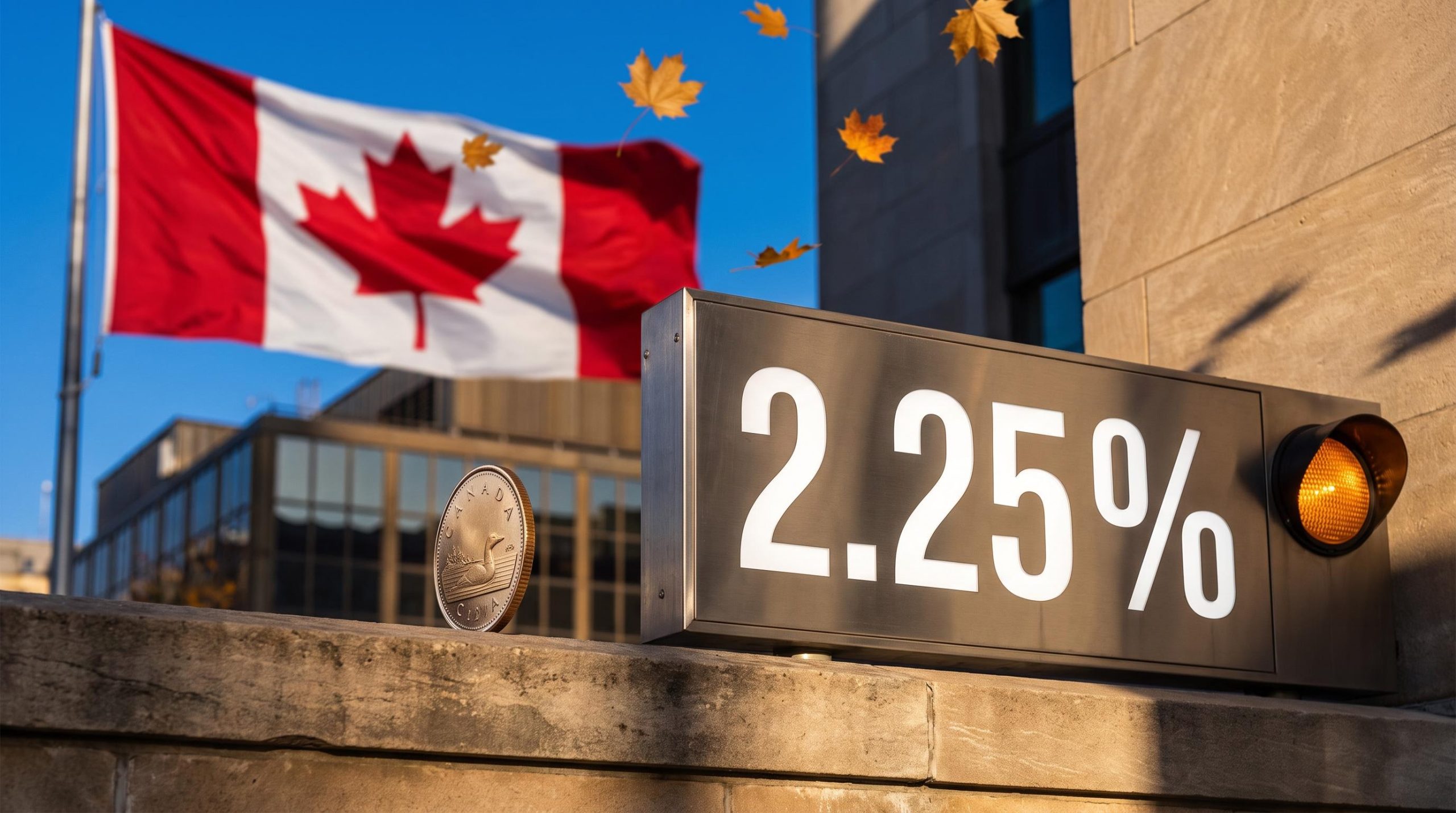
Canada has shed 110,000 jobs in two months, yet ING says a precautionary rate rise from the Bank of Canada in December remains a clear possibility. According to the bank, markets already price that December hike in full.
The timing matters. September’s consumer price index (CPI) and the Bank’s Q3 Business Outlook Survey both landed today, 19 October 2026, nine days before the 28 October rate decision and Monetary Policy Report.
Headline CPI reportedly rose to 3.2% year on year. The bigger question is what the Bank’s preferred core gauges showed.
After this, you will be able to judge two things: how likely a December move really is, and why a hike that is already fully priced may do little for the Canadian dollar.
Why would the Bank of Canada hike into a weakening economy?
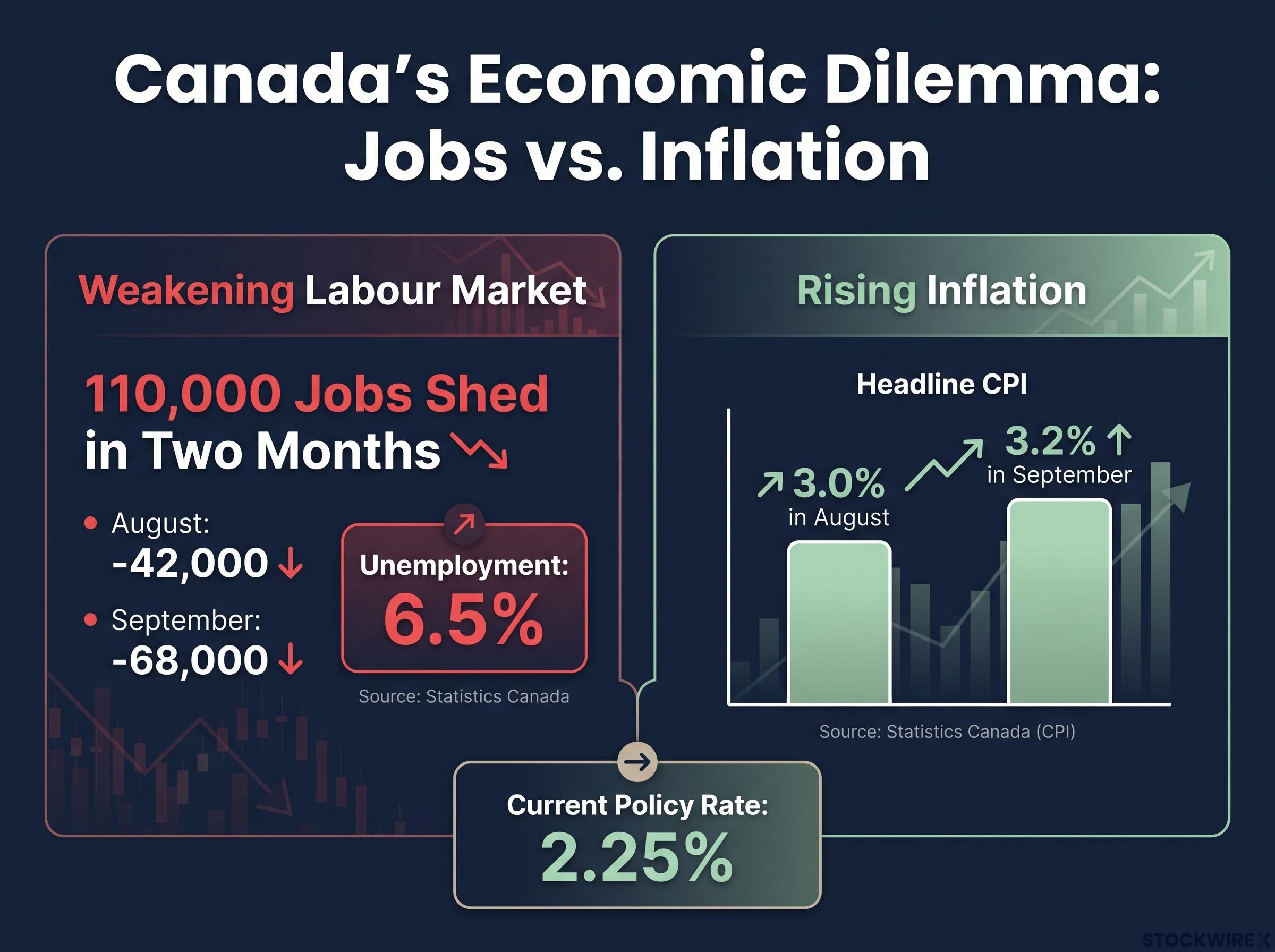
On paper, it looks backwards. Employment fell 42,000 in August and 68,000 in September, pushing unemployment to 6.5%, and the policy rate sits at 2.25%.
The logic only appears once you see the “insurance hike” idea. An insurance hike is a small, preventive rate increase used when a central bank judges that waiting for clearer inflation evidence costs more than slightly weaker demand.
Macklem’s warning in Halifax that waiting too long forces steeper and higher hikes is the clearest statement of the insurance logic, and it explains why the Bank cannot simply dismiss an energy-driven rise in headline CPI.
The case for acting
ING currency strategist Francesco Pesole points to resilient growth and a widening rate gap with the US Federal Reserve, even with subdued underlying inflation and a soft labour market. The broader insurance argument rests on four points:
- Anchoring expectations: stopping energy and tariff costs from embedding in wages and prices
- Second-round effects: limiting firms’ ability to pass on higher input costs
- Rate differential: a wider Canada-Fed gap can support the currency and curb imported inflation
- Policy room: a small, framed-as-limited move rather than a new tightening cycle
Headline CPI rose from 3.0% in August to a reported 3.2% in September. August’s CPI-median (2.0%) and CPI-trim (1.9%) sat near target; these measures strip out volatile price swings.
Here the sources split. ING’s pre-release note described core gauges as steady near 2.0%, while post-release reporting said CPI-trim and CPI-median came in higher than expected. Official core figures had not been confirmed at the time of writing.
The case for waiting
The cautious camp is not disputing that headline inflation rose. It is disputing whether the rise will last, given two straight months of job losses, trade pressure and a housing market sensitive to higher rates. If energy prices reverse, a hike could look unnecessary while its damage lingers.
| Institution | View on a hike | Reasoning |
|---|---|---|
| ING (Francesco Pesole) | December hike a clear possibility | Resilient growth, widening Fed gap |
| RBC Economics | No hike in 2026 | Trade uncertainty, energy, weak sentiment |
| TD Economics | Hold through 2026 | Weak employment, uncertainty |
| CIBC (Avery Shenfeld) | Little prospect of a move | Weak labour market, no clear inflation need |
| Scotiabank (Jean-François Perrault) | 50 bp of tightening in H2 to 2.75% | Inflation risks, return to neutral |
| Reuters-poll economists | Split: December hike to no move until 2027 | Rising inflation versus falling jobs |
That split tells you a December hike is a genuine judgement call on whether energy-driven inflation spreads. Treat any single forecast as one scenario, not the answer.
What do the October 28 meeting and the Business Outlook Survey signal?
The near term looks calm. Consensus expects the Bank to hold at 2.25% on 28 October, and ING says markets price just 9 basis points (bp) for the meeting, roughly 36% odds of a quarter-point move by simple arithmetic. Other coverage after the jobs data put the odds near 25% or lower.
ING on October pricing ING does not think markets are underpricing an October hike.
The Business Outlook Survey, built from interviews with about 100 firms representative of Canadian GDP, shows how businesses see hiring, pricing and inflation. RBC Economics expected energy and trade tensions to lift short-term inflation expectations, with medium and long-term views anchored near 2%. The exact readings are the item to check.
If that pattern holds, the Bank has room to wait. Only a drift in longer-term expectations would make December likely. On 28 October, watch:
- Statement tone on how persistent inflation looks
- Inflation and growth forecasts in the Monetary Policy Report
- Language on labour market slack
October’s real job, in other words, is setting up December.
If December is already priced in, what does the Canadian dollar do?
A rate hike may barely help the loonie.
How to read priced-in expectations
Market pricing works like a probability. When traders fully price a hike, yields and the currency have already adjusted, so prices move on the surprise relative to that pricing, not on the decision itself.
Historically the loonie has traded more on Canada-US rate differentials than on domestic headlines, which is why a hike that markets already hold in the price can leave the currency almost unmoved.
| Outcome vs pricing | BoC action | Likely CAD reaction |
|---|---|---|
| Matches | 25 bp hike as expected | Modest gain or a dip on profit-taking |
| Exceeds | Larger hike or hawkish guidance | CAD rises, USD/CAD falls |
| Misses | Hold or “one-off” signal | Sharper CAD decline |
What it means for USD/CAD
ING says markets fully price a 25 bp December hike, though reporting around 17 October showed no December change priced. That swing shows how volatile expectations have been.
ING forecast USD/CAD back at 1.420 by end of October and year-end, with little further downside and only marginal CAD support from a December hike.
The pair traded near 1.4298 on 9 October after the weak jobs data. ING’s upside risk for CAD is an unexpected October hike. A Fed cut alongside a Bank of Canada hike would widen the gap and help CAD; a hawkish Fed or higher US yields would blunt it.
For you as a CAD holder, importer or traveller, waiting for a December hike to lift the currency looks like a poor bet, because the move is largely in the price already.
Three signals that will decide whether December happens
The hike hinges on persistence, not headline CPI alone. Three signals will confirm or kill it: official core CPI readings, the next jobs report, and the Bank’s guidance on 28 October, read against the Fed’s path.
Firm core inflation and stabilising jobs strengthen the insurance case. Soft core figures and further losses weaken it. Either way, a December hike is plausible, contested and mostly priced, so the surprise, not the decision, will move markets.
This article is for informational purposes only and should not be considered financial advice. Investors should conduct their own research and consult with financial professionals before making investment decisions. Forecasts are speculative and subject to change based on market developments.