On Friday the S&P 500 dropped 1.1%, and the US dollar fell with it. That runs against one of the most trusted rules in markets: when stocks fall, nervous money usually rushes into dollars. This time the US Dollar Index (DXY), which measures the dollar against a basket of major currencies, slipped below 102 and kept sliding.
The trigger was a shrug from Federal Reserve Chair Kevin Warsh. Speaking in Bangkok on 16 October 2026, he declined to say what the Fed would do at its 27-28 October meeting. Markets had been leaning towards a rate hike, and that lean faded quickly.
Why the US dollar is falling matters well beyond currency traders. The same forces show up when you change money for a holiday, price imports for a business, rebalance a portfolio or decide whether gold still belongs in it.
Here is a working model for reading dollar moves, built on this week as the live example. You will come away knowing which questions to ask the next time a currency headline catches your eye.
Why did the dollar slip below 102 this week?
The slide did not start on Friday. It started on 2 October, when US employers reported adding only 29,000 jobs in September against the 90,000 economists expected, with earlier months revised lower.
Weak hiring weakened the case for an immediate rate hike. Then September inflation came in hotter than expected, and the odds of an October hike briefly jumped to about 50%, according to Axios. The market was being pulled in two directions at once.
Warsh was supposed to settle it. He did not.
“I don’t prejudge meetings. I don’t believe in saying now what I might do at the meetings we have in the balance of this year.” Kevin Warsh, Federal Reserve Chair, 16 October 2026
CME FedWatch, a tool that converts interest rate futures prices into meeting-by-meeting probabilities, showed about 72.3% odds of a hold and 27.7% odds of a hike on 16 October, per CNBC. A separate CNBC reading that morning put the hike chance at just 15%. The gap reflects how fast futures pricing moves within a single day.
Futures pricing can swing by tens of percentage points on a single speech, as happened in September when one Fed official’s remarks cut October hike odds from a 73% peak, so any single reading deserves caution.
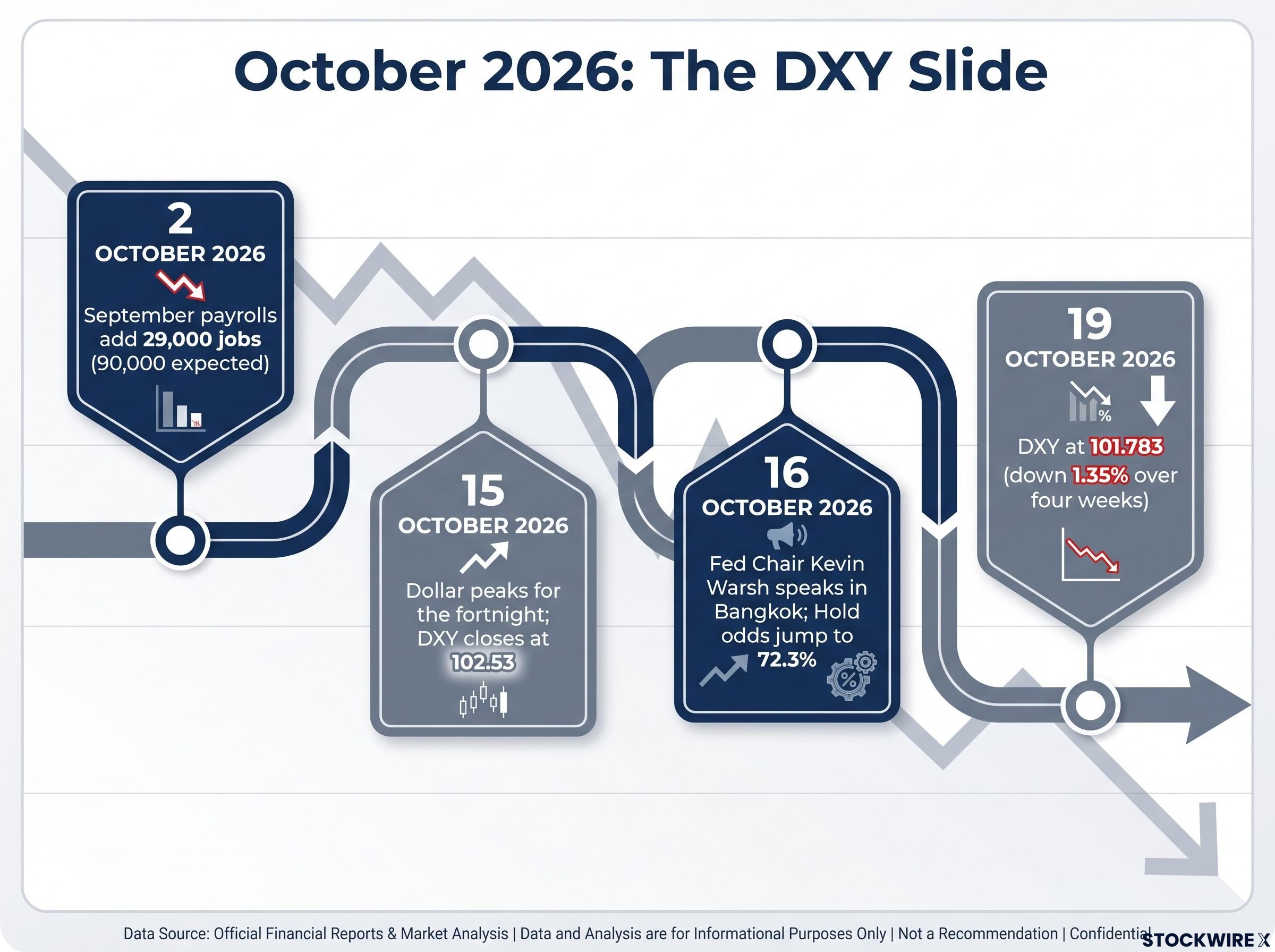
| Date | Event | DXY or hike-odds reading |
|---|---|---|
| 2 October 2026 | September payrolls: 29,000 jobs | Hike odds around one in four (Reuters) |
| 15 October 2026 | Dollar peaks for the fortnight | DXY near 103.00, closes 102.53 |
| 16 October 2026 | Warsh speaks in Bangkok | DXY below 102; hold odds 72.3% |
| 19 October 2026 | Monday trade | DXY 101.783, down 1.35% over four weeks |
Notice what did not happen. Markets still priced roughly 5 basis points (hundredths of a percentage point) of tightening for October and 25 basis points by December, according to Scotiabank. The hike was pushed back, not cancelled.
For you, that is the key lesson. A currency often moves on the change in expected policy rather than the policy itself, so a Fed that merely sounds less urgent can weaken the dollar without cutting anything.
How expectations turn into currency moves
Scotiabank pointed to narrowing rate gaps and a DXY sitting above its fair-value estimate. MUFG noted Warsh offered no hawkish steer. Put together, the chain looks like this:
- Fed expectations shift towards fewer or later hikes.
- Treasury yields on short and medium-term US bonds drift lower.
- Yield differentials, the gap between US and foreign yields, narrow, so holding dollars pays less.
- Positioning amplifies the move as traders who bet on hikes unwind those bets.
- Gold benefits, because lower expected rates cut the cost of holding an asset that pays no interest.
Step four explains the speed. ING described the dollar as overvalued with positions extended, which means a small change in the story can trigger a sharp slide.
When big ASX news breaks, our subscribers know first
How risk-on and risk-off sentiment moves currencies, gold and stocks
Rates are one engine. Mood is the other, and it helps to start with the simplest version.
Reading the regimes
Risk-on describes periods when investors feel confident and buy assets that can grow quickly but also fall hard. Risk-off describes periods when fear dominates and money moves towards assets seen as safe. Each asset tends to lean one way, for specific reasons.
| Asset | Risk-on tendency | Risk-off tendency | Why |
|---|---|---|---|
| USD | Often weaker | Usually stronger | Reserve currency status and deep, liquid markets |
| JPY | Weaker | Stronger | Japanese bonds mostly held at home; carry-trade unwinds |
| CHF | Weaker | Stronger | Confidence in Swiss institutions and banking law |
| AUD/CAD/NZD | Stronger | Weaker | Economies tied to commodity exports and global growth |
| Gold | Often softer | Stronger | Gains when real yields and confidence fall |
| Equities | Stronger | Weaker | Prices depend on growth and appetite for risk |
The yen row needs one definition. A carry trade means borrowing in a low-interest currency, such as the yen, to invest in a higher-yielding one; when fear rises, traders repay those loans and buy yen back. Gold’s link to real yields (interest rates after inflation) follows the same logic: when real returns on bonds shrink, a metal that pays nothing looks less costly to hold.
The yen carry trade persists because a wide rate gap over US yields keeps borrowing in yen attractive, which is why the yen can weaken even after Bank of Japan tightening and why unwinds can ripple across global markets.
You can see the pattern working cleanly on 11 May 2025, when a US-China tariff truce flipped markets risk-on. The yen fell 2.1%, the franc 1.8%, gold 2.7%, and the dollar rose, according to Reuters.
What this week’s prices show
Here is how the major markets read over 16-19 October:
- AUD/USD rose 0.6% to 0.6960 on 16 October
- USD/JPY eased to 157.79 on 19 October from 158.02 on Friday, a mild yen gain (Saxo Bank)
- Gold traded at $4,184.34/oz on 16 October, up 0.3% on the day
- S&P 500 fell 1.1% on 16 October
That mix does not fit one regime. A firmer yen and supported gold look risk-off, a rising Aussie dollar looks risk-on, and the dollar fell regardless. When you see one asset move, check whether the others are moving in the pattern of a single regime, because a mismatch is information rather than noise.
Why the dollar did not act like a safe haven this time
On the table above, Friday’s stock drop should have lifted the dollar. The reason it did not comes down to one question: where did the fear start?
The October selloff was concentrated in technology, with the Nasdaq posting its worst week since late June on AI-related worries. The dollar got no clear haven bid. Instead, the yen firmed modestly and gold held up as hike bets faded.
There is a recent precedent. In April 2025, when US tariff announcements hit markets, the dollar fell alongside US stocks while the yen, franc and gold gained, Reuters reported.
The 2025 dollar slump According to Reuters, the DXY fell roughly 11% in the first half of 2025, its worst first half since 1973.
| Episode | Regime | Dollar behaviour | Main beneficiaries |
|---|---|---|---|
| Tariff announcement, 3 April 2025 | Risk-off, US-policy driven | Fell with US stocks | Yen, franc, bonds, gold |
| Tariff escalation, 7-10 April 2025 | Severe risk-off | Fell against other havens | Yen, franc, gold |
| US-China truce, 11 May 2025 | Risk-on | Rose | Dollar, risk assets |
| AI/tech selloff, October 2026 | Mixed risk-off | No clear haven boost | Yen (modestly), gold |
| Weak jobs repricing, October 2026 | Risk-on for rate-sensitive assets | Weakened | Bonds, equities initially |
The principle is straightforward. When a shock begins in US policy or confidence, investors may prefer the yen, franc and gold. When it is a global scramble for cash, the dollar’s depth can still make it the first refuge.
For you, “risk-off equals buy dollars” is a default, not a law. The first question in any selloff should be where the shock started.
Cyclical drag versus structural doubt
Two stories are running at different speeds. The fast one is cyclical: weak jobs data and a Fed repricing that could reverse within weeks.
The slow one is structural. State Street keeps a pessimistic multi-year view on the dollar, citing tariffs, high public debt, fiscal deficits, the current-account gap and fading confidence in US assets. That debate plays out over years, so do not mistake this week’s slide for proof of it.
Investors exploring the slower structural debate should read our deep-dive into de-dollarisation risk, which weighs reserve-share data against rising US debt and shifting central bank allocations.
Could the dollar rebound before or after the October 27-28 FOMC?
None of this makes the slide a one-way street. The same speed that pushed the dollar below 102 can pull it back.
ING’s view ING strategists Francesco Pesole, Frantisek Taborsky and Chris Turner judged the dollar overvalued against most G10 currencies, but argued a reversal would need a clear macro or market catalyst.
Hike odds have already swung from about 15% to about 50% in recent days, with hold odds now near 72.3%. One data print can redraw that picture within hours.
Rebound triggers
- Hotter inflation: ING said upside surprises could lift October hike odds, though not necessarily above 50%
- Firmer US activity data: Morningstar, citing Chris Turner, flagged EUR/USD possibly moving towards 1.11-1.12 if US data surprise strongly, which would mean a stronger dollar
- Rising Treasury yields relative to foreign yields
- Geopolitical stress that lifts demand for dollar liquidity
- Stabilising equities that draw investors back into US assets
State Street, despite its gloomy long-term call, also allows for temporary rebounds given how fast the dollar has already moved.
What would extend the slide
- A dovish tone from the Federal Open Market Committee (FOMC), the Fed’s rate-setting body, on 27-28 October
- Further weak jobs data
- Deeper equity weakness driven by US-specific worries
On the charts, analysts flag support near 101.80, then 101.60, 101.34 and 101.03. Scotiabank sees limited support before roughly 101. MUFG adds a cross-currency caution: high global yields keep many Asian currencies under pressure, so a weaker dollar does not lift everything evenly.
The main error to avoid is treating a breach of 102 as a trend rather than a pause. A single inflation or payrolls release can reprice the odds before you have finished reading about it.
These statements are speculative and subject to change based on market developments. Past performance does not guarantee future results.
Reading the next dollar move with a clear framework
This week’s slide is mostly a repricing of October Fed odds, with a slower debate about confidence in US assets running underneath. The dollar’s safe-haven status is conditional, not gone.
When the next dollar headline lands, run three checks:
- What changed in rate expectations? Watch the odds, not just the decision.
- Is the shock global or US-originated? That decides who the haven is.
- Is positioning stretched? Crowded bets turn small shifts into sharp moves.
The 27-28 October FOMC is the next test, followed by the December meeting. Whatever the Fed decides, the language around the decision will likely move the dollar as much as the rate itself.
This article is for informational purposes only and should not be considered financial advice. Investors should conduct their own research and consult with financial professionals before making investment decisions.