

Mayo Clinic presentation outlines emu™ Brain Scanner early clinical experience
In its October 2026 presentation at the 18th Annual Mayo Clinic Stroke and Cerebrovascular Disease Review, Mayo Clinic Florida outlined its early experience integrating the investigational emu™ Brain Scanner from EMVision Medical Devices into its emergency code stroke workflow. Mayo Clinic Florida is a participating site in EMVision’s Pivotal (Validation) Trial, and the material was released to the ASX on 19 October 2026.
The presentation noted that more than 230 participants had been enrolled in the Trial internationally as of early October 2026, with the majority in the primary analysis cohort. It also noted 33+ total participants enrolled at Mayo Clinic Jacksonville, FL.
The presentation, titled “Portable Radiofrequency Brain Scanner Early Clinical Experience,” was delivered by Yelim Lee, with Dr. David Freeman and Dr. Leslie Simon listed as Co-PIs. For investors, it offers a view of how a US stroke centre described real-world workflow experience while enrolment continues.
Mayo Clinic presentation conclusion
“Compatible with emergency code stroke workflow”
When big ASX news breaks, our subscribers know first
Early workflow experience in the emergency department
What Mayo Clinic Florida observed
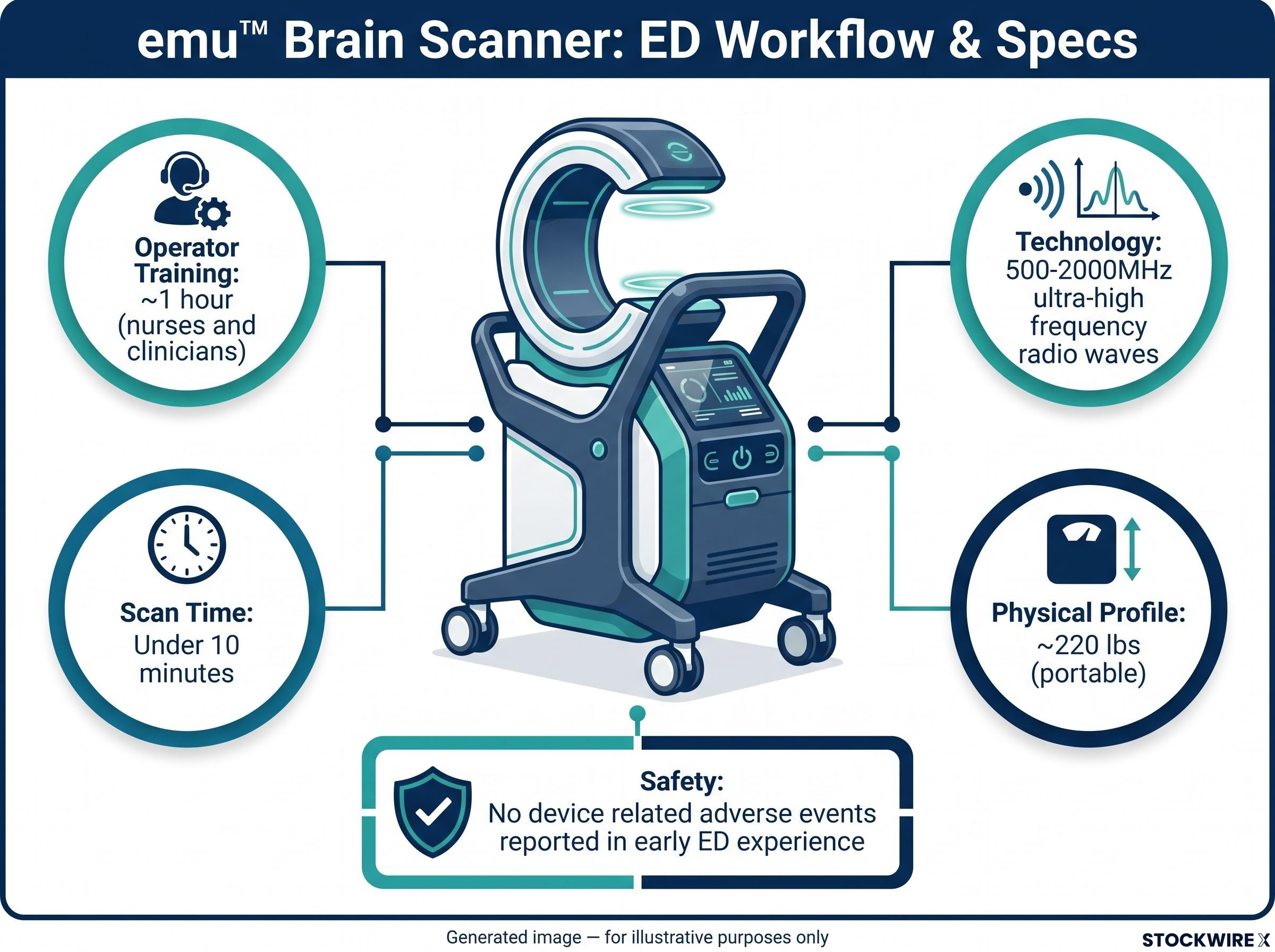
The presentation described the scanner being placed in an emergency department (ED) alcove in front of the CT suite. Key points from the results slide included:
- Operated by nurses and clinicians
- Operator training of approximately 1 hour
- Each scan under 10 minutes
- Scan success in the majority of cases
- No device related adverse events
Common scan opportunities were during stroke team assessment and while waiting for CT availability.
Challenges noted
The presentation listed three key challenges: agitated patients due to their condition, an inability to remain still for the scan, and a limited time window.
How the emu™ Brain Scanner works
Stroke occurs when blood flow to part of the brain is interrupted. An ischaemic stroke is caused by a blocked vessel, while a haemorrhagic stroke is caused by bleeding into the brain. According to EMVision, different stroke types require different types of care, and early recognition and fast access to diagnosis are critical.
The emu™ Brain Scanner uses non-ionizing radiation, meaning ultra-high frequency radio waves (500-2000MHz). Brain tissue types differ in conductivity and permittivity (together called dielectric properties), which cause scan signals to reflect and phase shift.
An AI algorithm recognises scan characteristics of haemorrhage, ischaemia and healthy tissue to generate a neurodiagnostic output. The device is investigational, weighs approximately 220 lbs, is portable, and is designed for in-hospital use by trained healthcare professionals.
EMVision states it is working to make rapid stroke diagnosis possible at the point of care. Whether this can complement imaging in time-critical settings will depend on the outcome of the ongoing trial.
Preliminary performance and the path to FDA De Novo clearance
Earlier EMView study data
The presentation cited EMView, an earlier multi-centre Australian study that enrolled 307 participants, including 277 suspected strokes (48 ICH and 140 confirmed ischaemic strokes). About 75% of data was used for training and about 25% for unseen testing. The study was published in npj Digital Medicine on 13 July 2026.
| Test | Total test cases | Correctly identified cases | Performance | 95% CI |
|---|---|---|---|---|
| Haemorrhage | 13 | 12 | 92% sensitivity | 66.1%-98.2% |
| Not haemorrhage | 55 | 47 | 85% specificity | 73.8%-92.4% |
| Ischaemic | 20 | 19 | 95% sensitivity | 75.1%-99.9% |
| Not ischaemic | 50 | 40 | 80% specificity | 66.3%-90.0% |
The test sets were small and the confidence intervals wide, particularly for the sensitivity figures. These are EMView results and are not Pivotal Trial results.
The npj Digital Medicine publication gave the EMView development results independent peer review, though the sensitivity and specificity figures remain development-stage data and should not be read as final clinical-trial outcomes.
The Pivotal (Validation) Trial design
The presentation and ASX release outlined the following design:
- A multi-centre, prospective, consecutive, paired diagnosis, diagnostic performance study.
- A primary objective of demonstrating haemorrhage detection sensitivity and specificity of >80%.
- A sample size of 300 suspected stroke participants (150 intracranial haemorrhage and 150 other), with training verification on a small number of initial participants at each site beforehand.
- Four US sites (Memorial Hermann-Texas Medical Center, Mayo Clinic Florida, Mount Sinai Hospital and Ronald Reagan UCLA Medical Center), two network sites (Mount Sinai West and Memorial Hermann Memorial City Medical Center), and three Australian sites (Royal Melbourne Hospital, Liverpool Hospital and Princess Alexandra Hospital).
The presentation noted additional academic centres are currently being onboarded.
Preparations are also underway to add an acute ischaemia detection endpoint. This may require a modest adjustment to the sample size, with the final design subject to planned FDA pre-submission (Q-Sub) engagement.
The stated goal is to obtain n ≅ 300 analysis phase participants to demonstrate diagnostic performance to support FDA De Novo clearance. The presentation described the study as progressing rapidly with active enrolment across participating centres, and further enrolment updates will show how the Trial advances.
For readers wanting to understand the strategic rationale, our detailed coverage of the ischaemia endpoint expansion explains how adding the endpoint to the existing trial could save up to two years and target roughly 80% of stroke presentations.
Want the Next Healthcare Breakout in Your Inbox?
Get FREE breaking ASX healthcare news delivered within minutes of release, complete with in-depth analysis and the full announcement. Join 20,000+ subscribers who stay ahead of the market. Click the “Free Alerts” button at Big News Blast to receive alerts the moment market-moving news breaks.