Professional fund managers are good at picking what to buy. When it came to selling, though, they often did worse than if they had chosen their sales at random. That finding comes from one of the largest studies of institutional trading, and it should make you question your own instincts about when to sell investments.
Your portfolio’s results depend on what you sell as much as on what you buy. Even so, most self-directed investors have no real process for exiting a position. They react to a sharp rise, a painful fall, a valuation headline or a gloomy macro story.
In Australia the stakes are higher than they first appear. Capital gains tax (CGT), brokerage and the emotional pull of a long-held legacy position all make a sale feel heavier than a purchase.
This guide gives you three questions to ask before selling any share or exchange-traded fund (ETF), which is a fund that trades on the ASX like a share. It also shows you how to weigh tax and fees in the answer.
Why is selling harder than buying, even for professionals?
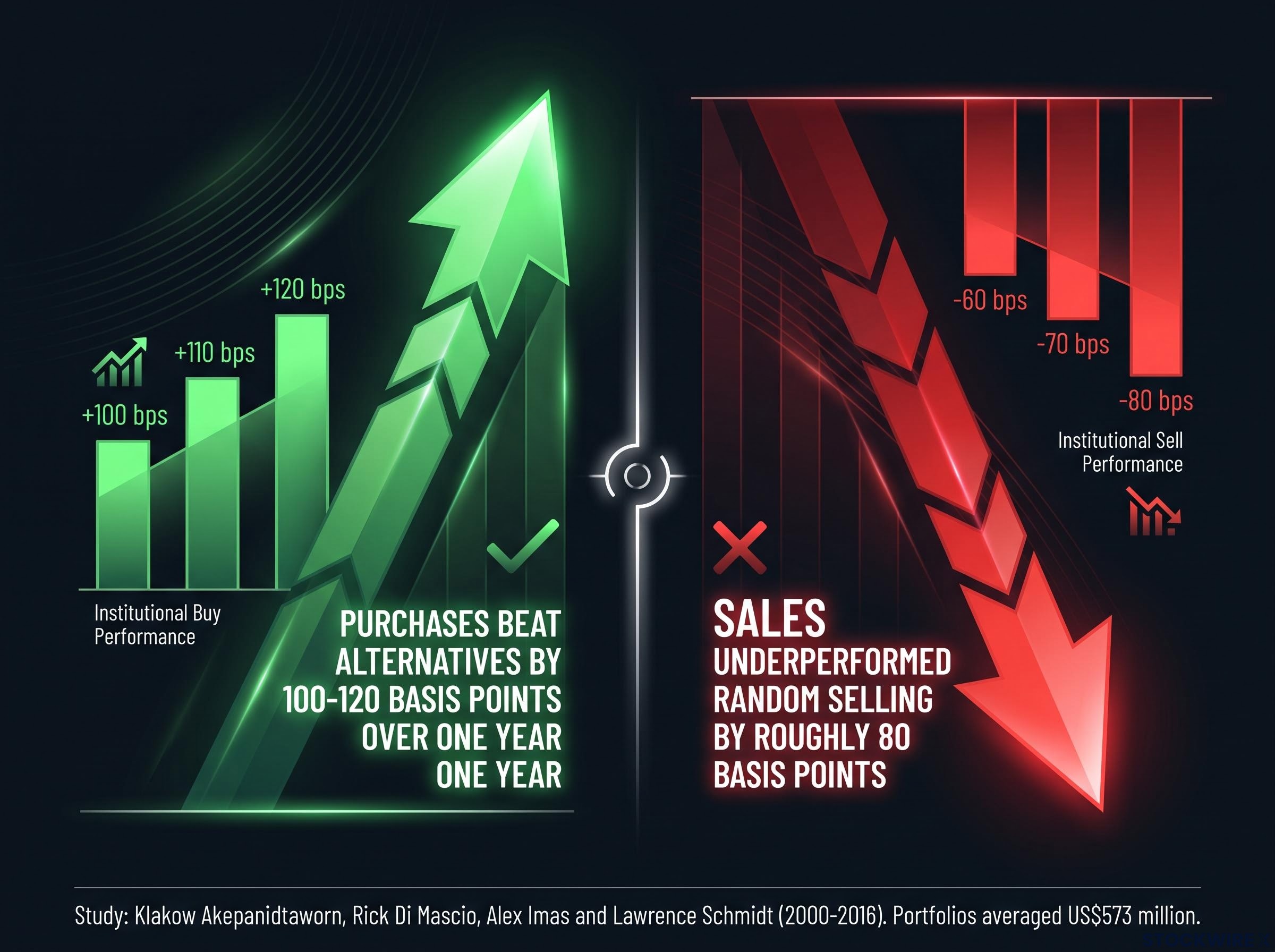
The evidence here is unsettling. Klakow Akepanidtaworn, Rick Di Mascio, Alex Imas and Lawrence Schmidt studied institutional fund managers and found a sharp split in their skills. They bought well and sold poorly.
- Portfolios averaged roughly US$573 million
- The sample covered about 2 million sells and 2.4 million buys between 2000 and 2016
- Purchases beat relevant alternatives by roughly 100-120 basis points over one year (a basis point is one hundredth of a percentage point)
- Sales underperformed random selling by roughly 80 basis points
- Holdings with extreme recent returns were more than 50% more likely to be sold
The uncomfortable finding The stocks these professionals sold often went on to outperform the stocks they kept. Picking sales at random may have done better.
Morningstar Australia’s source article described this as a 2018 study, reflecting an earlier version. It became NBER Working Paper 29076 in July 2021 and was published in The Journal of Finance in 2023.
The researchers trace the problem to attention. Buying decisions received deep fundamental analysis, while selling decisions were easily triggered by whatever had moved most dramatically.
If professionals with analysts and large budgets sell poorly when recent price moves guide them, your urge to sell after a big move deserves suspicion. Treat it as a prompt to investigate, not an instruction to act.
Your urge to sell after a big move is rarely neutral, because several investing biases at exit, including recency and herd behaviour, act together to push you toward the wrong holding at the wrong time.
What the research does not say
None of this means you should never sell. Sales made on earnings-announcement days performed materially better, by more than 150 basis points annually in the study’s comparison, which suggests fresh information improves exit decisions.
A 2022 study, Fund manager skill: selling matters more!, found a small group of managers with genuine selling skill. The lesson is about process, not intelligence.
When big ASX news breaks, our subscribers know first
How does the disposition effect push you to sell the wrong holdings?
Picture two shares in your portfolio. One is up 25%, the other down 25%. Most investors make the same pair of moves:
- Sell the winner to “lock in” the profit, even though it remains attractive.
- Hold the loser until it gets back to breakeven, even though the reason for owning it has failed.
That pattern is called the disposition effect: the tendency to sell winners too early and hold losers too long. It rests on reference-point dependence, which means treating your purchase price as meaningful when the only economic question is what the asset is likely to return from here.
Researchers disagree slightly on why it happens.
| Source | Explanation | What it means for you |
|---|---|---|
| Shefrin and Statman (1985) | Loss aversion, mental accounting, regret avoidance and self-control | Closing a position below cost feels like admitting a mistake, so you delay it |
| Odean (1998) | Investors may hold losers partly because they believe those stocks will rebound | Your optimism about a loser may be a belief worth testing, not a fact |
| Akepanidtaworn et al. | Attention flows to holdings with extreme recent returns | The loudest holding in your portfolio is not necessarily the one to act on |
This is not just a US quirk. Markku Kaustia studied investors on the Australian Stock Exchange from 1995 to 2000 and found they were more reluctant to realise losses than gains. The effect faded over time, became undetectable at about 200 trading days after purchase, and shifted around the end of the Australian tax year.
The Australian Shareholders’ Association described the same behaviour on 7 December 2023.
The fix is a single question: if you held neither share today, would you buy each one at its current price? The price you paid is a sunk fact, so judge every holding as a fresh buying decision.
Testing your reasons for owning: has the thesis shifted, and is the position still justified?
Morningstar Australia’s Tyger Fitzpatrick sets out a three-question framework. The first two tests are about the holding itself.
Question 1: Revisiting your initial investment rationale
Every share or ETF you own needs a purpose: income, growth, diversification or satellite exposure. It also needs a thesis, meaning a short explanation of how it delivers that purpose.
If you cannot state that thesis in one sentence, you have no basis yet for keeping or selling the holding. Fix that first.
Once the thesis is written, watch for signals that it has broken:
- A change in dividend policy, such as cash redirected from payouts to new ventures
- A deteriorating balance sheet
- A shift in strategy or capital allocation
- A change in management or management’s long-term aims
The core rule Identify the specific fact that changed, not merely the share price.
Take an income holding that cuts its dividend. Ask whether the payout was funded by recurring free cash flow and whether the balance sheet now carries more risk. A dividend change is a signal to review, not an automatic sell.
ETFs work the same way, though index funds change less. Watch for provider strategy changes, and check whether a thematic ETF overlaps so heavily with your other holdings that its original diversification role has blurred.
Your test should be personal. Fitzpatrick, a long-term growth investor with a horizon beyond 30 years, focuses on quality businesses with moats and whether management’s aims still match his own.
Question 2: Checking portfolio fit and alignment
A broken thesis does not mean you must sell, and an intact one does not mean you must keep. The question is whether the holding still deserves its weight.
Compare its expected return, risk, diversification benefit and position size with the rest of your portfolio. Remember your goals evolve too.
Consider a legacy blue-chip that now makes up 30% of your portfolio against an intended 10% maximum. The company may be fine, yet the position has outgrown the role you gave it.
Weighing the cost of switching: tax, fees and what the capital could do elsewhere
The third question is whether your money could work harder somewhere else. Capital tied up in one holding cannot be used in another.
This is where many investors stop. “I would have to pay tax” feels like a complete answer, but it is the wrong comparison.
The right comparison is the after-tax value of continuing to hold versus the after-tax value of selling and reinvesting the proceeds. Tax is a cost to measure, not a veto.
CGT basics for Australian investors
CGT is not a separate tax. Your net capital gain is added to your assessable income and taxed at your marginal rate.
| Item | Treatment | Why it matters |
|---|---|---|
| Net capital gain | Gains less current and prior-year capital losses, then less any discount | Losses you hold can reduce the tax on a sale |
| 12-month rule | Resident individuals generally must hold at least 12 months for the discount | Selling just before the mark can cost you the discount |
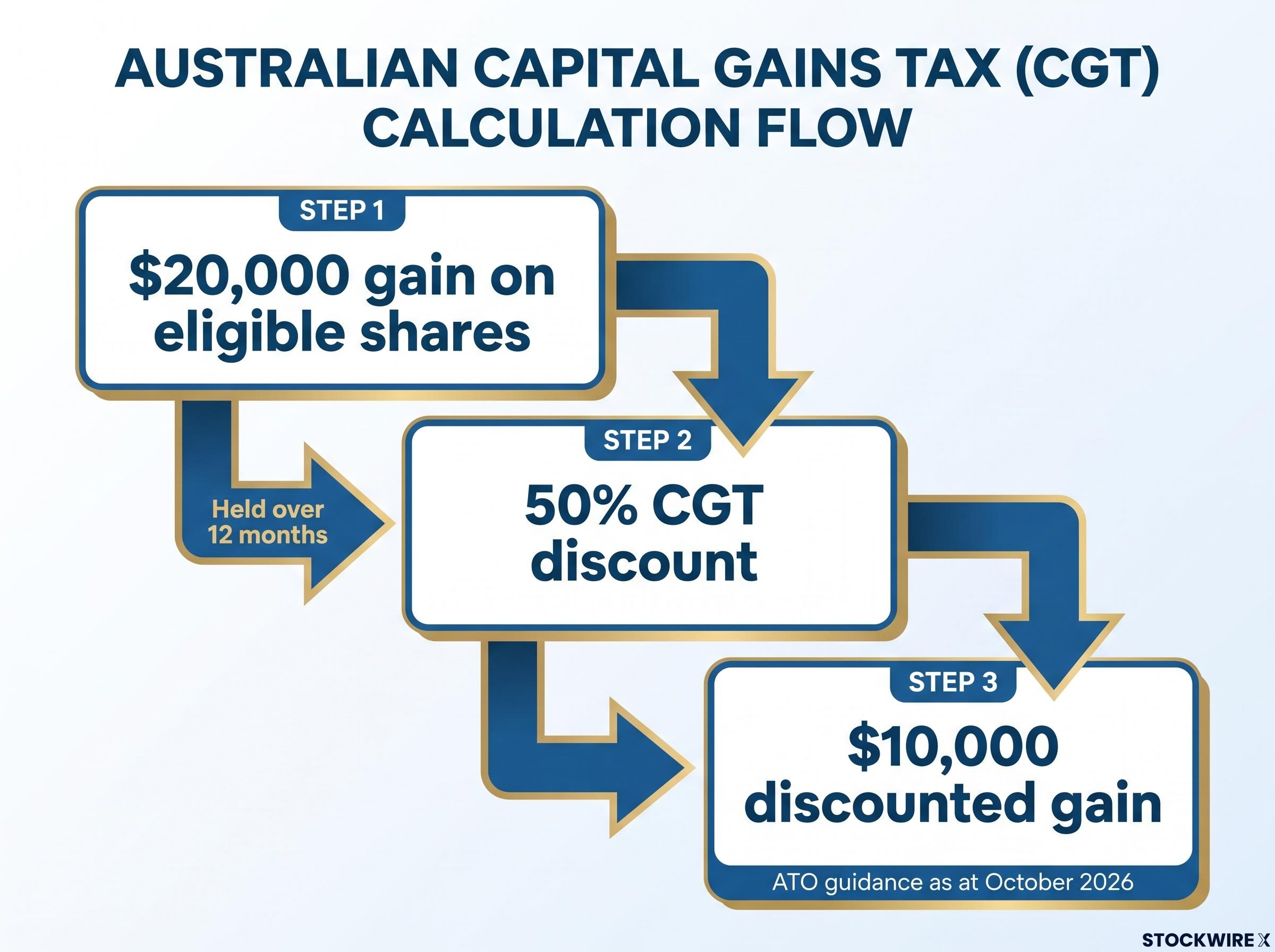
| CGT discount | 50% reduction of the eligible gain | Lowers, but does not remove, the cost of selling |
| Held 12 months or less | No discount | Short-term trades are taxed on the full gain |
| Capital losses | Offset capital gains only; unused losses generally carry forward | They cannot reduce tax on your salary |
For example, a $20,000 gain on eligible shares held over 12 months generally becomes a $10,000 discounted gain before other gains and losses. Australian Taxation Office (ATO) guidance confirms these rules are unchanged as at October 2026.
One caution. Australia has no automatic US-style wash-sale rule, but the ATO warns that selling to manufacture a loss and buying back the same or substantially similar exposure can fall foul of Part IVA anti-avoidance provisions.
For investors planning sales this financial year, our dedicated guide to reducing investment tax before the 2027 CGT change shows how the discount ending on 1 July 2027 affects timing.
Counting the real cost of switching
Tax is only one layer of friction:
- Brokerage, such as CommSec‘s $5 to $29.95 depending on trade size, Selfwealth‘s $9.50 or Pearler‘s $6.50
- The bid-ask spread, the gap between buying and selling prices
- CGT on realised gains
- Distributions you give up while out of a holding
- Foreign exchange costs on international holdings
On small trades these add up quickly. A $10 fee is 2% of a $500 trade, before the spread.
Treat friction as a premium the alternative must overcome. A large embedded gain should change how and when you sell, through staged sales, parcel choice or timing around the 12-month mark. It should not by itself stop you from selling a holding that no longer earns its place, because avoiding tax is not risk management. If the amounts are material, get personal tax advice.
Thesis, rules or rebalancing: which sell trigger should you use?
Investors argue about what should trigger a sale. Each camp has a point, and each has a blind spot.
| Approach | Core idea | Main weakness |
|---|---|---|
| Thesis-based | Sell when the original case breaks | Theses can be vague or rewritten after the fact |
| Rules-based | Stop-losses, position limits or valuation bands decide | Stop-losses can force sales in temporary volatility, add costs and cause whipsaw |
| Rebalancing | Trim what exceeds its target weight | May sell a long-term compounder early and create taxable gains |
| Buy-and-hold | Minimise turnover, tax and behavioural errors | No protection against permanent impairment or concentration |
| Valuation-based | Exit when expected returns look unattractive | Valuation is uncertain; expensive stocks can keep rising |
Morningstar Australia describes two rebalancing styles: interval-based, such as an annual review, and threshold-based, such as acting when an allocation drifts five percentage points from target. If your 60% equity target drifts to 70%, selling back to target controls risk even if markets keep rising.
You do not have to pick one camp. A workable hybrid looks like this: define the thesis in advance, set a maximum position size, review at fixed intervals, and apply rebalancing or risk rules without letting recent price movement alone decide.
Write your trigger down while markets are calm. When headlines get loud, you will be following your own rule rather than reacting.
Top ASX fund managers rely on pre-committed exit rules covering valuation ceilings and staged profit targets, so the sell decision is made calmly at purchase rather than under pressure.
A six-step checklist before you sell
- Has the thesis changed? Name the specific fact, not the price move.
- Would you buy it today at this price? Ignore your purchase price except for tax.
- Does it still earn its place? Compare return, risk, diversification and size.
- What is the after-tax, after-fee outcome? Include CGT, losses, the discount, brokerage and spreads.
- Is this information or emotion? Fear, regret and the urge to “lock in” are warning signs.
- What will replace the capital? Without a better destination, a sale becomes market timing.
A price fall alone does not prove a thesis has failed, but refusing to sell can hide genuine impairment. The checklist helps you tell volatility apart from changed business economics. The right answer still depends on your residency, marginal rate, cost base, horizon and goals.
Building a sell process you can repeat
The research points one way: disciplined selling beats both indiscriminate selling and never selling. Your routine comes down to three questions. Has the thesis changed, does the holding still earn its place, and is there a better use for the capital after tax and fees?
This week, write a one-line thesis and a maximum position size for each holding you own. Then put your next review date in the calendar, so your future sell decisions come from a rule you set calmly rather than a headline.
Where the tax or financial consequences are material, seek personal advice before acting.
This article is for informational purposes only and should not be considered financial advice. Investors should conduct their own research and consult with financial professionals before making investment decisions. Past performance does not guarantee future results.