


Scientists can cheer the quantum progress coming out of Google and IBM’s labs while the stocks attached to that science slide. Yesterday, 12 October 2026, IonQ fell about 9% intraday to $36.19, and D-Wave Quantum dropped about 4% to $13.99.
The trigger was IonQ’s proposed all-stock acquisition of cybersecurity company Elisity, worth up to $1.3B. The deal raised dilution fears that spread across the sector. That selloff landed on top of a punishing year: D-Wave is down 45.74% year to date, Rigetti Computing is down 38.47%, and Quantum Computing Inc. (QUBT) is down 29.34%. For anyone holding quantum computing stocks, the real question is the distance between the technology story and the company accounts.
Once you finish, you will be able to tell technical progress apart from investable profit. You will also have a clearer sense of how much of the sector’s strength rested on government sponsorship rather than paying customers.
Why is error correction the problem that decides everything?
If qubits are the building blocks, why can’t companies simply add more of them? The answer explains almost every headline you will read about this sector.
Physical versus logical qubits
A physical qubit is the actual hardware unit, such as a superconducting circuit, a trapped ion or a neutral atom. It is fragile. Noise, imperfect operations and a loss of its quantum state over time (called decoherence) all corrupt the information it holds.
A logical qubit is a single reliable unit of information spread across many physical qubits, so the machine can detect and fix errors. The catch is that the correction circuitry runs on physical qubits too, and those can introduce fresh errors. A commercially useful machine may need thousands or more physical qubits for each high-quality logical qubit.
Google’s Willow chip showed the idea can work. In December 2024, the 105-qubit processor grew its error-correcting grid from 3×3 to 5×5 to 7×7, and the error rate fell by about 2.14 times at each step. Its logical qubit outlived its best physical qubit. Yet the logical error rate was still about 0.143% per correction cycle, far too high for long calculations.
That makes Willow a proof of principle, not a product.
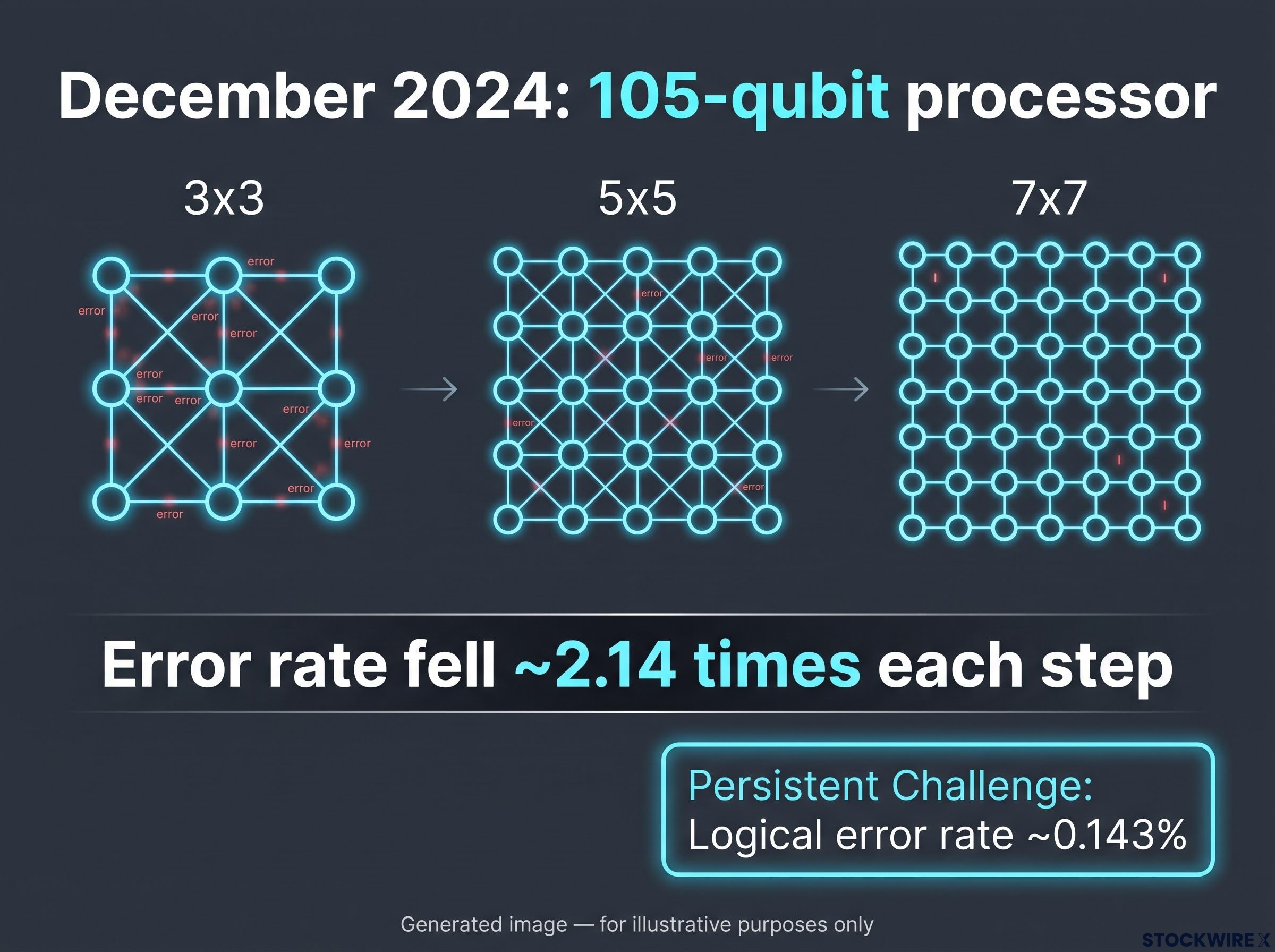
The number that matters More physical qubits do not mean a more useful computer. What counts is the number of usable logical qubits a machine can sustain.
Four architectures, four different bets
Companies are also building on very different hardware, and each faces its own scaling wall.
| Approach | Main advantage | Main scaling problem |
|---|---|---|
| Superconducting (Google, IBM) | Very fast operations, chip-style manufacturing, strong error-correction progress | Needs extreme cold; short coherence; heavy wiring; large correction overhead |
| Trapped-ion (IonQ, Quantinuum) | Long coherence, high-fidelity operations, identical qubits | Slower operations; lasers, traps and networking are hard to scale |
| Quantum annealing (D-Wave) | Systems available commercially for selected optimisation problems | Not a universal gate-model computer; broad advantage is contested |
| Photonic, neutral-atom, silicon-spin, topological | Possible gains in networking, manufacturing or density | Mostly earlier-stage; large-scale correction unresolved |
D-Wave’s annealing machines solve a narrower class of problems than the universal computers Google and IBM are chasing. For you, that means a headline qubit count tells you little about commercial readiness. When you buy a quantum stock, you are also underwriting the risk that its chosen architecture loses to a cheaper one.
Because no single company owns the full stack, a diversified quantum ETF is one way to spread architecture risk across hardware, software and infrastructure rather than betting on one design winning.
When big ASX news breaks, our subscribers know first
Why do quantum timelines range from two years to thirty-plus?
Ask five informed people when quantum computing becomes useful and you may hear answers from two years to three decades. Both ends can be honest.
| Source | Estimate | What “useful” likely means |
|---|---|---|
| Optimistic industry voices | Within a few years | Narrow demos, hybrid workflows, sensing, cloud access |
| DARPA Quantum Benchmarking Initiative | 2033 test | Whether an industrially useful machine can be built |
| Google Quantum AI and IBM roadmaps | The 2030s | Fault-tolerant systems, if error correction scales |
| Jensen Huang, Nvidia (January 2025) | 15-30 years | Broad, economically meaningful applications |
Brookings summarised Huang’s view as at least 15-20 years. In separate market commentary, one broadcaster said he had heard meaningful technology was 30-40 years away. That secondhand claim sits above even Huang’s range.
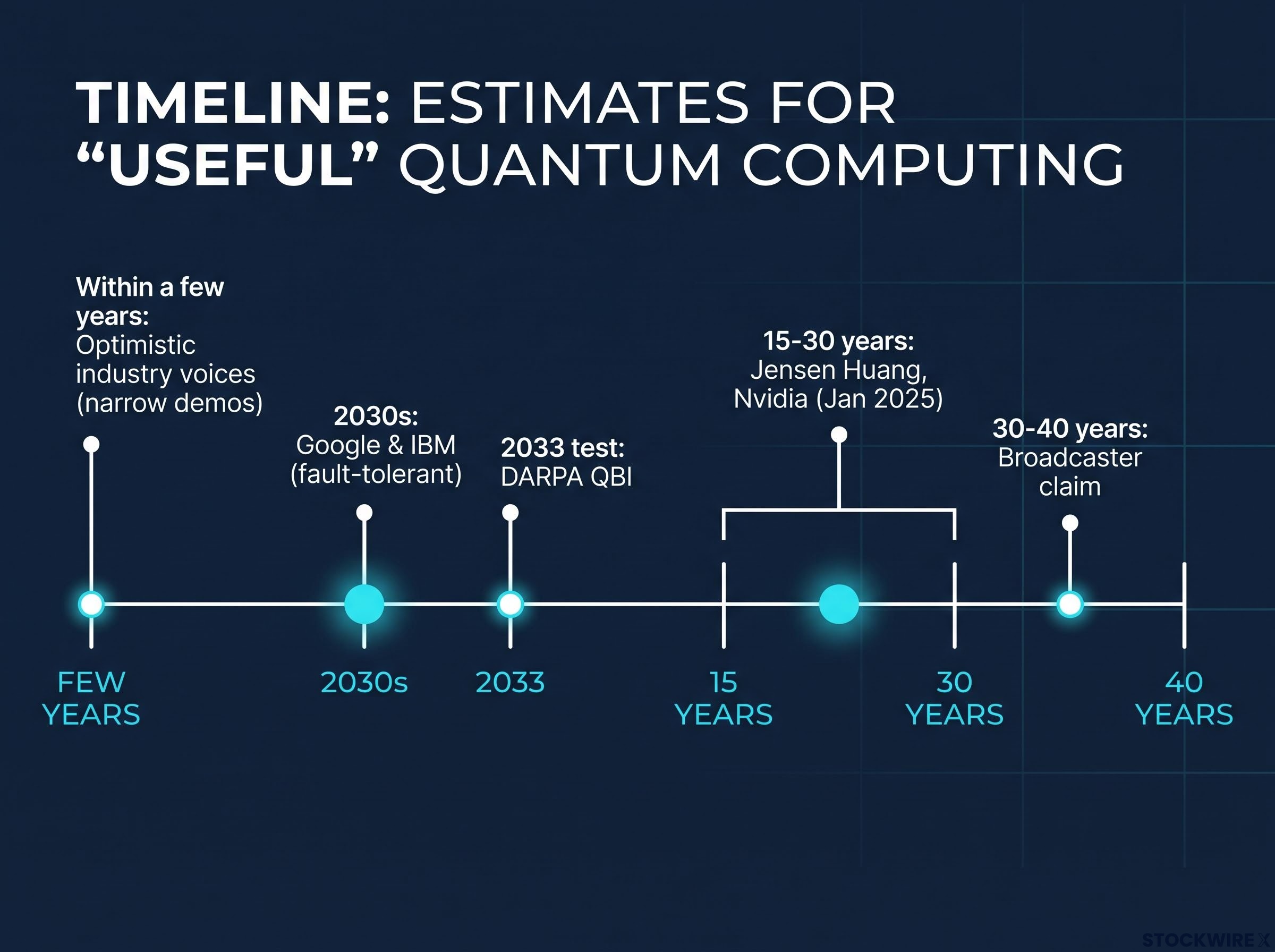
The contradiction dissolves once you see what each estimate measures. Short timelines usually describe specialised uses or early commercial advantage. Long timelines describe reliable, general-purpose, fault-tolerant computing at scale.
Not every near-term opportunity depends on fault-tolerant machines; post-quantum cryptography deadlines create compliance-driven demand today, which is why some investors look beyond hardware when asking what counts as useful.
The spread persists because four engineering questions remain open:
- How many physical qubits each logical qubit will need
- Whether error rates stay low as machines grow
- Whether algorithms deliver real advantage on commercial problems
- Whether operating costs fall below the value of the output
Whenever you see a timeline, ask which definition of “useful” it uses. A stock priced as if the long-range machine is coming, but justified with short-range wins, is a mismatch you should notice before the market does.
How much are governments propping up quantum computing stocks?
Public money in quantum is real, and it is growing. Washington treats the technology as strategic, and the framing of a new space race with China gave investors reason to expect financing would keep flowing.
The Defense Advanced Research Projects Agency (DARPA) is the clearest example. Its benchmarking programme offers up to $15M per Stage B participant and up to $300M per Stage C participant. On 7 October 2026, IonQ was among four Stage C selections, alongside Atom Computing, Diraq and IBM.
Not every figure carries the same weight, though.
| Programme | Amount | Status |
|---|---|---|
| DARPA QBI | Up to $15M (Stage B); up to $300M (Stage C) per performer | Enacted |
| US Department of Energy research centres | $625M (later years depend on appropriations) | Enacted |
| National Quantum Initiative reauthorisation | House about $1.8B; Senate about $2.7B over five years | Proposed |
| Air Force Research Laboratory and Rigetti | $5.8M over three years | Enacted contract |
| US equity-stake funding linked to Rigetti | About $100M | Reported in secondary coverage only |
| China | About $15B cumulative; reported 1 trillion yuan (about $138B) fund | Estimate |
The China figures are estimates and announced mobilisation, not direct spending on listed companies. For Europe, no authoritative aggregate figure could be located, and guessing would mislead you.
Here is the harder point. A DARPA selection or a Department of Energy grant validates the science and funds the research, but it does not show that commercial customers will pay enough to make a company profitable.
Validation is not demand Government backing proves a technology is worth testing. It does not prove a recurring customer base.
Part of the sector’s strength therefore reflects policy sentiment. Appropriations can stall, elections can redirect budgets, and priorities can change. Treat government support as a prop under your thesis, not a floor beneath your share price.
The same policy sentiment showed up in May 2026, when CHIPS Act equity stakes in nine quantum companies lifted the whole category, including names that received no funding at all.
What drove the rally, and why did the selloff follow?
Both sides of this argument rest on genuine facts. The financials show where they diverge.
The bull case
- Technical milestones: Willow revived the view that quantum is moving from theory to engineering.
- Government sponsorship: DARPA, Department of Energy funding and defence contracts signalled strategic priority.
- Optionality: potential markets in chemistry, materials, logistics, finance and cryptography made the stocks a long-dated bet on a platform technology.
- Early revenue: IonQ’s Q2 2026 revenue reached $80.1M, up 287%.
The bear case
- Valuation ahead of revenue: IonQ was worth about $17.48B in early October, against limited sales.
- Retail momentum: rallies clustered in volatile names and often reversed within days.
- Funding dependence and dilution: loss-making companies raise capital by issuing shares, shrinking your slice.
- The Elisity deal: an all-stock purchase made dilution concrete and raised questions about why IonQ is broadening beyond quantum.
IonQ’s market value stood at about $14.7B by 12 October. Its accounts show why sentiment is fragile.
| Company | Latest quarterly revenue | GAAP net loss | Cash |
|---|---|---|---|
| IonQ (Q2 2026) | $80.1M | $1.8677B (about $1.65B non-cash warrant change) | $3.0B |
| D-Wave (Q2 2026) | $3.08M (per Zacks) | $48.0M | $546.2M |
Sources conflict on D-Wave’s revenue; the loss and cash figures come from company filings. Short seller Wolfpack Research alleged in February 2026 that as much as 86% of IonQ’s 2022-2024 revenue was linked to Pentagon grants or earmarks. That is an unverified allegation from a party that profits if the share price falls.
Risks to weigh before sizing a position
- Dilution from share issues and acquisitions
- Architecture risk if a rival technology scales more cheaply
- Policy risk from delayed or redirected government funding
- Bubble precedent: the internet, genomics and clean energy produced lasting winners alongside many failures
Cash on the balance sheet buys time, but it does not prove an economic model. If you hold these names, size the position as money you can afford to lose without harming your broader goals.
When a loss-making company funds itself by issuing stock, your ownership slice shrinks even if revenue climbs. Tracking share dilution through diluted share counts, rather than headline growth, shows whether per-share value is really rising.
What separates the science from the investment case
The technology is real, and it is advancing. The stocks, however, rallied on government-backed expectation well ahead of revenue, and the selloff reflects that gap starting to close.
To judge which way it moves next, watch five variables:
- Error-correction milestones measured in logical qubits, not physical ones
- Progress by IonQ and others through DARPA’s Stage C
- Whether National Quantum Initiative proposals become enacted funding
- New share issues or all-stock deals
- The ratio of revenue to losses each quarter
Your decision comes down to matching expectations to reality. Treat any exposure as venture-style capital, and set your holding period against the realistic definition of “useful”, not the most optimistic one.
Past performance does not guarantee future results. Financial projections and timelines cited are speculative and subject to change based on technical, market and policy developments.
This article is for informational purposes only and should not be considered financial advice. Investors should conduct their own research and consult with financial professionals before making investment decisions.






