The S&P 500 closed Monday’s session at 7,807.24, down just 0.06%. A flat index looks like a quiet day, but this one wasn’t. The Philadelphia Semiconductor Index (SOX), which tracks the largest US chipmakers, fell 2.7%. The Dow Jones Industrial Average rose 0.38% on the same day.
Most coverage of the semiconductor stocks selloff pointed to one cause. Hours earlier in Singapore, Broadcom CEO Hock Tan had warned that investor expectations around AI had become extreme, and headlines tied the drop to his remarks. That story is neat. It may also be incomplete.
Here is how to separate the headline explanation from the buying and selling underneath it. You will also see what the rotation out of chips and into defensive stocks says about how much risk the market is willing to take on right now.
Why does the semiconductor stocks selloff get a story attached to it?
At the DBS Asia Future Forward Conference on 12 October 2026, Tan argued that financing, not chip shortages, could become the biggest limit on AI expansion. He said investors held “very extreme expectations” and compared the activity to a casino.
Hock Tan, Chief Executive Officer, Broadcom “A lot of investors have no clue what they are investing in.”
Commentators on Tasty Live, including trader Tim Knight, set the remark beside Alan Greenspan’s “irrational exuberance” warning from the 1990s. That comparison was their own; no October 2026 report connects a new Greenspan comment to this selloff. Claims that the remarks erased “hundreds of billions of dollars” within hours also remain unverified, because no authoritative industry-wide figure has been published.
The figures that can be verified are smaller. The SOX logged its fourth straight losing session. Micron fell 3.9% and SanDisk dropped 6.0%. Broadcom slid 1.88% to $354.73 on 13 October, giving it a market value of about $1.69 trillion, roughly 28% below its $495 52-week high.
The competing explanations
Tan never said Broadcom’s demand had collapsed. Several other forces were already in play:
| Explanation | Evidence |
|---|---|
| Funding warning | Tan named financing, not supply, as the AI constraint |
| Valuation | The casino remark sharpened fears that AI names are priced for extreme outcomes |
| Profit-taking | Jim Cramer said memory names rose too far too fast; semis still up about 62% in 2026 |
| China memory competition | TheStreet cited competition concerns; Micron -3.9%, SanDisk -6.0% |
| Forced selling | Cramer cited a hedge fund unwinding positions in Bloom Energy, SanDisk and Micron after heavy losses |
Intel CEO Lip-Bu Tan reportedly raised concerns about borrowing costs and AI returns at the same event, although those remarks have not been independently confirmed. Commentators split into two camps. One sees a fundamental reassessment of AI economics. The other sees a crowded trade unwinding for technical reasons.
The simpler reading
Knight argues that the media attach convenient stories to price moves when the real cause is simply more sellers than buyers. One session can neither prove nor disprove that view.
Timing is the point to check. The SOX was already on a losing streak before Tan spoke. When a single quote gets the blame for a fall that was already underway, treat the quote as a headline for existing selling, not as new information about the companies.
When big ASX news breaks, our subscribers know first
How to read a flat index when sectors pull in opposite directions
The S&P 500 is cap-weighted, which means larger companies move the index more than smaller ones. If chipmakers fall sharply while banks, healthcare and staples rise, the gains and losses can cancel out. The index then barely moves even though large amounts of money have changed hands.
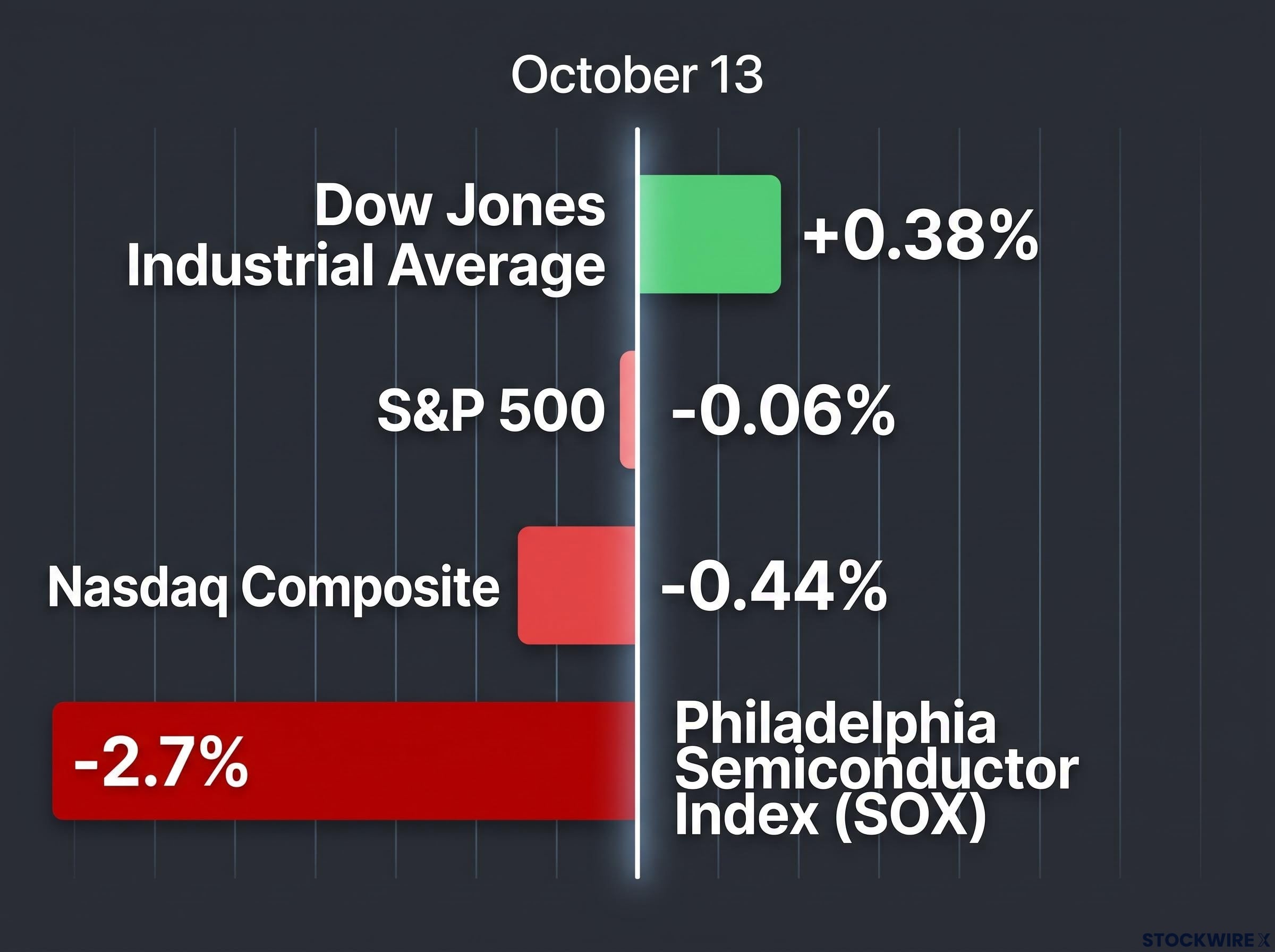
| Index | Level | Move |
|---|---|---|
| S&P 500 | 7,807.24 | -0.06% |
| Nasdaq Composite | 27,245.90 | -0.44% |
| Dow Jones Industrial Average | 51,850.55 | +0.38% |
Source: Charles Schwab, 13 October 2026
What the Dow and Nasdaq gap shows
The Nasdaq holds a heavy weighting in chipmakers. The Dow leans towards banks, healthcare and mature industrials, and two of its members had strong results. UnitedHealth reported third-quarter adjusted earnings per share (EPS) of $4.69, against about $4.12 expected. Goldman Sachs posted EPS of $17.01, against forecasts of about $13.02-$13.09.
Those results helped the Dow outperform the Nasdaq by about 0.82 percentage points. Different holdings produced different outcomes on the same day.
Institutional capital often repositions ahead of official data, which is why sector rotation can act as a forward-looking signal; a move from chips into staples and software fits that pattern, though one session cannot confirm it.
Where the money went
Consumer staples had gained about 5% in October through 12 October. Software gained too. Data from 24/7 Wall St. shows how sharply leadership within tech has changed:
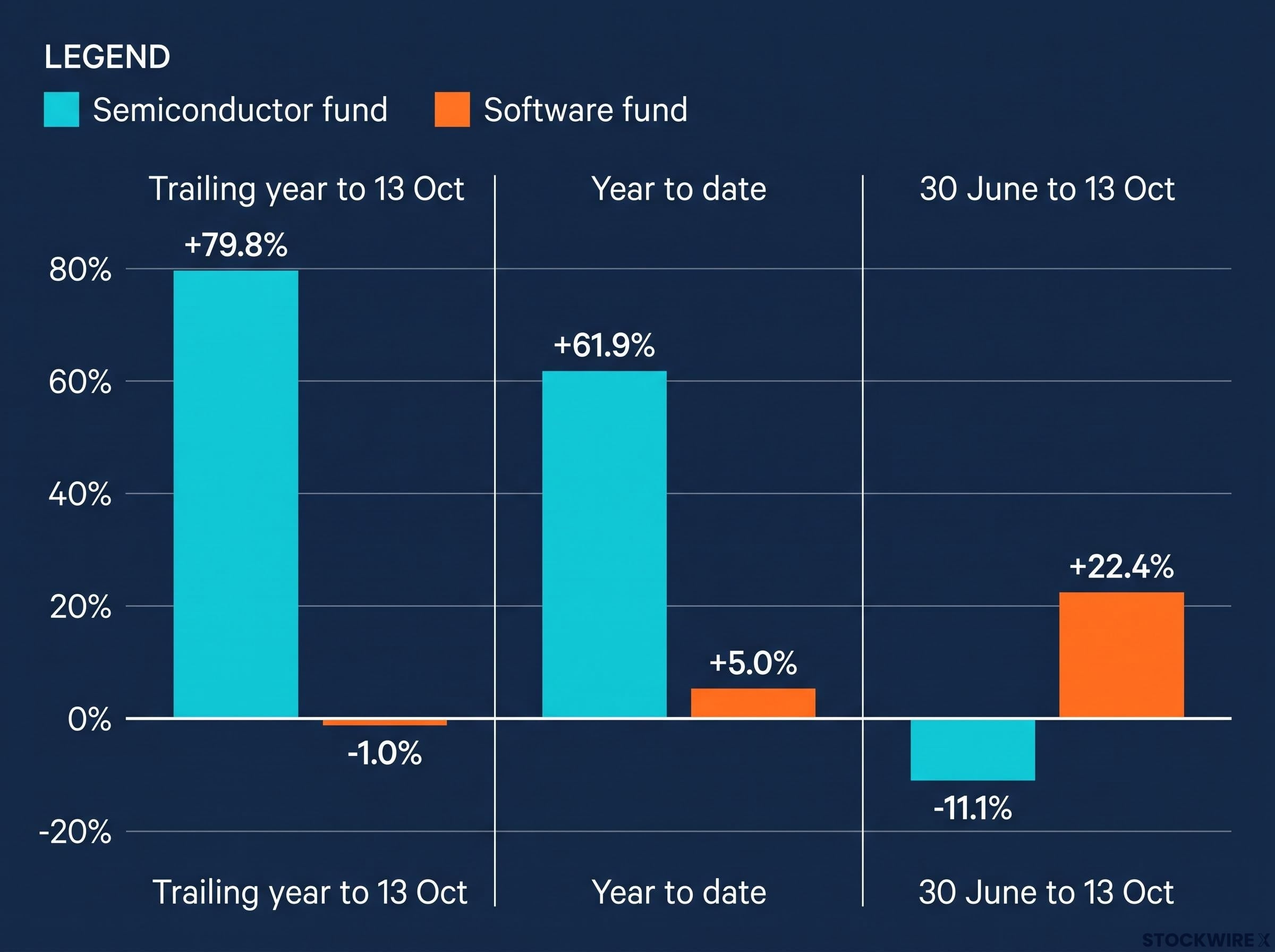
| Period | Semiconductor fund | Software fund |
|---|---|---|
| Trailing year to 13 Oct | +79.8% | -1.0% |
| Year to date | +61.9% | +5.0% |
| 30 June to 13 Oct | -11.1% | +22.4% |
Four drivers explain the shift:
- High-beta chip stocks (stocks that typically swing more than the overall market) had built up large gains that investors could lock in
- Defensive sectors depend less on heavy capital spending
- Strong earnings supported the companies that make up the Dow
- Software offered a relative alternative without leaving tech entirely
Danske Bank reportedly described a “rotation away from AI and not least semiconductors” while noting that breadth, the share of stocks rising, stayed positive. This has not been independently confirmed. Knight is also heavily short semiconductors, meaning he profits if they fall, so weigh his commentary with that position in mind.
The market’s appetite for risk has become more selective rather than disappearing. A flat headline index tells you nothing about your own exposure, so check which side of this split your portfolio sits on.
Why do stocks fade when yields and the dollar fall?
The macro backdrop looked supportive. The 10-year Treasury yield eased about 5 basis points to roughly 5.19% (a basis point is one-hundredth of a percentage point). Schwab put the US Dollar Index at 102.23, down 0.34%, although IC Markets reported a rise, so the sources conflict. Lower yields and a softer dollar normally help stocks.
They didn’t help this time. Earlier in the session, the Dow was up about 400 points on the UnitedHealth and Goldman results before the gains narrowed. Schwab’s +195.60 reading reflects a different point in the day. UnitedHealth’s early gains faded during the morning. At one point, E-mini S&P futures were down 7 points and Nasdaq futures down 130.
Some claims overstated the weakness. The Nasdaq did not fall five days in a row; it fell in three of the last four sessions. The SOX’s losing streak is four sessions.
The five forces behind the fade
- Concentration: Losses clustered in chips while other sectors offset them.
- Weak post-earnings follow-through: Strong results from UnitedHealth and Goldman could not outweigh the pressure from semiconductors.
- Liquidity and positioning: Selling triggered by risk limits, stop-losses or fund redemptions happens regardless of interest rates.
- Supply-demand imbalance: Buyers were present for defensives and software, but there were more semiconductor shares for sale than buyers wanted.
- Information channels: Falling yields can signal worries about growth rather than optimism.
The core idea, from Tim Knight and the Tasty Live host Prices fall when there are more sellers than buyers, whatever the headline says.
A yield of 5.19% also remains high for long-duration growth stocks, whose value depends mainly on profits expected far in the future.
What to watch on the tape
The tape is the live record of trades and prices. Watch for early gains that fail even after strong earnings, check whether breadth holds up, and see whether defensive sectors keep absorbing money. When good macro news fails to lift prices, positioning-driven selling is likely outweighing valuation support. In that situation, price action is a better guide than headlines.
Investors exploring why high yields have not yet crushed AI names will find our detailed coverage of AI growth stocks and real yields, including three triggers for a regime change.
Is this a rotation, a reset or the start of something bigger?
The case for a tactical pullback
Semiconductors remain up 61.9% this year and 79.8% over the past twelve months. Previous chip pullbacks after long rallies produced sharp drops without demand collapsing. Broadcom has reportedly targeted about $58 billion in AI revenue for fiscal 2026, with $16.7 billion in third-quarter AI chip revenue and fourth-quarter guidance near $21.7 billion. These figures have not been independently confirmed.
The case for caution
Tan’s financing warning raises the question of whether AI enthusiasm has run ahead of near-term cash generation. If investors begin to doubt the returns on AI infrastructure, part of this move could prove structural rather than temporary. Treasury yields near 5.19% add pressure on high valuations.
Tan’s financing warning gains weight when hyperscaler capex funding is examined, since free cash flow is compressing and debt issuance is rising to cover spending commitments that run into the hundreds of billions.
- Bull case: Gains are being trimmed, positioning is crowded and needs to clear, and reported demand figures still look strong.
- Bear case: Financing may limit AI spending, the returns on that spending are uncertain, and yields remain high.
Your reading depends on your time horizon and on which constraint you think matters more for AI spending: demand or financing. This is general analysis, not personalised financial advice.
Past performance does not guarantee future results. These statements are speculative and subject to change based on market developments and company performance.
What the divergence tells you, and what it does not
A flat S&P 500 hid a sharp semiconductor decline and a rotation into the Dow, staples and software. Hock Tan’s remarks were one plausible cause among several, and the selling had started before he spoke.
Three signals will clarify what comes next:
- Whether the SOX extends its losing streak
- Whether defensive sectors keep gaining
- Whether the 10-year yield moves away from 5.19%
Risk appetite hasn’t disappeared. It has become more selective, so focus on where money is moving rather than on the headline index level.
This article is for informational purposes only and should not be considered financial advice. Investors should conduct their own research and consult with financial professionals before making investment decisions.