Most global coverage of India’s rupee has framed the story around a single rate decision. The more telling signal came five days later. The Reserve Bank of India (RBI) raised rates on 7 October, then on 12 October rolled out capital-market curbs normally linked to a currency crisis, a sequence that only makes sense against September’s 5.54% CPI inflation reading, the highest in nearly two years.
India’s central bank is now fighting rising prices and a weakening currency at the same time. The rupee jumped almost 1% on Monday as the new measures took effect, its sharpest one-day gain since April.
The two problems feed each other, and each tool the RBI has deployed targets a different pressure point. Understanding which tool does which job tells you what the response costs businesses and investors with rupee exposure.
Here is what the data says about whether a second rate hike in December is likely, and whether Monday’s rupee relief can last.
What the September inflation data says about where price pressure is heading
At first glance, September’s jump looks like a food story. Headline inflation rose to 5.54% (provisional) from 4.82% in August (some reports cite 4.83%), driven by food inflation climbing to 7.74%. Vegetables, onion, ginger, garlic, fruit and sugar-related items led the move, with poor rainfall linked to El Niño squeezing supply.
Food shocks tend to fade once harvests recover. If that were the whole picture, the RBI could afford to wait.
A 15% monsoon deficit points to a further 250-300 basis points of food inflation concentrated in perishables, where grain buffer stocks offer little protection and supply-side relief is slow to arrive.
The core numbers complicate that comfort. Core inflation, which strips out volatile food and fuel prices, rose to 4.6% according to ICRA, or 4.3% by the Indian Express calculation, up from about 4.1%-4.16%. India publishes no official core CPI series, so these are private estimates, but both point the same way.
| Measure | August 2026 | September 2026 |
|---|---|---|
| Headline CPI | 4.82% (some reports 4.83%) | 5.54% (provisional) |
| Food inflation | 5.95%-5.97% | 7.74% |
| Core inflation (private estimates) | 4.1%-4.16% | 4.3%-4.6% |
Four forces are pushing prices higher at once:
- Food: weather-driven supply disruption lifting vegetable and fruit prices
- Energy: higher crude tied to the Iran and West Asia conflict, raising fuel and transport costs
- Weak rupee: a slide of roughly 7% against the dollar, making every import dearer in local terms
- Underlying pass-through: rising core readings that suggest costs are spreading into wider goods and services
A food shock alone would justify patience. Rising core inflation is the reason policymakers cannot simply wait for vegetable prices to normalise, and with headline inflation near the 6% ceiling of the RBI’s 2-6% target band, a breach could come as early as October.
Why the consensus comparison looks contradictory
Reuters described September’s print as an upside surprise against its poll median of 5.40% (range 4.90%-5.90%), while the Bloomberg consensus of about 5.58% implies a slight miss. Both are accurate because they are different surveys, so a headline calling the figure a “miss” does not mean inflation pressure is easing.
When big ASX news breaks, our subscribers know first
How the 7 October RBI rate hike reset the policy path
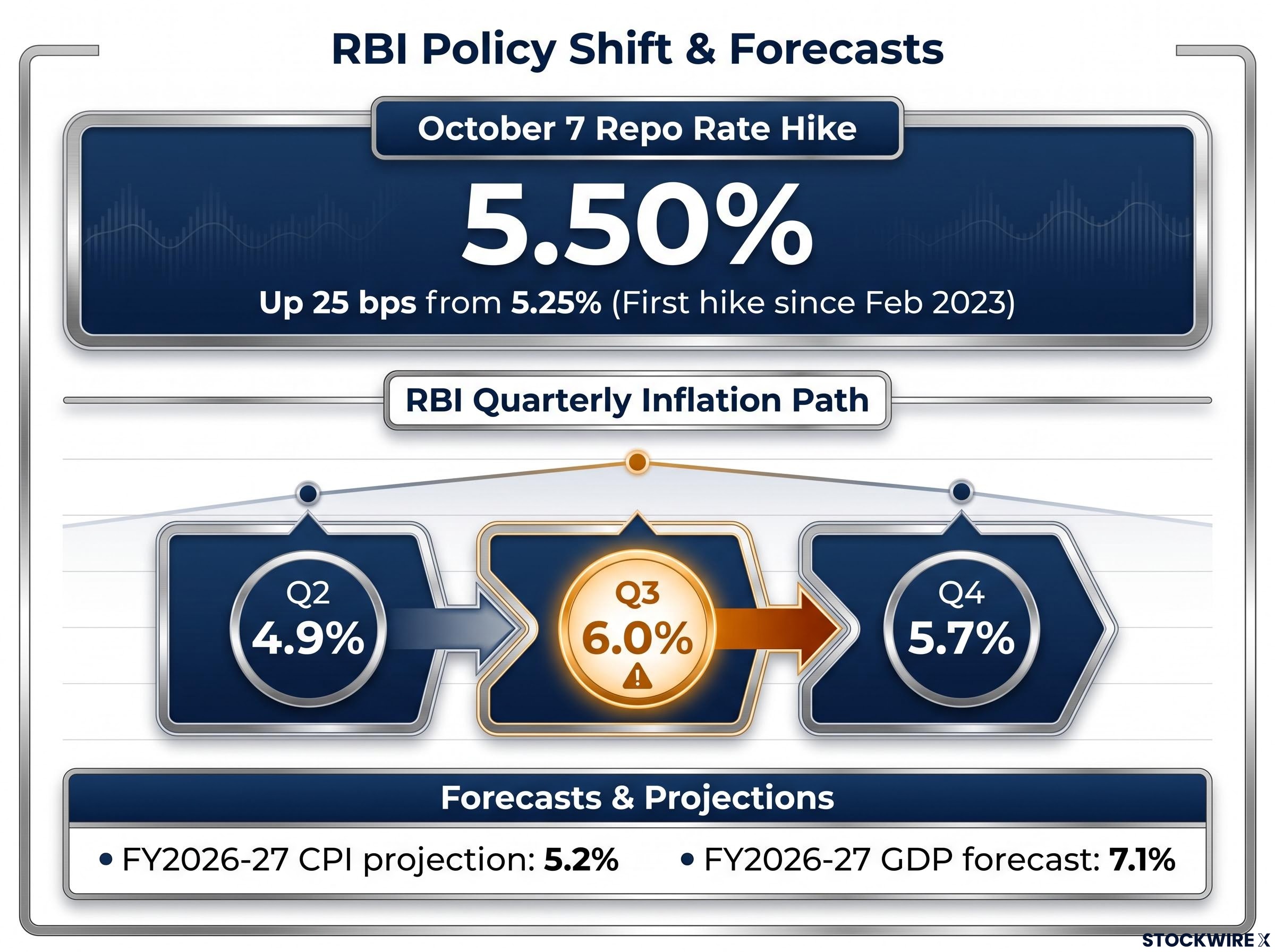
The RBI’s Monetary Policy Committee lifted the repo rate (the rate at which the central bank lends to commercial banks) by 25 basis points to 5.50% from 5.25%. The vote was unanimous and the stance shifted to calibrated tightening, meaning the bank is now biased towards further increases.
The shift to a calibrated tightening stance mattered more than the 25 basis point move itself, because most economists had priced the hike in and the rupee barely reacted on the day.
This was not a one-off adjustment. It was the first hike since February 2023, and Governor Sanjay Malhotra signalled that near-term rate cuts were no longer appropriate.
The RBI’s own forecasts explain why. It raised its FY2026-27 CPI projection to 5.2% from 5.0% (some reports cite 5.1%) and lifted its GDP growth forecast to 7.1% from 6.7%, a combination of strong growth and sticky prices that leaves little room for easing.
RBI quarterly inflation path Q2: 4.9% | Q3: 6.0% | Q4: 5.7%
That projected 6.0% in Q3 sits right on the ceiling of the band. For you, that makes a December hike the central scenario to watch rather than a tail risk.
Economists remain divided on how far the cycle runs. The debate turns on whether September’s food shock fades or whether broadening pressure forces another move.
| Institution | View | Rationale |
|---|---|---|
| Commerzbank | Another 25bp to 5.75% possible at the 2-4 December meeting, perhaps another in Q1 2027 | Upside risks from oil, a weaker rupee and El Niño rainfall |
| Nomura (Sonal Varma) | Expected two hikes to 5.75%; October done, December remains | Faster food and oil inflation, stronger underlying momentum |
| Reuters poll | About 60% expected the October hike; December seen as likely | Broadening inflation, solid growth, currency pressure |
| ICICI Securities PD (Abhishek Upadhyay) | Supported starting the cycle | Inflation about 20bp above the RBI’s quarterly forecast |
| ICRA | Rising core strengthens the case for action | Pressure not confined to food |
Rather than a single forecast, this gives you a checklist: core inflation, oil, the rupee and food persistence will decide the December outcome.
What the RBI’s rupee-defence package actually does
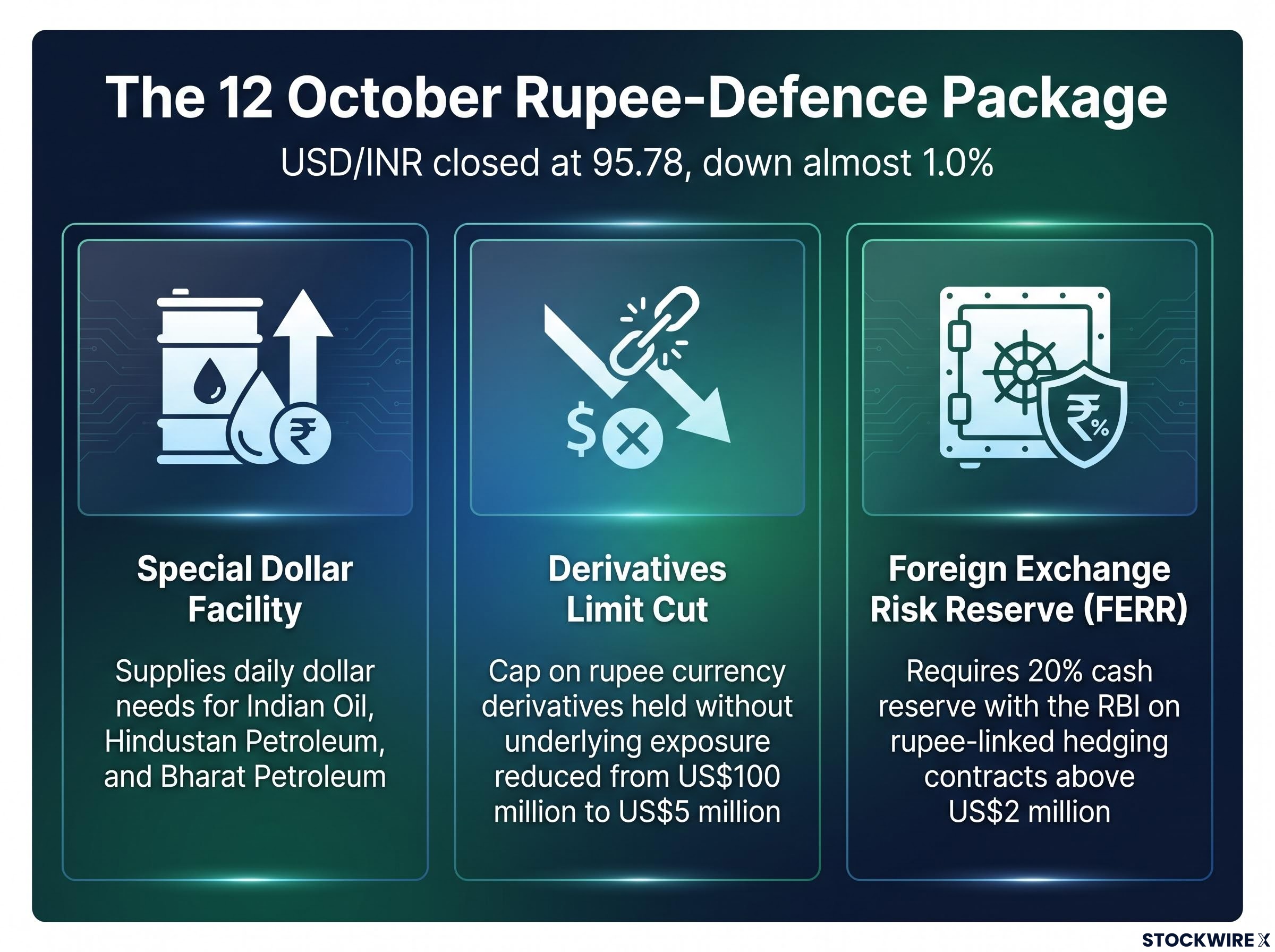
The visible result came quickly. USD/INR closed at 95.78 on 12 October, down almost 1.0% from recent levels near 97, while Bloomberg recorded a close of 95.7575, the rupee’s largest one-day rise since April.
Behind that move sit three tools, each aimed at a different source of dollar demand:
- Special dollar facility: the RBI supplies the daily dollar needs of Indian Oil, Hindustan Petroleum and Bharat Petroleum through designated banks, targeting state oil-company buying.
- Derivatives limit cut: the cap on rupee currency derivatives held without an underlying exposure falls from US$100 million to US$5 million, targeting speculative positions.
- Foreign Exchange Risk Reserve (FERR): a cash reserve requirement on larger hedges, targeting heavy users of rupee-linked contracts.
The oil facility works by taking those companies out of the interbank spot market, where banks trade currencies for immediate delivery. Their large daily purchases no longer push the dollar higher on open screens.
The derivatives cut applies across all dealers combined and, for exchange-traded contracts, across exchanges taken together. A derivative “without underlying exposure” is a currency bet not tied to any real import, export or loan, so the change squeezes traders positioning against the rupee rather than firms with genuine trade flows.
The FERR is more intrusive. For rupee-linked contracts above US$2 million used to hedge current-account exposure (payments for goods and services), dealers must hold cash with the RBI equal to 20% of the rupee notional value, alongside limits on rebooking cancelled contracts and tighter paperwork.
The intent is to curb speculation, not ordinary hedging. In practice, the line between the two may prove costly to police.
These measures change who can buy dollars and how, but they do not create dollars. They buy time for the rate hike to work rather than replacing it.
Why this resembles 2013, and where it differs
Bloomberg’s assessment The package ranks among the RBI’s toughest measures since the 2013 taper tantrum rupee crisis.
Both episodes involved intense depreciation pressure and a need to restore confidence fast. In 2013, the RBI also relied on emergency liquidity tightening and steps to attract foreign capital, whereas the 2026 package leans on market-access limits and targeted dollar supply.
The general lesson holds across both. Administrative measures produce a sharp first response, but lasting stability needs the underlying dollar imbalance reduced.
What the measures mean for USD/INR and importers’ hedging costs
The relief is real, but so is the bill. The same intervention that lifted the rupee also raises the price of protecting against it.
Reports citing Moneycontrol, Kotak and IDFC First Bank estimate importers’ hedging costs could rise by about 1.1-1.6 percentage points, though these figures have not been independently confirmed. Nomura’s Sonal Varma has warned the measures could raise hedging costs and dent FX liquidity, widening bid-offer spreads (the gap between buying and selling prices).
| Channel | Likely effect | Caveat |
|---|---|---|
| USD/INR | Initial gain of about 1%; Commerzbank sees a 94-96 range | Cannot permanently offset oil, outflows or a wider current-account deficit |
| Importers’ hedging costs | Reported rise of 1.1-1.6 percentage points | Not independently confirmed; depends on maturity and funding costs |
| FX liquidity | Thinner trading, wider spreads (Nomura) | Activity may migrate to other instruments or offshore |
| Banking-system liquidity | Emkay Global: FERR could absorb ₹450-500 billion; SBI: ₹80,000 crore rolling, package possibly over ₹1 trillion | Not independently confirmed; depends on contract volumes |
| Reserves | Fewer open RBI spot dollar sales | The import need remains; only the channel changes |
The liquidity drain matters because cash parked with the RBI is cash banks cannot lend, which tightens financial conditions on top of the rate hike. Some commentators have already labelled the package a “quick fix” without structural measures.
For anyone with rupee exposure, the trade-off is direct: a stronger rupee in the near term, but a higher price for protection. Your hedging decisions should assume wider costs and thinner liquidity than before 12 October.
The USD/INR outlook now hinges on the 96.00 level: a daily close back above it would suggest the policy effect is fading, while a hold below it implies the package is still working.
Three variables will decide whether the rupee holds its gains:
- Oil prices, which set the size of India’s import bill
- Capital outflows, which determine dollar supply beyond the RBI’s control
- Inflation, which shapes how far the RBI must tighten
Reading the RBI’s two-front fight: what holds and what could break
The inflation fight and the currency fight form one loop. Food and oil push prices up, a weaker rupee amplifies them, and the RBI’s tools aim to break the chain at both ends: the 5.50% repo rate on demand, the FX package on dollar pressure. A December move to 5.75% depends on whether core inflation and the rupee confirm the case.
A hawkish RBI repricing can be rupee-positive if it triggers a credible rate response, which is why Commerzbank and DBS argue that worsening inflation may counterintuitively support the currency.
Watch these signals before forming a view:
- October CPI against the 6% ceiling
- The 2-4 December policy meeting
- Crude oil prices
- USD/INR against Commerzbank’s 94-96 range
If you track only one, make it October CPI; a breach of 6% would make the December hike close to a given.
This article is for informational purposes only and should not be considered financial advice. Investors should conduct their own research and consult with financial professionals before making investment decisions. Past performance does not guarantee future results. Financial projections are subject to market conditions and various risk factors, and forward-looking statements are speculative and subject to change.