
Two stocks gapped higher before the opening bell on Monday, 12 October 2026, on deals that nobody involved has confirmed. Iren rose about 5% premarket on a reported multi-year AI cloud arrangement with Anthropic. CCC Intelligent Solutions climbed roughly 9.5% to 13%, depending on the session and source, on reported advanced buyout talks with GTCR and Elliott Investment Management.
The market has paid for something with no disclosed price, no contract size and no filing. These takeover rumours and deal reports have turned each stock into a bet on terms that do not yet exist in public.
Headline-driven re-ratings on incomplete information are where self-directed investors most often buy the top or miss the logic entirely. The Iren story came from a paywalled report in The Information, while the CCC story came via Bloomberg and was confirmed by Reuters.
Here is a way to judge what each report actually justifies in a share price, and the questions worth asking before you react to the next one.
What did the Iren-Anthropic report actually establish, and what did it leave out?
The optimistic read is easy to construct. According to The Information’s 11 October report, relayed by secondary outlets, Iren agreed a multi-year AI cloud services contract under which Anthropic can reserve big blocks of GPUs (the chips used to run AI models), gaining greater flexibility and a lower price than it would get leaning only on hyperscale providers.
Investing.com recorded a premarket gain of about 5%, while some overnight summaries cited moves of 8-9%. Invezz, citing AI Weekly, went further, identifying Anthropic as the “mystery artificial intelligence cloud customer” Iren alluded to on its August 2026 earnings call.
Then the gaps start piling up.
| Question | What is reported | What is not disclosed |
|---|---|---|
| Deal value | A multi-year AI cloud services arrangement | No dollar value |
| Contract term and structure | Flexible GPU access at lower cost than hyperscalers alone | Whether revenue is committed or optional |
| GPU capacity | Large clusters | No GPU count or contract size |
| Anthropic confirmation | Sources familiar with the matter | No joint press release or SEC filing |
The reported purpose ties to Anthropic’s planned initial public offering: securing compute so shortages do not cap growth before and after listing. That IPO remains planned, with no filed registration statement or timetable in the coverage. Both readings below start from the same thin facts.
The bullish reading
A Canadian edition of Investing.com said the deal “shows Iren can deliver and run high-performance AI computing centers” and signals strong demand for third-party AI infrastructure. Set against Iren’s contracted annual recurring revenue (ARR) target of $4 billion for 2026 capacity, and operating ARR of roughly $1 billion in late August, a frontier-lab customer would help close that gap.
The skeptical reading
Skeptics argue such arrangements may buy Anthropic optionality on GPU access rather than committed, take-or-pay revenue, meaning payment owed whether or not capacity is used. Concentration risk follows, as does counterparty risk tied to Anthropic’s funding and its relationships with Amazon and Google.
What this tells you is that one customer can change how the market values a smaller provider overnight. Until contract economics surface, though, you are buying a narrative about demand, not a revenue line.
Investors exploring how to size an AI compute contract once numbers do emerge can use our deep-dive into evaluating AI infrastructure deals, which converts headline contract value into ARR and capex payback ratios.
When big ASX news breaks, our subscribers know first
Why did CCC jump before anyone named a price?
The CCC move followed a cleaner sequence, and watching it unfold shows a probability being repriced rather than a valuation being set.
Bloomberg reported that GTCR and Elliott were in advanced discussions to acquire the Chicago-based provider of car-insurance claims software, and Reuters confirmed. CCC carried a pre-report market capitalisation of about $4.1 billion.
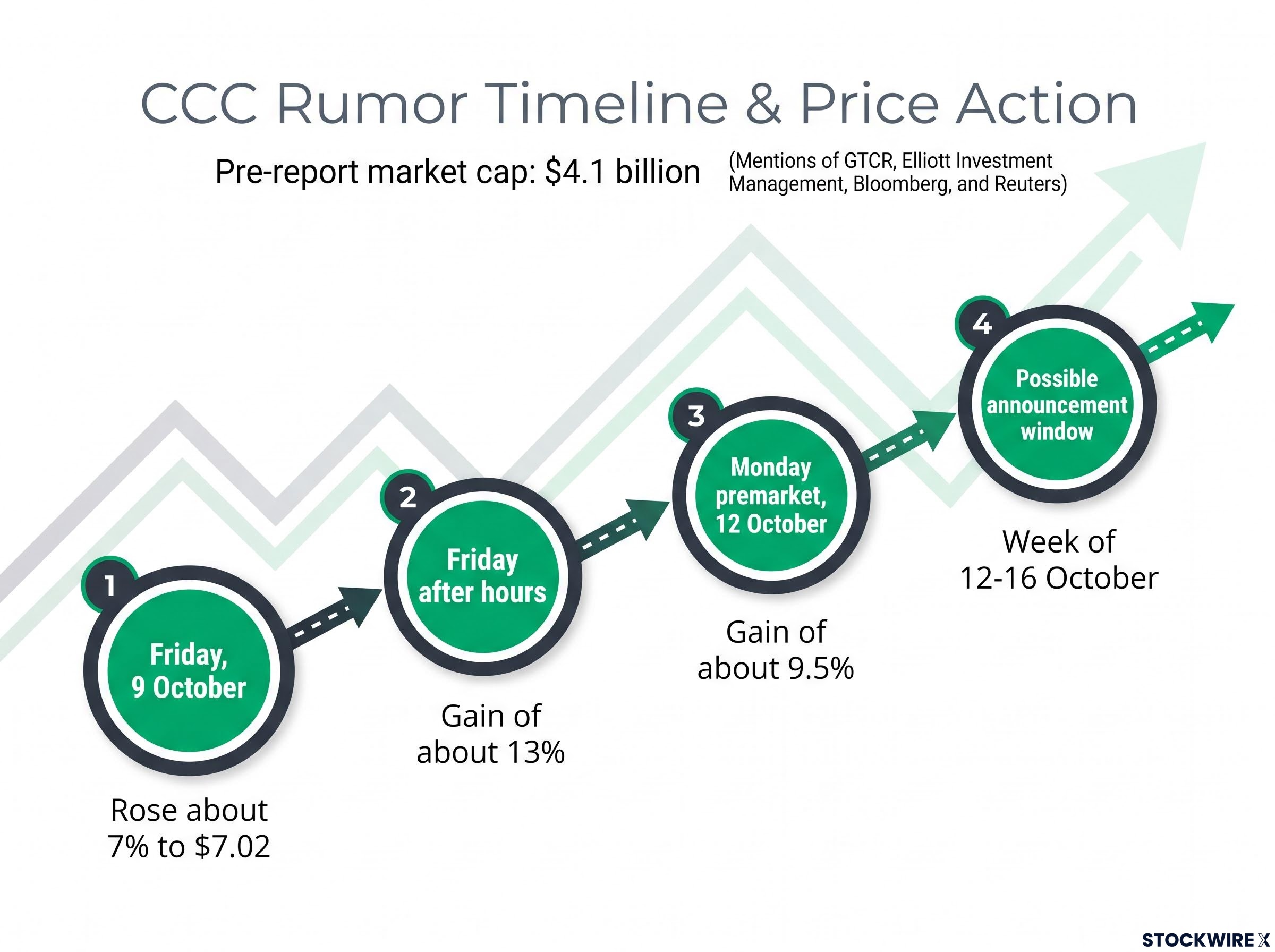
- Friday regular session, 9 October: CCC rose about 7% to $7.02.
- Friday after hours: Bloomberg’s report landed after the close; Seeking Alpha, Tekedia and Reuters-based coverage cited a gain of about 13% in extended trading.
- Monday premarket, 12 October: The Bloomberg-based source reported a gain of about 9.5%.
- Possible announcement window: As early as the week of 12-16 October.
The gap between the 13% and 9.5% figures most likely reflects different sessions and timestamps rather than a contradiction. Neither number is the definitive one, and treating either as settled would overstate what is known.
The pattern is not new: unconfirmed bid rumours, such as the GameStop and eBay reports in May, sent shares surging after hours with no filing, financing or company statement behind them.
The caveats in the original reporting matter just as much as the numbers. No final agreement had been reached, timing and details could change, talks could end and another bidder could emerge.
The odds, not the value Finimize described the move as “as much about changing odds as it is about CCC’s underlying results,” pointing to “no disclosed price, no signed agreement, and talks can break down.”
That framing is the right lens. The CCC move tells you the market’s estimated probability of a deal rose, not that anyone has agreed what CCC is worth. If you are weighing the remaining upside, you are weighing it against a failure risk that nobody has priced precisely.
How do markets price takeover rumours, and where does the logic break down?
Both stocks gapped rather than drifted. The reason sits in how professional deal investors think.
Probability, not valuation
Merger arbitrage is a strategy of buying a takeover target after a bid is known and profiting from the gap between its share price and the offer. That gap is called the spread. With a known bid, the target trades at a discount to the offer that reflects failure risk and time value, and the discount widens where financing or regulatory doubts are higher.
Academic work on merger arbitrage shows that even signed all-cash deals generally trade below the offer price until closing. Pre-announcement situations stack further uncertainty on top, because the deal itself is not yet agreed.
| Situation | Price known? | Can a spread be computed? | Typical behaviour |
|---|---|---|---|
| Signed all-cash deal | Yes | Yes | Trades below offer until closing |
| Advanced talks, no price (CCC) | No | No | Gap-driven, volatile trading |
| Commercial deal, no economics (Iren) | No | No | Re-rating on inferred demand |
Why a spread cannot be calculated yet
With no reported price for CCC, there is nothing to measure a discount against. Investors instead infer a plausible private-equity multiple for a vertical SaaS company (software sold by subscription to one specific industry) with activist involvement, then shave it for execution risk. Every new headline shifts that estimate in a jump, which is why the trading arrives in gaps.
Precedent complicates the optimism. In 2023-2024, smaller data-centre and GPU-hosting firms, including bitcoin miners pivoting to AI, re-rated sharply on compute deals before economics emerged, then often turned volatile once filings clarified contract size, utilisation and margins. Software take-privates have similarly given back gains when talks stalled, and Elliott’s presence raises the odds of a sale without guaranteeing one.
No quantitative base rate for Bloomberg-reported “advanced talks” ending in signed deals turned up in the research, so the true odds remain an estimate. For you, a rumour-driven premium is a double bet: that the deal happens, and that the terms are generous. The gaps in both stocks are the market pricing that uncertainty, not delivering a verdict.
A framework for weighing unconfirmed deal reports
The mechanism becomes useful when you turn it into questions you can ask before placing a trade. Here are five, applied to both cases.
- How good is the source? Iren rests on a paywalled report relayed second-hand; CCC has Bloomberg plus Reuters confirmation, which is stronger but still anonymous.
- Which terms are missing? Iren lacks value, size and structure; CCC lacks a per-share price, premium and total transaction value.
- Is financing exposed? CCC is a leveraged buyout candidate, so credit-market shifts or weaker lender appetite could prompt a reprice or walkaway; Iren’s version is Anthropic’s funding and planned IPO.
- What obstacles sit in the way? Antitrust scrutiny is a live risk in data-intensive software and AI deals, and CCC shareholders, activists included, may demand more.
- Where does the price go if it fails? Tekedia noted no final agreement exists, meaning CCC buyers face rapid reversal; Iren could give back gains if disclosed economics underwhelm.
Even the strongest outlets rely on sources “familiar with the matter,” whose information can be partial or outdated.
The PayPal episode in August showed how takeover speculation risks play out when talks collapse: the stock gave back its entire premium within hours, and holders without a standalone valuation had nothing to fall back on.
The key warning Accurately reported talks can still fail. A correct story about negotiations is not a promise of a signed deal.
In the US, confirmation arrives in specific documents. These are the signals to watch for:
- A definitive agreement announcement
- An 8-K filing with the SEC (the form companies use to report material events)
- Joint statements from both parties
- A disclosed contract value
The macro backdrop adds noise too. Nasdaq 100 futures were flat and S&P 500 futures up about 0.1% this morning, with earnings and inflation data due, so both stocks could move for reasons unrelated to either deal. Your strongest protection is deciding before you trade what evidence would change your mind, and how much you can afford to lose if the deal falls through.
These statements are speculative and subject to change based on market developments and company performance.
What these two moves do, and do not, tell you
Iren shows the market paying up for AI compute access before any economics are disclosed. CCC shows it pricing the odds of a private-equity deal before a price exists. Both moves are about expectations, and both can unwind if what is eventually signed falls short.
The next checkpoints are concrete. For CCC, watch for any announcement during the week of 12-16 October. For Iren, watch for an Iren or Anthropic disclosure, filing or earnings detail that puts a number on the contract.
This article is for informational purposes only and should not be considered financial advice. Investors should conduct their own research and consult with financial professionals before making investment decisions.
—