
HARNESS-1 safety committee clears RC220 to escalate to 100 mg/m²
Racura Oncology announced on 12 October 2026 that the Safety Review Committee (SRC) has cleared RC220 to move to the next planned dose level of 100 mg/m² in the Phase 1 HARNESS-1 trial (RAC-020). The trial is evaluating the safety and tolerability of RC220 in combination with osimertinib in patients with Epidermal Growth Factor Receptor-mutant Non-Small Cell Lung Cancer (EGFRm NSCLC).
The SRC reviewed all safety data from both Cohort 1 patients, who received RC220 at 50 mg/m² with osimertinib at 80 mg daily. No dose-limiting toxicities or treatment-related safety concerns were identified in either patient during the safety observation period.
The second Cohort 1 patient has received three doses of RC220 21 days apart without any dose-limiting toxicities or treatment-related safety concerns. Pre-screening is now underway to recruit the single patient in Cohort 2, who will be dosed with 100 mg/m² of RC220.
Dr Daniel Tillett, CEO and Managing Director
“We are pleased with the SRC’s clearance, which allows RC220 to progress to the next dose level in the HARNESS-1 trial. This is an important early milestone for the trial and reflects the disciplined execution of our clinical development plan…”
For investors, the update means the trial can move from Cohort 1 to Cohort 2 under its planned dose-escalation steps.
When big ASX news breaks, our subscribers know first
Why Cohort 1 had two patients
Cohort 1 included two patients because the SRC requested an additional patient be dosed at 50 mg/m². This followed the first patient experiencing Grade 2 colitis outside the safety observation period.
The cause of the colitis could not be determined, and the SRC could not exclude a role for RC220. The second patient experienced no colitis symptoms after any of the three RC220 doses received.
The colitis finding emerged after the first SRC safety review, which cleared HARNESS-1 to continue but required one more patient at 50 mg/m² before any move to the next dose level.
The additional patient reflects the SRC reviewing safety data and requesting further information before dose escalation. The colitis event remains part of the Cohort 1 record alongside the clean safety result in the second patient.
How HARNESS-1 dose escalation works
An SRC is a group of clinicians and trial experts that reviews patient safety data. Its role is to determine whether the safety data support moving to the next planned dose level. It does not decide whether the medicine is commercially valuable or effective.
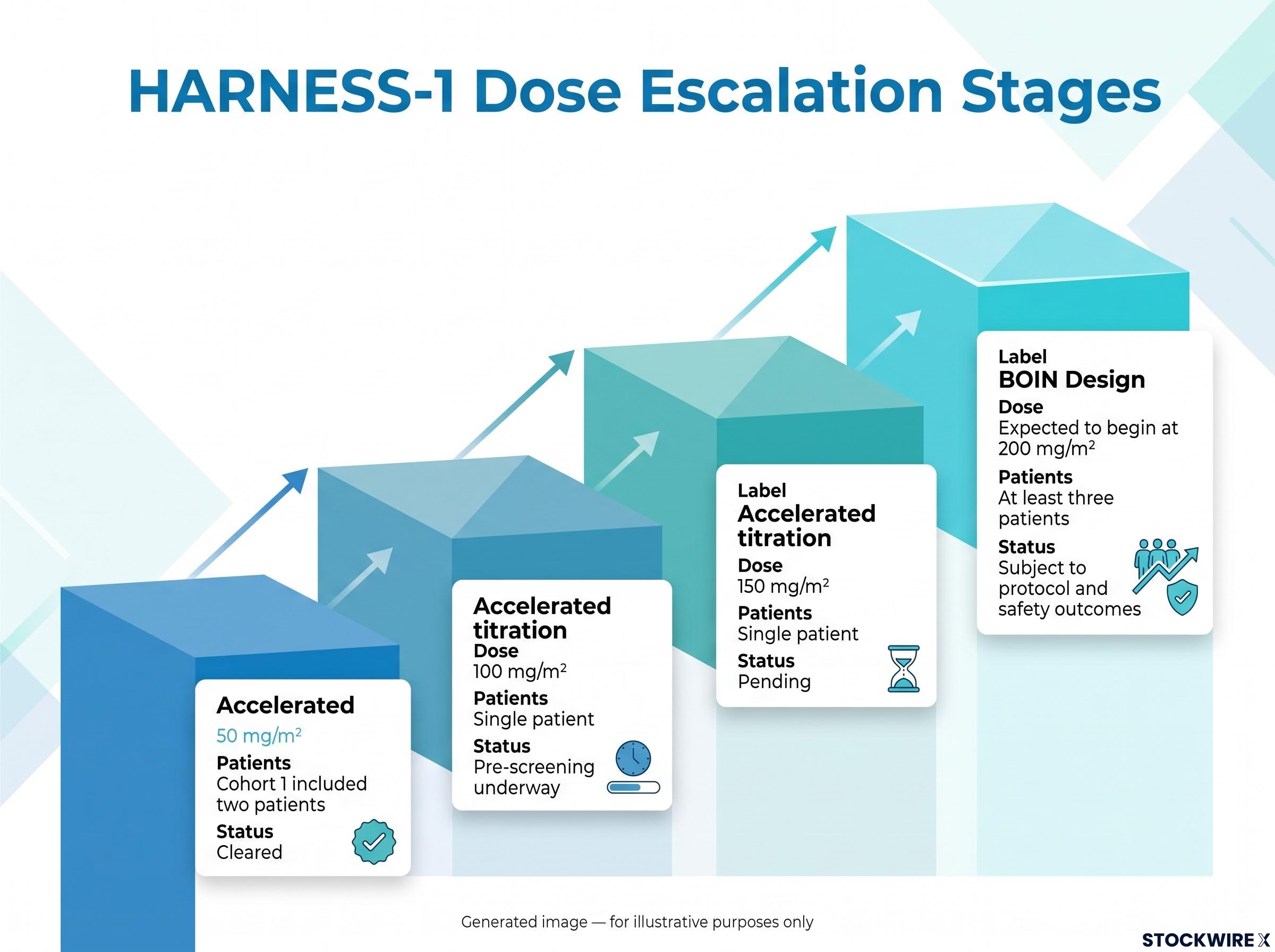
HARNESS-1 is based on an accelerated titration design, which uses single-patient cohorts for the first three dose levels of 50, 100 and 150 mg/m². Once that stage is complete, the trial transitions to a Bayesian Optimal Interval (BOIN) design, where at least three patients are included at each dose level, providing additional safety data.
| Stage | Dose levels | Patients per cohort | Status |
|---|---|---|---|
| Accelerated titration | 50 mg/m² | Single patient (Cohort 1 included two patients) | Cleared |
| Accelerated titration | 100 mg/m² | Single patient | Pre-screening underway |
| Accelerated titration | 150 mg/m² | Single patient | Pending |
| BOIN | Expected to begin at 200 mg/m² | At least three patients | Subject to protocol and safety outcomes |
Each dose step follows the same cycle:
- A patient is treated at a set dose.
- The patient is monitored through the 21-day safety observation period.
- The SRC reviews the safety data.
- If cleared by the SRC, the trial moves to the next dose.
This step-by-step approach helps the trial build safety information while limiting each patient’s exposure to higher doses before the safety data have been reviewed.
A comparable step was taken in CPACS trial dose escalation, where the Safety Review Committee cleared RC220 to move from 40mg/m2 to 80mg/m2 after no dose-limiting toxicities across three Cohort 1 patients.
What happens next for RC220 and what is not yet known
The next steps in HARNESS-1 are:
- Enrolment of the single Cohort 2 patient, who is expected to receive RC220 at 100 mg/m² with osimertinib at 80 mg daily, if an identified patient meets the trial requirements.
- Monitoring of the patient for the required period, followed by SRC review of the safety data.
- Progression to the 150 mg/m² single-patient cohort, then, subject to the trial protocol and safety outcomes, the BOIN stage at 200 mg/m².
Timing is event-driven rather than date-driven. It depends on enrolment progress, site capacity and SRC meeting scheduling, and Racura will update the market as required under its ASX continuous disclosure obligations.
Expectations should be kept in context. The announcement contains no efficacy data, and dose-escalation clearance does not prove that RC220 works against EGFRm NSCLC in combination with osimertinib. The absence of dose-limiting toxicities is described as an encouraging early safety result, but it is based on just two patients at the lowest dose level.
RC220 is Racura’s proprietary formulation of (E,E)-bisantrene. The company’s clinical programmes also include the EMILI Phase 3 trial in acute myeloid leukaemia and the CPACS-1 Phase 1 trial in combination with doxorubicin.
Clinical details for HARNESS-1, including open and recruiting sites, are available from the Australian New Zealand Clinical Trials Registry under trial code ACTRN12626000325303. Enquiries can be directed to trials@racuraoncology.com. The Principal Investigator is A/Prof Surein Arulananda, working with the Monash Health team.
Get Biotech News Before the Market Moves
Join 20,000+ investors receiving FREE breaking ASX news within minutes of release, complete with in-depth analysis and the full announcement. Click the “Free Alerts” button at Big News Blast to get healthcare and biotech updates the moment they break and stay ahead of the market.