

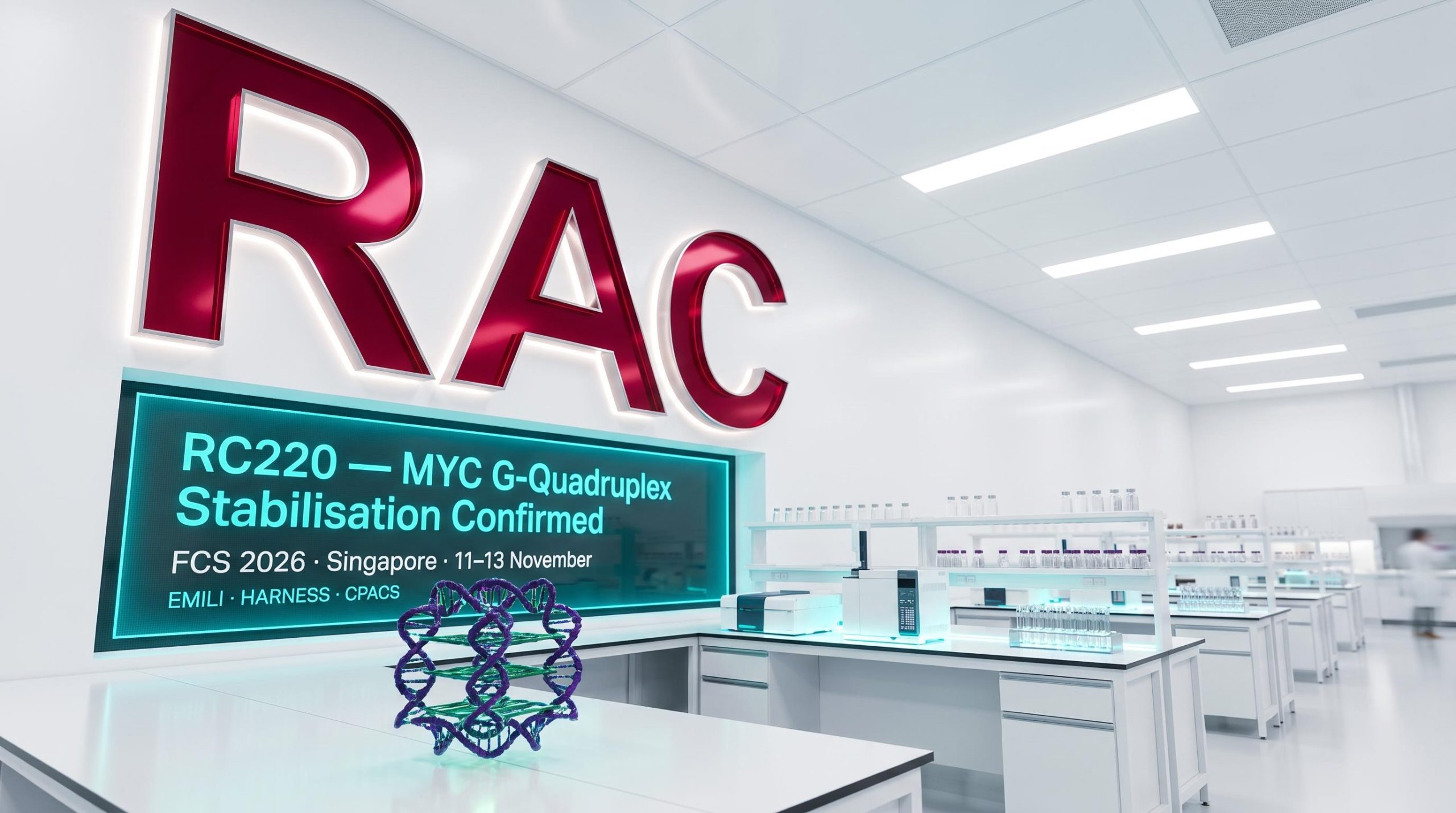
RC220’s MYC-silencing mechanism validated ahead of FCS 2026 poster presentation
Racura Oncology (ASX: RAC) has been selected to present preclinical RC220 data at the 2026 Frontiers in Cancer Science (FCS) Conference, held in partnership with the American Association for Cancer Research (AACR) in Singapore from 11–13 November 2026. The data confirms that (E,E)-bisantrene is the active isomer responsible for stabilising G-quadruplex (G4) DNA in the MYC gene promoter, leading to MYC suppression. The accepted abstract will subsequently be published in the AACR peer-reviewed journal Cancer Research.
When big ASX news breaks, our subscribers know first
What the preclinical data shows
(E,E)-bisantrene confirmed as the active isomer
Bisantrene can exist in different molecular configurations, known as isomers. The key finding from Racura’s preclinical studies is that the (E,E)-isomer is the configuration responsible for the therapeutic effect.
When bisantrene is exposed to visible light, it converts into less active (E,Z) and (Z,Z) mixtures. This photoisomerisation significantly reduces G4 stabilisation, MYC silencing, and anticancer activity. The abstract’s conclusion states it plainly: “Photoisomerization to (E,Z)- and (Z,Z)-bisantrene weakens c-MYC G4 binding/stabilization, reduces c-MYC silencing, and diminishes anticancer activity, supporting light protection and clinical use of pure (E,E)-bisantrene.”
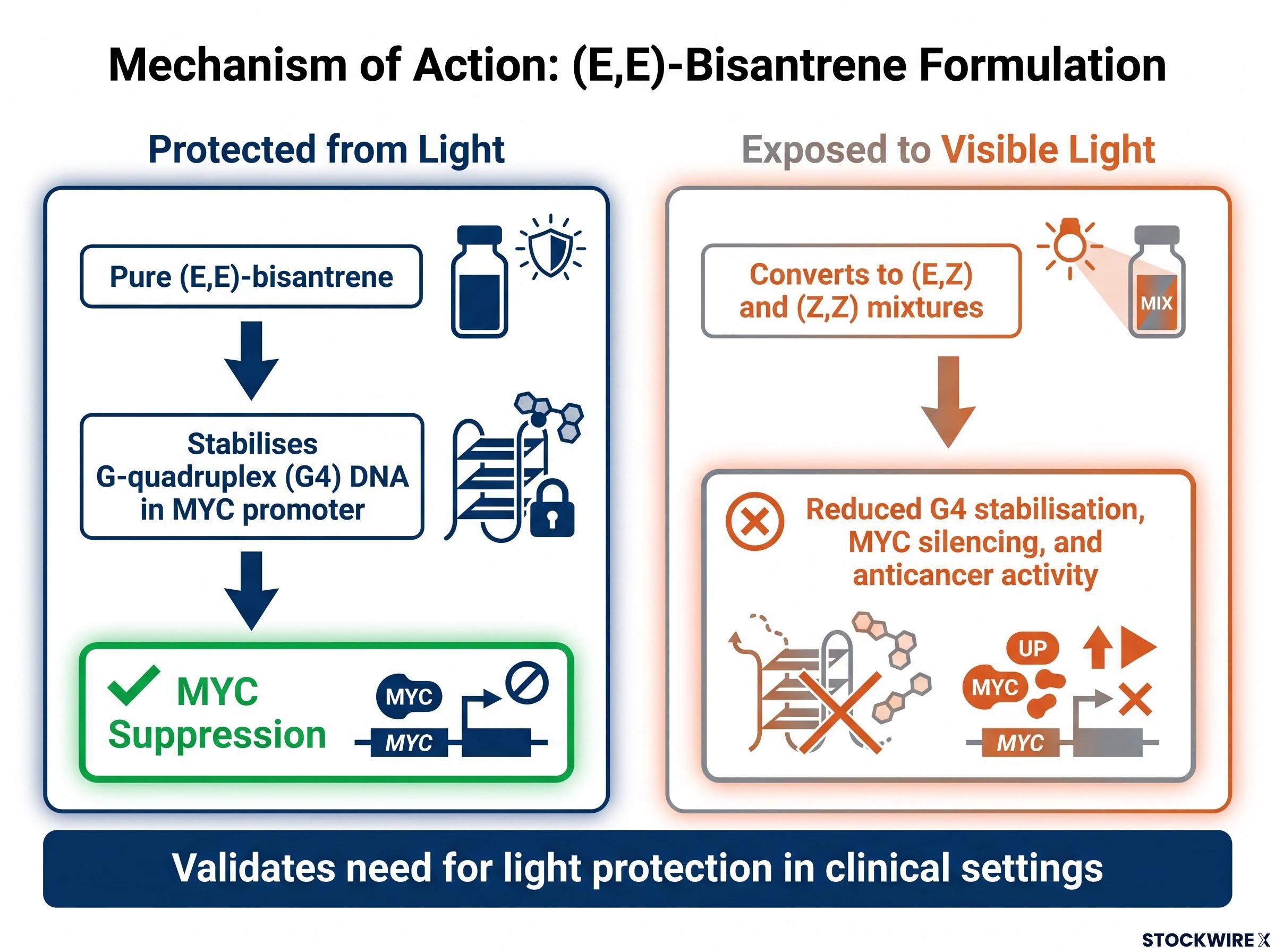
These findings validate Racura’s formulation approach. Protecting the (E,E)-isomer from light exposure is critical to maintaining the therapeutic potency of RC220 in clinical settings.
Why MYC matters in cancer
MYC is a protein that controls the expression of many cancer-related genes, including those involved in cell growth, survival, metabolic reprogramming, therapy resistance, and immune surveillance. It is dysregulated in up to 70% of all cancers, making it one of the most consequential targets in oncology.
Despite this, MYC has long been considered “undruggable” by the pharmaceutical industry. Its structure does not lend itself to conventional small-molecule inhibition, which is why it has historically resisted therapeutic targeting.
The MYC gene promoter contains a structural region known as G-quadruplex (G4) DNA. When a small molecule binds to and stabilises this region, MYC expression is suppressed. This is precisely what (E,E)-bisantrene achieves. For investors, a drug candidate targeting a gene dysregulated across up to 70% of cancers — one the industry has historically viewed as inaccessible — represents a potentially broad addressable opportunity, and mechanistic validation of this kind strengthens the scientific rationale underpinning the clinical programs.
Strengthening the IP position and clinical programs
The FCS conference results support Racura’s patent filings in several areas:
- Protection of (E,E)-bisantrene from light-induced photoisomerisation
- Manufacture and formulation of pure (E,E)-bisantrene
- Composition of matter claims on (E,E)-bisantrene, (E,Z)-bisantrene, and various isomer mixtures
If granted, these filings could provide up to 20 years of patent protection. The preclinical data provides mechanistic support — not merely empirical evidence — for three active clinical programs currently underway:
- EMILI — Phase 3 trial in acute myeloid leukaemia (AML)
- HARNESS — Phase 1a/b trial combining RC220 with osimertinib for EGFR-mutated non-small cell lung cancer (NSCLC)
- CPACS — Phase 1a/b trial combining RC220 with doxorubicin for anthracycline cardioprotection and enhanced anticancer activity
Dr Daniel Tillett, CEO and Managing Director
“These results reinforce our focus on (E,E)-bisantrene and underpin the clinical development strategy for RC220… We are pleased this work has been accepted for FCS 2026, a respected international cancer science conference held in partnership with AACR.”
What’s next for Racura Oncology
The FCS Conference takes place in Singapore from 11–13 November 2026, with the accepted abstract subsequently to be published in Cancer Research, the AACR’s peer-reviewed journal.
The FCS presentation builds on data already presented at the 2026 AACR Annual Meeting in April 2026, establishing a growing body of peer-reviewed evidence supporting the RC220 program. Each successive presentation adds to the mechanistic understanding of how (E,E)-bisantrene acts on the MYC pathway.
The FCS presentation builds directly on AACR Annual Meeting data published in April 2026, which reported a binding affinity of 208 nM to c-MYC G4 and confirmed MYC expression was suppressed in breast and lung cancer cells within two hours at EC50 values between 322.5 nM and 518.1 nM.
Racura is a Phase 3 clinical-stage biopharmaceutical company. Beyond its active clinical programs, the company is exploring partnerships, licence agreements, and potential commercial merger and acquisition opportunities to accelerate global patient access to RC220. No financial guidance or clinical timelines were disclosed in this announcement.
Investors wanting full context on how the RC220 pipeline is funded can find our detailed coverage of Racura’s $34.3 million capital raise, which outlines how the three active trial programs are financed, the fee-free structure of the raise, and management commentary on anticipated clinical milestones in the coming months.
Don’t Miss the Next ASX Healthcare Breakthrough
Big News Blast delivers FREE breaking ASX healthcare news directly to your inbox within minutes of release, complete with in-depth analysis already done for you. Join 20,000+ investors who never miss a market-moving announcement. Click the “Free Alerts” button at StockWire X to start receiving alerts the moment news breaks.