

Racura Oncology presents CPACS Phase 1 poster at Global Cardio-Oncology Summit 2026
In a poster presented at the Global Cardio-Oncology Summit 2026 in Williamsburg, Virginia, on 7 October 2026, Racura Oncology outlined progress in its CPACS Phase 1 trial of RC220 combined with doxorubicin. The poster was titled “Cardioprotection & Anticancer Synergy (CPACS) – A Phase 1 Study of RC220 in Combination with Doxorubicin – Trial in Progress.”
The poster detailed that Cohort 1 completed the dose-limiting toxicity (DLT) evaluation period with no DLTs observed. The Safety Review Committee (SRC) supported escalation to Dose Level 2 (RC220 80 mg/m²), with all clinical data carrying a cut-off date of 30 June 2026.
Dr Daniel Tillett, CEO and Managing Director
“Presenting our CPACS clinical study at the Global Cardio-Oncology Summit highlights the growing interest in RC220’s potential to address cardiotoxicity, one of the key limitations of anthracycline-based cancer therapy, while also improving anticancer treatments…”
For investors, the update marks the trial’s progression to a higher RC220 dose following the first cohort.
When big ASX news breaks, our subscribers know first
Why anthracycline cardiotoxicity matters
Anthracyclines, a class of chemotherapy drugs that includes doxorubicin, remain central to many anticancer treatment regimens. Their clinical use is limited by irreversible cardiotoxicity, meaning damage to the heart that cannot be reversed.
RC220 is Racura’s proprietary formulation of (E,E)-bisantrene, a small molecule anticancer agent. According to the company, (E,E)-bisantrene was recently shown to act through G-quadruplex DNA and RNA binding, which leads to silencing of c-MYC oncogene expression in preclinical cancer models.
The G-quadruplex binding data presented at AACR in April 2026 measured an affinity of 208 nM to the c-MYC G4 structure, with c-MYC expression suppressed in breast and lung cancer cells within two hours.
Preclinical studies cited by Racura showed that RC220 combined with doxorubicin improved anticancer activity in human and murine (mouse) tumour models. The same combination reduced anthracycline cardiotoxicity in human cardiomyocytes (heart muscle cells) and in murine and canine cardiac models.
A treatment that achieves both effects could address a limitation of a widely used drug class. These findings are preclinical, however, and have not been demonstrated in humans. CPACS is a Phase 1 study whose primary objective is to assess safety and tolerability.
Cohort 1 safety and pharmacokinetic results
Safety and dose escalation
Cohort 1 received RC220 40 mg/m² with doxorubicin 60 mg/m². The poster reported no DLTs during the protocol-defined first-cycle evaluation period, no Grade 4 or 5 treatment-emergent adverse events (TEAEs), and no unexpected safety signals identified to date.
Treatment-related TEAEs were described as clinically manageable, with diarrhoea most frequently reported and most events resolved or resolving at data cut-off. Grade 3 TEAEs included diarrhoea, fatigue, hypotension, decreased platelet count and neutropenia.
One Grade 3 diarrhoea serious adverse event was reported as a suspected unexpected serious adverse reaction (SUSAR) during combination treatment. It was considered possibly related to RC220 and doxorubicin in the presence of potential confounding factors, and resolved with medical management.
Cohort 2 at Dose Level 2 (RC220 80 mg/m²) is enrolling, and SRC oversight continues.
The Safety Review Committee decision behind the dose escalation to 80 mg/m2 followed a review of all three Cohort 1 patients, with screening for Cohort 2 opening across Australia, Hong Kong and South Korea.
Pharmacokinetics
Pharmacokinetics (PK) describes how a drug moves through the body over time. (E,E)-bisantrene displayed a biphasic PK profile consistent with previous observations. The poster noted no apparent influence of doxorubicin on (E,E)-bisantrene PK.
Patient snapshot
The poster summarised three patients. No acute adverse events were recorded for any of them, and the sample is very small.
| Patient | Cohort | Age/Sex | Disease | Outcome |
|---|---|---|---|---|
| Patient 1 | **1** | **87** M | Metastatic prostate | Withdrawn after Cycle 1 due to frailty |
| Patient 2 | **1** | **74** M | Metastatic prostate | Completed **5** cycles; end of treatment (EOT) due to progressive disease (PD) |
| Patient 3 | **2** | **42** F | Metastatic breast (ER+/PR+/HER2-) | Completed **2** cycles; EOT due to PD |
The poster table lists Patient 3 under Cohort 2, while the same poster describes Cohort 2 as currently enrolling. The source does not explain this difference.
Trial design and what comes next
CPACS is a multicentre, open-label, two-part Phase 1 trial using a Bayesian Optimal Interval (BOIN) design in adult patients with advanced solid tumours. Enrolment is ongoing in Australia, Hong Kong and South Korea (ClinicalTrials.gov NCT06815575).
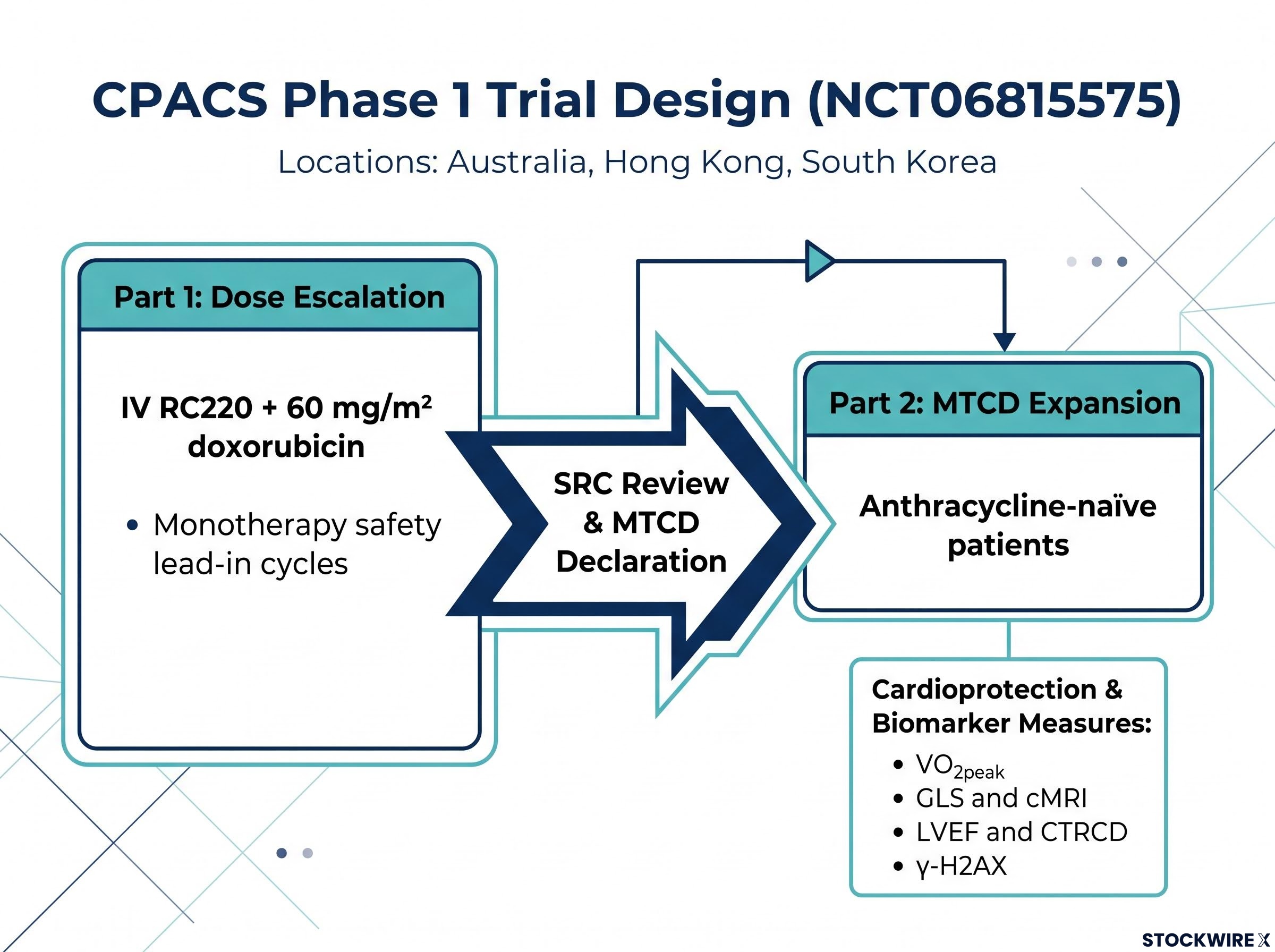
The design steps outlined in the poster are:
- Part 1: dose escalation of IV RC220 with 60 mg/m² doxorubicin, preceded by monotherapy safety lead-in cycles of each agent.
- SRC oversight and interim review.
- Declaration of the maximum tolerated combined dose (MTCD).
- Part 2: expansion at the MTCD in anthracycline-naïve patients.
Part 2 is intended to evaluate cardioprotection using complementary functional, imaging and biomarker measures, while continuing to assess antitumour activity:
- VO₂peak (peak oxygen uptake)
- Global longitudinal strain (GLS) and cardiac MRI (cMRI)
- Left ventricular ejection fraction (LVEF) and cancer therapy-related cardiac dysfunction (CTRCD)
- A pharmacodynamic (PDx) surrogate, γ-H2AX
The primary objective is safety and tolerability of the combination. Cardioprotection biomarkers are exploratory, and cardiac safety assessment forms part of Part 2.
Racura’s wider clinical programmes include the EMILI Phase 3 trial in acute myeloid leukaemia and the HARNESS Phase 1a/b trial. The company states it is actively exploring partnerships and licence agreements, and no timelines were disclosed.
Don’t Miss the Next Biotech Breakthrough
Get FREE breaking ASX healthcare news delivered to your inbox within minutes of release, complete with in-depth analysis. Join 20,000+ subscribers already staying ahead of the market. Click the “Free Alerts” button at Big News Blast to receive alerts the moment market-moving news breaks.