A big trade surplus usually points to a cheap currency. China’s central bank says that reading is wrong. A newly released document from the People’s Bank of China (PBoC) argues that the yuan’s level is not what drives the country’s export surplus; manufacturing competitiveness is.
One of the more prominent currency analysts covering China partly agrees. MUFG‘s Derek Halpenny thinks the yuan is undervalued, but he does not see the exchange rate as the main reason for the yuan trade surplus debate.
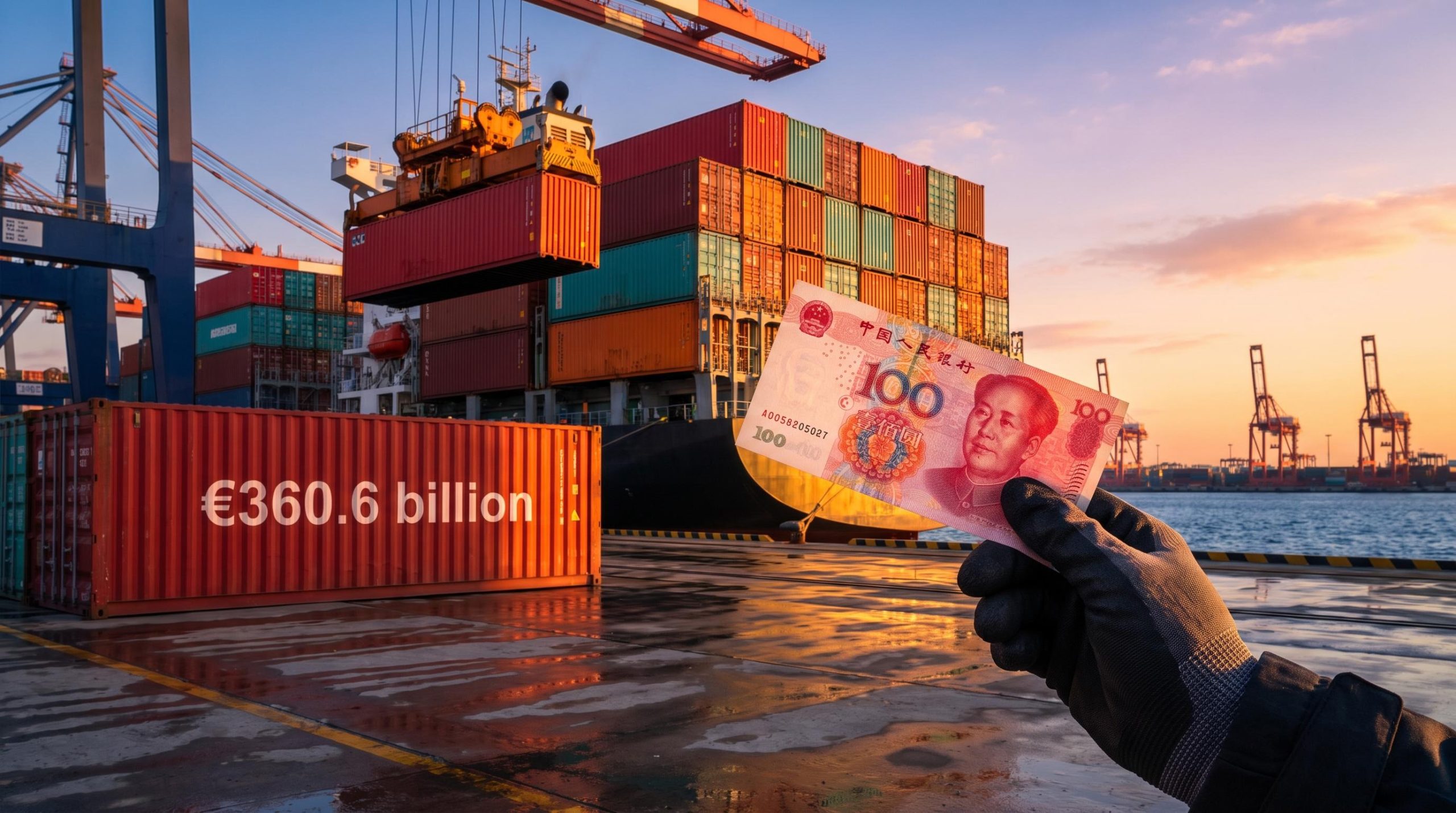
The timing is deliberate. The document surfaced while EU Trade Commissioner Maroš Šefčovič was negotiating with Chinese Commerce Minister Wang Wentao, against a bilateral surplus of €360.6 billion for 2025 and a deficit Šefčovič calls “unsustainable”. If currency appreciation offers a realistic path to rebalancing, holders of euro-yuan (EUR/CNY) exposure face a different outlook than if trade tools do the heavy lifting.
Here is how to read the real exchange rate data, where Beijing and MUFG genuinely part ways, and which signals would tell you the yuan is about to move.
Does the yuan drive China’s surplus, or does manufacturing?
Put the two positions side by side and the gap narrows quickly. According to the original FXStreet report, the PBoC document defends its currency policy and credits export strength to manufacturing. No independent coverage of the document’s wording could be located, so its exact arguments rest on that single account.
Halpenny reads the publication as a signal that Beijing will not change its stance. He considers the yuan undervalued, yet says undervaluation explains only part of China’s export strength, with manufacturing gains doing most of the work.
Beijing’s stance looks easier to hold because a record current-account surplus is already pushing the currency higher, which means a pledge not to weaken the yuan costs little today.
European officials frame the problem differently again. Their complaints centre on rising Chinese exports, “trade-distorting” goods and shrinking access to Chinese buyers, which points to subsidies and overcapacity rather than currency misalignment.
Šefčovič on the imbalance “China’s exports to the EU keep rising, while our market share in China keeps shrinking,” Šefčovič said after meeting Wang in Brussels, adding that “the status quo is not an option” (Reuters, 29 June 2026).
The EU’s goods deficit with China now runs at about €1 billion per day, and the 2025 surplus rose 15% on 2024.
| Party | Stated cause of surplus | Role of the yuan | Implied remedy |
|---|---|---|---|
| PBoC (per original source) | Manufacturing competitiveness | Not a cause | No currency change |
| MUFG (Halpenny) | Mainly manufacturing gains | Undervalued, a partial driver | Gradual appreciation plus other levers |
| EU officials | Subsidies, overcapacity, market access | Not raised explicitly | Sectoral trade measures |
| Chinese officials in trade talks | Not tied to the currency | Not raised | Cooperation in emerging sectors and services |
The research also found no other named commentary since 2024 blaming the surplus mainly on yuan undervaluation. So the real question is how much of the surplus comes from price and how much from capability. Even those who think the yuan is cheap do not believe fixing it alone would close the gap, so you should treat any appreciation call as one lever among several.
When big ASX news breaks, our subscribers know first
What the REER actually measures, and what the numbers say
The real effective exchange rate (REER) measures a currency’s value against a basket of trading partners’ currencies, weighted by trade, and adjusted for differences in inflation. A rising REER means a country’s goods are becoming more expensive abroad, so its exporters become less competitive.
How to read a REER in 60 seconds
Three parts matter: the basket (who the country trades with), the inflation adjustment (how fast prices rise at home versus abroad) and the direction (higher means less competitive). Suppose the yuan’s nominal rate against the euro stays flat for a year. If Chinese prices fall 1% while eurozone prices rise 2%, Chinese goods become roughly 3% cheaper in real terms, and the REER falls without any headline devaluation.
That is the story the Bank for International Settlements (BIS) data tells, according to the original source:
- 2005 to end-2015: the yuan’s REER rose by almost 60%, as China gave back a large share of its price advantage.
- 2022 peak to last year’s low: the index fell 20%, returning much of that competitiveness to exporters.
- Since last year’s low: a further 6.5% decline to the current level, extending the slide.
Read in sequence, the undervaluation case emerges from the data itself. Slower domestic price and wage growth, or deflation at home while partners see inflation, can push the REER lower even when the nominal rate barely moves.
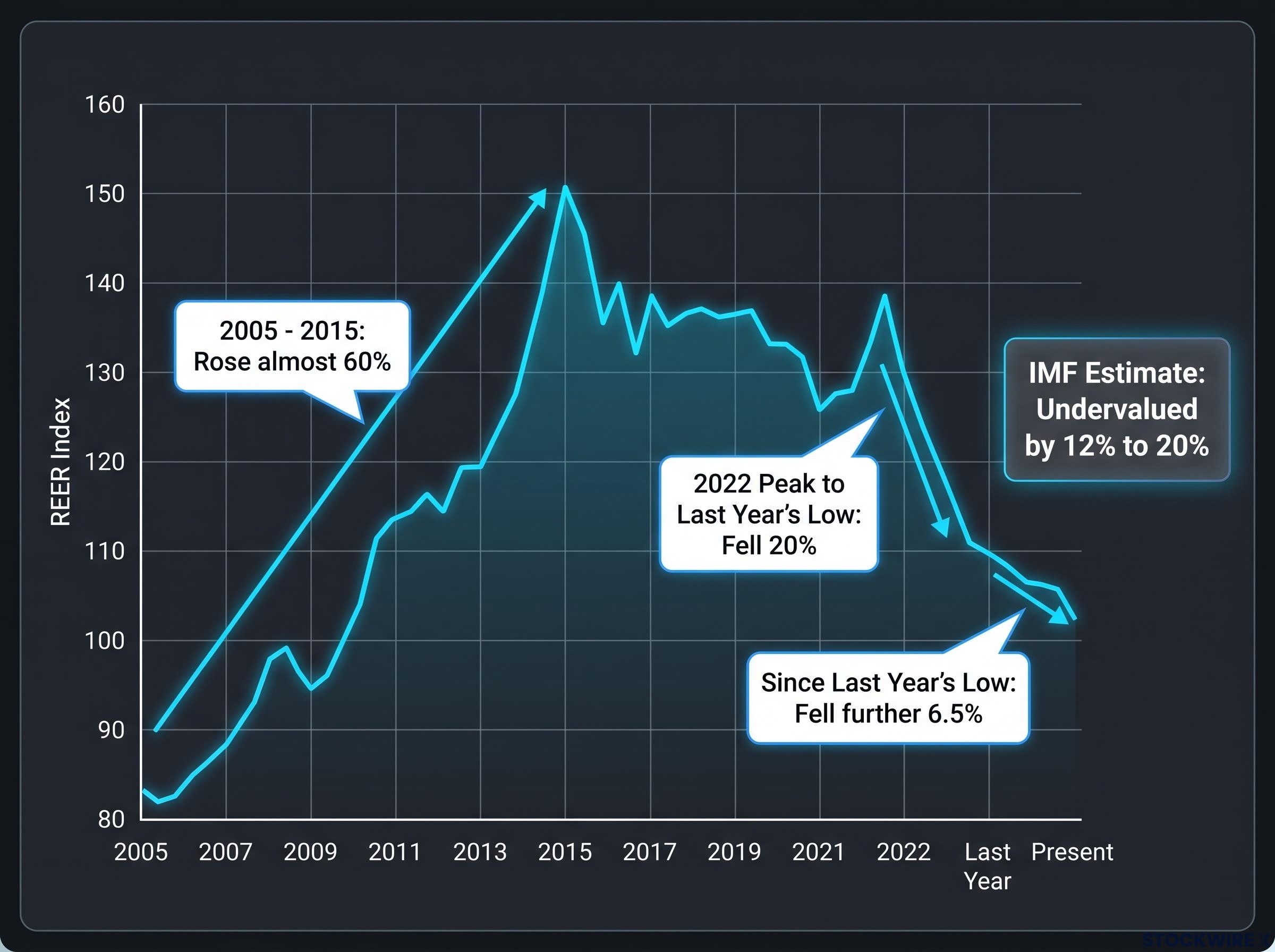
IMF valuation estimate The International Monetary Fund (IMF) estimates the yuan is undervalued by 12% to 20%, a range the original source describes as roughly consensus.
Two caveats apply. Current BIS and IMF series could not be independently verified, and a REER built on consumer prices may miss producer costs, administered prices and quality differences, so apparent undervaluation may be partly overstated. Still, the takeaway for you is clear: Chinese exporters have become cheaper in real terms without a dramatic devaluation, which is why the debate persists despite a fairly stable nominal rate.
The BIS effective exchange rate methodology derives real rates by adjusting nominal effective rates for relative consumer prices, with weights drawn from manufacturing trade flows, which explains why a consumer-price REER can diverge from measures built on producer costs.
Why trade pressure points toward a stronger yuan and a lower EUR/CNY
If the real exchange rate has fallen this far, pressure has to land somewhere. Europe is applying that pressure through a formal channel.
The diplomatic track
The Trade and Investment Consultation Mechanism (TIC) runs four workstreams: trade and investment balancing, export controls, intellectual property rights and World Trade Organization reform. Its timeline so far:
- Late June 2026: first meeting in Brussels, co-chaired by Wang and Šefčovič.
- October 2026: second meeting in Beijing, producing a 16-point list of “common understandings” plus an understanding on hybrid vehicles and rare-earth access.
- January 2027: ministerial video conference.
- March 2027: third TIC meeting.

None of this involves a currency commitment. The channel relies on sectoral tools such as price undertakings on hybrids, not explicit demands on the yuan.
The currency channel
Markets are reading the signals anyway. Halpenny notes that EUR/CNY sits 10% below its January high, and that recent dollar-yuan (USD/CNY) fixings, the PBoC’s daily reference rate, suggest a wish to keep the yuan strengthening even as the dollar gains. He sees room for EUR/CNY to fall further.
The daily USD/CNY fixing is built from the previous onshore close, overnight basket moves and a discretionary counter-cyclical factor, which is why the gap between the fix and market estimates is read as a direct signal of Beijing’s priorities.
Current spot levels and fixing figures were not located in the research, so treat the direction rather than any level as the signal. The mechanism runs through real appreciation: either the yuan rises in nominal terms, or Chinese prices climb relative to the eurozone, and both erode China’s export edge into Europe.
For anyone exposed to EUR/CNY, policy signals point to gradual yuan strength, but the route runs through the dollar pair and trade diplomacy, not a euro-specific currency deal.
Why appreciation may not be enough, and what could hold it back
A stronger yuan is plausible. The harder question is how much rebalancing it can deliver, and the constraints are specific:
- Exporters: rapid appreciation would squeeze margins in lower-value-added sectors, risking closures and job losses.
- Deflation: with weak domestic demand, a stronger currency could deepen price declines.
- Capital flows: appreciation expectations can drive inflows and asset booms, with reversal risk later.
- Dollar dynamics: a strong US dollar makes appreciating against the euro alone difficult without destabilising USD/CNY.
- REER limits: consumer-price measures may overstate the undervaluation in the first place.
History offers calibration rather than a template.
| Episode | Mechanism | Outcome |
|---|---|---|
| 1985 Plaza Accord | Coordinated appreciation of the yen and mark against the dollar | Aimed at reducing the US trade deficit |
| China 2005 to 2015 | Exit from the dollar peg; REER up almost 60% | Rising wages and some narrowing of the surplus with advanced economies |
| Today | No currency pact; EU sectoral measures | Hybrid and rare-earth understanding; surplus still large |
The last decade-long appreciation took ten years and coincided with wage growth. Meanwhile, Halpenny’s view that manufacturing gains drive exports means price alone cannot erase a capability advantage, and EU measures on hybrids, electric vehicles and critical minerals are proceeding regardless of Beijing’s currency stance.
The sober conclusion: a stronger yuan is a supported direction but a modest contributor, so if you expect a quick fall in the surplus, you are likely to be disappointed. For companies exposed to EU-China trade, policy outcomes may matter more than the exchange rate.
What to watch before the yuan’s next move
The PBoC denies the link, MUFG sees undervaluation as a partial driver, and trade pressure looks more likely to surface as gradual yuan strength than as any policy announcement. The PBoC document and current valuation data were not independently verified, so hold your view loosely.
Three signals will sharpen the picture:
- The direction of daily USD/CNY fixings
- Outcomes of the January 2027 ministerial call and March 2027 TIC meeting
- The next BIS or IMF valuation readings
A recent fix gap shows how this works in practice: the PBoC set its reference rate weaker than model estimates while spot traded stronger, a pattern that suggests Beijing is moderating yuan appreciation rather than defending against weakness.
These statements are speculative and subject to change based on market developments and policy decisions. Past performance does not guarantee future results.
This article is for informational purposes only and should not be considered financial advice. Investors should conduct their own research and consult with financial professionals before making investment decisions.