A contract’s headline annual value tells you what a company hopes to earn. It tells you very little about how the work is actually going, and the signal most investors miss is what the customer does in the first ninety days.
Newly awarded service contracts give outsiders very little to judge. Early revenue is easy to misread, management commentary tends to lean optimistic, and customers rarely say anything in public about whether they are happy.
That leaves you judging execution from the signing announcement alone. The risk is that you anchor on a number that was only ever an estimate, and miss the evidence that arrives later.
Early scope expansion is the evidence worth looking for. Here is a three-part test you can apply to any contract variation announcement, plus a live ASX example, Orcoda‘s Wellcamp agreement, that shows the test at work.
Why early scope expansion is the signal investors rarely look for
Good delivery is mostly invisible from the outside. A contract value disclosed on signing day is an estimate. Customers seldom comment, and contracts that underdeliver often produce no announcement at all. The first sign of trouble is usually a revenue line that quietly comes in below what the market assumed.
A signing-day figure like this is closely related to annual contract value, a non-statutory metric that reflects what contracts are worth on an annualised basis, not the revenue you actually see in the accounts.
Early revenue does not help much either, because you can misread it in both directions. Low billings can look like failure when they are simply the ramp-up. Strong billings can look like a run rate (the level of revenue a business can expect to repeat each period) when they include one-off mobilisation work.
Start-up months usually bill low for practical reasons. Set-up work takes time, occupancy builds gradually, and mobilisation is sometimes billed separately or at lower rates.
So where do you look instead? Consider how scope tends to behave. In our reading, scope on service contracts is more often trimmed, deferred, renegotiated or held flat until renewal than increased. Growth in the first few months looks rarer still.
If that pattern holds, that rarity is what gives it meaning. When a contract is signed, the customer is backing a proposal. By day ninety it has seen the work first-hand, so any ask for additional work rests on what it has observed.
The useful question about a new contract, then, is not how big it was announced as. It is whether the customer has since behaved in a way that required evidence.
Three tests that separate meaningful expansion from cosmetic expansion
Not every expansion carries the same weight. Run any variation through these three questions:
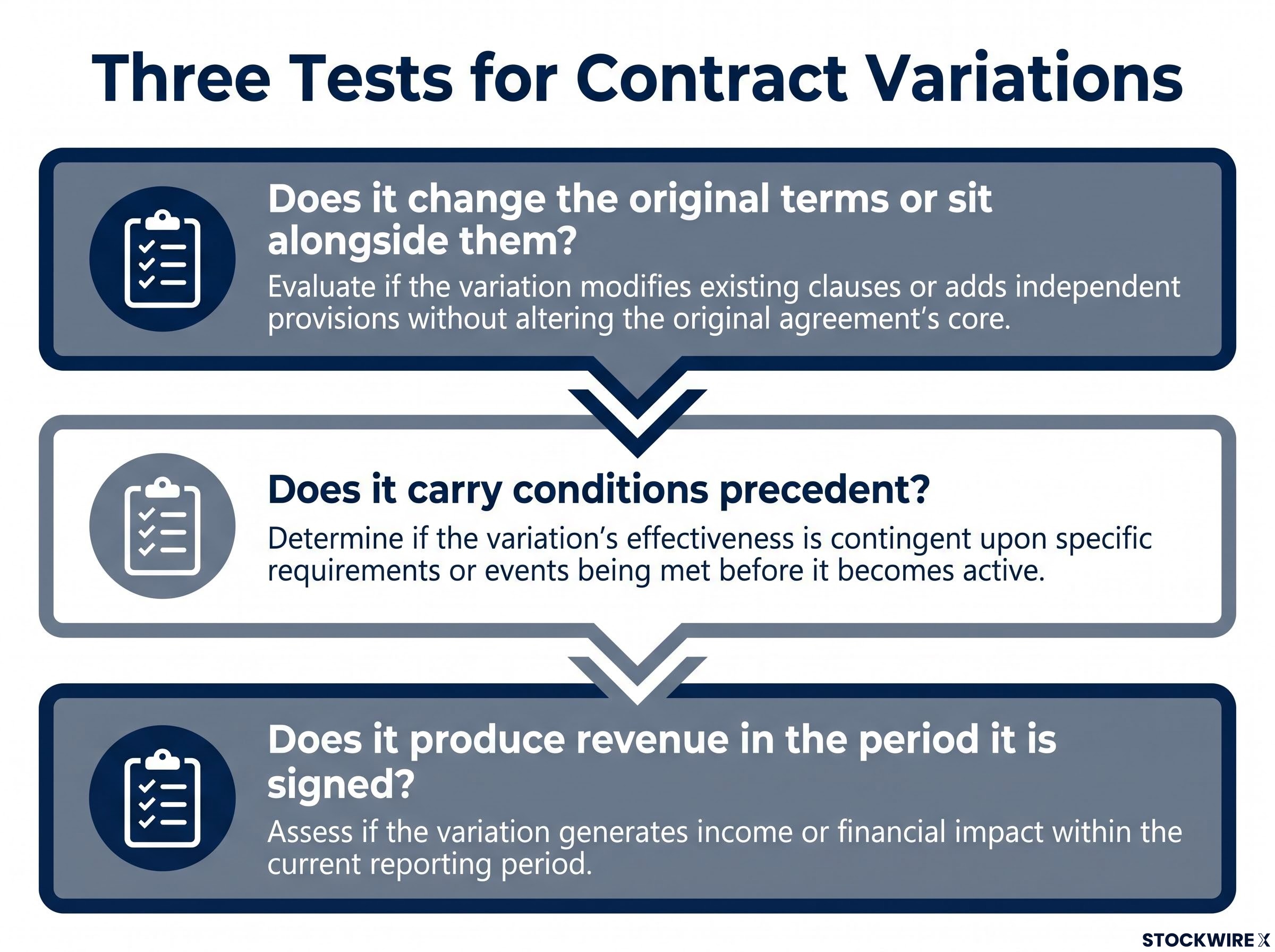
- Does it change the original terms or sit alongside them? If the base deal has to be renegotiated to accommodate a variation, that hints the original terms were falling short.
- Does it carry conditions precedent? A condition precedent is something that must happen before an agreement takes effect. Conditions suggest the customer is hedging; their absence suggests confidence.
- Does it produce revenue in the period it is signed? In-period revenue means the extra work is already happening, not waiting on a future trigger.
This test works on any variation announcement you come across, in any sector.
A caveat on reading variations
Early expansion is one indicator among many, not proof. Variations can be corrective, or driven by changes in the customer’s own project rather than the supplier’s performance.
The tests also leave two questions untouched: customer concentration and margins. On concentration, Orcoda estimates the Wellcamp contract at circa $8 million per annum based on workforce projections provided by Wagner. Against trailing group revenue of roughly $16.9 million, that would be close to half of revenue from one customer group. Margins are not disclosed. Both need separate attention.
When big ASX news breaks, our subscribers know first
Putting the three tests to work on Orcoda’s Wellcamp contract
Orcoda in brief
Orcoda Limited (ASX: ODA) is an integrated Australian technology company citing more than 30 years of experience. It operates across Healthcare Logistics, Transport Logistics and Resource Logistics.
Its centrepiece is Contractor360, a patented workforce mobilisation platform that connects site teams, contractors, subcontractors and suppliers. Orcoda describes it as recently modernised into an AI-led solution, with conversational AI, workflow automation and real-time operational monitoring.
At Wellcamp, Contractor360 is the platform through which Orcoda delivers workforce logistics and facilities management services. Fees are calculated monthly on actual workforce occupancy. That ties Orcoda’s revenue directly to how many workers the platform mobilises each day.
Orcoda is not the only ASX name pushing logistics AI platforms into live deployments, and Yojee’s Mosaic rollout offers a useful comparison for how these products move from strategy to paying customers.
On 25 June 2026, Orcoda announced a three-year agreement between Orcoda Resource Logistics and Wellcamp Accommodation Pty Ltd, an affiliate of Wagner Corporation. The facility houses construction workers in the greater Toowoomba area. The term runs from 1 July 2026 to 30 June 2029, at circa $8 million per annum, with fees calculated monthly on actual workforce occupancy.
Today, 8 October 2026, Orcoda announced upscope variation addendums lifting the number of workers per day, disclosed under ASX Guidance Note 8. That lands roughly ninety days after the contract began.
The three tests applied
On the first test, the announcement states there is no impact on the previous contract, and the duration stays at three years. The expansion sits alongside the original deal rather than rewriting it.
On the second, the announcement states there are no other conditions precedent. On the third, the addendum produced circa $500,000 of additional revenue in September 2026, the period in which the expanded work was underway.
| Test | What was disclosed | Reading |
|---|---|---|
| Original terms | No impact on previous contract; duration unchanged at three years | Sits alongside the base deal |
| Conditions precedent | No other conditions precedent stated | No sign of customer hedging |
| In-period revenue | Circa $500,000 additional revenue in September 2026 | Work already happening |
All three point the same way.
That is this article’s own analytical observation, not a company claim, and it is what makes this expansion unusually informative. You can now judge a variation on its terms rather than its headline.
What the billing phases show: one operational month against two start-up months
The 8 October announcement also broke Wellcamp billings down by phase. Look at the figures before reading the explanation.
| Period | Phase | Billings |
|---|---|---|
| July and August 2026 (combined) | Start-up | $1.15M |
| September 2026 | Operational | Circa $1.2M |
| Quarter ending 30 September 2026 | Total | Circa $2.35M |
One operational month roughly matched two start-up months combined. That comparison is drawn from the disclosed figures; Orcoda did not frame it that way.
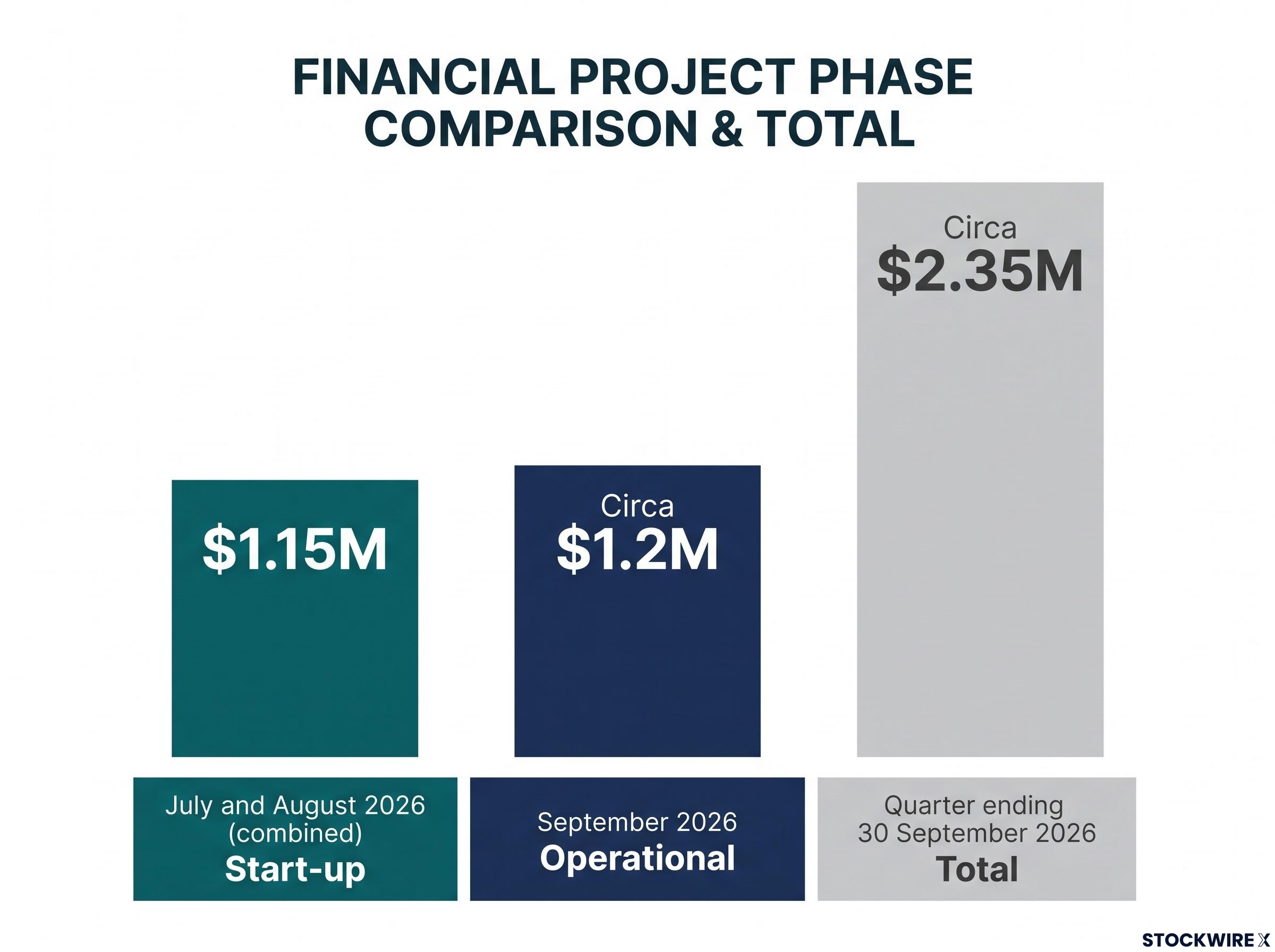
The gap reflects how contracts like this begin. Early months carry mobilisation and set-up work while occupancy builds, so if you had treated July and August as the run rate, you would have understated the contract considerably.
One further reading is possible from the same figures. September billings of circa $1.2 million include circa $500,000 from the variation. That leaves a base of circa $0.7 million for the month. Annualised, that sits close to the circa $8 million per annum Orcoda estimated at signing. This is the article’s own arithmetic and not a company disclosure. It should not be read as a forecast.
The lesson travels well beyond Wellcamp. Before drawing any conclusion from a new contract’s revenue, ask which phase the figure belongs to, not simply what month one billed.
Headroom inside the facility
Current arrangements support up to 750 workers per day, against facility capacity of 1,000 workers per day. Wagner and Orcoda are working to lift utilisation toward that level.
Because fees are based on actual workforce occupancy, that gap is meaningful to the billing structure rather than a vague aspiration. No timeframe for reaching capacity and no total contract value are disclosed.
Chairman Brendan Mason pointed to the relationship and the start so far.
The company is privileged to work with Wagner, is pleased with progress at Wellcamp, and looks forward to building on a strong start, said Brendan Mason, Chairman (paraphrased from the 8 October announcement).
What the announcement does not tell you, and what to watch next
The evidence above is favourable. It is also incomplete, and knowing the gaps matters as much as reading the numbers.
What is not disclosed
- No forward revenue guidance.
- No total contract value.
- No timeframe for reaching 1,000 workers per day.
- No margins or profitability. Revenue is not earnings.
The extra September revenue of circa $500,000 could go up or down with the number of billing days in a month and the stage of the project. It is not a monthly or annual figure.
Management has set an FY27 annual recurring revenue (ARR) target of $14.2 million, against an FY26 recurring revenue base of $6.2 million. That is a management target, not a result, and nothing here rests on it.
Revenue is not earnings, and earnings quality is what separated ASX tech names that recovered after the 2025-2026 sell-off from those that stayed down, so margin disclosure deserves separate attention.
Three things worth watching
These watch-points let you test the story yourself as new filings arrive:
- Daily worker numbers. Whether they keep moving from 750 toward the 1,000 capacity.
- Operational billing across a full quarter. Whether it holds at or above the September level of circa $1.2 million once start-up months drop out.
- Contractor360 beyond Wellcamp. Orcoda has previously named construction, mining and resources as potential standalone markets for the platform. A live deployment at scale is the kind of reference that tends to matter in those conversations, so watch for agreements outside this facility.
Reading the next contract variation with the same three questions
When the next variation lands in your feed, run the same check. Does it change the original terms? Does it carry conditions? Does it produce revenue now?
Treat the answers as one indicator among several, alongside customer concentration, utilisation trends and margins. Wellcamp is a clean illustration of the method in action, not a forecast of where the contract goes from here.
The habit is what you keep. Headline values are estimates; customer behaviour after delivery is evidence, and that evidence is worth more than any signing-day number.
StockWire X has no commercial relationship with Orcoda Limited or any related party. This article is for informational purposes only and should not be considered financial advice. Investors should conduct their own research and consult with financial professionals before making investment decisions. Past performance does not guarantee future results, and management targets are subject to market conditions and various risk factors.
—