USD/CHF has gained for three sessions straight and is hovering near 0.8330, so it is easy to call this a strong-dollar story and move on. That reading leaves out the more important part of the outlook. The Swiss Franc does not respond to interest rates the way most currencies do, and it can ignore yield logic as soon as markets turn nervous.
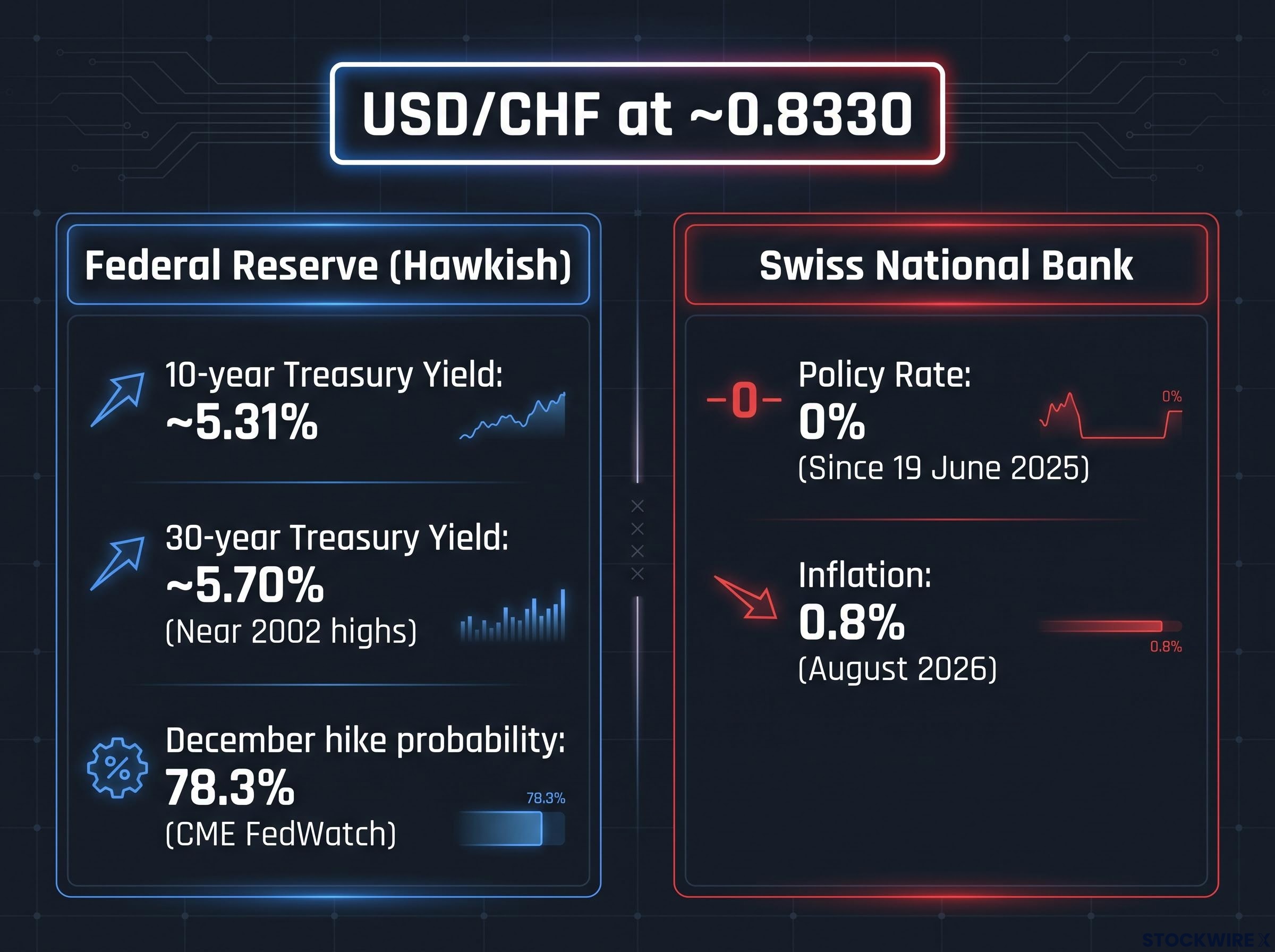
The setup favours the dollar for now. The Federal Reserve (Fed) has taken a hawkish line, and US Treasury yields have climbed back toward levels last seen in 2002. The Swiss National Bank (SNB), by contrast, has held its policy rate at 0%. In a Thursday Asian session covered by FXStreet, the pair stopped rising and held its ground.
The pause matters. It shows that the dollar’s support is already priced in, which leaves the next move dependent on what comes next. Here is how to read the pair from this point, including which signals point higher and which could reverse it.
Why is USD/CHF holding near 0.8330 while the Fed leans hawkish?
The climb was steady. USD/CHF rose for three straight sessions before stalling around 0.8330 in Asian trading. FXStreet analyst Akhtar Faruqui said hawkish Fed signals and high US yields may limit how far the pair can fall.
The Fed’s own record supports that view. Minutes from the September meeting showed every policymaker backed that month’s rate hike, and most saw another increase as probably appropriate before year-end. Markets broadly expect the Fed to hold rates at its October meeting, so the dollar’s support depends on what happens in December.
December hike pricing CME FedWatch put the probability of a December rate hike at 78.3% in the snapshot cited by FXStreet.
CME FedWatch is a tool that estimates the odds of Fed rate moves from futures prices. A reading of 78.3% means the market has already priced in most of the hawkish case. For the dollar to gain further, you would need the Fed to sound more hawkish than expected. Simply confirming the current view would not be enough.
Fed funds futures pricing can swing sharply on a single speech, as odds of an October hike moved by about 20 percentage points after one Fed official’s remarks, so a 78.3% reading is not fixed.
The figures below come from a single dated source. They are a snapshot from the time of that report, not live market data.
| Indicator | Level | Source | Why it matters |
|---|---|---|---|
| USD/CHF | ~0.8330 | FXStreet | Pause after three gains |
| December hike probability | 78.3% | CME FedWatch | Hawkish case largely priced |
| 10-year Treasury yield | ~5.31% | FXStreet | Wide gap with Swiss rates |
| 30-year Treasury yield | ~5.70% | FXStreet | Near 2002 highs |
The next test is upcoming commentary from Fed officials Christopher Waller and Alberto Musalem. If either sounds less sure about December, the pair’s main support starts to weaken.
When big ASX news breaks, our subscribers know first
How wide is the gap between a hawkish Fed and a 0% SNB?
Put the two central banks side by side and the imbalance is plain. The SNB cut its policy rate to 0.25% on 20 March 2025 and then to 0% on 19 June 2025. At its 24 September 2026 assessment, it left the rate unchanged, a decision also reported by CNBC and TradingEconomics.
This gap drives what traders call the carry trade. In a carry trade, investors borrow in a low-yielding currency and invest in a higher-yielding one to earn the difference. A 0% Franc set against Treasury yields above 5% makes the Franc an attractive currency to borrow in.
| Factor | Federal Reserve | Swiss National Bank |
|---|---|---|
| Policy stance | Hawkish, December hike seen as likely | Holding at 0% since June 2025 |
| Rate or yield context | 10-year near 5.31% (dated snapshot) | Policy rate 0% |
| Inflation backdrop | Persistent inflation risks | 0.8% in August 2026 |
| Next signal | Waller and Musalem comments | Next assessment date not confirmed |
One source claimed money markets were pricing up to three SNB hikes. That claim predates the September 2026 decision and conflicts with the SNB’s own projections, so it is best treated with caution. Economists generally expect the rate to stay at 0% for years.
Swiss inflation: energy-led, not broad
According to the SNB’s Quarterly Bulletin 3/2026, annual inflation rose from 0.6% in May to 0.8% in August 2026. CNBC linked the rise mainly to higher prices for gasoline, diesel and heating oil. A fuel-driven increase like this one does not point to broad price pressure across the economy.
The SNB defines price stability as inflation below 2%, which works as a 0-2% range. At 0.8%, inflation sits below the middle of that range. The bank projects about 0.7% for 2026 and 0.8% for 2027-2028, although it flags uncertainty tied to Middle East tensions, trade policy and exchange rates.
Real rates are interest rates after subtracting inflation, and in Switzerland they offer little to yield-seeking investors. That means you should read Franc strength as a safe-haven signal, not a yield signal. The SNB meets only four times a year and says it stands ready to intervene in currency markets.
What makes the Swiss Franc behave differently from other currencies?
A currency paying 0% should have little appeal. Yet in a crisis, the Franc tends to rally.
Safe haven without the yield
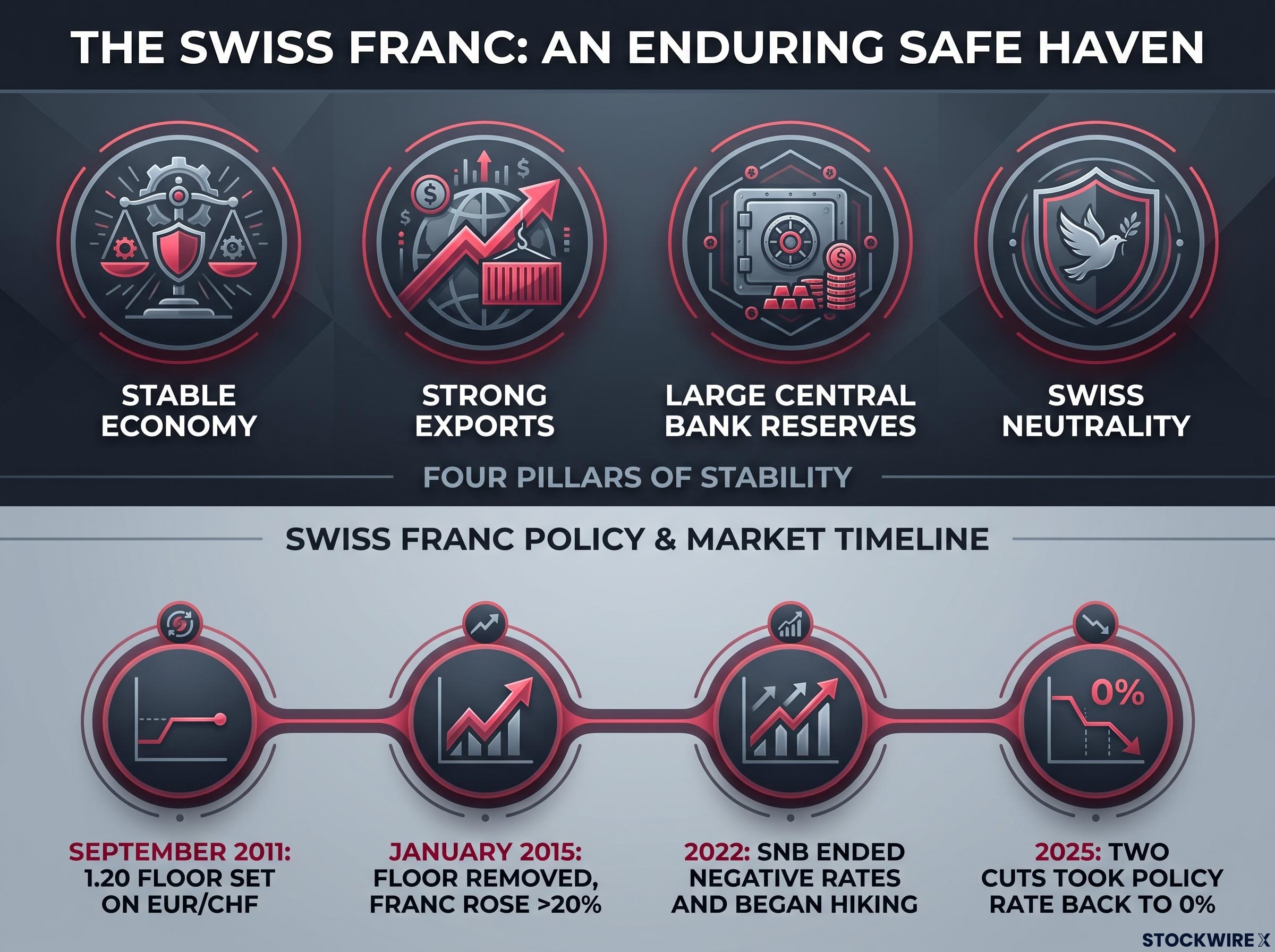
A safe haven is an asset investors move into for protection when markets fall. The Franc earns that status through four pillars:
- A stable economy
- Strong exports
- Large central bank reserves
- Swiss neutrality
The Franc is also one of the ten most traded currencies in the world, with volumes far larger than Switzerland’s economy alone would suggest. When fear rises, capital flows into it regardless of interest rates. Strong Swiss data and higher SNB rates tend to support it, while weak data and lower rates tend to weigh on it.
The Franc’s safe-haven status rests on more than a stable economy: its outsized share of global currency turnover and deep SNB reserves give it a liquidity profile that capital seeks out whenever fear rises.
Eurozone conditions also matter. Switzerland depends heavily on its neighbours, and some models put the correlation between the Euro and the Franc above 90%, although no recent study confirms that figure. Stress in Europe can therefore reach USD/CHF through this link.
The peg that broke in 2015
The history explains why traders treat the Franc with care:
- September 2011: The SNB set a 1.20 floor on EUR/CHF, which capped the Franc’s strength against the Euro.
- January 2015: The SNB removed the floor without warning. The Franc rose sharply, by more than 20% according to the original source.
- 2022: The SNB ended its long period of negative rates and began hiking, and the Franc quickly repriced higher.
- 2025: Two cuts took the policy rate back to 0%.
The lesson In a shock, the Franc’s safe-haven role can outweigh its yield disadvantage.
The takeaway for you is simple. High US yields do not guarantee that USD/CHF will rise, and currency regimes can change overnight.
What could break the hawkish-Fed story for USD/CHF?
The bullish case is easy to state. The Fed leans hawkish, US yields sit near 2002 highs and the SNB is at 0%. On those facts alone, USD/CHF looks like a pair with a floor beneath it.
The drivers behind it, however, work on two different timescales:
- Structural: Long-term gaps in growth potential, inflation trends and neutral rates, which favour the dollar through carry.
- Cyclical: Near-term Fed and SNB expectations, temporary spikes in risk aversion and energy-price shocks, which can push the pair either way.
The risks, ranked roughly by likelihood, sit mostly on the cyclical side.
| Scenario | Effect on USD/CHF | What to watch |
|---|---|---|
| Risk-off shock | Lower, as capital moves into the Franc | Geopolitical stress, equity volatility |
| Fed pause or yield retreat | Lower, as yield support fades | Waller and Musalem comments, December pricing |
| Growth or deflation surprise | Lower, as defensive demand rises | Global growth data, Swiss CPI |
| SNB intervention | Caps disorderly moves either way | SNB statements and balance-sheet activity |
The SNB has said it remains willing to intervene in currency markets, according to TradingEconomics. If inflation undershoots, it could turn to balance-sheet operations or, more speculatively, push rates below zero. Either step could hold USD/CHF lower than carry arguments alone would suggest.
If inflation undershoots, the SNB could lean on balance-sheet operations such as foreign-exchange purchases, its primary tool given roughly CHF 770 billion in reserves, rather than relying on rate moves alone.
Analyst coverage is thin. Faruqui is the only named voice in the available research, so claims of a broad expert consensus should not be taken at face value.
The pair is best understood as a tug-of-war between yield and fear. Check risk sentiment and Fed pricing together before leaning on either one alone.
Reading the pair from here: what to weigh before the next Fed signal
The policy and yield gap still favours USD/CHF. Safe-haven demand and possible SNB intervention, however, keep the downside open.
Three things deserve your attention:
- Waller and Musalem’s comments, and whether December hike pricing holds near 78.3%.
- Risk sentiment, because fear can overpower yield quickly.
- The next SNB assessment, which has not yet been dated in available sources.
The Fed and yield figures here are a dated snapshot. Check live quotes before acting on them.
Past performance does not guarantee future results. Financial projections are subject to market conditions and various risk factors.
This article is for informational purposes only and should not be considered financial advice. Investors should conduct their own research and consult with financial professionals before making investment decisions.