Owning the most talked-about AI company is not the same as beating the market, and the arithmetic of the Anthropic IPO vs S&P 500 debate shows why. A reported valuation above $2 trillion means a buyer starts the race with the index already far ahead.
Anthropic’s offering is reportedly targeting that figure, with a draft prospectus showing roughly $46-47 billion in annualised revenue and about $518 billion of compute commitments over a decade. As of early October 2026 the shares have not priced or begun trading, so every figure here is reported, draft-prospectus based and subject to change.
Here are the break-even numbers a $2 trillion entry demands, a clear view of what an index fund already gives you, and a repeatable test for any big new listing.
Why does a $2 trillion price tag set such a high bar?
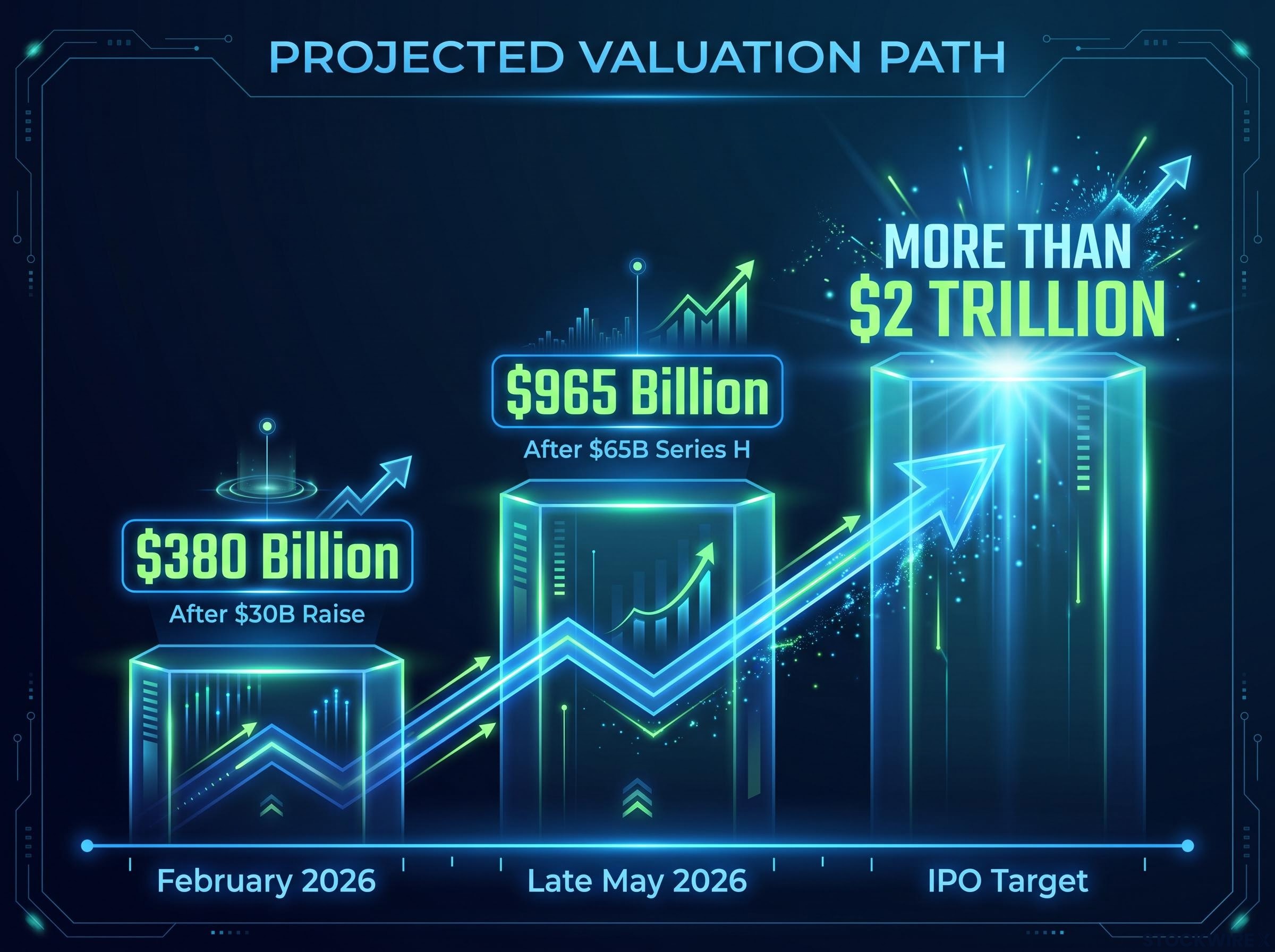
The valuation path has been steep. Each step reset what buyers are asked to believe:
- February 2026: $380 billion, after a $30 billion raise
- Late May 2026: $965 billion, after a $65 billion Series H
- IPO target: more than $2 trillion
Reuters reported on 28 September that the sale could value the company at more than $2 trillion, more than double the May figure.
Reuters: The public sale “could value it at more than $2 trillion.”
The raise itself is unsettled. The New York Times reported on 21 August that Anthropic could aim for $100 billion, while Euronews reported on 17 September an expected raise of more than $60 billion, led by Goldman Sachs, JPMorgan and Morgan Stanley. The company filed confidentially on 1 June 2026.
Now translate the price. Last year’s revenue was nearly $4.6 billion, about 12 times the prior year, which puts $2 trillion at roughly 436 times sales. On the annualised second-quarter pace of about $46 billion (CNBC cited a $47 billion run rate), it is about 43 times revenue.
A 43x multiple tells you the price already assumes years of flawless growth. Anyone buying at listing is paying today for a future that must arrive on schedule.
Reading the loss correctly
Of the $42 billion headline loss, roughly $34 billion came from a non-cash accounting charge linked to how earlier financing was valued. The operating loss was a little over $8 billion, and Anthropic reported its first positive adjusted operating income in the latest quarter.
That distinction matters later. S&P 500 rules count as-reported (GAAP) profit, not adjusted profit.
The gap between GAAP versus adjusted earnings matters here because index eligibility rules count only as-reported profit, so an adjusted-only milestone does little to move Anthropic toward S&P 500 membership.
When big ASX news breaks, our subscribers know first
Bull case, bear case and what IPO research says about both
The bull case has real pull. Growth is rapid, adjusted operating income has turned positive, and the $518 billion infrastructure commitment signals that the company expects demand to match. Reuters noted that near $1 trillion, Anthropic would “vault to the top tier of the S&P 500,” and CNBC called the listing “the first big test of AI boom valuations.”
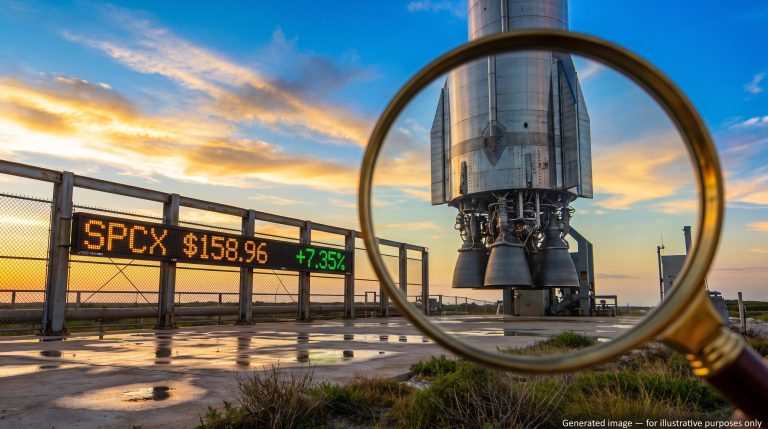
There is also regret. One hypothetical buyer, “Darius,” remembers missing SpaceX’s first-day gain, from $135 to $160, about 19%.
- Bull points: fast growth, first positive adjusted operating income, infrastructure spending as a demand signal
- Bear points: surging capex, a re-rating from $380 billion to $2 trillion+ that sceptics attribute to enthusiasm, competition from OpenAI (reported at $852 billion) and Google, and GAAP losses
Then the base rate arrives. University of Florida’s Jay Ritter found that across more than 9,000 US IPOs since 1980, buying at the first-day close and holding three years trailed the market by about 20 percentage points.
Jay Ritter’s finding: a roughly 20-point three-year shortfall reflects the price paid, not poor company quality.
The index, by comparison, returned about 10% annually with dividends reinvested from 1928 through last year. Giant listings show the same split:
| Company | Year | Outcome pattern | Key driver |
|---|---|---|---|
| 2004 | Winner | Sustained earnings growth | |
| Meta | 2012 | Weak first year, strong decade | Mobile monetisation, then earnings |
| Alibaba | 2014 | Mixed | Regulatory and geopolitical risk |
| Saudi Aramco | 2019 | Mixed | Oil prices |
| Rivian | 2021 | Heavy underperformance | Valuation versus production |
A great company and a great stock purchase are different things. The question for your portfolio is the price paid, not whether Anthropic succeeds.
Dot-com era lessons are instructive for the sceptics’ re-rating argument: Cisco investors were right about the internet yet waited more than 25 years to recover their peak price, showing that being right about a technology is not enough.
The break-even math: what Anthropic must become to match an index fund
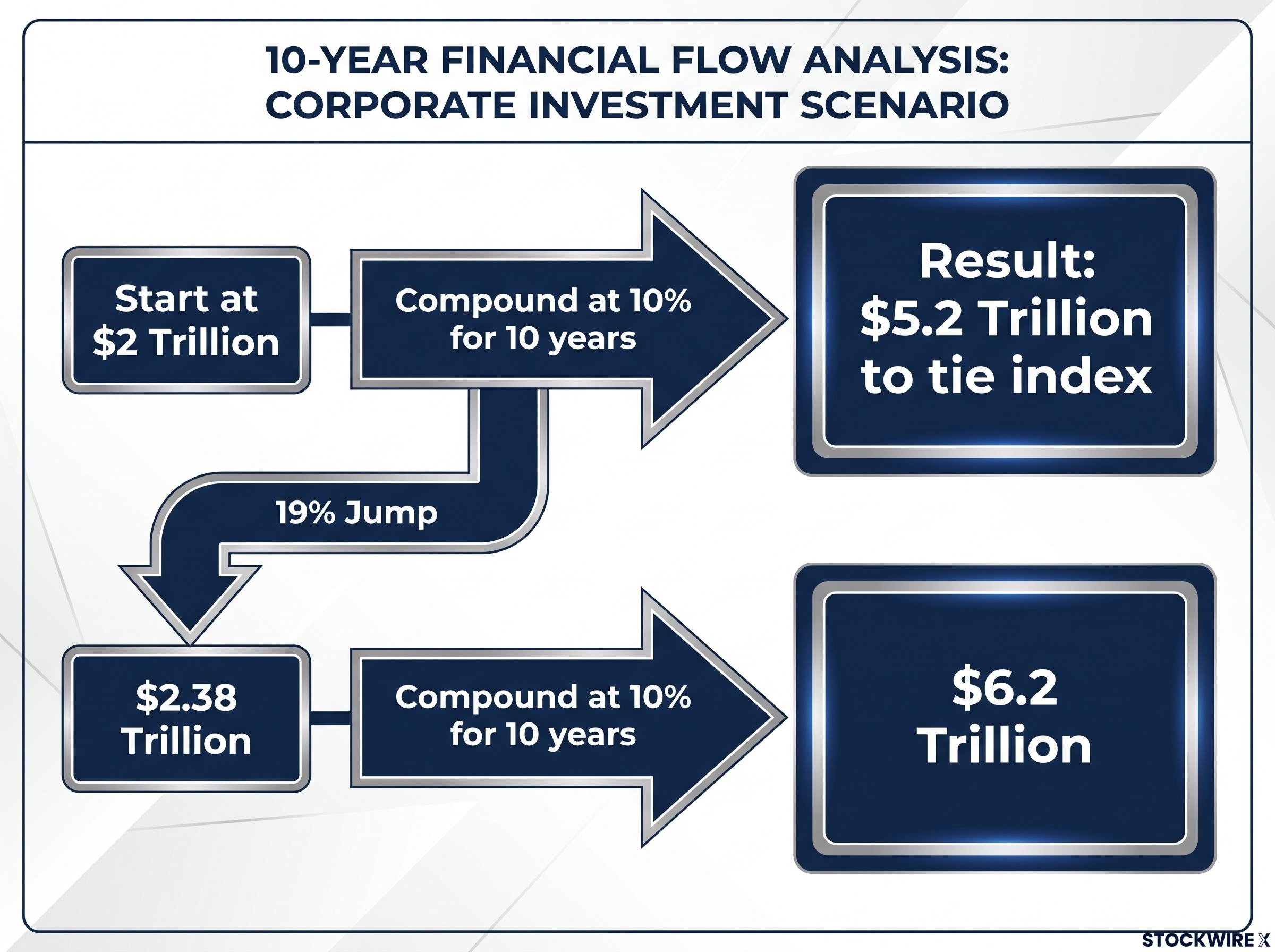
The rules favour the buyer. The horizon is 10 years, the benchmark is 10% a year, the start is $2 trillion, and dilution is ignored. A second buyer enters after a 19% jump at about $2.38 trillion.
- Start at $2 trillion.
- Compound at 10% for 10 years.
- The result is about $5.2 trillion to tie the index.
Nvidia set the record for a public company this year at about $5.5 trillion. Matching a plain index fund therefore needs roughly the largest value any public company has reached.
Assume a 10x revenue multiple (an assumption, not a forecast). Then $5.2 trillion needs about $519 billion in annual sales, roughly 11 times the current pace and about 27% annual growth for a decade. That exceeds Apple’s roughly $416 billion in last fiscal-year revenue.
| 10-year value | Annual return (entry at $2T) | Annual return (after 19% jump) |
|---|---|---|
| $3 trillion | ~4.1% | ~2.3% |
| $5.2 trillion | ~10% | ~8.1% |
| $10 trillion | ~17.5% | A little over 15% |
Even reaching about $5 trillion only ties an index fund you could have bought with no research. The upside must be extraordinary to justify the added risk.
Why the aftermarket price matters more than the listing price
Listing-price shares mostly go to large institutions. Ordinary buyers typically pay the post-open price, as with SpaceX.
A 19% pop lifts break-even from $5.2 trillion to $6.2 trillion. A higher final IPO price makes the test harder, and a lower one eases it.
What the S&P 500 already gives you (and when Anthropic could join it)
The S&P 500 is cap-weighted, meaning bigger companies carry bigger weights. Nvidia is about 8% of the index, and the top 10 companies make up close to two-fifths of it. Your index fund is already an indirect AI bet through suppliers.
With a handful of mega-caps dominating the cap-weighted benchmark, index fund concentration risk means the passive alternative is already a heavy bet on a few AI-linked names, not a neutral baseline.
Anthropic cannot simply slot in. The eligibility rules include:
- Market cap: at least $22.7 billion as of July 2026 (older sources cite $20.5 billion and $8.2 billion)
- Seasoning: at least 12 months of trading since IPO, with specified exceptions
- Profitability: positive GAAP earnings in the latest quarter and the trailing four quarters
- Float and liquidity: investable weight factor of at least 0.10, at least 250,000 shares traded in each of the prior six months, and a float-adjusted liquidity ratio of at least 0.75
The earnings rule: Adjusted profits do not count. Only as-reported GAAP earnings qualify.
The index operator recently considered and rejected relaxing rules for giant listings, and no formal change was found. With a GAAP loss and an adjusted-only profit milestone, Anthropic likely would not qualify soon.
| Index type | Entry speed | Anthropic outlook |
|---|---|---|
| S&P 500 | At least 12 months, GAAP profit required | Unlikely soon |
| Major total-market index | Five trading days (SpaceX precedent) | Could add quickly |
| Nasdaq-100 | 15 trading days (SpaceX precedent) | Could add quickly |
Check whether your fund tracks the S&P 500 or the total market. That tells you whether you will own Anthropic automatically, and when.
A four-step test for any big new listing, and the risks that can break it
This method works for any large new listing, and it is built for long-term money rather than short-term traders.
- Tie test: grow the price at about 10% and judge whether the company can plausibly beat it.
- Satellite sizing: keep any new listing a small position around a diversified core.
- Patience: wait for the price to settle and lock-ups to expire.
- Check fund holdings: look at top holdings and whether the fund tracks the S&P 500 or the total market.
The decision is about position size and timing, not a yes or no on Anthropic. One investor leaned on a compelling narrative and the other on a reassuring fund label, and neither ran the numbers.
Risks that can break the plan
- Lock-up expiries: insider restrictions typically last 6-12 months, and expiry can raise free float sharply and pressure the price.
- Dilution: hundreds of billions in compute spending will likely mean more equity or convertibles.
- Allocation: retail buyers typically pay aftermarket prices, while institutions get listing-price shares.
- Idiosyncratic risk: a single-name bet adds execution, competition and capital-intensity risk.
The comparison favours the buyer, so real results may be worse. Forward index returns may also fall below the historical 10%, according to outlooks from major institutions. That lowers the bar for Anthropic, but it weakens the index alternative too.
For investors weighing timing around expiry, our dedicated guide to trading US IPOs around lock-up dates shows how float expansion creates a predictable supply shock.
Making the call: arithmetic first, story second
A reported $2 trillion+ price and $518 billion of compute commitments mean Anthropic needs about $5.2 trillion, or $6.2 trillion after a pop, just to tie the index. That sits near or above the all-time record.
Success is possible but rare. The index fund offers diversified AI exposure with lower single-name risk.
Before sizing any position, watch the final IPO price, the first-day move, the lock-up dates and GAAP profitability.
This article is for informational purposes only and should not be considered financial advice. Investors should conduct their own research and consult with financial professionals before making investment decisions. Past performance does not guarantee future results, and financial projections are subject to market conditions and various risk factors.
—