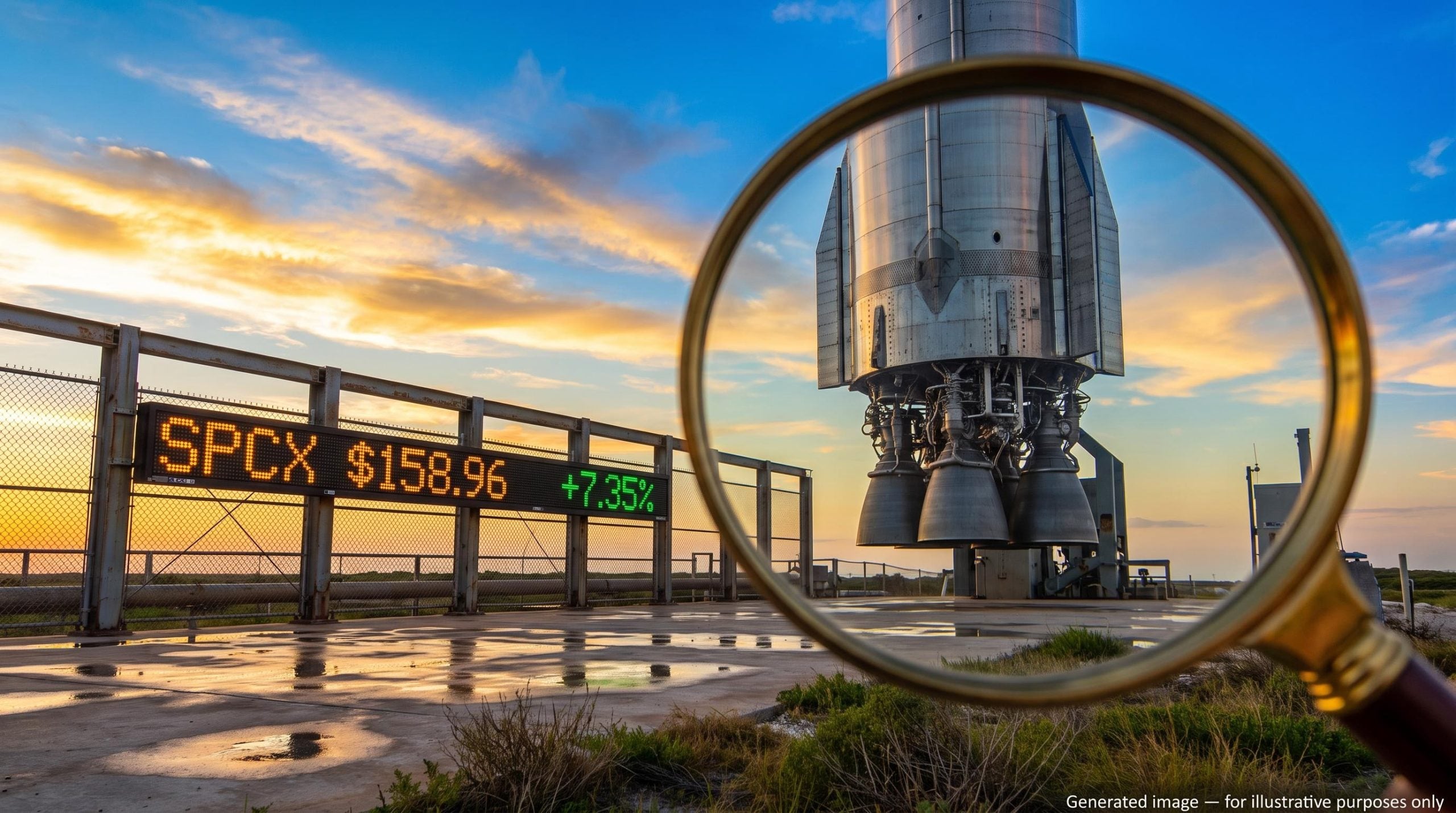
SpaceX trades at roughly 30x 2028E EV/EBIT, nearly double the roughly 16x of other mega-cap AI enablers, yet Morgan Stanley’s Adam Jonas calls it “cheap and getting cheaper.” SPCX closed at $158.96 on 5 October 2026, up 7.35%, after his note.
The stock priced at $135 in June 2026 in a record IPO and has traded on both sides of that level since. Analyst targets now run from $140 to $450. The question for any SpaceX stock analysis is whether a headline multiple can tell you if a high-growth stock is expensive.
Here is how growth-adjusted valuation works, which single input moves the thesis most, and what to watch next. This is analysis, not a recommendation.
Why does a 30x multiple look cheap once growth is added?
On the raw numbers, the verdict is “expensive”. EV/EBIT compares a company’s total value (market value plus net debt) with its operating profit, and 30x against 16x for the mega-cap peers looks like a steep premium.
Then growth enters. Jonas divides the multiple by the earnings growth rate, which lets you compare companies expanding at very different speeds. On that measure SPCX trades near 0.3x 2028 EV/EBIT/Growth, about 40% below the 0.5x mega-cap median.
“Cheap and getting cheaper” Jonas’s framing of SPCX at $159, in a note published on 5 October 2026.
At the $300 target, the growth-adjusted multiple would be about 0.6x. That matches Amazon and sits below Alphabet and Meta, which is the real content of the “cheap” claim.
| Measure | SPCX at $159 | Mega-cap AI median | SPCX at $300 target |
|---|---|---|---|
| 2028E EV/EBIT | ~30x | ~16x | n/a |
| Growth-adjusted EV/EBIT/Growth | ~0.3x | 0.5x | ~0.6x |
How to read a growth-adjusted multiple
The ratio is simple: the multiple divided by the growth rate. A lower number means you pay less for each unit of growth. It is a comparison tool, not a fair-value answer.
The weakness is that 2028 figures are forecasts, not reported results. A growth-adjusted discount exists only if you believe the growth forecast, so you are really being asked to underwrite the growth rate, not the multiple.
When big ASX news breaks, our subscribers know first
What is the market actually paying for, business by business?
A single share price hides three linked businesses. A sum-of-the-parts valuation prices each separately and adds them up:
- Launch services: reusable rockets and space infrastructure
- Starlink connectivity: satellite broadband and direct-to-device service
- AI infrastructure: data centres, energy and orbital computing, valued like a neocloud (a company renting out AI computing capacity)
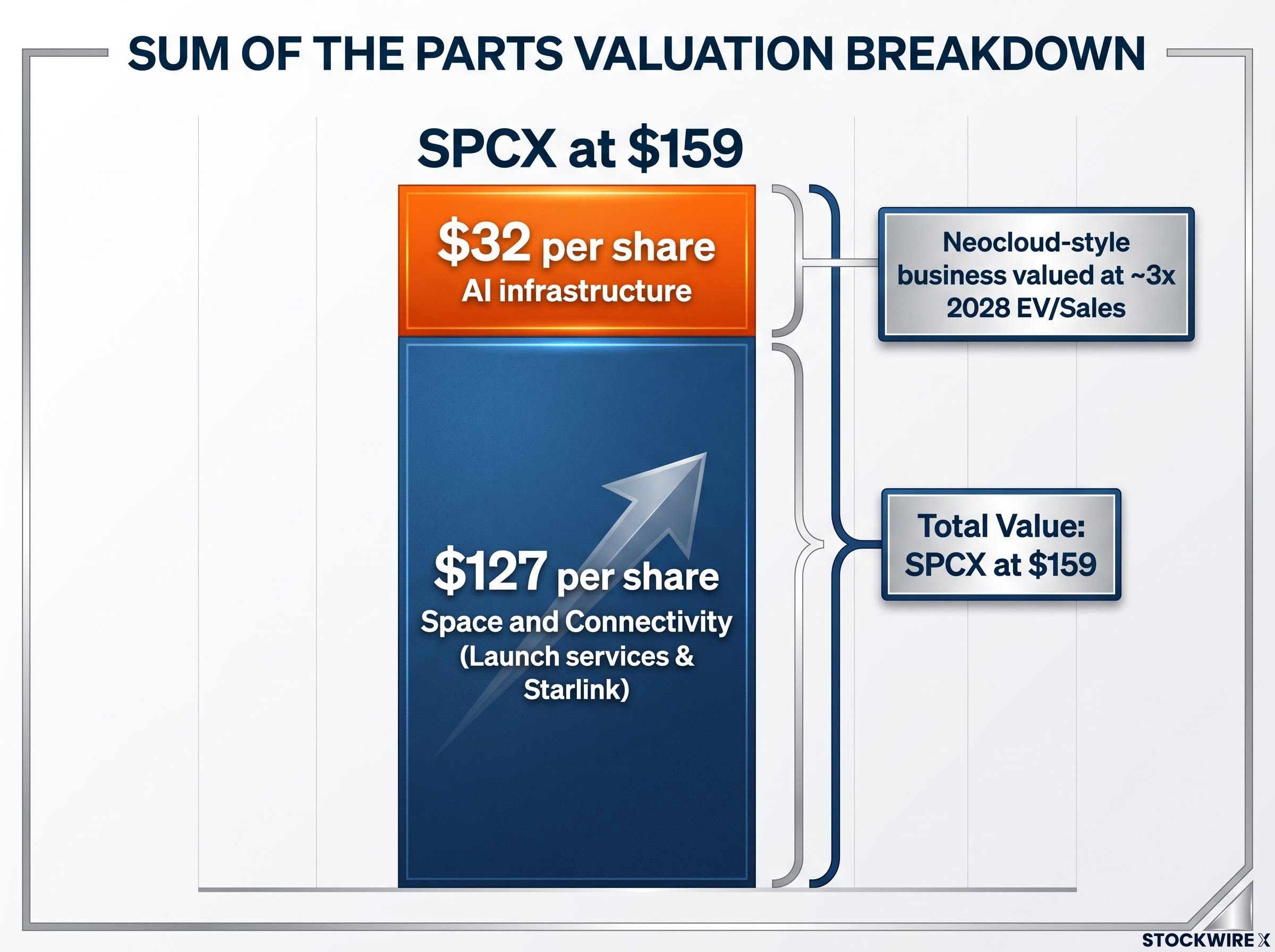
Jonas’s arithmetic is the surprise. Of an estimated $127 per share for Space and Connectivity, nearly all of it is already built into the $159 price, which leaves only about $32 per share to account for AI. For a neocloud-style business, that works out at around 3x 2028 EV/Sales.
At the $300 target, more than half the value comes from AI. Owning SPCX at $159 is therefore largely a bet on one segment, not on rockets or satellites alone.
The valuation gap Coindesk and MarketWatch/Morningstar highlighted a gap of more than $1 trillion between Goldman Sachs’s and Morgan Stanley’s views of the company.
| Source | Target | Stance | Note |
|---|---|---|---|
| Morgan Stanley | $300 | Overweight | Mid-2027 horizon; $75 bear, $600 bull |
| Goldman Sachs | $205 | Effectively buy | Analyst Eric Sheridan |
| Consensus average | $226.04 | Buy | 25 analysts, Investing.com, 4 October |
| Consensus high/low | $450 / $140 | n/a | Same source |
Both Morgan Stanley and Goldman were lead underwriters, which is relevant context when weighing their research. With a bear-to-bull range of $75 to $600, treat any single target as one scenario, not a forecast, and focus on which assumptions drive the gap.
How sensitive is the AI case to compute pricing per watt?
Neocloud revenue links to power capacity. Customers pay per watt of computing capacity, so revenue equals watts multiplied by price.
Recent short-term contracts signed by SpaceX are priced at $30-$50 per watt. Visible Alpha consensus assumes just $17.60 per watt across 4.1 GW of capacity. Every extra $10 per watt adds over $40 billion of revenue.
That spread shows how little pricing movement swings the thesis. Illustratively, 4.1 GW at $17.60 versus $27.60 is the difference between the consensus base and a $10 uplift.
| Price per watt | Capacity | Implied annual revenue effect |
|---|---|---|
| $17.60 (consensus) | 4.1 GW | Consensus baseline |
| +$10 sensitivity | 4.1 GW | Over $40 billion added |
| $30-$50 contract range | 4.1 GW (illustrative) | Above baseline; not calculated beyond cited inputs |
The logic runs in three steps:
- Capacity in watts sets the revenue base.
- Price per watt scales that base into revenue.
- Revenue feeds the 2028 multiples that Jonas’s valuation rests on.
Jonas reads the premium as evidence of monetisation upside. The same spread signals risk if pricing converges toward consensus or lower. Counterparties, contract durations beyond “short-term” and peer neocloud multiples were not available in the research.
Short-term pricing is not necessarily a durable rate. The premium shows demand today, not proof of 2028 revenue.
What could move the stock next, and what could break the thesis?
Catalysts on the calendar
Jonas’s watch-list is full of binary events. A Starship ship catch could be the largest positive since the IPO.
| Catalyst | Jonas’s timing | Confirmed? | Why it matters |
|---|---|---|---|
| Starship Flight 15 | Late October or early November | Not confirmed in coverage | Reuse progress; possible ship catch |
| Q3 earnings | Late October | Not confirmed in coverage | First read on AI revenue disclosure |
| Starship Flight 16 | Before year-end | Not confirmed in coverage | Test cadence |
| Grok 4.8, 4.9, 5.0; neocloud deals | No schedule given | Not confirmed in coverage | AI monetisation evidence |
These timings are Jonas’s expectations, not announcements. Because the dates are unconfirmed and the outcomes binary, position sizing and time horizon matter more than predicting any single result.
Jonas considers Grok’s standing and Starlink Mobile spectrum access already priced in. None of about 40 clients he surveyed held the shares, which suggests limited positioning.
Risks the growth-adjusted view can mask
A growth-adjusted multiple says nothing about whether the growth arrives. Jonas’s listed risks and others include:
- Slower Starship reuse and longer time-to-power
- Weaker enterprise AI monetisation and higher compute cost per watt
- Funding needs, including a planned $100 billion Starbase facility in Louisiana, and dilution
- Regulatory delays
- Speculative sentiment: David Einhorn of Greenlight Capital called the $1.75 trillion IPO valuation a sign a speculative top may be near
His $100 downside case would need an AI slowdown, a serious test setback or a dilutive event. Lock-up expiries could be flashpoints, though their schedule was not found.
Sum-of-the-parts inputs are also subjective, as the gap between the two lead underwriters shows. Current market capitalisation and contract counterparties remain gaps in the evidence.
What a growth-adjusted discount does and does not tell you
The “cheap” case is a conditional claim. It rests on 2028 growth, AI monetisation and compute pricing, not on a verdict you can take at face value.
Three variables are worth tracking:
- Compute price per watt in new contracts
- Starship progress and reuse
- How much AI revenue is disclosed at Q3 earnings
Analyst targets, including those from underwriters, are opinions with wide dispersion. Past performance does not guarantee future results, and these statements are speculative and subject to change based on market developments.
This article is for informational purposes only and should not be considered financial advice. Investors should conduct their own research and consult with financial professionals before making investment decisions.
—