
USD/CHF is rebounding toward 0.83 and the Dollar Index (DXY, a gauge of the dollar against a basket of major currencies) has printed a 2026 high of roughly 102.5, yet US payrolls just missed badly at +29,000. October Fed hike odds have collapsed. So why is the dollar winning when its own data is soft?
The answer, as of 5 October 2026, sits mostly in Europe. Investors are selling the euro on French fiscal stress rather than buying the dollar on US conviction, and that matters if you trade or hedge franc exposure, because the franc competes with the dollar as a haven.
This USD/CHF analysis sorts out which forces are pushing the pair higher, which could cap it, and which basic dollar mechanics you need to read the next move.
Why is USD/CHF rebounding when US data is soft?
The price action is simple. USD/CHF rose on Monday, ending a two-session decline, and sits around 0.8300-0.8316, still under last week’s high of roughly 0.8382-0.8384 (data providers differ slightly), the pair’s strongest since May 2025.
| Instrument | Level | Context | Note |
|---|---|---|---|
| USD/CHF | **0.8300-0.8316** | Below last week’s high | High cited as 0.8382-0.8384 |
| DXY | **102.3-102.5** | 2026 high of about 102.53-102.54 | Reported closes range 102.37 to 102.48 |
| EUR/USD | Low of **1.1161** | Weakest since May 2025 | Traded near 1.12 afterwards |
| French-Bund 10-year spread | Above **140 bp** | Widest since the 2012 crisis | Two-year French yields up about 76 bp in a day |
Peel back a layer and the dollar’s gain looks like a by-product. French public debt is high, political gridlock ahead of the 2027 presidential election threatens fiscal consolidation, and French government bonds have sold off hard. Yahoo Finance reported five-year French credit default swaps (insurance against default) climbing sharply, which tells you markets are repricing sovereign risk, not just growth.
The euro’s slide traces back to French fiscal stress, where a 117.6% debt-to-GDP ratio, a minority government, and a 2027 budget unlikely to pass intact have pushed the OAT-Bund spread to levels last seen in 2012.
The core read Investors are selling the euro rather than buying the dollar.
Convera, a payments and FX firm, noted that EUR/CHF posted its biggest daily fall in a year in early October (a secondary-sourced observation). Money is leaving the euro and landing in both the franc and the dollar.
What this tells you is that a rally built on euro fear can reverse quickly if French stress eases. Watch the euro, not just US data.
When big ASX news breaks, our subscribers know first
What do soft payrolls and 5.30% Treasury yields mean for the Fed and the dollar?
US data is sending mixed signals, and the tension is the story.
- Weak: September nonfarm payrolls (the monthly count of net new non-farm jobs) rose just 29,000, unemployment sat at 4.2%, and July and August were revised down by a combined 60,000.
- Resilient: the final S&P Global Services PMI edged up to 58.8 from 58.7, while the ISM Services PMI slipped to 54.9 from 55.4, just under the 55 forecast. Both sit well above the 50 line that separates expansion from contraction.
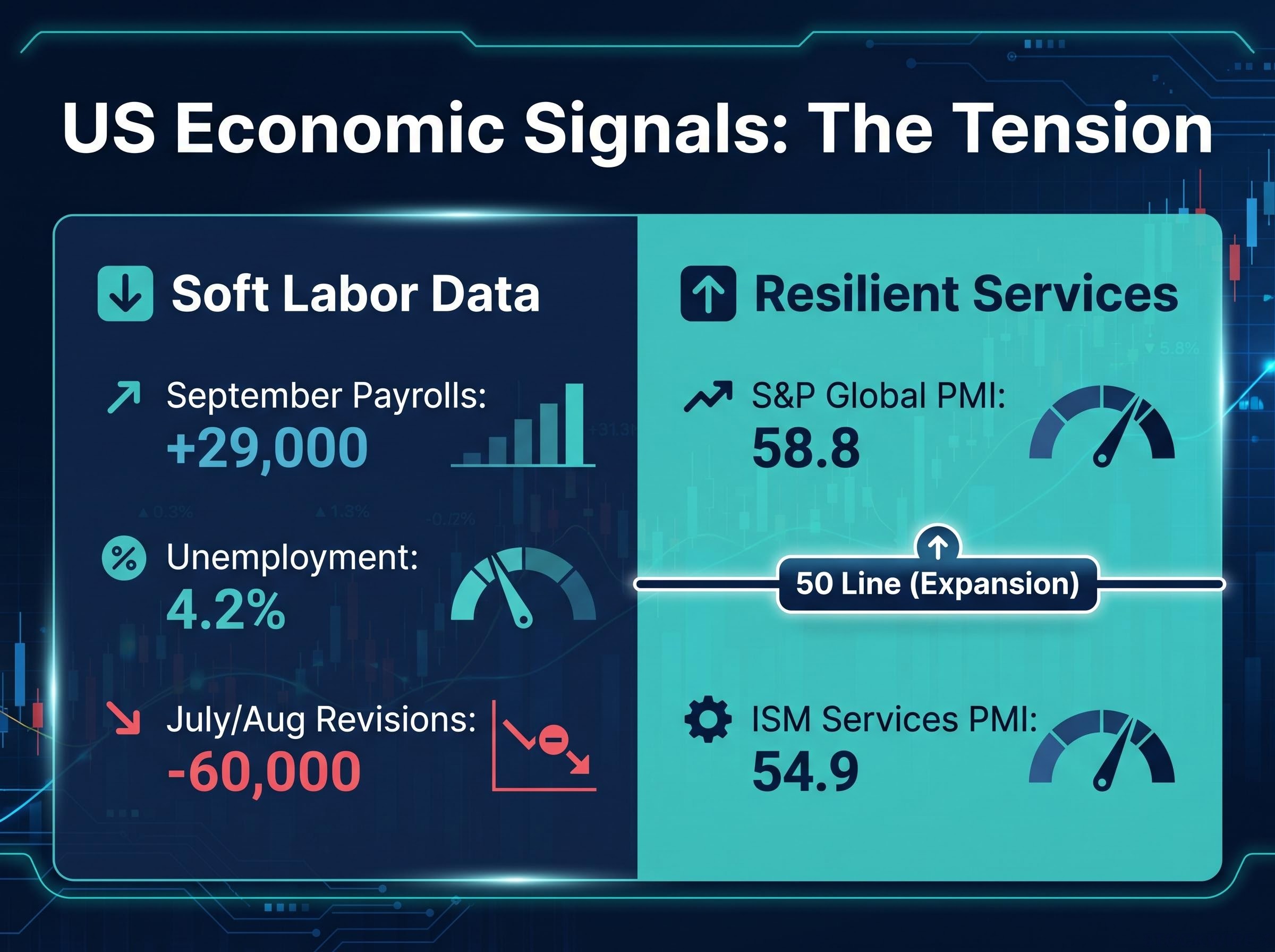
The market has leaned toward the soft side. CME FedWatch shows about a 20% chance of a Fed hike at the 27-28 October meeting, down from nearly 70% a week earlier.
Yet the Fed remains committed to returning inflation to 2%, and oil-related price pressure keeps later hikes alive. Falling October odds tell you the Fed path is no longer the main dollar driver this week, so a hot inflation print could revive it faster than a jobs miss can bury it.
Fed influence runs through rate differentials and market pricing, which is why a fully priced hike can leave the dollar flat while a surprise in CME FedWatch odds moves it sharply, as this week’s collapse in October hike probabilities shows.
The yield paradox
The 10-year Treasury yield sits near 5.30%, below last week’s 5.34% peak, which was the highest since 2002. High yields support the dollar through rate differentials, since investors earn more holding US debt than most alternatives.
They also cut the other way. Elevated yields reflect worry about US debt and the fiscal position, which could eventually temper foreign demand for Treasuries. A yield that props up the dollar today can become a warning sign tomorrow.
Can the franc’s safe-haven pull outlast the SNB’s intervention risk?
The case for the franc is strong. Switzerland carries lower debt and strong institutions, and contagion fears centred on a large core economy like France make the franc a natural hedge. The EUR/CHF drop Convera flagged on 2 October is that hedge in action.
History backs the pattern. During the 2010-2012 Eurozone crisis and the early-2020 pandemic shock, both the franc and the dollar drew repeated haven flows. That is why you should treat USD/CHF as a relative-strength contest, not assume haven demand pushes it lower automatically.
Then come the brakes. Low Swiss yields could cap franc gains against higher-yielding currencies, and the Swiss National Bank (SNB) has a record of leaning against excessive appreciation. The current SNB policy rate and recent intervention comments were not located in available coverage, so the risk is best read through history: in January 2015 the SNB abruptly removed its 1.20 EUR/CHF floor, and the franc surged.
Commerzbank analysts argue the franc’s strength despite a zero policy rate comes down to fiscal credibility, with Swiss central government debt near 14% of GDP against 122% for the US, a gap that explains why low yields have not deterred buyers.
Strategists split accordingly. Yield-focused investors expect the dollar to stay firm while US rates are high, while hedge-focused investors expect the franc to outperform in tail-risk scenarios.
| Factor | Favours USD/CHF higher | Favours USD/CHF lower | Reader signal to watch |
|---|---|---|---|
| Rate gap | High US yields versus low Swiss yields | Treasury yields read as fiscal stress | Direction of the 10-year yield |
| Euro stress | Dollar draws haven flows | Franc draws haven flows | French-German spread |
| SNB | Intervention against franc strength | Policy shift tolerating appreciation | Any SNB commentary |
What could stall the dollar’s run
A policy backstop from the European Central Bank (ECB) or the EU would steady the euro and cut the haven appeal of both currencies. Easing French spreads would do the same.
Two quieter risks sit beside that. A weaker euro raises French import costs, feeding the fiscal problem, and oil-driven inflation could complicate growth expectations that favour the dollar. If high yields come to be read as a symptom of global fiscal fragility, the dollar’s upside is not unlimited.
What actually drives the dollar? A primer for reading the next move
Three levers explain most dollar moves, and each shows up in the current setup.
- Fed policy. The Fed pursues a dual mandate of price stability (a 2% inflation target) and full employment, mainly through interest rates. Hikes when inflation runs above target support the dollar; cuts weigh on it. Now: October hike odds near 20% are a drag, but high yields still hold the dollar up.
- Quantitative easing (QE) and tightening (QT). QE means creating money to buy bonds, as in the 2008 crisis, and usually weakens the dollar. QT stops those purchases and reinvestment, and is usually dollar-positive. Now: no QE-style liquidity push appears in the research, so this lever is background rather than driver.
- Reserve and safe-haven status. After World War II the dollar replaced sterling as the reserve currency under Bretton Woods, a system pegging currencies to the dollar, which was convertible to gold. It ended in 1971, yet investors still default to dollar assets in foreign stress. Now: that default is helping the dollar despite soft payrolls.
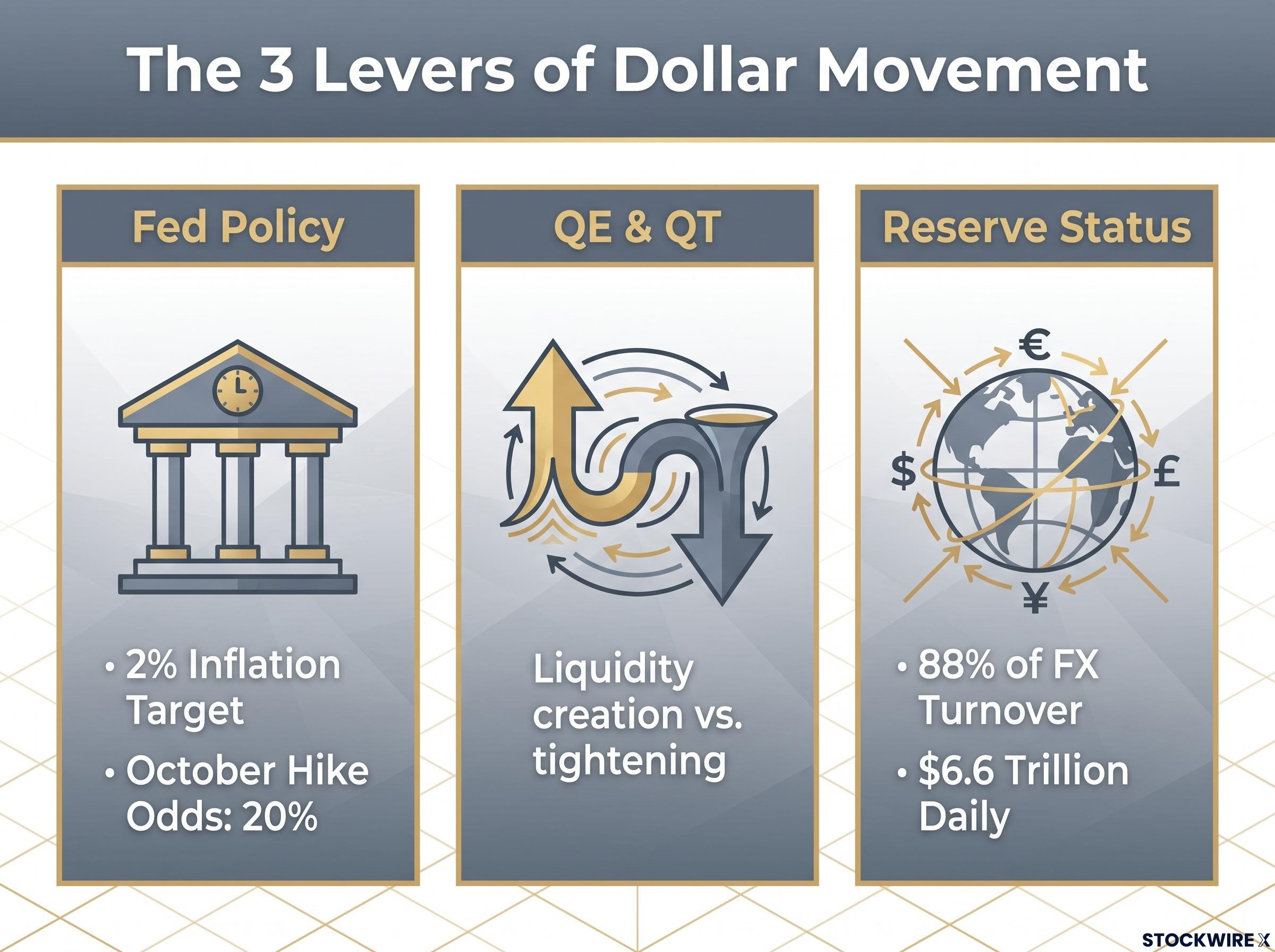
Why the dollar’s status matters The dollar accounts for over 88% of global FX turnover, about $6.6 trillion daily, according to the Bank for International Settlements (BIS) Triennial Survey (2022 data).
Knowing these levers lets you judge whether a dollar move is policy-driven, liquidity-driven or status-driven. Status-driven moves, like this one, tend to track the crisis that caused them rather than the US economy.
The dollar’s reserve status explains why it sits on one side of nearly 89% of FX trades despite the US producing only about 10% of world trade, and why investors default to it when stress hits abroad.
What this USD/CHF setup does and does not tell you
The rally is euro-led, the Fed path is uncertain, Treasury yields are a double-edged support, and the franc’s haven role is real but constrained by the rate gap and SNB risk.
Three items will decide what comes next:
- The direction of the French-German spread.
- The 27-28 October Fed meeting and incoming inflation data.
- Any SNB commentary or intervention signal.
Continuation looks more likely if spreads keep widening and inflation runs hot. A reversal would gain credibility if spreads ease, a European backstop appears, or yields start reading as fiscal alarm.
This article is for informational purposes only and should not be considered financial advice. Investors should conduct their own research and consult with financial professionals before making investment decisions. These statements are speculative and subject to change based on market developments.