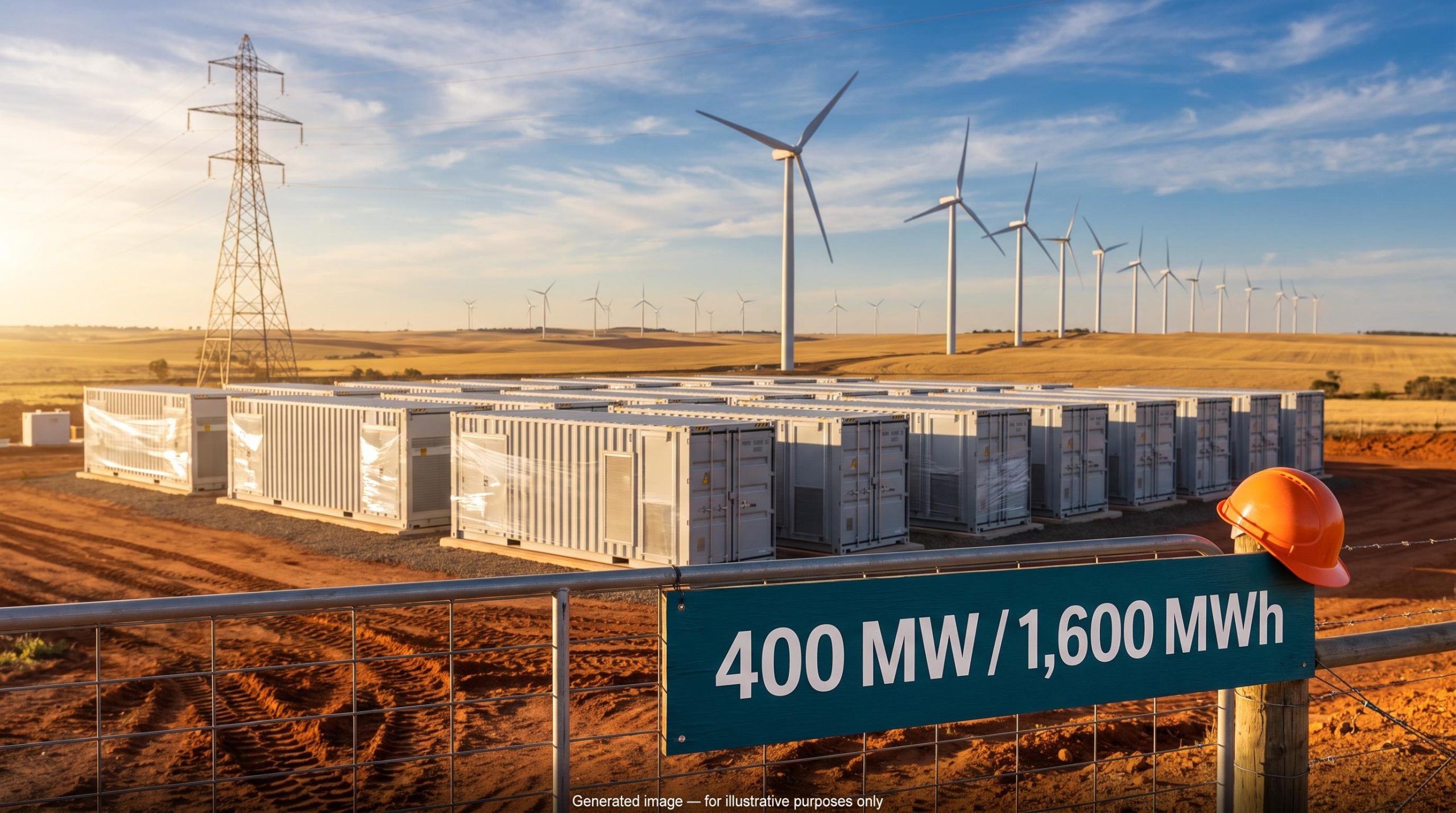
Atmos Renewables and its owner Igneo Infrastructure Partners have taken a 400 MW / 1,600 MWh Queensland battery and a 470 MW Western Australian wind farm to financial close, and both rest on federal revenue underwriting. The company release dates the Atmos Renewables financial close to 2 October 2026, though some coverage is dated 5 October.
Financial close is the point where a project’s funding and contracts are locked in and construction can begin. For a Capacity Investment Scheme (CIS) award, it is the step that turns a government revenue promise into a funded build.
The timing matters because firming capacity, meaning assets that can deliver power when wind and solar fade, is the scarce part of the grid transition.
Here is what the milestone tells you about where institutional money is going, and where the risks still sit.
What did Atmos and Igneo actually lock in, and where do the two projects stand?
The Teebar battery sits in the Fraser Coast region near Maryborough, beside Powerlink’s Teebar Creek substation. It will use Valo technology, with Enerven as builder, and operations are expected in 2028. The CIS award was announced on 24 September 2025.
Parron Maam Marang is a different animal. The wind farm, about 200 km north of Perth in the Wheatbelt, will carry up to 78-79 turbines and sells to state-owned retailer Synergy under a long-term power purchase agreement (PPA), alongside CIS underwriting. The WA Government expects electricity by late 2028.
| Attribute | Teebar BESS | Parron Maam Marang | Merredin BESS |
|---|---|---|---|
| Capacity | 400 MW / 1,600 MWh | 470 MW | 100 MW / 400 MWh |
| Location | Fraser Coast, Queensland | Wheatbelt, Western Australia | Western Australia |
| Revenue support | CIS | CIS plus Synergy PPA | CIS |
| Status | Operations expected 2028 | Electricity late 2028 | Financial close June 2025 |
The Atmos project page lists Parron at 489 MW, but the WA Government and news coverage use 470 MW.
Together with the 100 MW Merredin battery, which closed in June 2025, the pair takes Atmos’ CIS-backed capacity to 970 MW. Its operating and in-construction portfolio already exceeds 1.5 GW.
That pace is the test that separates credible developers from those holding contracts that never reach construction.
The public record has limits. Total project costs, debt providers and the exact construction start date have not been disclosed.
When big ASX news breaks, our subscribers know first
How does the Capacity Investment Scheme pull institutional capital into firming assets?
Lenders dislike merchant revenue, meaning income that swings with wholesale electricity prices. A battery that earns from price volatility is hard to finance on that basis alone.
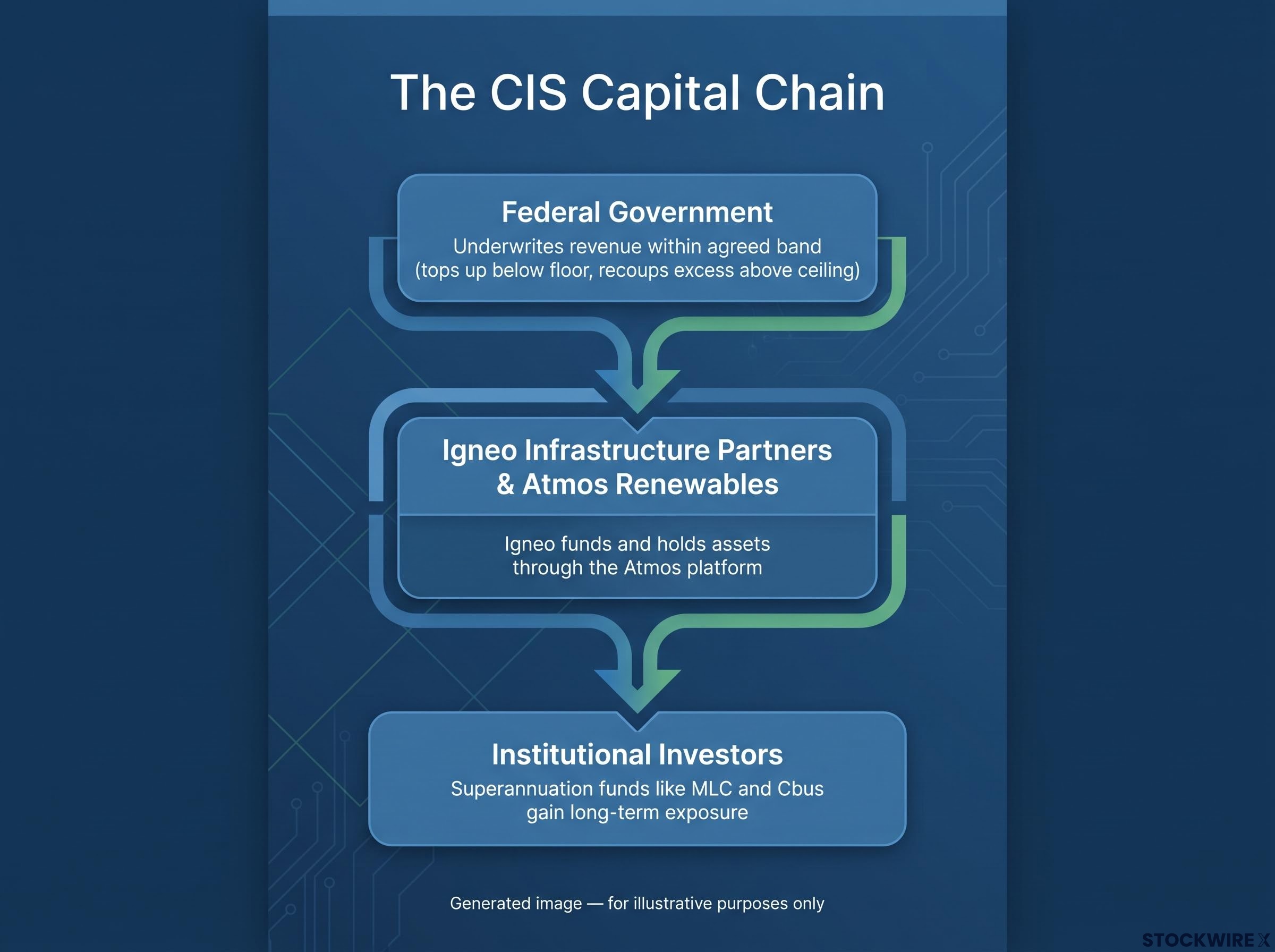
The CIS addresses this with a long-term revenue agreement carrying a floor and a ceiling. According to pv magazine Australia (4 May 2026), the government tops up revenue that falls below the floor and recoups part of any excess above the ceiling. Specific contract terms for these two projects were not found.
The capital chain runs in three steps:
- The federal government underwrites revenue within the agreed band.
- Igneo, as platform owner, funds and holds the assets through Atmos.
- Institutional investors such as superannuation funds gain exposure through Igneo.
Danny Latham, Partner and Head of Igneo Infrastructure Partners Australia and New Zealand, framed it that way:
The investment provides long-term value to institutional investors such as MLC and Cbus.
That means super money reaches these assets directly through an infrastructure platform, not only via listed equities. Pinsent Masons (18 May 2026) said the WA projects show the CIS catalysing private investment through long-term revenue certainty. The WA round covers 10 projects, with 1.9 GW of generation and 482 MW of storage.
The trade-off is that the structure caps upside while limiting downside. If you hold super or unlisted infrastructure exposure, returns on these assets will be shaped more by contract design than by wholesale price swings.
Why Atmos’ CEO says a CIS award is only the first step
The milestone is real, and Atmos CEO Nigel Baker is the first to keep it in proportion:
“The CIS provides important long-term revenue support, but an award is only one step. Projects still need to secure financing, grid access, wider commercial arrangements and a credible delivery pathway.”
That gives four hurdles:
- Financing
- Grid access
- Complementary commercial contracts, such as PPAs and network services
- Credible construction and delivery capability
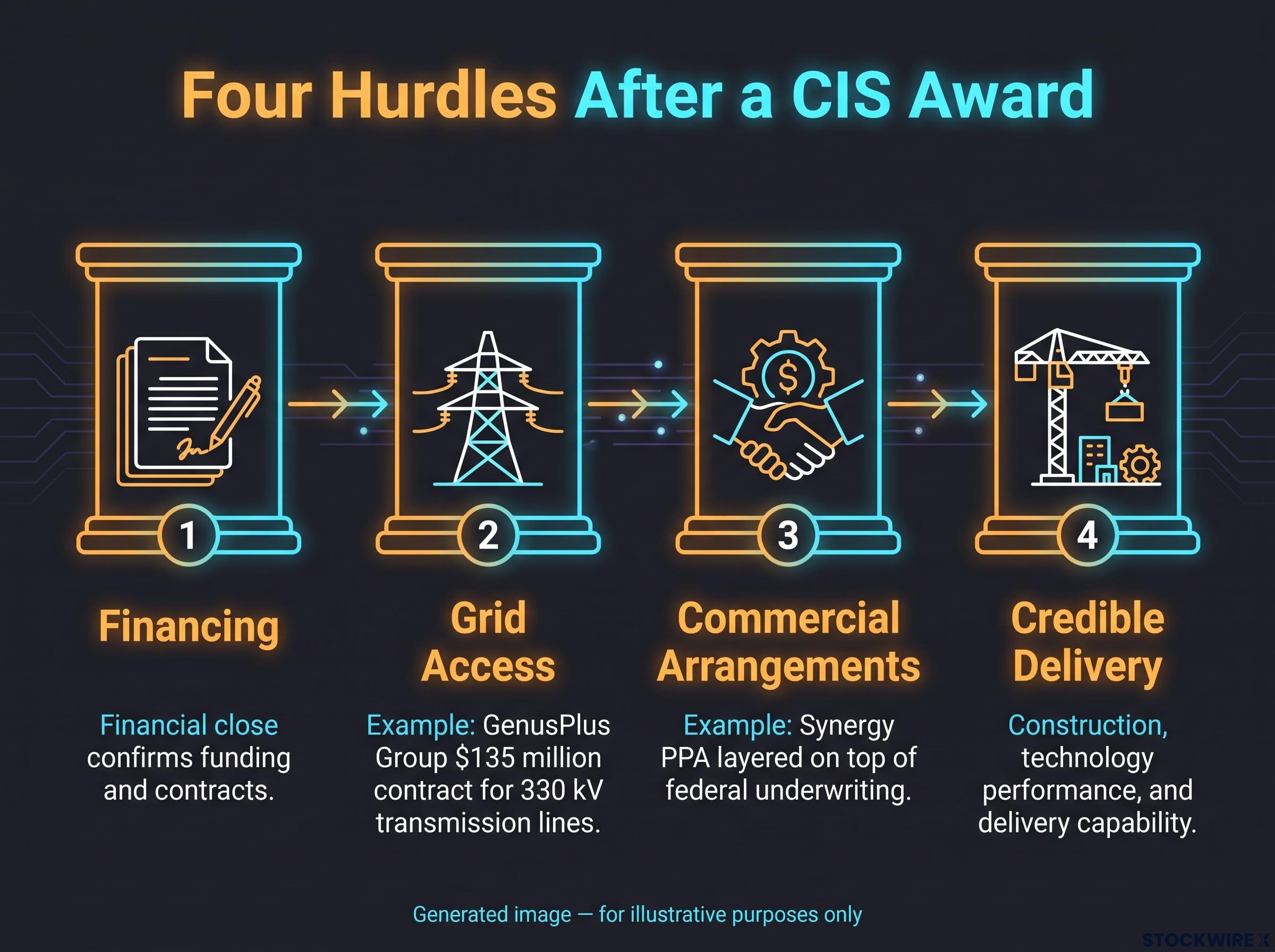
Grid access is the most visible. GenusPlus Group holds a $135 million contract to design and build a 330 kV terminal and transmission lines serving Parron (RenewEconomy, 24 September 2026).
The layering is deliberate. Synergy’s PPA, announced on 22-23 March 2026, sits on top of the federal underwriting, on WA’s isolated South West Interconnected System, which Western Power operates and which trades through the Wholesale Electricity Market.
Construction, technology performance and market participation risks sit outside the CIS contract. No project-specific criticism had been published by early October 2026.
Read financial close as de-risking the financing, not the delivery. The watch points are transmission timing, construction progress and commissioning dates.
What the milestone signals for investors and the grid transition
Zoom out and a pipeline appears. Merredin led, Teebar and Parron followed, and the wider WA round suggests more dispatchable capacity is queued behind them, though not every project in that round had reached close by May 2026.
Baker pointed to the market need: electricity demand is rising while older generation retires. Firming assets fill that gap.
Revenue-backed storage and firmed wind fit a wider infrastructure investment cycle in which energy, grids and storage now absorb most clean-energy capital, and where returns depend more on contract design than on venture-style growth.
The national CIS target and total contracted capacity were not found, so the scheme’s overall scale cannot be sized here.
Milestones to track through 2028
- Construction starts at Teebar and Parron Maam Marang
- Delivery of the 330 kV transmission works
- Teebar operations, expected in 2028
- Parron electricity, expected in late 2028
- Further CIS financial closes from other developers
For investors, the signal is that revenue-backed storage and firmed wind can reach funded construction. Returns, though, will be judged on delivery and operating performance over the next two years.
What financial close does and does not settle
Financial close confirms that funding and contracts are ready. It does not confirm that the batteries will charge or the turbines will spin.
The award-to-close risk window is where large Australian projects tend to be tested, and Victoria’s planned offshore wind auction, with contracts due in 2028, will face the same gap between a revenue promise and funded construction.
Three variables decide that: whether transmission arrives on time, whether construction runs to schedule, and how the assets perform under the CIS terms once operating. Until those resolve, the 970 MW figure describes commitment, not output.
This article is for informational purposes only and should not be considered financial advice. Investors should conduct their own research and consult with financial professionals before making investment decisions. Commissioning dates are company and government expectations, and these statements are speculative and subject to change based on market developments and project performance.