Switzerland’s central bank pays nothing to hold its currency. The policy rate has sat at 0.00% since 20 June 2025. By the rulebook most investors carry in their heads, that should make the Swiss franc an unattractive place to park money.
Yet the franc has been strengthening while the bonds of the world’s largest economies sell off hard. Government yields in major economies are rising as investors demand more compensation to hold heavily indebted sovereigns, and the usual flight-to-safety trade (into US Treasuries or German Bunds) is pointing at the very assets under pressure.
The franc is drawing on a different and newer logic. Not interest-rate carry, but fiscal credibility.
Here is the framework for understanding why Switzerland’s debt position, rather than its interest rates, is doing the heavy lifting for the Swiss franc as a safe haven right now, and what Commerzbank’s analysts expect to happen next with the USD/CHF pair.
The signal in the market: why the franc is rising when the safe-haven playbook should favour dollars
Before the explanation, the numbers that frame it:
- USD/CHF spot: 0.8353 as of 1 October 2026
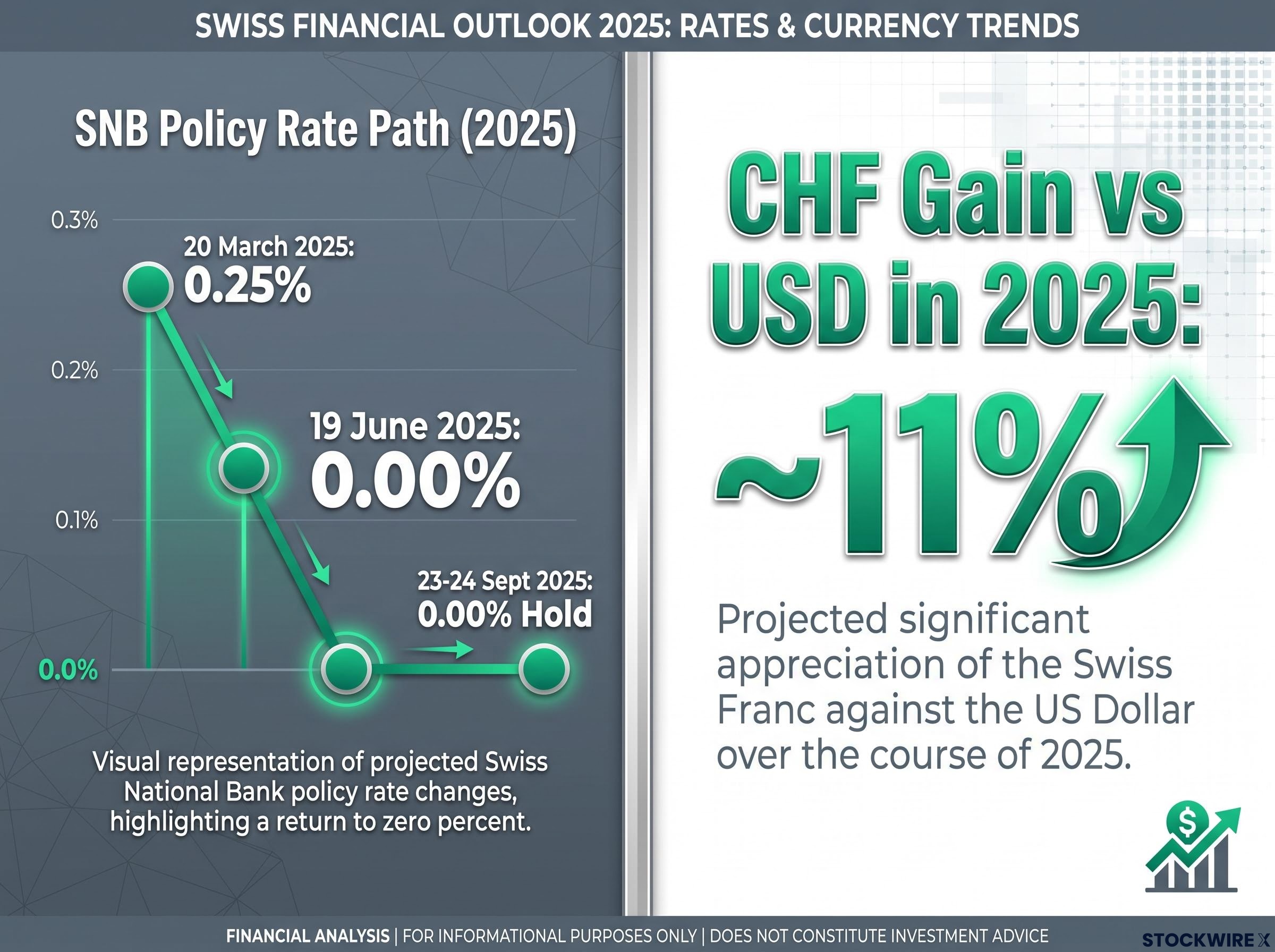
- CHF gain versus the US dollar in 2025: roughly 11%
- SNB policy rate: 0.00%, valid from 20 June 2025
In the near term, the move has been sharp. The USD/CHF pair fell approximately 1.2% over two consecutive trading days, with intraday lows touching 0.8266 after reaching a 16-month peak of 0.8382 earlier in the same week. A lower USD/CHF number means the dollar buys fewer francs, so the franc is getting stronger.
Zoom out to 2025 and the trend is the same, only larger. The franc gained roughly 11% against the US dollar through the middle of the year, according to Reuters reporting from 19 June 2025. The Swiss National Bank’s own Monetary Policy Assessment, published after its 23-24 September 2025 meeting, put it plainly.
“The Swiss franc appreciated against the US dollar, but remained relatively stable against the euro.” (SNB Monetary Policy Assessment, September 2025)
Now the puzzle. The SNB policy rate is zero, and has been since June 2025. Normally a zero-yield currency is exactly what yield-seeking capital avoids, because there is no return to collect simply for holding it. Demand should fall. Instead it has risen.
A currency that climbs 11% against the dollar in a year when it pays nothing domestically is telling you that something other than yield is pulling money in. For anyone holding dollar-denominated assets or watching global risk sentiment, that is an early sign the market’s definition of safety is shifting. Identifying the driver is the prerequisite for reading what the franc does next.
When big ASX news breaks, our subscribers know first
What Switzerland’s debt position actually looks like, and why it matters in a bond sell-off
Start with a single number. Switzerland’s central government gross debt sits near 13.65% of GDP, according to the IMF Global Debt Database for 2024. On a net federal basis, the figure comes to roughly CHF 140-149 billion, or around 15-16% of GDP. Either way, the debt burden lands in the low-to-mid teens.
That number means little on its own. It starts to mean something when you place it next to Switzerland’s peers.
| Country | Central Government Debt (% of GDP) | General Government Debt (% of GDP) | Source / Year |
|---|---|---|---|
| Switzerland | ~13.65% | ~37.6% | IMF, 2024 |
| France | ~113% | ~113.1% | IMF, 2024 |
| United States | ~122.3% | slightly above 120% | IMF, 2024 |
| Japan | ~200.9% | ~236.7% | IMF, 2024 |
Read down that first column and the gap accumulates weight. Switzerland carries a central government debt load near 14%. France sits above 113%. The United States is above 122%. Japan runs past 200%, and on a general government basis closer to 237%.
The US fiscal trajectory is more nuanced than the headline debt ratio suggests; interest payments currently represent roughly 18-19% of tax revenue, below the threshold many analysts treat as a warning level, which partly explains why Treasury markets have not yet priced a crisis premium despite debt above 122% of GDP.
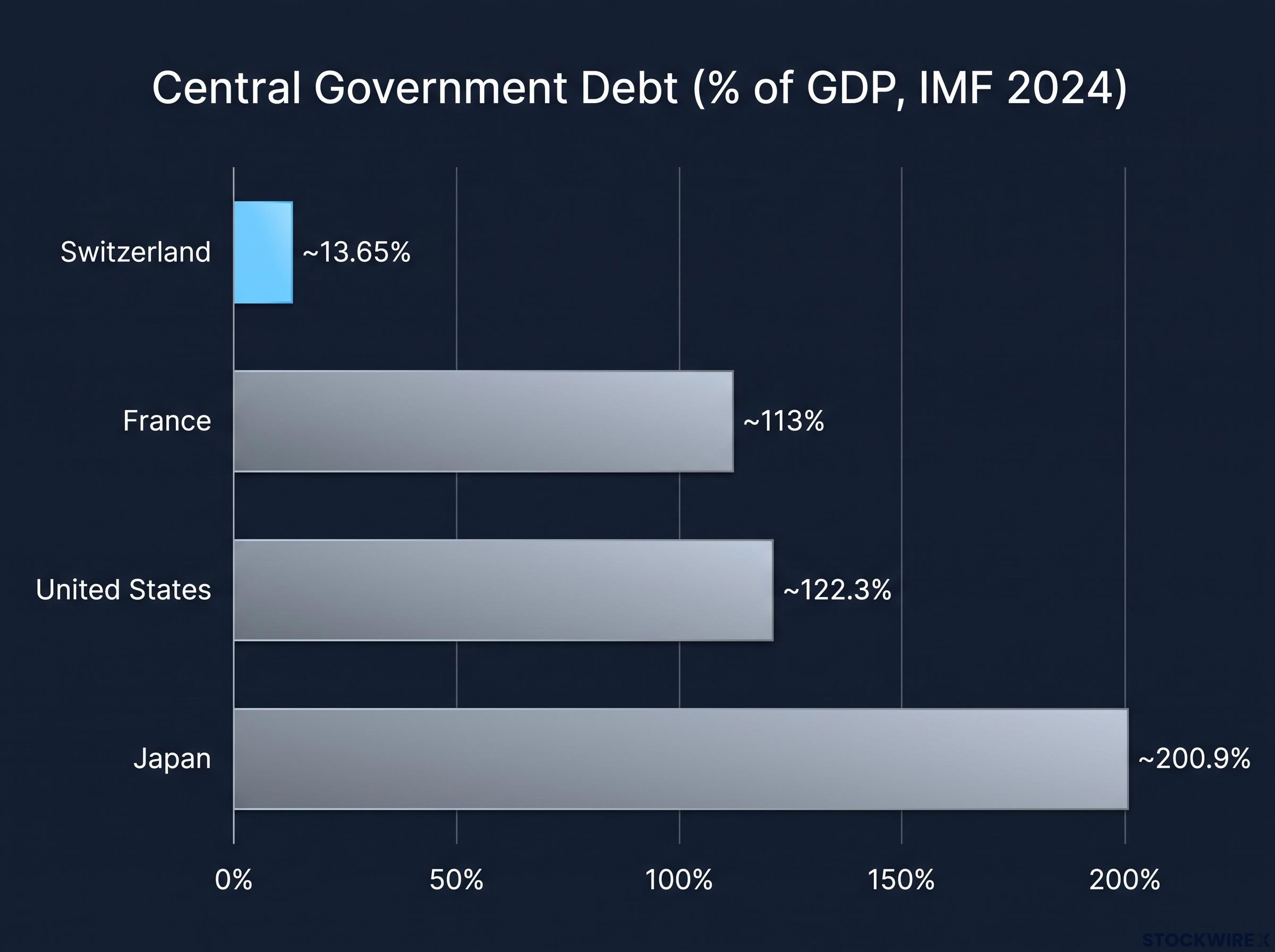
That divergence is not academic colour. When investors decide which sovereign bonds still function as genuine safe assets in a world of rising debt, Switzerland’s 14% against Japan’s 237% is the kind of gap that moves allocation decisions at scale. This is the structural reason CHF demand is tied to Switzerland’s fiscal position rather than coincidentally correlated with it.
The backdrop makes the point sharper. Global public debt reached approximately 94% of global GDP in 2024, according to the IMF’s Global Debt Monitor, and the trend is upward. The pool of sovereigns whose debt remains credibly sustainable is small, and Switzerland sits near the top of it.
How fiscal credibility translates into currency demand
The transmission from fiscal health to currency demand is more direct than it first appears. Investors accept very low, even near-zero, yields on Swiss government bonds because the fiscal risk premium (the extra return demanded to compensate for the chance a government struggles to repay) is correspondingly low. To buy those bonds, foreign investors must first buy francs. Demand for the bond becomes demand for the currency.
That channel is visible in the data, not just the theory. The SNB Quarterly Bulletin 2/2025 ties a significant fall in yields on long-term Confederation bonds to “increased demand for safe investments” in Swiss sovereign paper. Falling yields at a time of rising demand confirm the fiscal safe-haven channel is working, and that it shows up in bond markets before it shows up anywhere else.
The complication: why zero interest rates make Switzerland’s safe-haven story genuinely unusual
Here is where the clean story gets complicated. The same zero rate that sits beneath Switzerland’s fiscal appeal also turns the franc into a cheap funding currency. When the SNB holds at zero while other major central banks keep rates higher, traders borrow in francs to buy higher-yielding assets elsewhere. That is a carry trade, and it places steady downward pressure on the franc even as fiscal fundamentals pull the other way.
The rate path that got us here was deliberate:
- 20 March 2025: cut of 0.25 percentage points, to 0.25%, citing reduced inflationary pressure and safe-asset demand for Confederation bonds
- 19 June 2025: cut of 0.25 percentage points, to 0.00%
- 23-24 September 2025: rate held unchanged at 0.00%, FX intervention readiness reaffirmed
So the franc is caught between two forces. Fiscal credibility draws capital in. Carry dynamics push capital out. And the SNB holds tools powerful enough to tip the balance either way.
The bank has been open about the dual dynamic. Its September 2025 assessment noted that geopolitical shocks could drive safe-haven appreciation in the franc, then added a qualifier that matters.
The SNB intervention mechanics that sit behind this tension are formidable: CHF 770 billion in foreign exchange reserves, a balance sheet larger than Switzerland’s entire annual output, built specifically to lean against the safe-haven appreciation the bank cannot prevent but must constantly manage.
Safe-haven appreciation pressure is “currently being countered somewhat by the relatively high interest rate differential with other countries.” (SNB Monetary Policy Assessment, September 2025)
That is the clearest official acknowledgement that rates still matter, even in a fiscal safe-haven story. The SNB also reaffirmed its willingness to intervene directly in currency markets, and Reuters reported on 19 June 2025 that the bank did not rule out a return to negative rates, a policy Switzerland operated for an extended stretch in the past.
Commerzbank analysts frame this as a genuine tension rather than a problem with a tidy answer. They acknowledge that temporary periods of franc softness can occur during phases of market stabilisation, even while holding the view that the franc has likely reached its recent floor.
For anyone weighing CHF exposure, the takeaway is that the safe-haven bid is real but conditional. The SNB has both shown and retained the willingness to lean against its own currency’s strength, which means fiscal fundamentals alone are not a sufficient basis for a one-way view on the franc.
Why fiscal concerns are now reshaping currency markets more broadly, and what comes next for CHF
Step back from Switzerland and the Swiss case starts to look like a window onto something larger. Commerzbank’s overarching view is that fiscal concerns are increasingly shaping foreign exchange dynamics heading into year-end, and not only for the franc. Investors are repricing sovereign risk across currency pairs, treating a government’s debt trajectory as a live currency input rather than background noise.
The global numbers explain why. Global public debt stands near 94% of global GDP and is rising, per the IMF’s 2024 Global Debt Monitor, while total global debt including private borrowing sat around 237% of GDP in 2023. As the Bank for International Settlements has noted, through work presented by Carmen Reinhart at its 24th Annual Conference in 2025, high government debt pushes markets to demand higher term premia (extra compensation for holding longer-dated bonds), which feeds the broader sell-off.
As that debt load climbs across the major economies, the universe of low-debt sovereigns whose currencies can absorb safe-haven flows gets smaller. That makes Switzerland’s fiscal position comparatively more valuable over time, not less.
Commerzbank’s forward view on the franc follows from that logic:
- Fiscal concerns are increasingly influencing FX dynamics heading into year-end
- The franc’s recent floor is likely to hold
- Temporary periods of CHF softness remain possible during phases of market stabilisation
The SNB’s own framing points the same way. Its September 2025 assessment noted that geopolitical shocks could send money into “currency areas regarded as safe havens,” producing franc appreciation. Switzerland’s fiscal advantage, in other words, is not a static quirk of a small economy. It is a dynamic source of currency demand that grows more relevant as debt in major economies keeps rising.
The CHF outlook: what to watch as the year closes
Rather than chase a price target, watch three signals as the year winds down:
- SNB intervention signals. Any sign the bank is stepping into the FX market, or reopening the negative-rate question, can override the fiscal story quickly.
- Global rate differentials. If other major central banks begin cutting, the carry disadvantage that weighs on the franc narrows, changing the equation.
- Sovereign credibility commentary. Shifts in IMF or ratings agency views on French or US debt sustainability feed directly into the fiscal safe-haven bid.
Commerzbank’s guidance here is qualitative, not a number on a screen, and the monitoring approach should match that.
What makes a currency a fiscal safe haven, and why not all safe havens are built the same
Here is the distinction most investors never draw. Not all safe-haven currencies are safe for the same reason, and the reason is what determines when each one holds up.
A fiscal safe haven is a currency whose protective status rests primarily on the issuing government’s low debt burden and strong institutional credibility, rather than on high interest rates or deep, liquid markets. The franc is the clearest current example. Demand for it tracks Switzerland’s fiscal discipline, visible in the SNB’s Quarterly Bulletin 2/2025 observation that Confederation bond yields fell on increased demand for safe investments, not on the appeal of the yield itself.
The US dollar is a safe haven too, but for a different reason entirely. The dollar’s status flows from its role as the world’s reserve currency and the unmatched depth and liquidity of its markets, not from fiscal restraint. With US central government debt near 122.3% of GDP against Switzerland’s 13.65% in 2024, the two currencies rest on structurally different foundations.
Dollar reserve status rests on structural foundations that have little to do with fiscal restraint: the US dollar appears on one side of 89.2% of all global FX trades and holds 57% of official global reserves, a grip that persists even as US central government debt runs above 122% of GDP.
The contrast sharpens across three dimensions:
- Primary driver. CHF safety rests on low debt and institutional credibility. USD safety rests on reserve status and market liquidity.
- Rate sensitivity. A fiscal safe haven can hold its bid even at zero yield. A liquidity-driven haven leans more on rate and reserve dynamics.
- Fiscal trajectory risk. A liquidity-driven haven can lose its premium if its own debt position deteriorates. A fiscal-credibility haven tends to grow more resilient as the gap between high-debt and low-debt sovereigns widens.
Commerzbank captures the practical effect: Switzerland’s comparatively modest debt burden has helped counterbalance the negative drag of its unfavourable monetary policy differential. The SNB’s own language, referring to “currency areas regarded as safe havens,” treats this as a recognised category of demand rather than a simple risk-off reflex.
For a reader who once thought of safe-haven currencies as interchangeable, the point is that the mechanism behind franc safety is categorically different from the one behind dollar safety, with different implications for when each is likely to outperform.
Making sense of CHF in a world where fiscal credibility is becoming a scarce asset
Pull the threads together and the franc’s strength stops looking anomalous. A currency gaining ground at zero interest rates is exactly what you would expect when investors are repricing fiscal safety in a world where most major sovereigns are deep in debt and bond markets are charging more to hold them. The debt gap is the story: Switzerland near 14% of GDP, France around 113-119%, the US near 122-125%, Japan between 200% and 237%.
The constraints are genuine, though. The SNB has the tools and the stated willingness to push back against excessive franc strength, including FX intervention and the option of negative rates it has declined to rule out. Carry-trade dynamics can also produce stretches of franc weakness even inside a supportive fiscal backdrop.
For investors wanting to pressure-test the carry side of this equation, our deep-dive into carry trade risk examines why thin-liquidity periods concentrate rather than reduce carry reversals, with three historical August blowups showing how quickly fiscal or policy surprises can unwind positions built on suppressed implied volatility.
Switzerland’s comparatively modest debt burden has helped counterbalance the negative effect of its unfavourable monetary policy differential. (Commerzbank analysts)
That observation holds the whole argument in a single line. Commerzbank expects the franc’s floor to hold and fiscal concerns to grow as an FX driver into year-end, while the SNB keeps its rate at zero and its intervention readiness live.
Tracking the franc from here means tracking two things at once: global fiscal conditions, which support it, and SNB policy signals, which can override it. The interaction between those forces is where the real story lives, and the franc is the market’s current best expression of how seriously investors are taking sovereign debt sustainability as a currency driver.
This article is for informational purposes only and should not be considered financial advice. Investors should conduct their own research and consult with financial professionals before making investment decisions. Past performance does not guarantee future results. Financial projections are subject to market conditions and various risk factors, and forward-looking views are speculative and subject to change based on market developments.