
Picture a stock that turned $9 into roughly $2,400 over fifteen years. One of the great compounding stories of the modern market. Then, in a matter of weeks, it handed back three-quarters of that gain. No earnings miss. No accounting scandal. No product that stopped working.
What broke it was a single government decision. The Federal Housing Finance Agency, which oversees Fannie Mae and Freddie Mac, changed one rule about which credit scores lenders could use when writing mortgages sold into the government-backed market. That was enough to erase decades of pricing power at Fair Isaac Corporation (FICO) and knock the share price down roughly 75% from its peak.
This is not a story about management failing or markets panicking. It is about a specific category of danger that most investors never explicitly price: the risk that government action, not competition or operational stumbles, rewrites a company’s economics overnight. After this, you will know how to spot when a company’s moat is regulatory in origin, why that distinction matters before any rule changes, and why a stock that has already fallen a long way offers you no protection at all.
Why regulatory risk is a different kind of danger
Most investment analysis is built to catch three threats. Business risk: can the company execute? Market risk: what happens when the whole market moves? Credit risk: can it service its debt? Regulatory risk sits apart from all three, because it does not come from a competitor, a recession, or a balance sheet. It comes from a government making a decision.
That changes how it behaves. An earnings shortfall usually announces itself. Guidance softens, a sector peer warns, short interest creeps up, and the market prices the pain in stages. A regulatory shift can arrive with no warning, take effect almost immediately, and permanently restructure who is allowed to compete and on what terms.
This is not a fringe worry dreamed up after the fact. NYU valuation specialist Aswath Damodaran treats regulatory action as a standalone factor capable of changing a company’s cash flows, its required return, or its very viability, through price controls, licensing changes, or forced competition. Oaktree’s Howard Marks has argued for years that a shift in the rules can invalidate every prior assumption about an industry’s profitability, especially in finance and technology, where regulation decides who may participate. Index providers and large asset managers such as MSCI and BlackRock treat regulatory exposure as a systematic factor in their sector outlooks.
Here is the uncomfortable part. If you evaluate a holding purely through its financial statements, its moat, and its market position, you are using tools that are largely blind to the mechanism that destroyed three-quarters of FICO’s value. The professionals price this risk separately. Skipping that step has direct consequences for what you own.
It helps to know the specific ways the danger strikes.
Not every regulatory moat collapses the way FICO’s did: the regulatory moat mechanics at S&P Global have survived five decades, a tripling of approved competitors, and multiple enforcement actions, because the moat rests on four reinforcing institutional layers rather than a single pricing grid at a single agency.
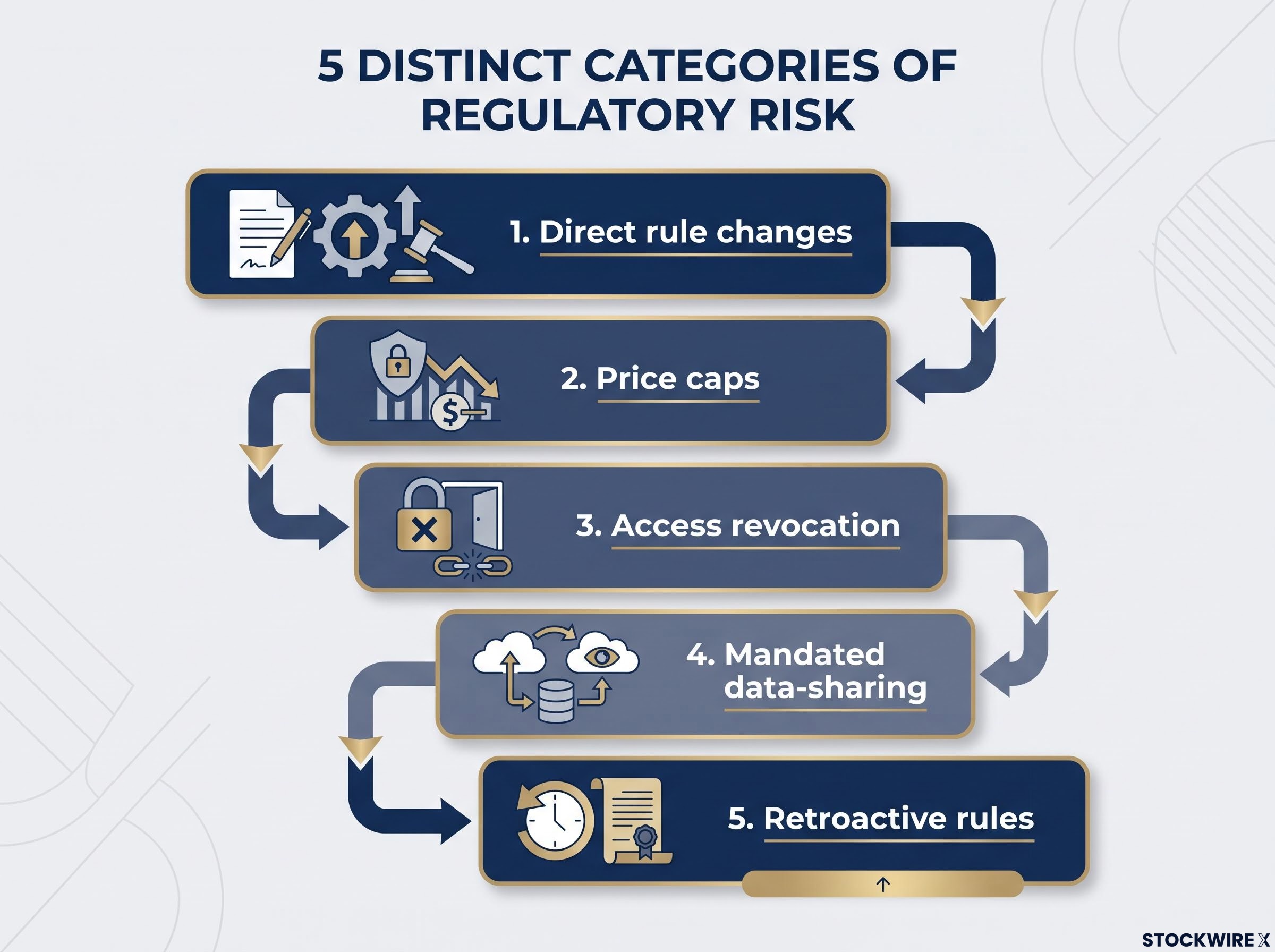
Five channels through which regulatory risk strikes:
- Direct rule changes that introduce competitors, instantly ending an incumbent’s exclusivity
- Price caps or forced pricing-grid changes that compress margins for everyone at once, regardless of competitive strength
- Licence, charter, or access revocation that strands otherwise valuable products out of a key channel
- Mandated data-sharing or interoperability that dissolves an information advantage by forcing a dominant player to share its inputs
- Retroactive or highly uncertain rules that impair long-life assets even after the capital is already sunk
Once you can name these channels, FICO stops looking like a freak accident and starts looking like a textbook outcome of the first one on the list.
When big ASX news breaks, our subscribers know first
How FICO built a regulatory moat, and why that made it fragile
FICO’s dominance in mortgage credit scoring was real, but it was never purely about superior technology. Its deepest advantage was written into the rules themselves. For years, Classic FICO scores were effectively required for the vast share of U.S. mortgages that get sold to or guaranteed by Fannie Mae and Freddie Mac, the government-sponsored enterprises that sit at the centre of the housing finance system.
The five economic moat sources identified by Morningstar — intangible assets, switching costs, network effects, cost advantage, and efficient scale — apply differently when the intangible asset in question is a regulatory mandate rather than a brand or patent, because mandates can be rescinded by a single administrative decision without any product failure.
That embedding produced extraordinary economics. If lenders had to use your score to sell a conforming loan, you held pricing power that no competitor could match on product merit alone. The moat was durable precisely because it lived inside regulation.
Then the regulation changed. In late September 2026, FHFA Director Bill Pulte directed Fannie Mae and Freddie Mac to accept VantageScore 4.0 from all lenders and to adopt a single loan-level pricing adjustment grid that treats VantageScore 4.0 and Classic FICO equally. The previous setup had imposed a 20-point pricing disadvantage on VantageScore. Removing it ended FICO’s functional exclusivity in the GSE mortgage channel in a single stroke.
The pricing contrast made the threat concrete. VantageScore 4.0, jointly owned by Equifax, Experian, and TransUnion, carries a mortgage scoring fee of $0.99 through 2028, well below FICO’s higher wholesale pricing. That gap hands lenders a direct economic reason to switch wherever they now can.
The FHFA’s unified pricing grid decision, as reported by HousingWire, removed the 20-point loan-level pricing disadvantage that had kept VantageScore 4.0 out of meaningful competition in the GSE mortgage channel, handing lenders a direct economic incentive to switch at scale.
Notice the structure of the failure. One regulator. One rule. One pricing grid. FICO’s moat was not spread across many regulatory relationships; it rested entirely on a single agency’s continued willingness to preserve the status quo. That concentration is the whole lesson. The same regulatory embedding that built the fortress also created one door, and when the FHFA opened it, there was nothing behind it to slow the fall.
The market priced that in violently. FICO fell roughly 26% on 29 September 2026, its steepest single-day drop since 1989. Its 52-week range as of early October 2026 stood at $586 to $1,998, a reminder that the stock had traded above $1,900 within the prior twelve months. If you hold any company whose pricing power depends on a government mandate or an exclusive channel, FICO is your template: the embedding that creates the moat is the same thing that creates the single point of failure.
What the analyst split tells you about regulatory shock pricing
What happened next among professional analysts is itself instructive. They did not converge on a view. They scattered.
| Analyst Firm | Rating Change | New Price Target | Key Rationale |
|---|---|---|---|
| BofA Securities | Downgraded Buy to Neutral | $700 (halved) | Increased risk to volumes, pricing, and market share after the LLPA distinction was removed |
| Goldman Sachs | Maintained Buy | $1,129 (from $1,322) | Analytics platform and non-mortgage businesses retain substantial value |
| BMO Capital | Constructive stance retained | $1,150 (from $1,550) | Continued belief in the broader franchise despite reduced targets |
BofA was blunt about what had changed.
BofA Securities on the downgrade The decision cited “increased risk to volumes, pricing, and market share following removal of the key LLPA pricing distinction.”
A gap from $700 at the bearish end to $1,129 at the constructive end is enormous for a single stock after a single event. That dispersion is the point. With an earnings miss, analysts can model the shortfall and roughly agree. A regulatory shock produces a genuinely wide range of outcomes that the market cannot resolve quickly, so the disagreement itself becomes a signal: this is uncertainty of a kind that takes time, not a quarter, to clear.
FICO’s own response follows a familiar post-shock playbook. It is pushing FICO Score 10T and aims to make it available to FHA-approved lenders from January 2027, an attempt to rebuild regulatory embedding in a different channel now that the old one has opened up.
The fallacy of the built-in floor, and what Nike shows
There is a tempting thought that visits every investor looking at a wrecked stock: it has already fallen so far, how much lower can it really go? That instinct feels like value analysis. It is usually a cognitive bias wearing value’s clothing.
The buy the dip logic that surfaces after a large single-day decline — the intuition that a severe sell-off itself signals a buying opportunity — is most dangerous precisely when the decline reflects permanent fundamental restructuring rather than sentiment overshoot, which is what distinguishes a FICO-style regulatory shock from a garden-variety earnings miss.
Two mechanisms drive it. Anchoring, documented by Daniel Kahneman and Amos Tversky, makes you fix on a prior high and treat it as fair value, so a 75% decline feels like a discount even when the fundamentals have permanently changed. Loss aversion, central to Richard Thaler’s work, creates a powerful urge to get back to even, which pushes investors to average down and the related disposition effect makes them reluctant to crystallise a loss.
The empirical record does not cooperate with the floor assumption. Momentum research by Narasimhan Jegadeesh and Sheridan Titman found that stocks with large negative returns frequently keep underperforming, the exact opposite of a built-in floor. History is littered with the same pattern.
- Cisco, Intel, and Lucent fell more than 70% after the dot-com bubble, then drifted lower or stagnated for years as growth expectations reset
- Citigroup and Bank of America in 2008 punished investors who assumed prior declines had de-risked them, as capital needs and regulatory pressure drove repeated further drawdowns
- Eastman Kodak and BlackBerry looked cheap against their old peaks while their business models entered secular decline, the definition of a value trap
Ben Carlson of Ritholtz Wealth Management put it as plainly as anyone.
“Down 80% can go to down 90%.”
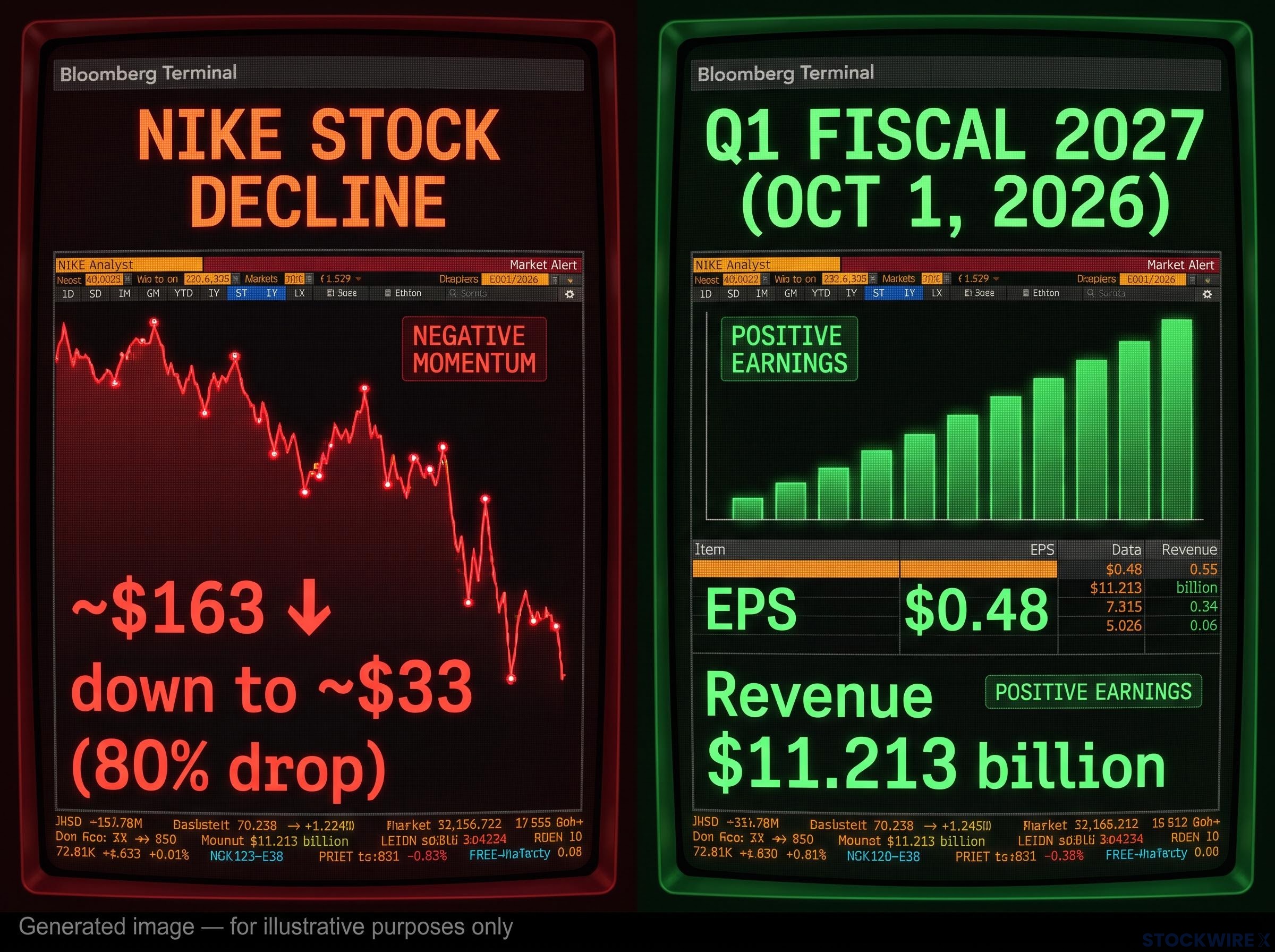
Which brings us to Nike, a live demonstration rather than a dusty case study. The stock had already fallen from around $163 to roughly $33, a decline of about 80%. By the floor logic, the downside should have been nearly exhausted.
Then came the Q1 fiscal 2027 report on 1 October 2026. Nike posted EPS of $0.48, which beat consensus, and revenue of $11.213 billion for the quarter ended 31 August 2026, with strength in North America and weakness in Greater China. A beat on earnings. And the stock still failed to turn, because an 80% prior decline is a fact about the past, not a promise about the future.
The read for you is simple. If your main reason for buying a stock is that it has already fallen a long way, that is anchoring, not analysis. The question that matters is future free cash flow and balance-sheet resilience, never the size of the loss already taken.
A practical framework for identifying regulatory risk before it strikes
Knowing how the trap works is only useful if you can run a check before you commit capital. The practitioner approach reduces to four questions you can ask of any position in a regulated industry.
Four questions to ask before investing in a regulated business:
- How dependent is revenue or profitability on specific rules, approvals, or mandated use? (FICO’s mortgage scoring revenue leaned heavily on the GSE rule that effectively required its score.)
- How concentrated is the regulatory exposure, measured in regulators, laws, and channels? (FICO’s exposure sat inside a single FHFA rule and a single pricing grid.)
- How politically salient is the company’s pricing or business model? (Credit scores are widely seen as raising borrowing costs, the exact rationale Director Pulte gave for the change.)
- What is the historical record of intervention in that sector? (The GSE mortgage channel has decades of documented regulatory intervention behind it.)
Run those four questions on FICO as it stood before 29 September 2026 and every answer points the same way: deep rule dependence, extreme concentration, high political heat, and a sector with a long interventionist history. The vulnerability was visible in advance to anyone asking these questions, even though the timing was not. When a holding’s answers trend toward concentrated dependence and high political salience in an interventionist sector, treat that as a signal to price the regulatory risk explicitly rather than assuming the moat is permanent.
When regulatory risk operates at two levels at once
The FHFA decision is not only a FICO story. Placing VantageScore 4.0 and Classic FICO on equal pricing footing creates a “score shopping” incentive: lenders may drift toward whichever model approves more borrowers, which could erode credit standards gradually. Edward Pinto of the American Enterprise Institute Housing Center has long warned that loosening underwriting standards raises default risk. So the same rule works as a stock-specific shock and a potential systemic one, a reminder that regulatory risk can cascade well beyond the company directly hit.
AI regulatory risk in semiconductor equities follows a structurally similar pattern: SK Hynix fell more than 6% and Kioxia dropped roughly 9% in a single week after industry safety calls in September 2026, with the repricing arriving before any earnings deterioration, confirming that the mechanism described in the FICO case is not sector-specific.
This article is for informational purposes only and should not be considered financial advice. Investors should conduct their own research and consult with financial professionals before making investment decisions. Past performance does not guarantee future results, and forward-looking statements are speculative and subject to change.
What this episode changes, and what it does not
Strip the FICO story to its anchors and the argument becomes hard to dodge: a 75% decline from peak, a 26% single-day drop, the worst since 1989, and not a cent of it caused by a bad quarter. Historical outperformance, a genuine competitive advantage, and even a prior crash all failed to protect the holder from a risk that lives outside conventional financial analysis. Nike reinforces the second half of the lesson. An 80% fall is no floor.
The takeaway is not to flee every regulated industry. Regulation builds moats as often as it breaks them; stable rules create barriers to entry that produce durable returns for years. The discipline is to price the regulatory concentration explicitly, rather than treating it as invisible until the rule changes.
For FICO specifically, the open questions are worth watching. Implementation details of the unified LLPA grid were still evolving as of early October 2026, so the full hit to mortgage revenue is not yet settled. Monitor lender adoption of VantageScore 4.0, uptake of FICO Score 10T in FHA channels from January 2027, and whether the analyst gap between the $700 bear and the $1,129 bull begins to close. Underneath it all sits one unresolved question: was FICO’s moat always regulatory in origin and merely revealed, or does enough analytical differentiation remain to rebuild pricing power elsewhere?
You cannot answer that yet. But you can now see the risk before the rule changes, and that is the only vantage point from which you still have choices to make.