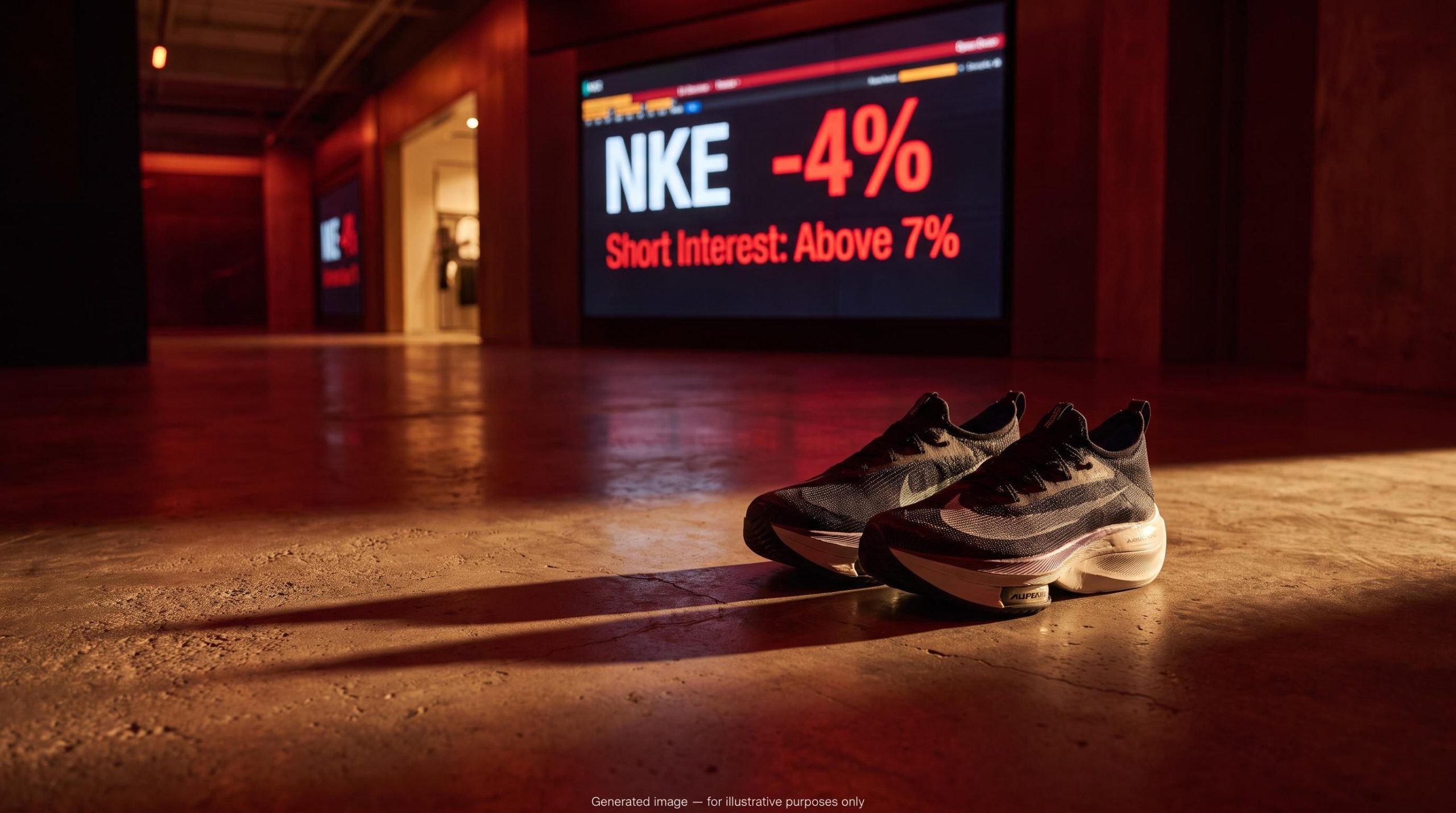
Nike reported its fiscal Q1 2027 results on 1 October 2026, and the quarter arrived split down the middle. Profit beat expectations, revenue missed, and in the same release the company guided for a full-year sales decline in the high-single-digit percentage range while launching a sweeping operating model overhaul called Pace, targeting $2.5 billion in cumulative savings. Shares fell.
The timing made the result sting more than the numbers alone suggest. Over the prior year, short interest had climbed from below 3% of float to above 7%, a reflection of how deeply institutional investors doubt that Nike can grow its way back rather than simply cut its way to a smaller, still-shrinking business.
The quarter did not settle that debate. Revenue fell 4% year over year, Greater China stayed a persistent drag, and Nike’s own outlook points to more pressure before anything stabilises.
This breaks down what the numbers actually show, what Pace is designed to do and what it will cost first, where analysts think the recovery story is cracking, and what a record short position signals about institutional conviction heading into Q2. Here is what investors need to understand about where Nike stands and what the next test will be.
Revenue fell, margins held, and the gap between the two is the whole story
Start with the top line, because that is where the problem lives. Total revenue came in at $11.213 billion, down 4% on a reported basis and 5% currency-neutral, falling short of the $11.35 billion consensus estimate.
The Q1 result landed against a backdrop of sharply lowered pre-earnings expectations, with the stock already down more than 44% year-to-date and Nike’s removal from the S&P 100 in September 2026 having stripped away a layer of institutional default ownership.
Now the profit line, which tells a different story. Adjusted earnings per share hit $0.48, beating the $0.44 consensus, while gross margin expanded 60 basis points year over year to 42.8%, helped by lower warehousing and logistics costs. Selling and administrative expense dropped 3% to $3.9 billion.
The single brightest number in the quarter Gross margin expanded 60 basis points to 42.8%, driven by reduced warehousing and logistics costs and disciplined cost management.
So the cost machine is working. The demand machine is not.
That split shows up most clearly in the channel breakdown. Nike Direct, the company’s own stores and digital channels, contracted 8% reported and 9% currency-neutral to $4.1 billion. Nike Brand wholesale held far better, down just 1% to $6.8 billion. Converse collapsed 28% to $263 million.
| Channel | Q1 FY2027 Revenue | YoY Change (Reported) | YoY Change (Currency-Neutral) |
|---|---|---|---|
| Nike Direct | $4.1B | -8% | -9% |
| Nike Brand Wholesale | $6.8B | -1% | -1% |
| Converse | $263M | -28% | -28% |
| Nike Brand Total | $11.0B | -4% | -4% |
The detail that matters most is Nike Direct. This is the channel Nike controls completely, and it is contracting faster than wholesale. Chief Executive Elliott Hill acknowledged further progress is still needed in Sportswear, Jordan Brand, and Greater China.
For investors, the read is this: Nike is managing what it can control and losing ground on what it cannot. Margin expansion signals discipline. The revenue miss across every major channel, including its own direct business, signals that the demand problem has not yet turned.
When big ASX news breaks, our subscribers know first
What Pace actually is, and what it will cost before it saves anything
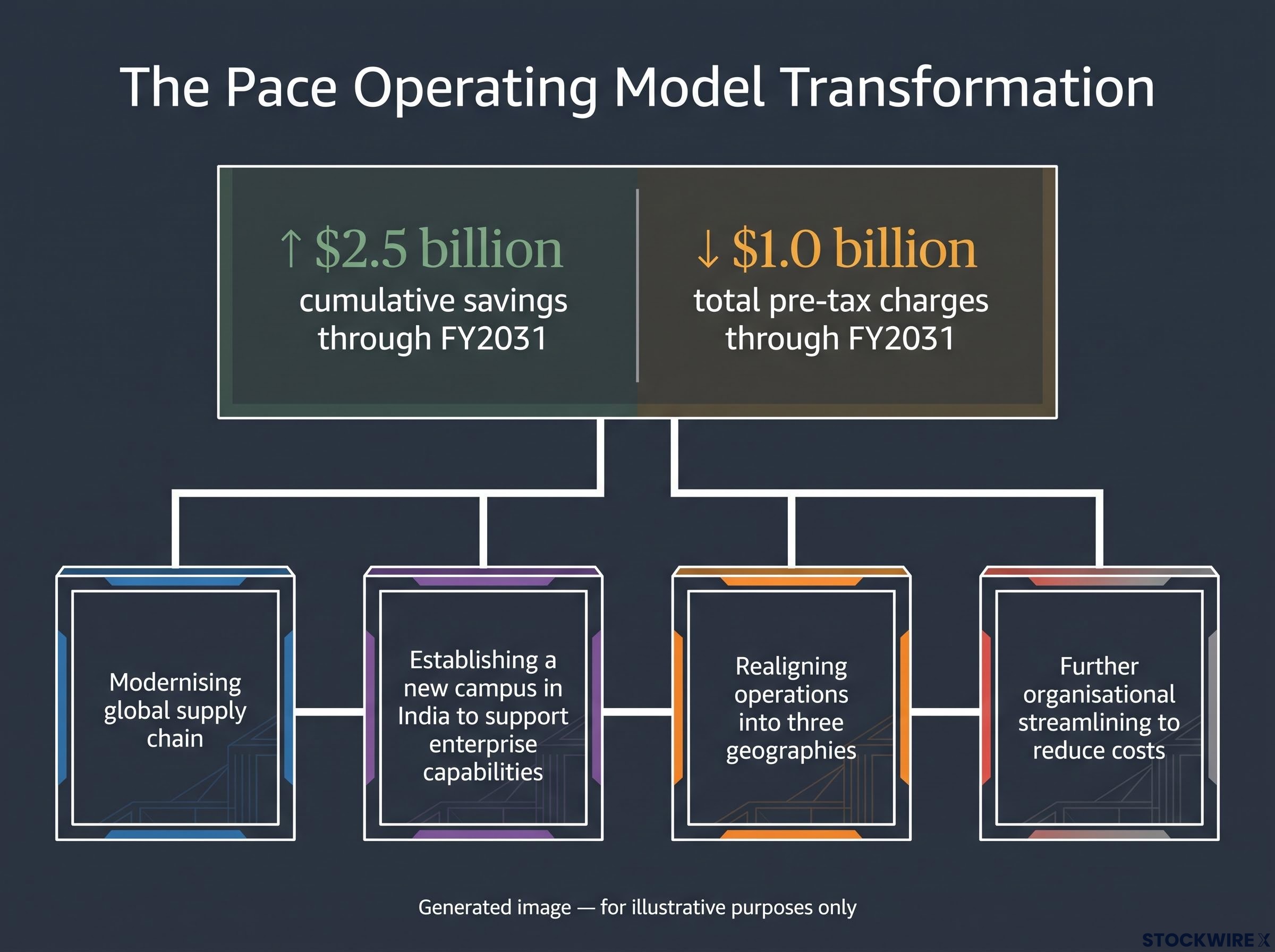
Nike does not call Pace a cost-cutting exercise. It frames the programme as an operating model transformation built to “accelerate and scale the success of the Sport Offense,” its performance-product strategy, building on a cost realignment plan announced in March 2026.
Strip away the framing and Pace has four concrete structural components:
- Modernising Nike’s global supply chain
- Establishing a new campus in India to support enterprise capabilities
- Realigning operations into three geographies
- Further organisational streamlining to reduce costs
The headline commitment Nike expects Pace to deliver approximately $2.5 billion in cumulative savings through fiscal 2031.
That figure anchors the whole programme. But a savings number spread across roughly five years means the annual benefit, while real, is not transformative on its own. Weigh it against a business currently guiding for a high-single-digit revenue decline, and the maths starts to look like a floor under margins rather than a growth engine.
The financial mechanics of Pace
Savings come later. Costs come first.
Nike expects total pre-tax charges of approximately $1.0 billion through FY2031, primarily employee-related costs. It has already recognised roughly $0.3 billion in FY2026 severance, and expects to book another $0.3 billion in Pace-related pre-tax charges during FY2027, equal to about $0.15 per share.
Nike’s official newsroom confirmed total pre-tax charges of approximately $1.0 billion through FY2031, with roughly $0.3 billion already recognised in FY2026 severance and another $0.3 billion expected during FY2027, a front-loaded cost profile that weighs on near-term reported earnings before any savings materialise.
Here is the detail investors need to catch. That $0.15 per share is excluded from the adjusted EPS guidance range of $1.15 to $1.35. In plain terms, adjusted guidance is stated before restructuring charges, so reported EPS will land lower than the headline range suggests.
For anyone judging whether the savings maths supports the long-term margin thesis, the honest answer from this quarter is that Pace is the most concrete commitment Nike has made to its recovery, but the payoff is years out and the bill starts now.
Scenario analysis published earlier in 2026 modelled three return trajectories for Nike shares, ranging from approximately breakeven in the bear case to roughly 200% upside in the bull case, with the central variable in every scenario being whether revenue stabilisation arrived before margin compression accelerated.
Guidance and analyst response: where the recovery thesis gets tested
Management’s own framing came first. Nike guided FY2027 reported revenue to decline in the high-single-digit percentage range, naming Greater China explicitly as the key driver, with adjusted diluted EPS of $1.15 to $1.35 before restructuring charges.
That is the company’s version. Then the analyst counterweight arrived.
Evercore ISI analyst Michael Binetti laid out a more cautious read. He noted that Nike’s trajectory had already been decelerating, from -1% year over year in F4Q26 to low- and mid-single-digit declines in Q1 FY2027, with further softening expected in Q2 FY2027.
The analyst counterweight According to Evercore ISI’s Michael Binetti, consensus had assumed revenue would bottom near -4% year over year in the first half of FY2027 before recovering to flat in the second half, a trajectory he views as at risk from retailer order behaviour.
Binetti’s specific concern is Spring 2027. He pointed to cancellations and negative order revisions from retailers, and argued that Nike had already significantly lowered its embedded China assumptions. If that order-book softness is real, he believes it translates into additional downside for second-half FY2027 revenue beyond what consensus assumes.
China’s structural economic split in 2026, with consumer spending turning negative for the first time since pandemic restrictions ended while technology exports surged above 70% year-on-year, helps explain why Nike’s assumptions for the region have already been cut sharply and why further normalisation is not straightforward.
The Converse drop of 28% and the Nike Direct contraction of 9% currency-neutral reinforce the point that weakness is not confined to one region or one channel.
For investors, the three forward-looking signals to watch are specific:
- Greater China order trends
- Nike Direct sell-through
- Spring 2027 wholesale order revisions
If Binetti’s read on Spring 2027 order behaviour proves correct, Nike’s second-half guidance may face downward revision. That would mean the current high-single-digit full-year decline estimate understates the actual pressure, and the gap between management’s optimism and the order book is the single most important question this release left open.
What record short interest signals about institutional conviction on the recovery
The scale of the bet against Nike is a fact before it is an interpretation. As of the Q1 report date, approximately 87 million shares were sold short, up from roughly 55 million over the prior 52 weeks, according to S3 Partners.
| Metric | 52 Weeks Ago | Current (Q1 FY2027 report date) |
|---|---|---|
| Shares Short (approx.) | 55 million | 87 million |
| Short Interest as % of Float | Below 3% | Above 7% |
S3 Partners characterises this as record short positioning in Nike stock. GuruFocus notes the surge “suggests that many investors are betting against the stock.”
How the market is positioned According to Yahoo Finance, “Nike stock has never been more hated by the market,” reflecting record short positioning per S3 Partners data.
Work through what that figure implies. Short interest at this level is not just a sentiment reading; it is a structural feature of how the stock will trade on any future result. A large cohort of professional investors is actively positioned for the turnaround thesis to fail.
That cuts both ways. Negative surprises on revenue, China, or Pace execution would reinforce the bearish consensus and could drive further downside. Positive surprises, such as better-than-feared China trends or a credible top-line turn, could force short covering and create asymmetric upside.
Short squeeze dynamics become relevant precisely at this level of short positioning: if Nike delivers a credible positive surprise on China or Nike Direct, the forced buying from 87 million covered short positions could produce price moves that significantly exceed what the underlying fundamental improvement alone would justify.
For investors weighing the stock at current levels, the practical takeaway is that Nike has almost no room for further guidance cuts or execution misses without triggering sustained selling pressure. A short position this large changes the risk profile, and it leaves the central question unanswered: can Nike return to sustained revenue expansion without leaning primarily on cost cuts, and when would that show up in the data?
The signals that will determine whether Pace is a turnaround or a bridge
The quarter does not deliver a verdict on Nike’s recovery. What it does deliver is a clear specification of what evidence would move the debate either way over the next two quarters.
Greater China sits at the centre. It is named explicitly in FY2027 guidance, flagged by Binetti as a region where assumptions have already been cut sharply, and cited by Hill alongside Sportswear and Jordan Brand as still requiring further progress. Stabilisation, then genuine revenue growth, is the single most important turnaround signal, because nothing else resolves the guidance overhang until China steadies.
Nike Direct is the second test, and arguably the more revealing one. At $4.1 billion and down 9% currency-neutral, the direct channel is contracting faster than wholesale, which tells you the issue is weakening consumer pull, not just cautious retail partners. A recovery that shows up in Nike Direct sell-through and margin would be evidence the brand is regaining demand on its own, independent of cost management.
The third variable is the one Evercore ISI raised: does the revenue decline bottom in H1 FY2027 as consensus assumed, or does H2 soften further as Spring 2027 order revisions suggest it might?
Here is the frame for the next two quarters:
- Greater China revenue trend
- Nike Direct sell-through and margin
- Spring 2027 wholesale order revisions
The adjusted EPS guidance of $1.15 to $1.35 proves cost actions can protect earnings even as revenue contracts. But Pace’s $2.5 billion savings target only becomes a growth catalyst if revenue eventually stabilises. Cut costs against a persistently shrinking top line, and the savings are effective damage control, not the re-rating catalyst the programme is positioned to enable.
Nike’s path to a credible recovery runs through visible improvement in Greater China revenue and Nike Direct sell-through. Without those, Pace manages a contraction with better margins rather than ending one.
This article is for informational purposes only and should not be considered financial advice. Investors should conduct their own research and consult with financial professionals before making investment decisions. Past performance does not guarantee future results. Financial projections and forward-looking statements are speculative and subject to change based on market conditions, company performance, and various risk factors.