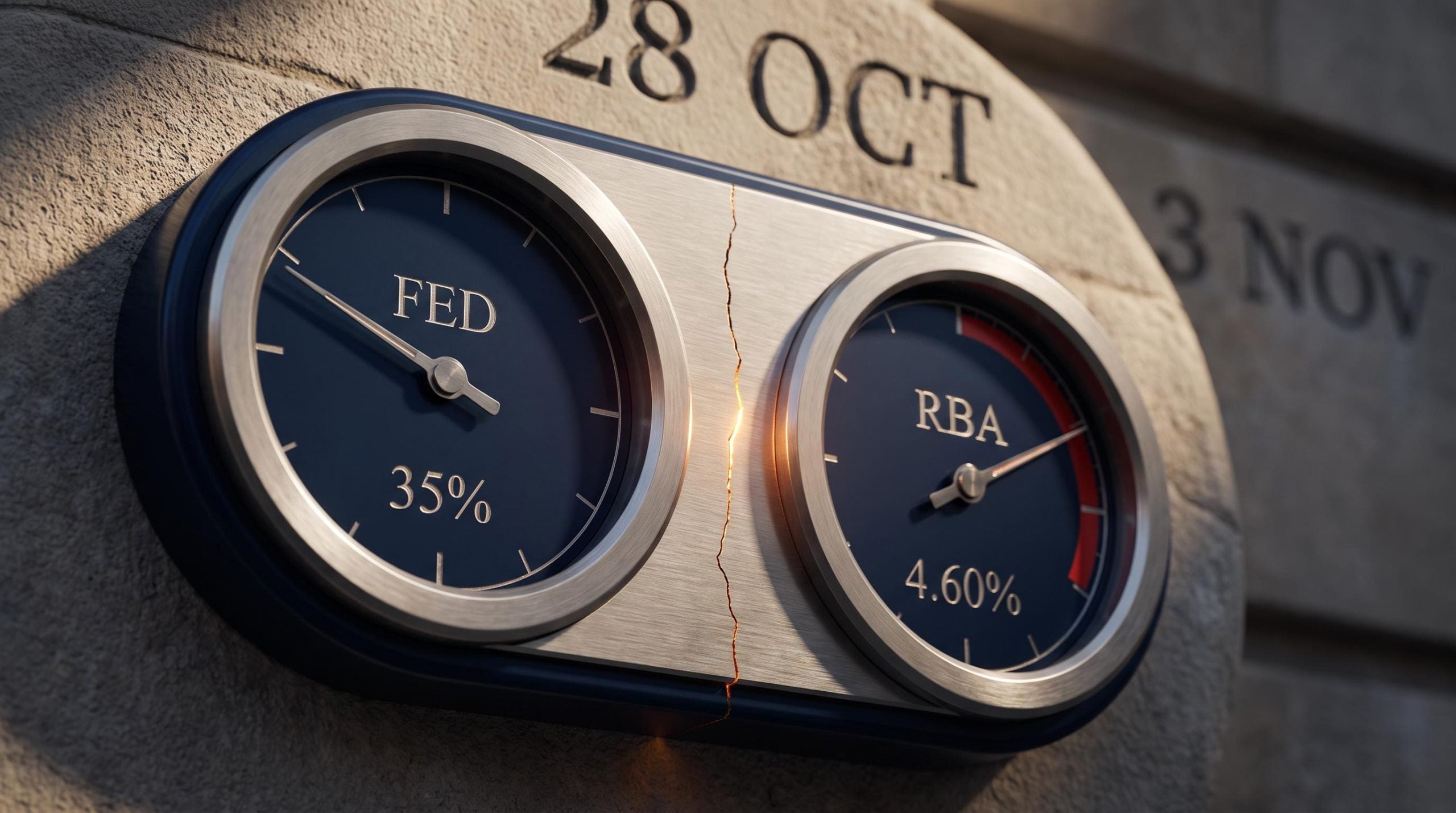
The run is over. After five straight months of gains, the S&P/ASX 200 closed September 3.16% lower, snapping the streak and leaving investors to reckon with a market that turned hostile almost overnight.
The reversal did not come from nowhere. The Reserve Bank of Australia delivered its fourth rate rise of the year on 29 September 2026, pushing the cash rate to a 15-year high, while surging global bond yields reshaped the cost of capital for every rate-sensitive asset on the board.
This breakdown of the Australian share market’s September performance shows where portfolios took the heaviest hits, and which isolated themes managed to climb while almost everything else sold off.
How a 15-year high in the cash rate derailed the market
The headline number was the cash rate. On 29 September, the RBA’s Monetary Policy Board lifted the target by 25 basis points to 4.60%, effective the following day, the highest setting since late 2011.
This was the fourth increase of 2026, and it landed on a market that had spent much of the year pricing in a peak. According to Yahoo Finance coverage, inflation was still running at roughly 3.5%, above the RBA’s 2-3% target band, and the Board made clear it was prepared to go further if the data demanded it.
The RBA tightening cycle that delivered September’s 4.60% cash rate began with three consecutive hikes earlier in 2026, a sequence that made Australia’s central bank the most aggressive in the developed world while the Fed, ECB, and Bank of England held rates steady.
The RBA’s September rate decision, published by the Monetary Policy Board on 29 September, confirmed that persistent energy costs and above-target inflation were the primary justifications for lifting the cash rate to its highest level in 15 years.
That single shift matters directly to you. The era of cheap capital is over, and any holding that depends on low borrowing costs, think property-linked stocks, long-duration growth names, and leveraged businesses, now needs reassessing under a higher-for-longer assumption.
The RBA milestone, in plain terms A cash rate of 4.60% is the highest Australia has seen in 15 years. The RBA’s own language, pointing to persistent energy costs and above-target inflation, signals a central bank still willing to tighten rather than one declaring victory.
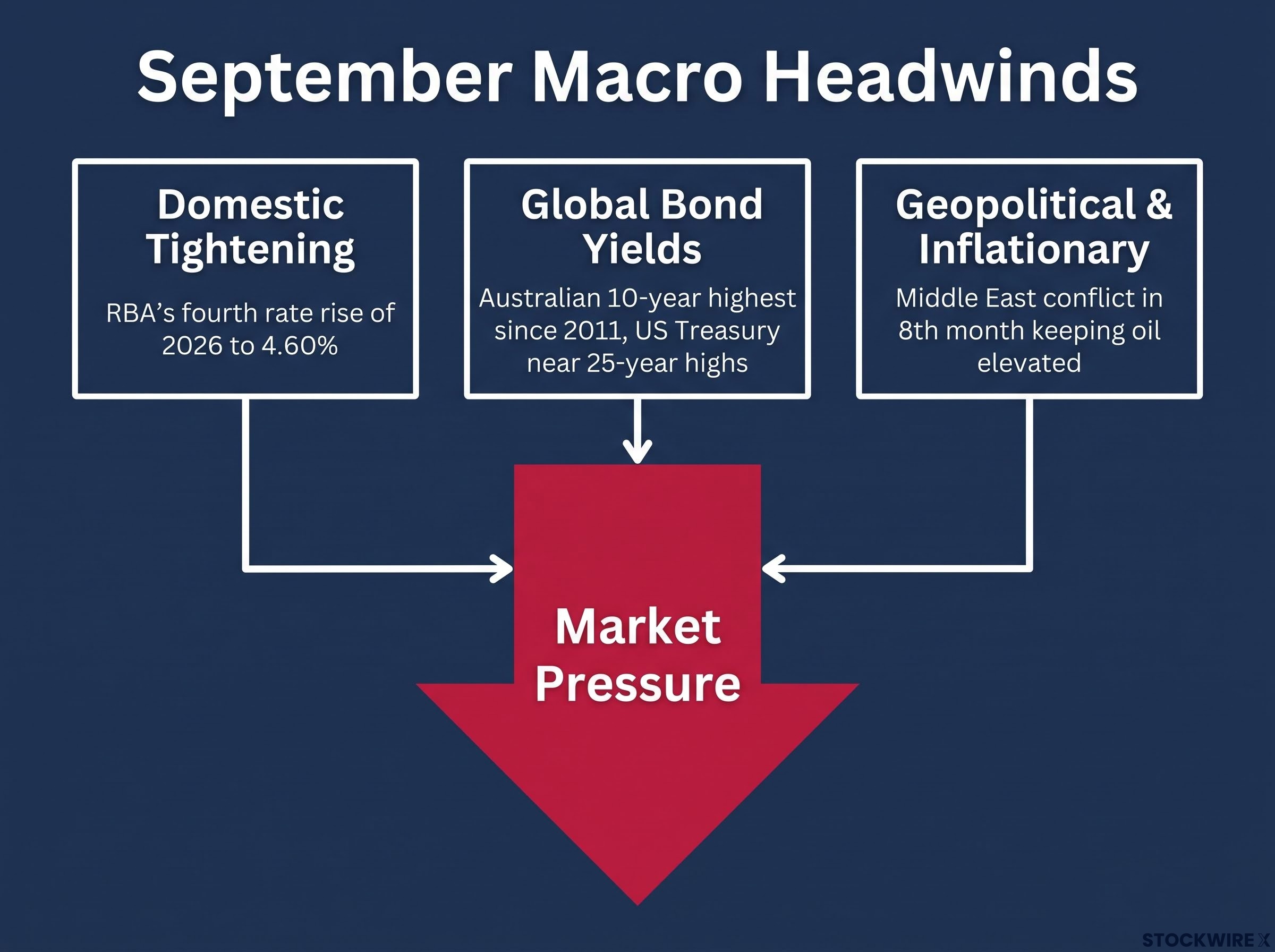
The domestic hike did not act alone. Three macro headwinds converged on the local market through September:
- The RBA’s fourth rate rise of 2026, lifting the cash rate to 4.60% and squeezing household and corporate cashflow.
- Surging global bond yields, with Australian 10-year yields at their highest since 2011 and US Treasury yields near levels not seen in close to 25 years.
- The unresolved Middle East conflict, now in its eighth month, keeping oil prices and inflation concerns elevated.
The US Federal Reserve added to the pressure, raising rates during September for the first time in over three years. The combined message was a global tightening cycle that refused to ease, and a local market suddenly forced to price capital at levels it had not confronted in more than a decade.
Where the September sell-off hit hardest
The index drop was broad, but it was not evenly spread. Ten of the eleven ASX sectors finished September in the red, and the real damage concentrated in companies exposed to discretionary spending and oversupplied commodities.
Start with the consumer. The latest hike adds roughly $100 per month to repayments on an average $600,000 home loan, according to Domain’s coverage, money that comes straight out of household budgets and, by extension, discretionary retail earnings.
Media felt a different kind of pain. Nine Entertainment, parent of Channel Nine and Stan, fell to its weakest share price since 2020 amid management changes layered on top of ongoing structural weakness in traditional media.
Then there was lithium. Pilbara Minerals and Allavra came under heavy selling as lithium prices slid to their lowest point of the year, driven by growing inventory surpluses with no near-term fix.
| Asset / Sector | Catalyst | September impact |
|---|---|---|
| Discretionary retail | RBA hike adds ~$100/month to an average $600,000 mortgage | Earnings pressure as household cashflow tightens |
| Nine Entertainment | Management changes plus structural media weakness | Weakest share price since 2020 |
| Lithium (Pilbara Minerals, Allavra) | Inventory surpluses and falling commodity prices | Lithium prices hit lowest point of the year |
The read here is that a 3.16% index fall understates the story. If you held discretionary consumer names or oversupplied commodity producers, your September looked far worse than the headline suggests.
Sector positioning consistently outweighs the binary decision of whether to hold equities through a rate-driven downturn: during the 2022 tightening cycle, Industrials and Energy each produced multiple outperforming stocks while Consumer Discretionary, Technology, and Real Estate produced none.
The isolated outliers that defied the downturn
Not everything bent to the macro pressure. A handful of names showed that thematic momentum, particularly around artificial intelligence and niche manufacturing demand, could override a falling market entirely.
Healthcare was the sole sector to close September in positive territory, supported by recovery stories across several companies while the other ten dragged lower.
The standout corporate story, though, was Megaport. On 29 September, the same day as the RBA decision, the company announced through its subsidiary Latitude.sh that it had secured three new AI infrastructure contracts, and Reuters reported the news sent shares nearly 21% higher.
Here is what the deal actually contained:
- A combined total contract value of approximately US$685.0M (A$978.6M) across the three agreements.
- Expected annual recurring revenue of roughly A$232.4 million from the contracts.
- Coverage spanning GPU and CPU compute, network, and storage for AI applications and inference workloads.
- An accompanying upgrade to Megaport’s FY27 earnings guidance, confirmed in its ASX announcement titled “Trading Update, and Upgrade to FY27 Guidance.”
The timing told its own story. These followed four similar deals worth A$458.9 million signed back in early June, reinforcing a pattern of accelerating AI-related deal flow rather than a one-off win.
AI infrastructure exposure through ASX-listed vehicles has attracted growing interest alongside the deal flow that drove Megaport’s September rally, with ETFs spanning broad index funds already holding key AI platform companies through to concentrated semiconductor products carrying meaningfully different risk profiles.
Conan offered a smaller but telling parallel. The company reached an all-time high share price in September after upgrading its first-half profit guidance on the back of strong demand from drone manufacturers.
What these counter-trend rallies show you is that a broad correction does not switch off every opportunity. When the underlying theme is powerful enough, in Megaport’s case, the infrastructure layer of the AI build-out, specific names can still deliver meaningful returns while the index falls around them.
Past performance does not guarantee future results. Financial projections are subject to market conditions and various risk factors.
Navigating a fragile fourth quarter
September’s reversal sets a cautious tone heading into the final months of 2026. The question is no longer whether rates have peaked, but how much further the RBA might go.
Westpac Economics has made its view explicit, publishing a note arguing that a follow-up hike in November is now the base case, while viewing the odds of anything beyond that as low. That positions the cycle as close to its top but not finished.
The risks that drove the sell-off remain live. Global bond yields at multi-year highs, domestic inflation above target, and energy costs tied to an unresolved Middle East conflict are all still in play as October begins.
For investors, the takeaway is active risk management over passive holding. In an environment where the cost of capital has reset to a 15-year high, the sectors you own and the themes behind them matter more than simply staying invested.
For investors wanting to model how the sector split played out over the preceding quarter, our deep-dive into ASX sector divergence heading into Q3 examines how a 22-percentage-point return spread between Consumer Staples and Energy shaped the index’s vulnerability to a rate shock.
This article is for informational purposes only and should not be considered financial advice. Investors should conduct their own research and consult with financial professionals before making investment decisions.