#
Most development teams assume securing land and grid interconnects are the only real hurdles in building out a modern site. That assumption ignores the physical reality of the data floor, where physical space and the availability of skilled electrical labour are increasingly your true bottlenecks. The introduction of factory-integrated platforms, such as the SENS PowerCab2 integrated DC power system, is fundamentally changing how developers view these constraints.
The United States development pipeline currently sits at roughly 25.7 gigawatts under construction. Tightening schedules mean developers are being forced to rethink how they arrange core power systems to maintain build velocities, especially in frontier markets where specialised labour is scarce.
Understanding this shift gives you a clear framework for evaluating how factory-validated power systems change the mathematics of your facility footprint and overall capital strategy.
Why the Industry is Abandoning Field-Built Battery Rooms
For decades, the historical approach to DC power infrastructure relied entirely on loose-piece, bespoke battery rooms. Development teams would source separate switchgear controls, stand-alone rectifiers, and extensive battery racks, assembling everything piece by piece on site. This legacy model worked well when campuses were smaller and local contractors were plentiful.
Today, the mandate for standardisation across multi-gigawatt portfolios has rendered this piecemeal approach obsolete. The broader development pipeline is reaching nearly 241 gigawatts, with 25.7 gigawatts actively under construction right now. You cannot build at that scale without standardising your power architecture.
Schedule compression and local labour constraints are driving the shift toward prefabricated, factory-integrated power modules. Industry data shows that roughly 64% of North American construction is now occurring in frontier markets rather than traditional tech hubs. The geographic shift toward these frontier markets means you can no longer rely on deep, specialised local labour pools to build complex power rooms from scratch.
Navigating severe AI infrastructure bottlenecks, including prolonged interconnection queues and power equipment shortages in established hubs, forces your development teams to target these emerging regions where local resources are often thinner.
This reality makes factory integration a critical risk-mitigation tool for your development timeline. Major original equipment manufacturers, including Vertiv, Schneider Electric, Eaton, and ABB, are aggressively moving toward prefabricated power modules to solve this exact problem.
Understanding the macroeconomic and labour drivers behind this shift allows you to position your development strategy ahead of supply chain constraints. Adapting your procurement model is necessary to hit your target time-to-power metrics.
The contrast between traditional and modern approaches reveals why this transition is accelerating:
Standardising across multi-gigawatt portfolios means your engineering teams avoid site-by-site redesigns. It establishes a repeatable template that maintains consistent protection settings and monitoring practices across every continent you operate in.
When big ASX news breaks, our subscribers know first
The Mechanical Architecture of Integrated DC Power Platforms
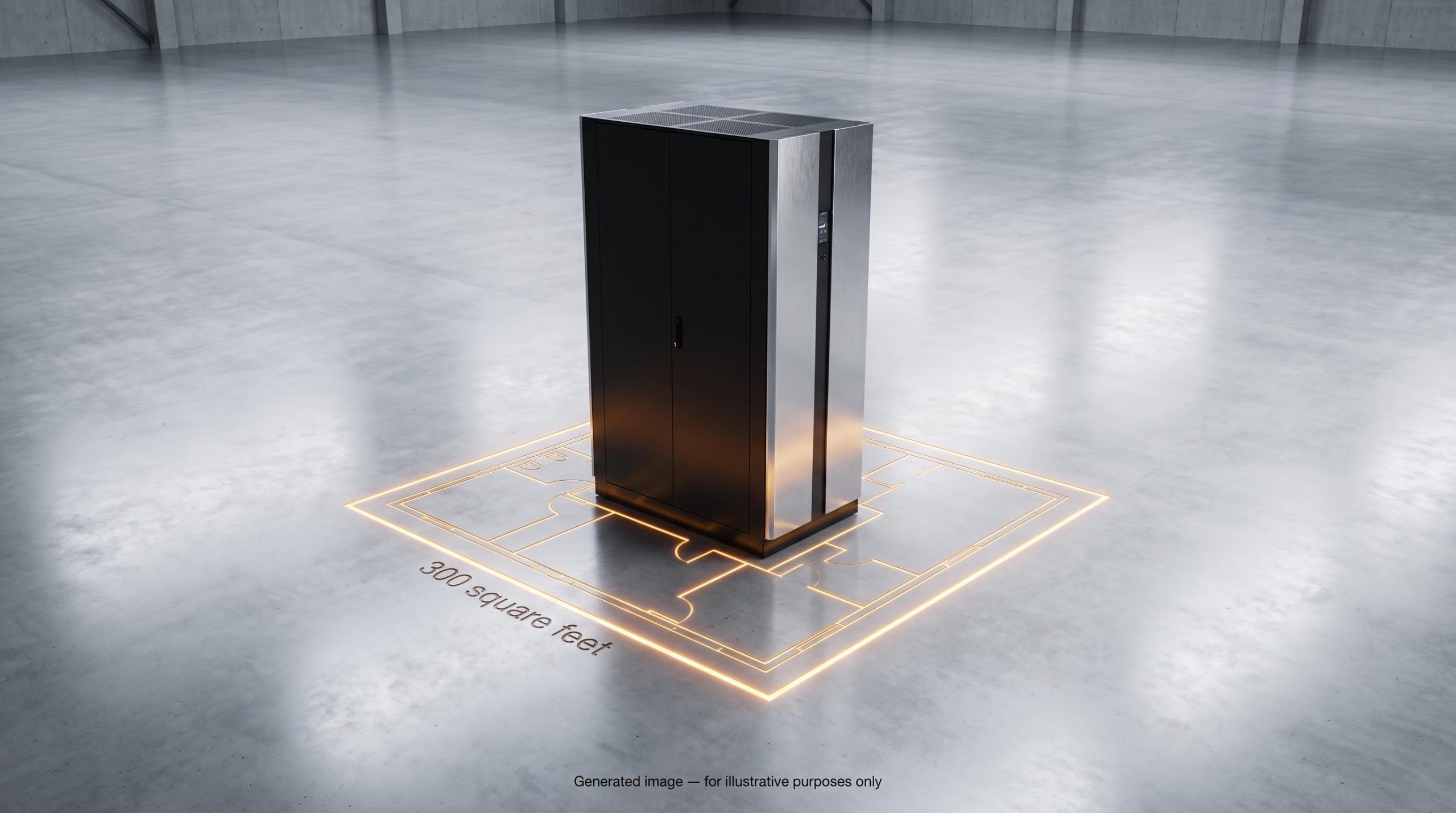
Moving from abstract design concepts to physical hardware reveals how high-density consolidation is actually achieved. Solutions like the recently debuted SENS PowerCab2 physically consolidate DC conversion, energy storage, distribution, and controls into a single enclosure. This eliminates the need for separate, dedicated rooms for each function.
These systems replace an entire battery room while maintaining the reliability required for critical infrastructure. They are engineered to accommodate varying operational environments and remain flexible across different battery chemistries. This flexibility ensures you are not forced into a single energy storage medium when supply chains fluctuate.
As you evaluate these consolidated platforms, you will find they increasingly support the broader industry transition toward native 800V DC infrastructure, a shift designed to eliminate inefficient conversion stages between the grid and your compute racks.
Redundancy and Environmental Tolerances
The technical specifications define the boundaries of what these integrated platforms can handle. They support multiple DC voltage outputs, including 24 VDC, 48 VDC, 125 VDC, and 240 VDC for control and station power. You can deploy multiple redundancy configurations to match your specific uptime requirements, selecting from N plus 1, N plus N, or dual-bus architectures.
The dual-bus architectures provide an extra layer of operational safety, allowing maintenance on one side of the power train while the other actively supports the facility load. This specific capability directly supports concurrent maintainability requirements.
Environmental resilience is built directly into the casing. The enclosures are available in NEMA 1 and NEMA 3R classifications, designed for operational temperatures spanning -40°C to 55°C. The NEMA 3R classification specifically protects against falling dirt, rain, and sleet, allowing you to deploy these units in harsh outdoor environments.
Because these platforms are factory-tested for failover scenarios and fault detection before they ever reach your site, you drastically reduce your on-site commissioning risks. Factory validation means the internal wiring, breaker coordination, and communication protocols are certified long before the unit sits on your concrete pad. You avoid the potential for costly delays right before go-live.
You need a grounded understanding of this engineering baseline to accurately compare packaged systems against conventional build-to-suit designs. Knowing the technical thresholds ensures you do not compromise facility resilience for the sake of spatial efficiency. By matching the mechanical architecture directly to your site requirements, you protect your broader capital investment.
Decoding the Capex Mathematics at Gigawatt Scale
The true financial impact of integrated power platforms becomes clear when you multiply a modest space reduction across a sprawling campus. Eliminating dedicated battery spaces from Power Distribution Centres or E-houses achieves a footprint reduction of 20% or more. In absolute terms, this removes over 300 square feet of dedicated battery room space per structure.
Applying standard industry construction cost assumptions to these spatial savings reveals a significant per-building financial impact. Current estimates place the installed cost at $850 per square foot for critical power spaces. When you eliminate that square footage, you realise estimated savings of approximately $255,000 per structure.
Scaling these individual building savings across the footprint of a modern gigawatt-level campus demonstrates the total capital expenditure reduction. A typical 1-gigawatt facility requires between 80 and 300 distribution structures. Across that scale, your aggregate campus savings fall between $20 million and $80 million.
Reclaiming 300 square feet per distribution centre fundamentally changes your site yield. It allows you to allocate that highly valuable footprint directly to revenue-generating compute infrastructure instead of support equipment. Every square foot transitioned from power support to server racks directly improves your return on invested capital.
This provides you with a direct financial modelling framework to evaluate vendor claims. By understanding the math behind the $80 million savings projection, you can adjust the variables to match the realities of your specific local land and construction costs.
| Scenario | Space Saved | Assumed Cost Per Square Foot | Total Capital Savings |
|---|---|---|---|
| Per Unit Structure | 300 square feet | $850 | $255,000 |
| 1-Gigawatt Campus (80 units) | 24,000 square feet | $850 | $20,400,000 |
| 1-Gigawatt Campus (300 units) | 90,000 square feet | $850 | $76,500,000 |
These per-unit calculations isolate the direct construction savings, but they do not fully capture the secondary benefits of shortened loan drawdowns. When you install infrastructure faster, you reduce your capital carrying costs ahead of revenue generation. The multiplication effect turns incremental spatial efficiency into massive capital relief.
For investors tracking where these deployment budgets are flowing, our deep-dive into hyperscaler AI capital expenditure breaks down the $725 billion spending trajectory and how it impacts the broader hardware supply chain.
The Operational Compromises of Ecosystem Dependence
While the upfront capital savings are highly attractive for your initial build budget, you must accept certain long-term operational trade-offs. The primary issue is the reality of vendor lock-in that occurs when controls, monitoring, and battery technologies are tightly bound within a single proprietary system.
Industry consultants frequently warn about the downstream challenges related to serviceability. Unlike generic switchgear components that any experienced electrician can service, highly specialised cabinets often require specific training. You face potential hurdles in securing long-term spare parts availability if the original vendor phases out the product line.
Maintaining warranties and certifications adds another layer of complexity. If you attempt to swap individual modular components with third-party alternatives, you risk voiding the system’s compliance ratings.
The physical reality of a proprietary ecosystem means you cannot simply substitute a generic battery rack if supply chain constraints delay a replacement shipment from your primary manufacturer. This operational rigidity forces you to hold higher levels of highly specific spare parts inventory.
There is also potential friction involved in upgrading integrated systems over a long facility lifecycle. Modifying a tightly integrated cabinet to accommodate future battery chemistries or different bus voltages is inherently more complex than retrofitting a conventional, spacious battery room.
Evaluating infrastructure is never just about initial capital expenditure. This context gives you the necessary counterweights to build a comprehensive total-cost-of-ownership model. You must prepare your operations teams for a long-term maintenance environment where you are entirely dependent on one vendor’s support ecosystem.
Your total-cost model must account for the 15 to 20 years of facility operation following the ribbon cutting. The core risks categorise into three primary areas:
Navigating the Integration Premium in Your Next Build Cycle
Development teams face a core tension between the speed and spatial efficiency of integrated platforms against the rigidity of long-term vendor dependence. The physical footprint reduction is highly profitable, but the primary value driver of these systems is the mitigation of labour-related construction delays. Avoiding an extended timeline in a frontier market often justifies the premium of a closed ecosystem.
A facility designed for a twenty-year lifespan will experience multiple generations of energy storage technology. You must weigh the immediate gratification of a faster ribbon-cutting against the structural limitations of a closed environment over that extended timeframe.
Your decision to deploy integrated platforms should ultimately hinge on your specific cost of capital. You must determine whether your most pressing constraint is time-to-market or long-term operational flexibility. If hitting your capacity delivery date is paramount, factory integration is likely your clearest path forward.
Refining your internal AI infrastructure cost estimate is critical when comparing bespoke builds against factory-integrated platforms, as space optimizations directly influence how much total compute capacity your capital can actually deploy.
Evaluate your upcoming pipeline strategy by mapping your local labour availability against your projected delivery dates. Use the square-footage math as a baseline, but let your tolerance for ecosystem dependence drive the final procurement decision.
This article is for informational purposes only and should not be considered financial advice. Investors should conduct their own research and consult with financial professionals before making investment decisions. Past performance does not guarantee future results, and financial projections are subject to market conditions and various risk factors.