Most people think the loudest economic argument of our time is left versus right, protectionism versus openness. It is not. The debate that actually determines whether ordinary citizens prosper or collapse runs underneath that surface, and it rarely gets named.
Consider one number. In the late 1990s, average monthly wages in Russia fell to roughly $56, while pensions dropped to $20-$30 per month and were frequently unpaid. That is not background colour. That is what the wrong answer to this question can cost.
The question is a choice between two economic models. One prioritises global capital mobility and competitive openness, inviting nations to compete for foreign investment. The other redirects capital toward domestic industry, infrastructure, and the living standards of working populations.
This is not a new argument. It has organised economic policy disputes for over a century. It is newly urgent because reshoring and industrial policy are now visible across US, European, and Chinese decisions all at once.
What follows here is a framework for reading economic policy debates as they actually function, not as they are typically presented to you. By the end, you will hold an analytical lens rather than a partisan position.
The two models that actually shape living standards
You can already see the surface signals: tariffs climbing, reshoring headlines, industrial policy arguments in every major capital. Beneath those signals sits an older contest between two incompatible ideas about what an economy is even for.
The free trade model, in its purest form, asks nations to compete for foreign investment capital by stripping away cost factors. That means downward pressure on minimum wages, pension obligations, healthcare standards, and environmental protections. Each becomes a competitive disadvantage to be minimised.
The national system of political economy runs the other way. It uses state capacity to direct capital toward domestic manufacturing, infrastructure, healthcare, and the living standards of the working population, rather than optimising for how freely capital can move across borders.
The left-right frame obscures this choice rather than clarifying it. Both major political traditions contain advocates of each model, which is why a policy debate framed as “left versus right” often tells you almost nothing about which citizens will actually benefit.
There is also intellectual credibility behind this structural view. In a widely cited 2001 study, economists Francisco Rodriguez and Dani Rodrik found that once measurement and methodology are corrected, there is no robust general link between trade policy and growth. The clean story many absorbed in the 1990s does not hold up.
When you review the foundational NBER research on trade policy, you will see how heavily early studies relied on flawed methodologies to promise universal growth. This context gives you a clearer perspective on why pure market openness often falls short for domestic workers.
The United Nations Conference on Trade and Development (UNCTAD) has argued a related point: across-the-board trade liberalisation cannot substitute for deliberate trade and industrial policy. Openness alone does not build productive capacity.
| Dimension | Free trade model | National system of political economy |
|---|---|---|
| Primary goal | Attract mobile foreign capital through competitive openness | Build domestic productive capacity and living standards |
| Treatment of labour costs | Minimised as competitive disadvantages | Protected as part of the policy objective |
| Treatment of capital | Maximum mobility across borders | Directed toward domestic industry and infrastructure |
| Expected distributional outcome | Gains concentrate with mobile capital holders | Gains broadened to domestic workers and industry |
Static efficiency versus dynamic efficiency
Orthodox free trade theory optimises for what economists call static efficiency: allocating the resources a country already has to their most productive current use through comparative advantage. It answers the question of how to squeeze the most output from today’s endowment.
Structuralist and national-system thinking prioritises dynamic efficiency instead. Drawing on work associated with UNCTAD economist José Antonio Ocampo, this view is about transforming production structures over time, building industrial capacity, and generating the learning economies that raise long-run productivity.
The distinction is not academic. It tells you whether a policy is optimising for today’s output or tomorrow’s productive capacity, and that difference determines which citizens benefit, at what wage levels, and over what timeframe.
When big ASX news breaks, our subscribers know first
What happens when the model fails: Russia in the 1990s as a documented case
Russia’s liberalisation under Boris Yeltsin between 1991 and 1999 stands as the sharpest documented case of living-standards collapse following a rapid shift toward free-market principles under external pressure. Start with the money and widen out from there.
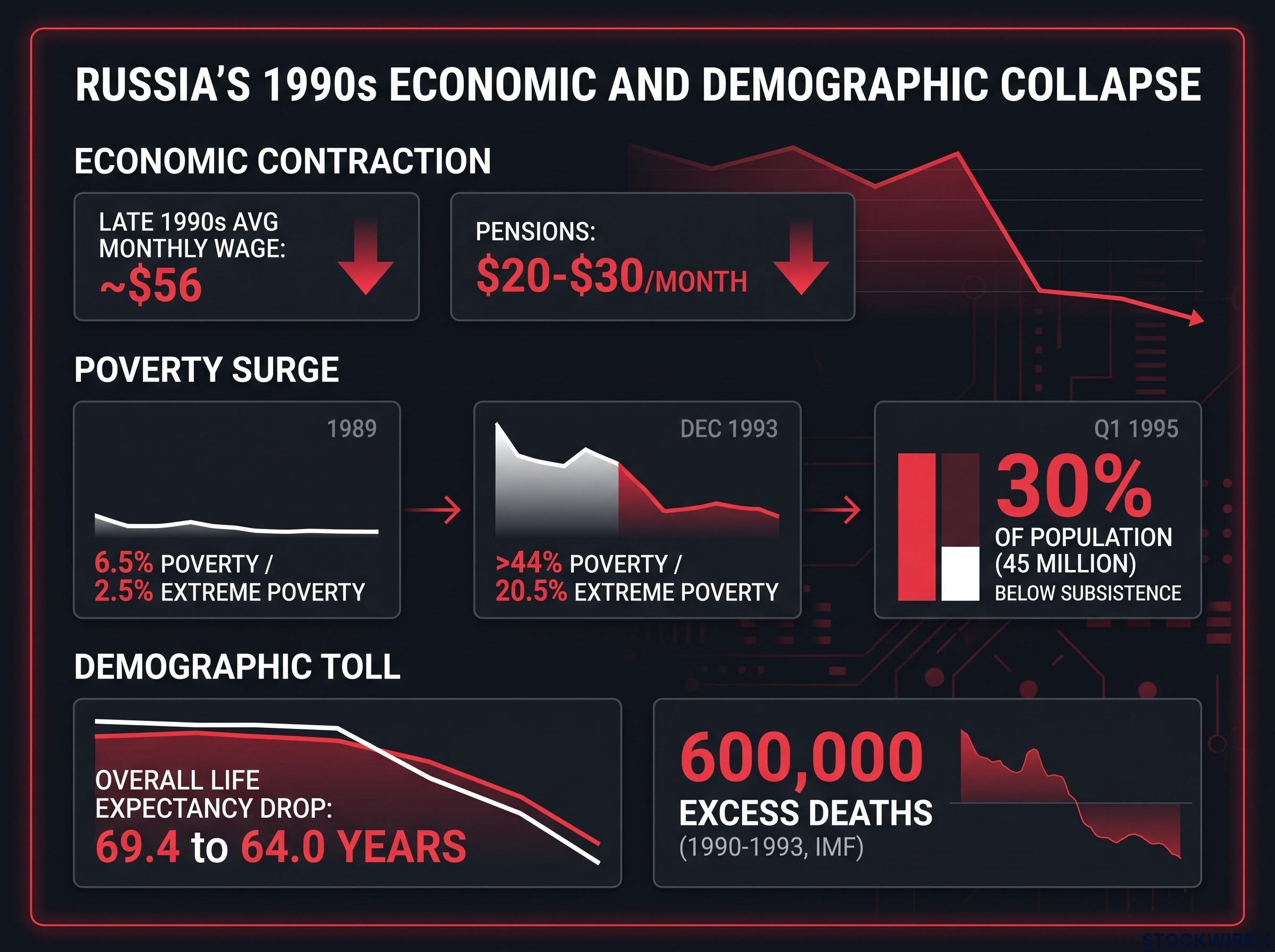
According to Alex Krainer’s analysis, average monthly wages fell to around $56 in the late 1990s, with pensions of $20-$30 per month that were often delayed or never paid at all. Those are survival-level figures in a country that had recently guaranteed employment.
The poverty data confirms the scale. Using a poverty line set at 40% of the 1989 average wage, an International Monetary Fund (IMF) study from 1998 found Russia’s poverty rate climbing from 6.5% in 1989 to over 44% by December 1993.
Extreme poverty tracked the same collapse, rising from 2.5% to 20.5% across that period. This was not a marginal group slipping backward. It was a broad population falling through the floor at once.
By the first quarter of 1995, the IMF estimated that roughly 30% of the population, around 45 million people, lived below a minimum subsistence level. A model change on paper had become a subsistence crisis for tens of millions.
From economic contraction to demographic crisis
Here the data stops being about income and starts being about survival. When wages collapse and healthcare infrastructure deteriorates at the same time, the consequences do not stay inside poverty statistics. They show up in death rates.
The demographic figures are stark. Between 1989 and 1994, according to the same IMF study, Russia’s crude birth rate fell 36% while the crude death rate rose 46%, the largest such increase among transition economies at the time.
- Male life expectancy fell by six years, reaching about 58 years, below the official retirement age
- Overall life expectancy dropped from 69.4 to 64.0 years between 1990 and the mid-1990s, per a World Bank report
- Homicides rose 137% and suicides rose 53%
- Diphtheria, measles, and tuberculosis climbed sharply, at times reaching epidemic levels
The mechanisms connecting economic collapse to these outcomes are documented. Collapsing healthcare systems, poor diets, hazardous working conditions, and deteriorating public services compounded one another. In his account of the Yeltsin-era shock therapy, Christopher Huygen describes the resulting social degradation, including gang violence and rising drug use, as the qualitative face of the quantitative picture.
Excess mortality, 1990-1993 The IMF estimated approximately 600,000 excess deaths in Russia between 1990 and 1993, with roughly two-thirds occurring in 1993 alone.
This is the outer boundary of what the model choice can produce. Not poverty as an abstraction, but population-level death registered in the official statistics. That is the reference point worth carrying into every industrial policy debate you encounter.
Why the evidence is contested and what the genuine disagreements are
After the Russia case, a clean verdict feels tempting. The honest evidence resists it. The strongest arguments on both sides deserve a fair hearing, because that is where the usable insight actually lives.
The orthodox free trade camp has real evidence behind it. The 1990s cross-country regressions did associate trade openness with faster growth, and the poverty-reduction record of export-led integration in parts of Asia is genuine. According to the International Institute for Sustainable Development (IISD), global trade has helped lift hundreds of millions out of extreme poverty, concentrated in export-oriented developing economies.
The structuralist camp points to a more complicated Asian story:
- South Korea and Taiwan combined outward orientation with selective industrial policy
- Those hybrid models achieved substantial manufacturing expansion and rising wages
- They fit neither pure free-trade nor autarkic national-system categories
But the national system has documented failures of its own, and ignoring them would be dishonest.
Where industrial policy has failed
Import-substitution strategies in parts of Latin America and Africa protected local industries that never became competitive, producing weak exports and eventual crisis. UN DESA’s 2007 paper Industrial Policy and Growth warns that industrial policy in weak institutional settings can foster capture by special interests, misallocation of credit and subsidies, and macroeconomic instability.
Heavy protection also invites rent-seeking. When the state controls allocation, subsidies can flow to entrenched incumbents rather than dynamic new entrants, rewarding political connections over competitive upgrading.
The contemporary version of this risk is external. Chad Bown’s 2024 work warns that large-scale industrial subsidies in rich countries risk subsidy wars and erosion of multilateral rules, while Switzerland’s Foreign Economic Policy report for 2024 notes that resilience-oriented industrial policy has protectionist effects on third-country suppliers, disproportionately hitting developing economies that depend on market access.
The Rodriguez-Rodrik finding Once measurement and methodology are corrected, there is no robust, general link between trade policy and growth. Rodriguez and Rodrik (2001).
The genuine lesson is not that one model always wins. It is that institutions, sequencing, and distribution mechanisms determine outcomes. When you evaluate any specific industrial policy proposal, the useful question is how those three factors are handled, not whether the policy wears a “free trade” or “protectionist” label.
The reshoring moment and what the current policy turn reveals
Look at the concrete moves first, before naming any thesis. In May 2024, the US announced tariffs of up to 100% on Chinese electric vehicles, alongside escalations on semiconductors and solar PV modules, according to the Economic Research Institute for ASEAN and East Asia (ERIA).
When you track the supply chain rerouting mechanisms triggered by these policies, you will often find that bilateral trade drops while overall deficits remain, forcing a deeper look at whether decoupling strategies actually work.
The European Union unveiled its Green Deal Industrial Plan on 1 February 2023, with the EU Chips Act as a central instrument for reshoring semiconductor production. China is running its Dual Circulation strategy to boost domestic demand and production while reducing reliance on external markets. India is pursuing manufacturing self-reliance through Make in India.
| Geography | Flagship policy | Key sectors | Stated goal |
|---|---|---|---|
| United States | Tariffs and subsidies (May 2024) | EVs, semiconductors, clean energy | De-risk supply chains, support domestic industry |
| European Union | Green Deal Industrial Plan / Chips Act | Cleantech, semiconductors | Industrial competitiveness with net-zero |
| China | Dual Circulation | Advanced manufacturing, technology | Domestic demand, reduced external reliance |
| India | Make in India | Electronics, autos, defence | Manufacturing self-reliance, production hub |
The pattern speaks for itself. Governments across very different ideological traditions are converging on national-system logic at the same time. This is a live experiment in the model, not a debating point.
Frame it accurately: this is not a simple return to protectionism. It is a deliberate acceptance of some efficiency costs in exchange for resilience, domestic employment, and strategic industrial capacity. The IMF’s 2024 working paper on reshoring and fragmentation quantifies long-run output and welfare costs from these strategies, which is the honest counterweight to the resilience case.
Naming the shift Chad Bown (2024) characterises current US policy as “forcefully pursued” industrial policy in semiconductors and clean energy.
For you, the convergence itself is the signal. When the US, EU, and China adopt national-system logic simultaneously, the free-trade orthodoxy of the 1990s has plainly lost its institutional consensus. IISD frames the current effort as an attempt to reconcile trade and industrial policy, keeping globalisation’s poverty-reduction gains while using industrial policy to address inequality and dislocation. Read structurally, this is a model shift, not a passing geopolitical reaction.
Reading the model choice clearly before the next policy cycle
Here is the core of it. The free trade versus national economy debate is not left versus right. It is a structural choice about where capital flows and who benefits, and the historical record shows the consequences for ordinary citizens are large and measurable.
Russia in the 1990s marks the outer boundary of the downside. Not a prediction that it will recur, but proof that this choice is never cost-free in either direction.
The Rodriguez-Rodrik finding is the methodological anchor: there is no automatic link between the model on paper and the outcome on the ground. Institutions, implementation, and distribution are the variables that actually move results.
So when you meet any industrial policy proposal, ask three questions:
- Institutional quality: How capable and accountable is the state that will implement it?
- Distributional mechanism: How are the gains shared, and who captures them?
- Sequencing: How does the policy fit the existing productive capacity, and in what order does it build?
The live tension sits in the IMF’s 2024 finding that current governments are consciously accepting some output loss for other goals. Whether that trade-off is worth it depends entirely on what those goals are and who bears the cost.
As you evaluate these policy trade-offs, paying close attention to the legal frameworks governing executive tariff authority will help you gauge whether these newly announced industrial strategies can actually survive domestic court challenges.
The model choice is being made right now, in real policy. Read it structurally rather than politically, and the next decade of decisions will look very different to you than it does to those still watching the left-right show.
This article is for informational purposes only and should not be considered financial advice. Investors should conduct their own research and consult with financial professionals before making investment decisions.
These statements are speculative and subject to change based on market developments. Past performance does not guarantee future results.