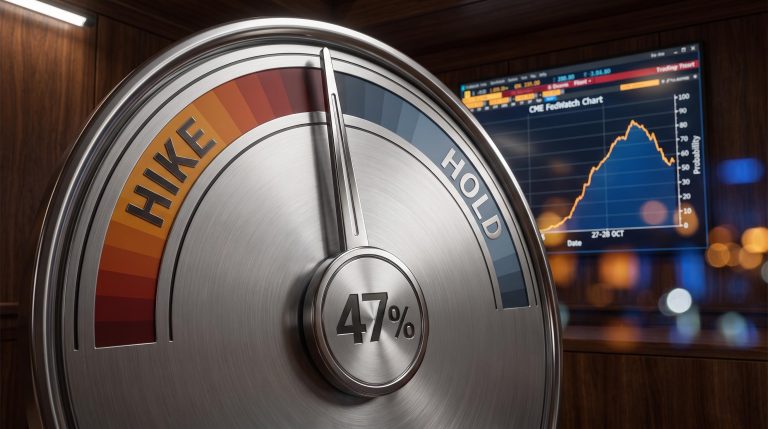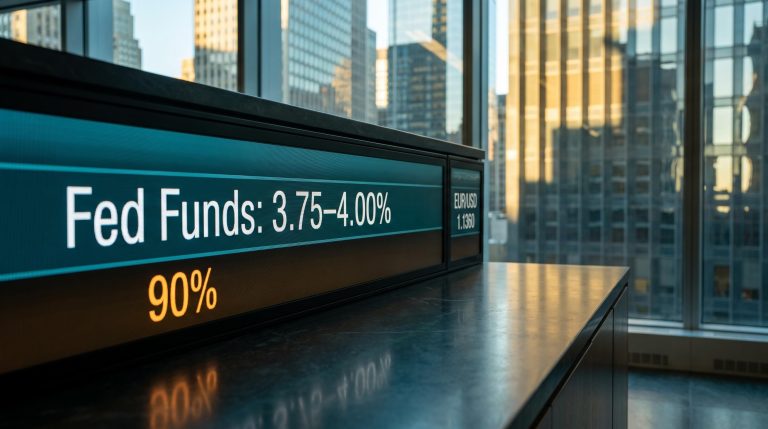
On Wednesday, the US Dollar Index slipped to roughly 101.20, pulling back from a two-month high above 101.60 after Treasury yields eased and a single Federal Reserve official struck a less hawkish note. That intraday retreat happened while the index was still sitting on an estimated 1.8% gain for the month.
That gap is the puzzle. A currency does not usually soften and strengthen in the same breath unless something structural is holding it up while short-term noise pushes it around at the margin. The backdrop makes the tension legible: the Fed has just raised rates for the first time in three years, PCE inflation is running at 3.7% with the 2% target now pushed out to 2029, and energy prices remain elevated in a war-driven supply environment.
Here is what the data actually tells you about the US Dollar outlook. This is a framework for reading dollar-strength signals, not a price call. By the time you finish, you will know which variables genuinely move the thesis, which ones are just noise, and why a one-day dip does not mean the setup has changed.
What is driving the dollar right now, and why the move has legs
Dollar strength today is not one story. It is four, and they reinforce each other.
Start with the Fed, because it sits at the centre of everything else. On 16 September 2026, the Federal Open Market Committee raised the federal funds target range by 25 basis points to 3.75%-4.00%, the first increase since 2023. Updated projections place the policy rate at 4.00%-4.25% through the end of both 2026 and 2027, which tells you this is a tightening cycle restarting, not a one-off adjustment.
The September hike to 3.75%-4.00% is one lever in a broader tightening configuration: Fed policy tools include not only the federal funds rate but an active Quantitative Tightening program still shrinking a $6.75 trillion balance sheet, meaning two simultaneous mechanisms are pressing on yields and dollar attractiveness at once.
The FOMC Summary of Economic Projections released on 16 September 2026 places the federal funds rate at 4.00%-4.25% through the end of 2027 and keeps the PCE inflation convergence path running out to 2029, the two figures that anchor the entire rate-differential argument.
The FOMC statement did not leave much ambiguity about intent.
“Inflation remains elevated.”
That single phrase, paired with the Committee’s framing of the hike as supporting a “timelier return to the 2 percent goal,” signals that policy stays restrictive until inflation is clearly tracking toward target.
The second pillar is the energy shock, and it works through a channel most people miss. War-driven oil price spikes are an inflation driver, yes. But MUFG/BTMU analysts noted that higher energy prices also deliver a positive terms-of-trade effect for the US economy, which supports the dollar directly, independent of the monetary policy channel. In other words, the energy shock props up the currency twice over.
Energy shock transmission runs through two distinct channels with different timing: a direct channel that reprices fuel and utilities within weeks, and an indirect channel flowing through logistics, agriculture, and manufacturing supply chains on a 6-12 month lag, meaning the full inflation impact of sustained elevated oil prices had not yet fully appeared in PCE data when the September hike was delivered.
The remaining two pillars compound the first two rather than standing apart from them. Here is the full structure:
- Fed tightening: higher actual and expected US rates widen yield differentials against peer economies.
- Energy shock and terms-of-trade effect: elevated oil sustains inflation and, per MUFG/BTMU, improves the US trade position directly.
- Yield differentials: rising Treasury yields make dollar assets more attractive relative to peers.
- Safe-haven demand: war-driven uncertainty pushes flows into the dollar on top of the rate story.
ING analysts flagged that rising back-end Treasury yields have weighed on global risk sentiment, with lower-liquidity and higher-beta currencies taking the hardest hit. That matters for how you read a pullback. When four drivers overlap this tightly, no single one unwinding is enough to break the thesis. A one-week dip in oil does not reverse a structure this broad. That is why the recent softness reads as noise rather than a turn.
When big ASX news breaks, our subscribers know first
How the transmission mechanism actually works
To tell a real signal from a false one, you need to see the dollar as the output of a system rather than a series of disconnected headlines.
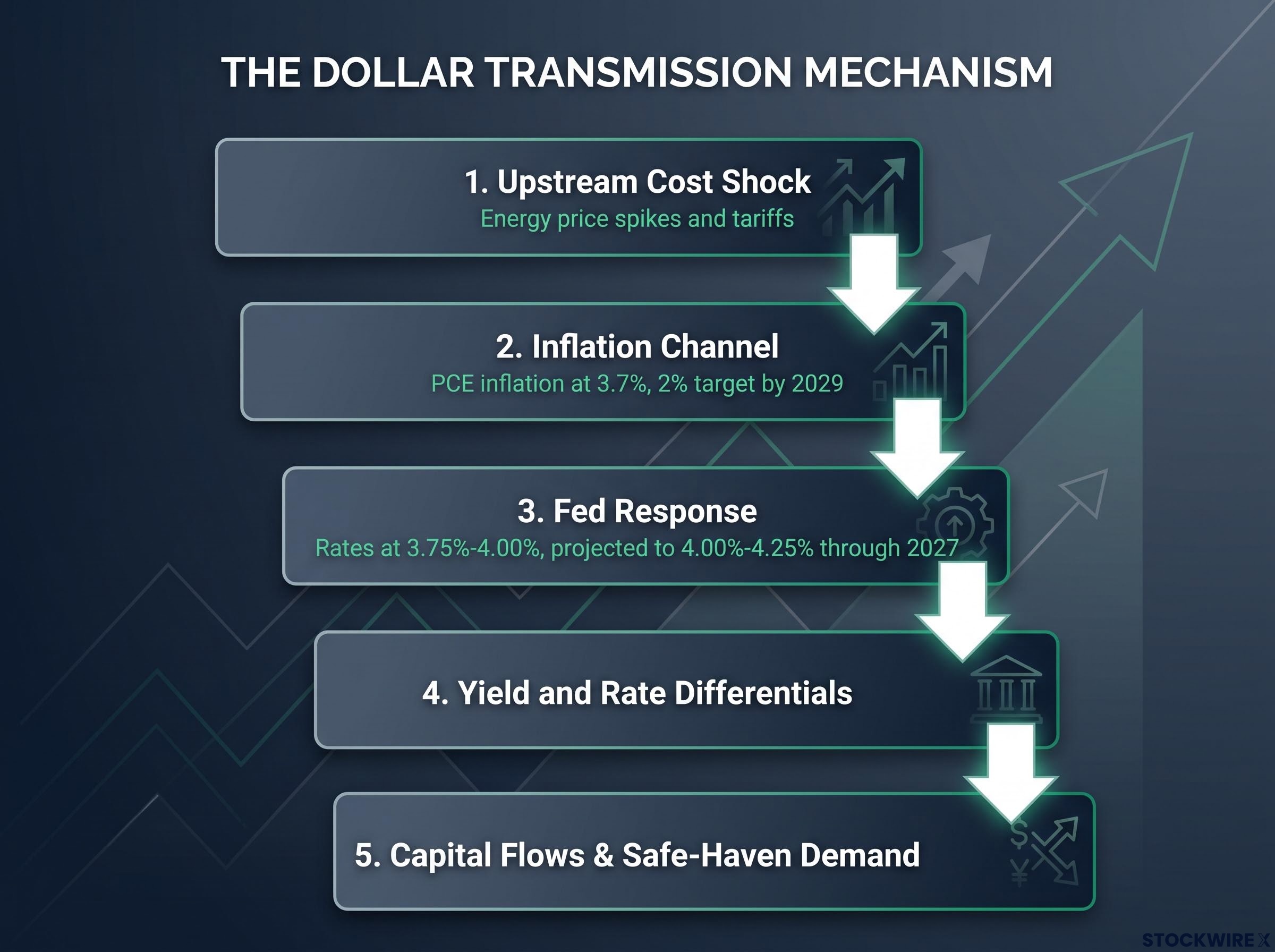
The chain runs in a specific order, and each stage produces the next:
- Upstream cost shock: energy price spikes and tariffs raise input costs across the economy.
- Inflation channel: those costs keep PCE inflation elevated at 3.7%, delaying convergence to the 2% target until 2029.
- Fed response: persistent inflation forces the Fed to raise rates and project a higher-for-longer path, already at 3.75%-4.00% with projections toward 4.00%-4.25% through 2027.
- Yield and rate differentials: higher US rates push up Treasury yields and widen the gap against other major economies.
- Capital flows and safe-haven demand: wider differentials draw capital into dollar assets, and geopolitical stress adds safe-haven flows on top.
What keeps this chain from being purely an energy story is its breadth at step one. Reuters attributed the September hike not only to the energy shock following the US-Israeli war with Iran, but also to Trump-era import tariffs and capital spending tied to the artificial intelligence boom. Three structural sources feed the same inflation, which means geopolitical de-escalation alone would not reset the picture.
| Structural inflation source | Dollar impact |
|---|---|
| Energy shock (war-driven oil spike) | Sustains inflation and, via terms-of-trade, supports the dollar directly |
| Trump-era import tariffs | Adds persistent price pressure, reinforcing the case for higher rates |
| AI-driven capital spending | Broadens demand-side inflation, extending the higher-for-longer path |
Step three is not an analyst inference. The Fed’s own language, framing the hike as supporting a “timelier return to the 2 percent goal,” is an explicit confirmation that the Committee is responding to inflation and will stay restrictive until it convincingly falls.
Once you can trace the chain, you can sort events. A single Fed official’s dovish comment is a noise event; it does not move any stage of the mechanism. A genuine shift in the inflation trajectory or in the Fed’s rate projections is a signal event, because it changes the engine itself. ING framed the current soft patch as a pause rather than a peak, noting scope for markets to reprice rate-hike probabilities higher. That is exactly the distinction this framework is built to help you make.
The risks that could break the thesis
A durable setup is not a guaranteed one. The dollar story has real downside scenarios, and they are not equally dangerous.
Start with the most mechanically direct. If energy prices moderate or inflation cools faster than projected, the Fed may deliver fewer hikes than markets currently expect. CNBC reported that officials suggested one more hike “could be in the cards” before year-end, which is explicitly conditional language. Fewer hikes narrow the rate differentials that underpin the whole thesis.
Then there is politics, and this one runs longer than a single data cycle. The Guardian highlighted that Fed Chair Warsh’s hawkish stance could set him on a collision course with Donald Trump, who has repeatedly pressed for rate cuts. Right now, markets read the Fed’s resistance to that pressure as an added hawkish signal. The implication cuts both ways: if the Fed ever appears to bend, markets would read the reversal as sharply bearish for the dollar.
The yield-strength relationship is not always self-reinforcing: analysts at Convera, Nomura, and Bank of America noted in early September 2026 that rising US 10-year yields near 4.77% were being read as a fiscal risk premium rather than an investment signal, which would invert the normal dollar-supportive effect and represents a scenario where the rate pillar becomes a headwind instead.
The safe-haven pillar is the most conditional of the four.
ING noted that some stabilisation in risk appetite could reduce the intensity of the Dollar rally.
That is the clearest reminder that a chunk of dollar support depends on sustained stress continuing, not on anything structural.
Here are the four named risks and what triggers each:
- Fewer-than-expected hikes: trigger is faster inflation cooling or softer oil, which narrows rate differentials at the margin.
- Political pressure for easier policy: trigger is a credible signal the Fed is bending to White House demands, which would restructure the thesis.
- Risk-appetite stabilisation: trigger is calmer markets, which erodes the conditional safe-haven premium.
- Geopolitical normalisation: trigger is easing Iran tensions, which softens the energy shock, the safe-haven bid, and part of the inflation rationale at once.
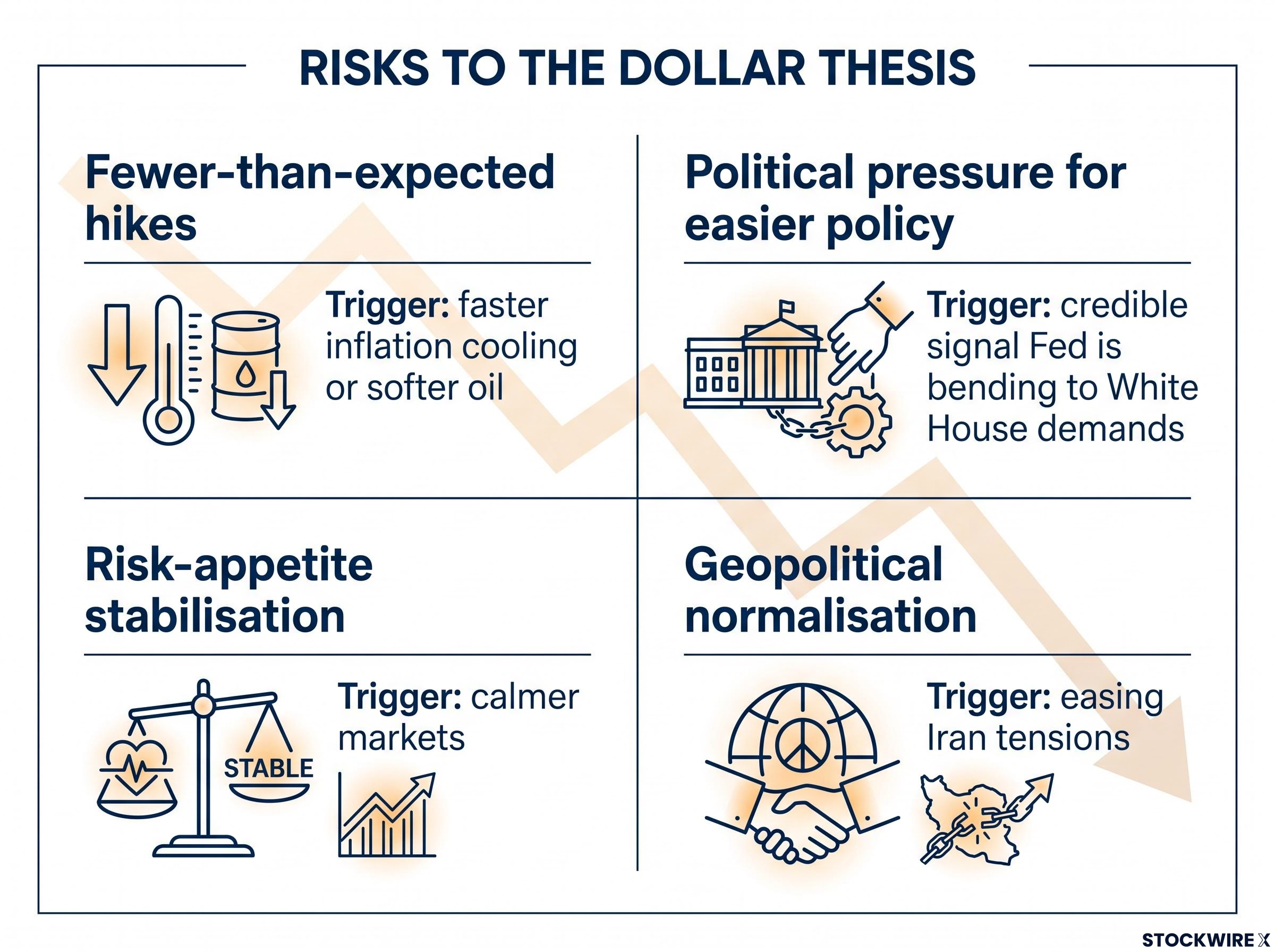
These risks are not symmetric, and that is the point. Fewer hikes or a calmer risk backdrop would trim dollar strength at the edges. Geopolitical normalisation is broader, because it unwinds several pillars together. But a credible Fed pivot under political pressure is the one true thesis-breaker, since it would remove the anchor that holds the whole structure in place. Reuters framed the September hike as effectively acknowledging the administration’s inability so far to control inflation, which sets up a genuinely fraught policy path if inflation persists. Knowing which risks trim and which risks break is how you decide where to point your attention.
What signals actually matter in the months ahead
You now have the framework and the risk map. The remaining question is practical: which specific data points and events will tell you whether the thesis is holding or bending?
Split your monitoring into two channels, watched independently.
Fed-side signals to watch
The highest-frequency signal is rate-path repricing. Markets are currently pricing three further quarter-point increases through 2027, and that expectation is already baked into the DXY at 101.268 as of 29 September 2026. Any deviation from that path, in either direction, will register in the dollar almost immediately.
Track the FOMC meeting cycle and the quarterly projection updates, where the Committee revises its rate-path and inflation dot plots. On the inflation side, weight the monthly PCE print above CPI, because PCE is the gauge the Fed explicitly targets and the one its 3.7% projection references. Convergence to 2% is not expected until 2029, so the relevant question at each release is not whether inflation has hit target but whether it is falling faster or slower than that path implies.
Geopolitical and energy signals to watch
Oil prices and the Iran conflict trajectory are the upstream variable, and they move several dollar pillars at once. A normalisation scenario is dollar-bearish across multiple channels simultaneously: it eases the energy shock, softens the safe-haven bid, and weakens part of the inflation rationale together. An escalation scenario does the reverse, adding to both the energy shock and safe-haven demand.
Treat political pressure as a separate, slow-moving signal. White House statements on Fed policy and any sign of a Warsh-Trump collision need watching over months, not days, unlike the market-data releases that reset every cycle.
One thing to internalise: the current three-hikes-through-2027 pricing is the baseline. Further dollar appreciation from here needs either a failure of inflation to converge or a fresh geopolitical shock. The bar for more upside is higher now than it was when the tightening cycle began.
Reading the dollar’s next move without losing the thread
The pullback to 101.20 was a noise event inside a macro setup that remains structurally dollar-positive. Four reinforcing drivers, a self-sustaining transmission chain, and a rate path projected at 4.00%-4.25% through 2027 do not unwind because one Fed official sounded dovish for an afternoon. The framework for telling that noise from a genuine signal is what you now hold.
The single most important variable from here is the inflation trajectory and how it feeds Fed rate-path pricing. That is the linchpin connecting energy, yields, and safe-haven flows. Watch it above everything else.
None of this makes the thesis certain. Fewer hikes, a Fed pivot under political pressure, and geopolitical normalisation are real scenarios that deserve ongoing monitoring rather than dismissal. Weight them by whether they trim the thesis or break it, and you will read the dollar’s next move without losing the thread.
For investors wanting to understand why macro fundamentals often fail to predict near-term dollar moves, our full explainer on short-run dollar drivers applies the voting machine versus weighing machine framework to show how Fed repricing and narrative shifts dominate exchange rates over weeks and months, while debt and inflation data play a secondary role.
This article is for informational purposes only and should not be considered financial advice. Investors should conduct their own research and consult with financial professionals before making investment decisions. Past performance does not guarantee future results. Financial projections are subject to market conditions and various risk factors, and forward-looking statements are speculative and subject to change based on market developments.