
The European Central Bank did something in September 2026 it had not done in more than a year: it raised interest rates. Yet one of the people sitting inside the room where that decision was made is telling markets the ECB’s stance is still not tight.
That person is José Luis Escrivá, a member of the ECB Governing Council, the body that sets ECB monetary policy for the entire eurozone. His view is that even after the hike, euro-area rates have not entered restrictive territory. It is a genuinely useful puzzle, not a contradiction to wave away.
Here is the backdrop that makes it worth understanding. Eurozone headline inflation ran at 3.2% year-on-year in August 2026, comfortably above the ECB’s 2% target. The deposit facility rate now sits at 2.50% after a 25 basis point hike effective 16 September 2026. And long-term borrowing costs are climbing around the world.
Escrivá’s remarks land at the intersection of all three pressures. Read on, and you will have a clear picture of what “restrictive” actually means inside the ECB’s own framework, why his reading holds together even with inflation above target, and what the specific risks he flagged mean for the euro and for European fixed income.
What Escrivá actually said, and why it matters that he said it
Start with the specific claim. Escrivá indicated that current euro-area rate settings have not yet become restrictive, even following the September hike that lifted the deposit facility rate to 2.50%. In plain terms, he does not think policy is actively slowing the economy down.
That is only half his position. Alongside the near-term dovish read on where rates sit today, he paired a medium-term hawkish warning: sustained high energy prices and a rising trend in global long-term yields could push inflation and borrowing costs back up. So he is relaxed about the present and watchful about what comes next.
Why should you weight this more heavily than any other central banker soundbite? Because of where Escrivá sits. The Governing Council is the body that collectively decides policy for the whole currency bloc, so when one of its members characterises the stance, they are effectively shaping expectations about the ECB’s next move.
Markets tried to measure the tone. FXStreet’s Speechtracker tool, which scores central bank communication for hawkishness, assigned his remarks a 6.2 out of 10, against a historical baseline of 6.0.
The Speechtracker score came in at 6.2 out of 10, against a historical average of 6.0.
That gap is small, and the smallness is the point. A 6.2 against a 6.0 norm tells you these remarks are not a strong directional signal. Escrivá is a calibrating voice, nudging the interpretation of the stance, not a dissenting one breaking from the Council. For anyone reading ECB communication to position euro or European bond exposure, that distinction matters: this is fine-tuning, not a policy pivot.
The remarks were reported by Reuters and delivered on a Tuesday, with no specific forward guidance date attached. Which raises the obvious question. What does “restrictive” even mean for the ECB, and how would you know it when you saw it?
When big ASX news breaks, our subscribers know first
How the ECB’s toolkit and mandate actually work
To judge whether 2.50% is restrictive, you need to know how the ECB defines restrictive in the first place, and that requires understanding the machinery. The ECB, based in Frankfurt, has one primary job written into its mandate: price stability, defined as inflation at around 2% over the medium term.
ECB monetary policy is set collectively by the Governing Council, whose three official rate instruments, the deposit facility rate, main refinancing operations rate, and marginal lending facility, each serve distinct functions in steering the cost of money across the eurozone banking system.
Decisions are made collectively. The Governing Council, made up of the heads of eurozone national central banks plus six permanent members including the ECB President, meets roughly eight times a year to set policy. No single member, Escrivá included, sets the rate alone.
The ECB steers policy through three official interest rates. Since March 2024, the deposit facility rate has been the primary steering instrument, the lever the Council actually pulls to set the stance. Here is where all three stand after the September hike.
| Rate name | September 2026 level | Change from prior setting | Primary function |
|---|---|---|---|
| Deposit facility rate | 2.50% | +25 bp | Primary steering instrument for the policy stance |
| Main refinancing operations rate | 2.65% | +25 bp | Rate on the ECB’s regular lending to banks |
| Marginal lending facility | 2.90% | +25 bp | Rate on overnight emergency borrowing by banks |
The recent history is what makes Escrivá’s framing coherent. Across January, April, and June 2025, the ECB cut the deposit facility rate from 3.00% to 2.00%. At the start of that sequence, many Council members judged 3.00% likely to “excessively dampen demand”, their own language for too tight. So 3.00% was considered restrictive, 2.00% was the floor they were comfortable with, and 2.50% now sits squarely between the two. That is precisely why “not yet restrictive” is an analytically defensible read rather than simply wrong.
The three tools the ECB reaches for, and what each one signals
Rates are one instrument among three. Knowing the difference matters, because a rate move and a change in the ECB’s bond posture pull the euro and sovereign spreads in different ways.
- Interest rates: the first-resort tool. Higher rates are generally associated with a stronger euro, lower rates with a weaker one.
- Quantitative easing (QE): the ECB creates euros to buy government or corporate bonds, a last-resort tool when rate cuts alone are not enough. It typically weakens the euro, and it was deployed during the Global Financial Crisis (2009-2011), amid subdued inflation in 2015, and through the Covid-19 pandemic.
- Quantitative tightening (QT): the reversal of QE, halting purchases and stopping reinvestment of maturing bonds. It is generally supportive for the euro.
For context on scale, the post-2022 hiking cycle moved the deposit facility from 0% upward in rapid 50 and 75 basis point steps. What you can read from all this: when you see an ECB headline, check which lever moved before assuming what it means for your euro exposure.
The inflation picture and why Escrivá is watching energy prices closely
If policy is not restrictive and inflation is above target, the natural worry is that price pressure runs away. This is exactly why Escrivá pairs his relaxed rate view with an energy warning, and the inflation data explains the tension.
Start with the headline. Eurostat’s final release on 17 September 2026 put euro-area headline inflation at 3.2% year-on-year in August 2026, revised down from a flash estimate of 3.3% published on 1 September 2026. That was up from 2.9% in July, and the increase was driven primarily by a surge in energy inflation, according to the ECB’s Economic Bulletin Issue 6, 2026.
Eurostat’s euro-area HICP data, the official harmonised series used by the ECB to measure inflation across the currency bloc, confirmed the August 2026 headline reading at 3.2% year-on-year, with the prior flash estimate standing at 3.3% before the final release on 17 September 2026.
Headline numbers, though, mix in volatile items like energy and food. To see where pressure really sits, the ECB watches its Supercore indicator, which strips the headline down to business-cycle-sensitive items, the prices that move with the strength of the economy rather than with oil markets.
The ECB’s Supercore indicator, measuring business-cycle-sensitive items, rose to 2.6% in July 2026.
Here is the two-level view side by side.
| Indicator | Value | Reference period | Source |
|---|---|---|---|
| Headline HICP (final) | 3.2% | August 2026 | Eurostat, 17 Sep 2026 |
| Headline HICP (flash) | 3.3% | August 2026 | Eurostat, 1 Sep 2026 |
| Headline HICP | 2.9% | July 2026 | Eurostat |
| Supercore indicator | 2.6% | July 2026 | ECB Economic Bulletin Issue 6, 2026 |
| Supercore indicator | 2.5% | June 2026 | ECB Economic Bulletin Issue 6, 2026 |
Note that a standalone core HICP figure for August 2026, the measure excluding energy, food, alcohol and tobacco, was not available in accessible releases. Escrivá’s specific fear is second-round effects: energy prices staying high long enough to leak into wages and services, so the inflation stops being just an energy story and becomes broad.
Energy inflation forecasts vary sharply between the ECB’s own projections and independent models: Rabobank’s energy-revised estimates project eurozone headline inflation peaking near 4.4-4.5% in early 2027 against the ECB’s 2.5% forecast for the same year, a divergence that has direct consequences for how far the deposit facility rate may ultimately need to travel.
The Supercore reading is what makes that fear meaningful. At 2.6% and ticking up from 2.5%, the underlying, economy-sensitive part of inflation is above target too. For anyone positioned in euro assets, that gap between headline and underlying inflation is not academic: it decides whether the ECB’s next step is a hold, another hike, or a fresh easing cycle. Reading the headline alone tells you a number. Reading the split tells you the signal.
Why rising global yields complicate the ECB’s room to manoeuvre
The other half of Escrivá’s warning points outward. He flagged the worldwide upward trend in long-term interest rates as a primary concern, warning it could add pressure to borrowing costs, and the logic runs through channels that reach the eurozone whether the ECB wants them to or not.
The mechanics move in steps. When global long-term yields rise, particularly on US Treasuries, integrated bond markets pull euro-area sovereign yields up too, through arbitrage and portfolio rebalancing. That raises borrowing costs for eurozone governments and firms even if the ECB never touches its short-term rate.
Global long-term yields have not merely spiked cyclically in 2026: US 30-year Treasury yields peaked at 5.311% in August, their highest since 2007, while UK, German, and Japanese sovereign yields hit multi-decade highs simultaneously, pointing to structural forces that a single soft inflation print is unlikely to reverse.
Three channels carry the risk.
- Global spillovers: higher US and global long-term yields drag euro-area sovereign yields up through cross-border arbitrage, tightening financial conditions independently of the ECB.
- A constraint on independence: the ECB is mandated to target euro-area price stability, but higher global yields transmit external shocks into domestic conditions regardless of the Council’s intent.
- Energy inflation amplification: if investors chase higher yields elsewhere, capital flows out of the euro, weakening it and making imported energy dearer in euro terms.
A note on the numbers: specific recent figures for German Bund and US 10-year Treasury yields were not available in accessible sources at the time of writing, so check current market data for live levels. The September hike to 2.50% was the ECB’s most recent response to the broad inflationary environment, and global yield pressure is one input feeding that picture.
The euro exchange rate as an inflation amplifier
The exchange rate channel is worth isolating, because it closes a loop. When the euro weakens, imported energy costs more in euro terms, since energy is largely priced in dollars.
Connect that to the data already on the table. The August headline surge was driven primarily by energy, so a weaker euro would push directly on the exact component already doing the damage.
That is the feedback loop Escrivá’s remarks implicitly flag as a medium-term risk. The takeaway if you hold euro or European bond exposure: the ECB’s policy rate is not the only lever moving your financial conditions. Global yields do parallel work continuously, and you need both layers to judge whether conditions are actually loosening or tightening.
What Escrivá’s stance signals about where ECB policy is headed
Put the pieces together and the real question is forward-looking. Not what the ECB did, but what Escrivá’s framing reveals about the live tension inside the Council between members who see room to tighten and those who see 2.50% already doing its job.
At 2.50%, the deposit facility rate sits between the 2.00% floor judged acceptable in June 2025 and the 3.00% ceiling many Council members considered excessively tight.
The neutral rate debate sits at the core of the disagreement inside the Governing Council: whether 2.50% is mildly restrictive, exactly neutral, or still accommodative depends on model assumptions that no single official estimate resolves, and Bundesbank President Nagel has signalled deliberate ambiguity rather than explicit guidance on precisely that question.
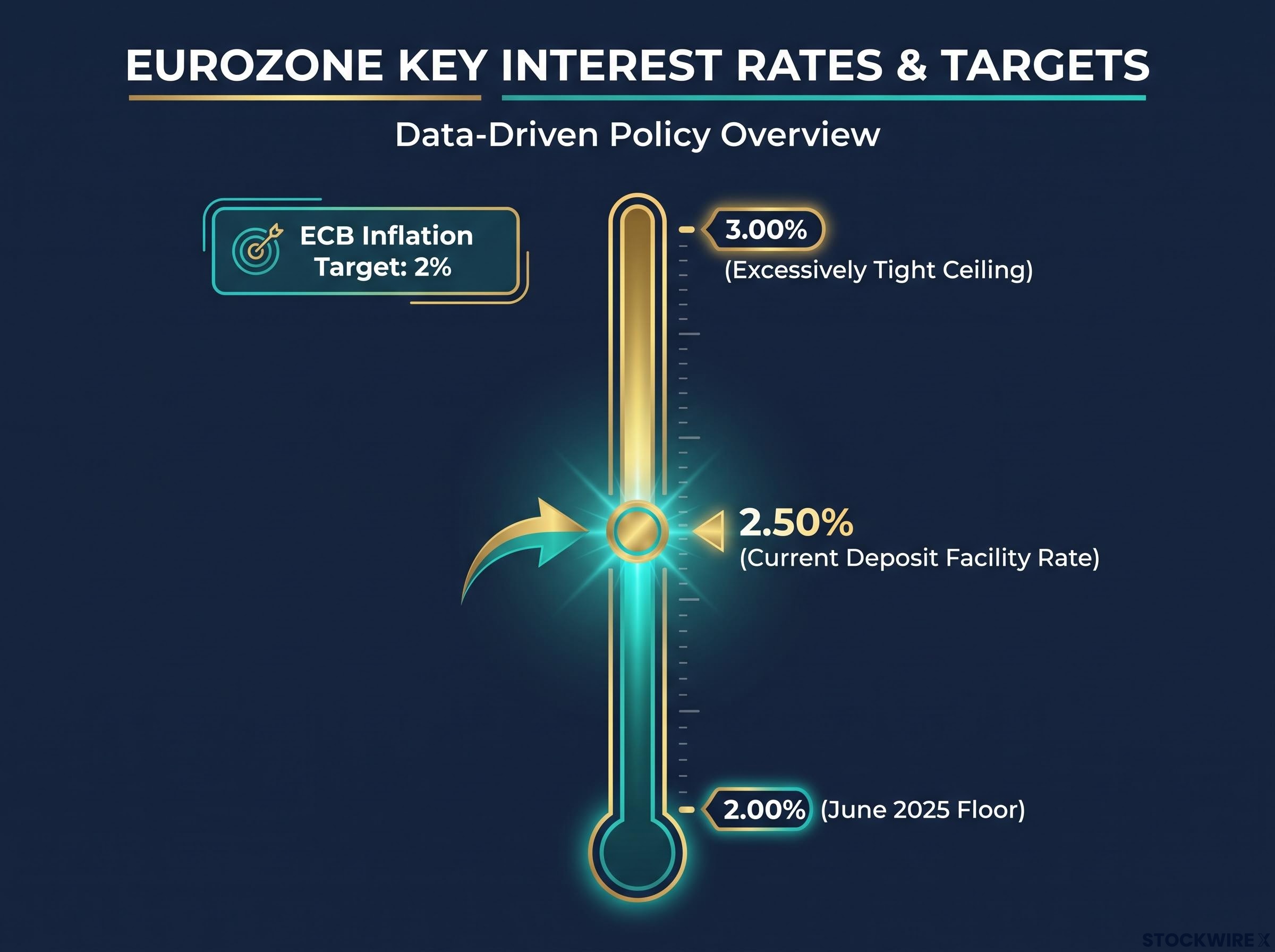
That corridor is the frame. To call 2.50% non-restrictive is to say policy sits in the workable middle, neither loose enough to fuel inflation nor tight enough to choke demand. Three risks could force the ECB’s hand.
- Energy second-round effects: sustained high energy costs seeping into wages and services, exactly the spread Escrivá warned about, with the Supercore at 2.6% already above target and rising.
- Rising global long-term yields: a further climb in international yields would tighten euro-area conditions independently of the ECB, and could weaken the euro into the bargain.
- Premature dovish signalling: communication read as too soft could loosen financial conditions before inflation is anchored at 2%, undoing the ECB’s own work.
Institutional memory shapes the caution here. The ECB’s 2011 hikes into a supply shock sit in the background, informing a more data-dependent stance in 2026. With headline inflation at 3.2% and the Supercore at 2.6%, both above target, the Council is navigating a narrow corridor: tight enough to steer inflation back to 2% without triggering an unnecessary recession.
What this means for positioning: Escrivá’s framing signals that the ECB’s reaction function is conditional, not directional. The next move hinges on whether energy prices stabilise, whether global yields stop rising, and whether underlying inflation keeps easing. If you hold euro or European fixed income, position for optionality rather than a predetermined path.
This article is for informational purposes only and should not be considered financial advice. Investors should conduct their own research and consult with financial professionals before making investment decisions. Past performance does not guarantee future results, and any forward-looking statements are speculative and subject to change based on market and policy developments.
Reading the ECB in 2026 without getting lost in the noise
The single most useful move in this whole story is a reframe. To judge whether ECB policy is restrictive, do not simply hold the rate up against headline inflation. Measure it against the ECB’s own calibration corridor, where 2.00% was the comfortable floor and 3.00% was judged too tight. Seen that way, Escrivá’s read stops looking odd.
That gives you a clean dashboard for the months ahead. The three variables he flagged, energy prices, global long-term yields, and the trajectory of underlying inflation, are the right things to watch to track where the ECB goes next.
And the ECB’s data-dependence is not indecision. It is a deliberate response to the narrow corridor between too-tight and too-loose that the 2025 experience defined. Watch those three variables, and each ECB meeting stops being a surprise and starts being something you can read.