
The US Dollar index is pressing against a line it has failed to break before, and it is doing so at exactly the moment two major data releases hit the tape together.
That resistance sits at 101.80, the level identified by Elias Haddad of Brown Brothers Harriman as the June 24 reference point. For anyone holding or trading Dollar-denominated assets, this is a moment where something gets resolved or something breaks.
The convergence matters because the two data points arriving alongside this technical test sit at different links in the same chain. Job openings speak to the Federal Reserve’s likely path. Consumer confidence speaks to the growth trajectory underpinning that path. Together they carry more informational weight than either would alone.
What follows gives you the tools to read any combination of outcomes from these two releases and understand what each scenario implies for Dollar direction relative to the 101.80 zone. Rather than waiting for consensus to form, you will be able to interpret the data as it lands.
The 101.80 line: what the DXY’s technical position is actually telling you
The DXY has been grinding toward 101.80, and that number is the analytical anchor for everything that follows. The latest live index level was not available at the time of writing, so the resistance zone itself, rather than a real-time reading, is where the analysis sits.
Treat 101.80 not as a ceiling the chart imposes but as the point where two structural forces meet head-on. One pushes the Dollar up. The other caps how far it can go.
The Dollar’s 2026 rebound to that same 101.8 level in late June, driven by the hawkish Warsh-era FOMC hold, is the immediate precedent for the current test; Morningstar’s valuation model flagged the DXY as roughly 15% overvalued at that point, suggesting the resistance zone carries both technical and fundamental weight.
- Upside pressure: Superior US growth relative to peers and strong overseas demand for American assets provide fundamental support. When US policy runs tighter than that of other advanced economies, higher yields draw capital in and carry the Dollar through resistance.
- Upside limitation: Rate tightening by other major central banks narrows the policy gap with the Fed, which limits how far the Dollar can extend beyond the 101.80 zone once that convergence sets in.
Strategists at Goldman Sachs and Bank of America have framed this directly.
A hawkish Fed set against a more cautious European Central Bank, Bank of England, and Bank of Japan pushes the DXY higher. When those central bank stances converge, rallies cap out near resistance.
Why the historical record matters here
The clearest precedent is 2022, when the DXY repeatedly ran into mid-100s resistance zones and broke through them anyway. The Fed was delivering aggressive rate hikes while the ECB and BoJ held loose policy, and surging US real yields overwhelmed the technical barriers.
Then the story changed. As markets began pricing a peak in Fed hawkishness in late 2022 and into 2023, rallies from resistance faded faster. Once rate expectations stabilise or tilt toward easing, resistance becomes far more durable.
That is the read you should take from the 101.80 test. The Dollar’s next directional move is not random. It is being decided by identifiable forces, and understanding those forces tells you more about your hedging and allocation timing than watching the index tick would ever do.
When big ASX news breaks, our subscribers know first
How labour market tightness feeds the Dollar, and what JOLTS 7.271 million means right now
Start with how a labour market survey ends up moving a currency, because the logic runs through several steps and the figure only lands with full weight once you see the whole chain.
Job openings signal how hard employers are competing for workers. Heavy competition sustains wage pressure. Wage pressure keeps inflation risks alive. Live inflation risks reinforce the Fed’s case for holding rates elevated. Elevated rates sustain the yield differentials that support the Dollar against its major counterparts.
Here is that transmission chain laid out in sequence:
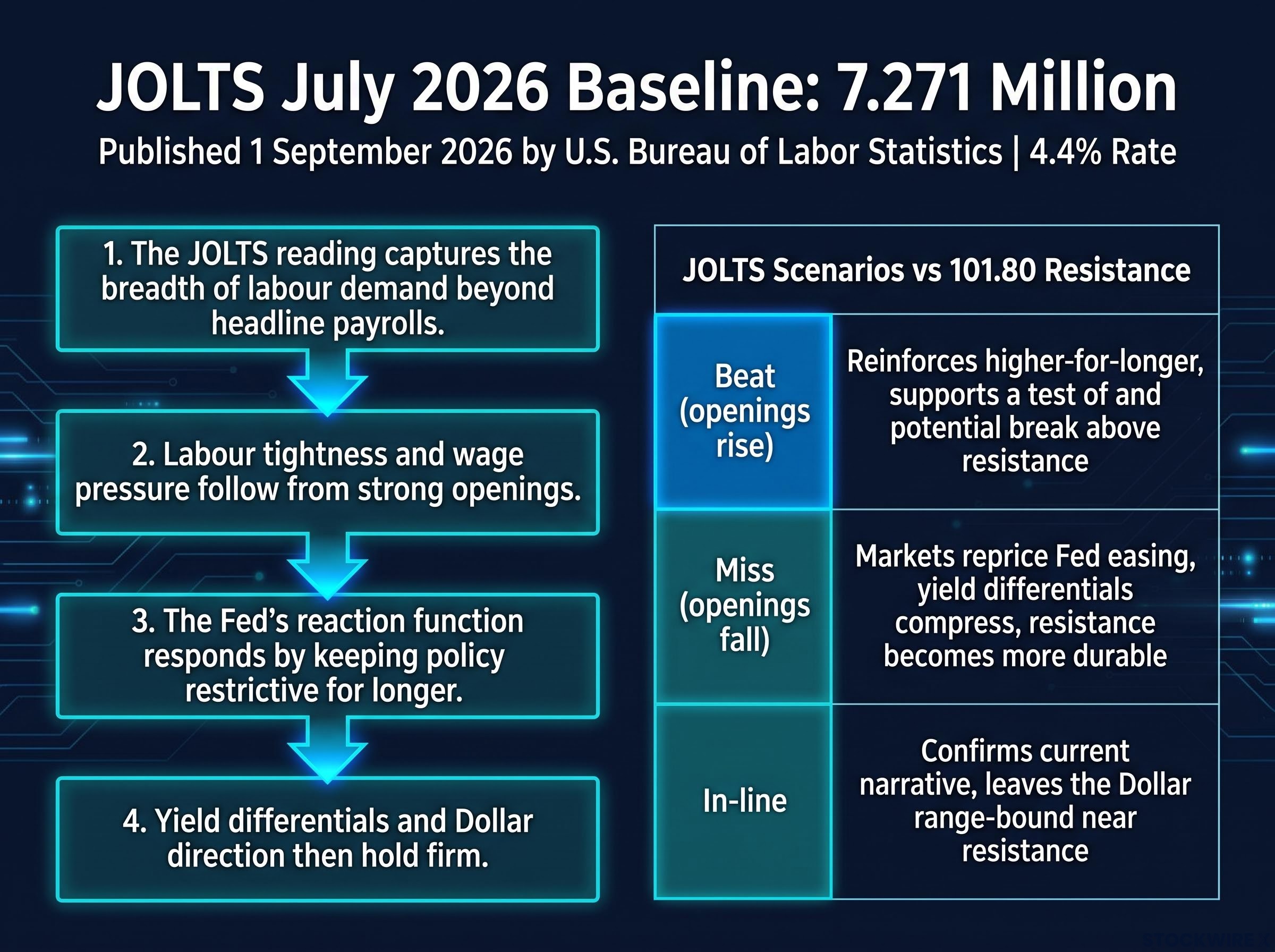
- The JOLTS reading captures the breadth of labour demand beyond headline payrolls.
- Labour tightness and wage pressure follow from strong openings.
- The Fed’s reaction function responds by keeping policy restrictive for longer.
- Yield differentials and Dollar direction then hold firm as long as the differential persists.
Now the number. The most recent official reading, published by the U.S. Bureau of Labor Statistics on 1 September 2026, showed 7.271 million job openings for July 2026, seasonally adjusted and preliminary, at a 4.4% openings rate.
At that level, labour demand remains elevated enough to keep the higher-for-longer narrative credible. In plain terms, the labour market has not yet handed the Fed clear cover to ease, which means Dollar support from yield differentials stays intact for now. The important word is now, because that support is contingent on the trend holding.
The directional risk cuts both ways, and history shows how sharply. A larger-than-expected drop in openings in early 2023 pushed US yields down and softened the Dollar as traders reassessed how aggressive the Fed needed to be. Upside surprises have done the reverse, sparking brief Dollar rallies when they reinforce sticky wage inflation narratives.
Labour market recession signals embedded in the August 2026 data, including long-term unemployed at 1.93 million exceeding job leavers and the Sahm Rule triggering at 4.3%, sit structurally below the JOLTS headline and represent the tail risk that a soft openings print would bring sharply into focus for Dollar bears.
FX strategists at Deutsche Bank and Citigroup have noted that JOLTS surprises can trigger immediate intraday Dollar moves as traders recalibrate expected real interest-rate differentials.
| JOLTS scenario | Likely near-term Dollar implication vs 101.80 |
|---|---|
| Beat (openings rise) | Reinforces higher-for-longer, supports a test of and potential break above resistance |
| Miss (openings fall) | Markets reprice Fed easing, yield differentials compress, resistance becomes more durable |
| In-line | Confirms current narrative, leaves the Dollar range-bound near resistance pending other data |
The July figure is the most recent confirmed baseline. The August JOLTS release, due around now, is the figure to watch, because it will tell you whether that baseline is holding or starting to slip.
Consumer confidence at 89.4 and what a modest decline signals for Dollar bulls and bears
The consumer confidence print is where the Dollar picture gets genuinely ambiguous, because the same number supports two opposite readings depending on which lens you apply.
The Conference Board Consumer Confidence Index came in at 89.4 for August 2026 (1985 = 100), published on 25 August 2026, down 0.8 points from 90.2 in July 2026.
The transmission runs like this. Household sentiment leads spending. Spending drives GDP growth. The growth trajectory shapes inflation expectations and the Fed’s stance. That stance feeds rate-implied pricing and Dollar direction. Because US consumption accounts for the dominant share of GDP, confidence is a leading indicator of where growth is heading.
At 89.4, sentiment is subdued but not collapsing. That leaves two credible interpretations open:
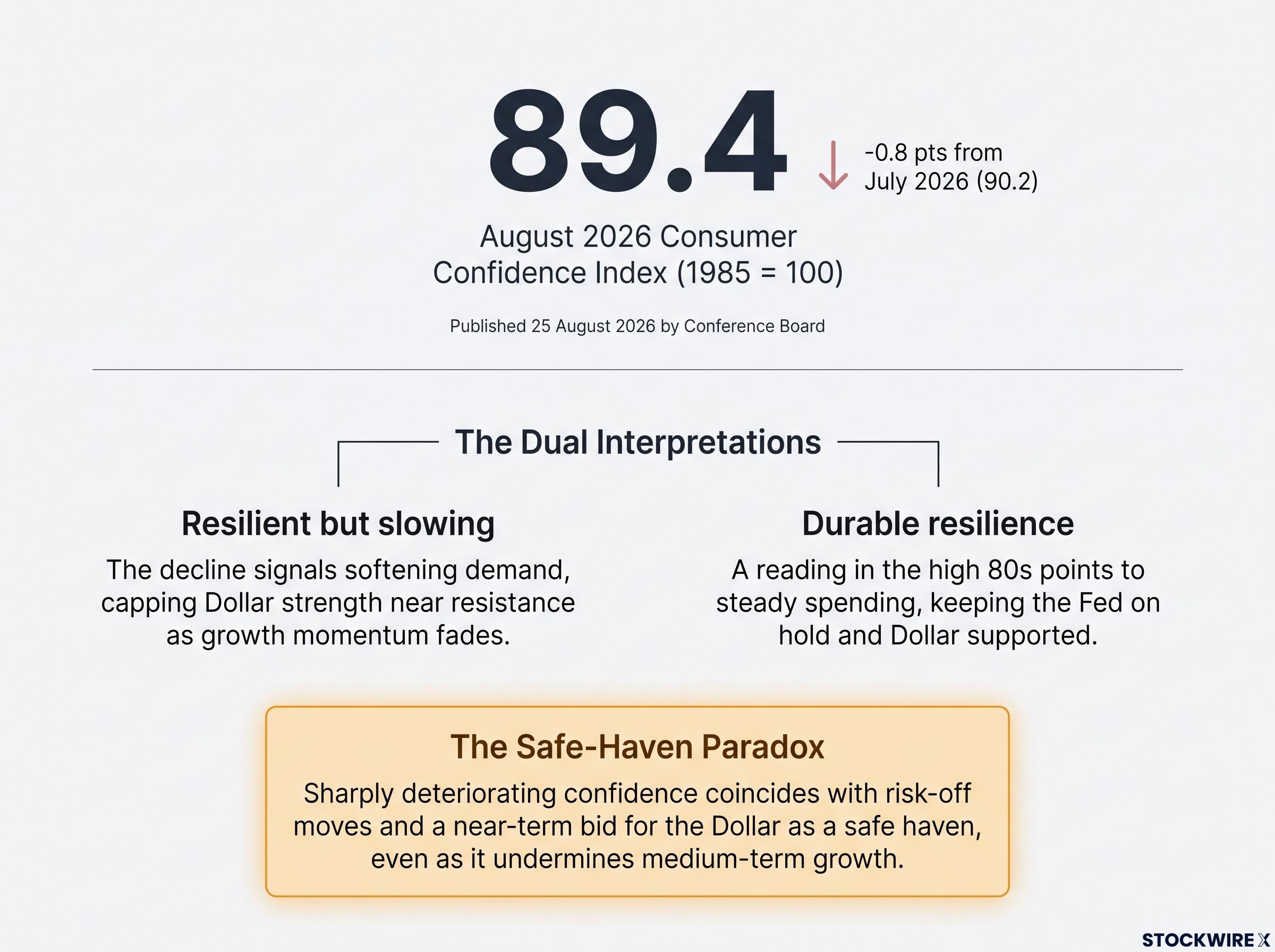
- Resilient but slowing: The decline signals softening demand, which would cap Dollar strength near resistance as growth momentum fades.
- Durable resilience: A reading in the high 80s still points to steady spending, which keeps the Fed on hold and the Dollar supported.
Analysts at Moody’s Analytics frame the growth side of this directly.
Weaker confidence tends to foreshadow slower consumption growth, while stable or rising confidence supports resilient spending and GDP.
The safe-haven wrinkle you should not miss
There is a paradox worth knowing before you trade around a soft print. Sharply deteriorating confidence has historically coincided with risk-off moves and a near-term bid for the Dollar as a safe haven, even as it undermines the medium-term growth story.
That dual-channel behaviour matters. A weak confidence reading is not automatically bearish for the Dollar in the short run, because the risk-off flow can run in the opposite direction to the growth signal.
The read you should take from the 0.8-point decline is measured. It does not resolve the Dollar outlook on its own. It tells you the growth narrative is softening at the margin, which makes the DXY’s ability to hold above or push through 101.80 more contingent on the labour market data staying firm.
Bulls, bears, and the structural forces shaping the Dollar’s medium-term path
Step back from the data releases and the picture at the institutional level is genuinely split. Both camps hold credible positions, and neither has clearly won the argument.
The bullish case rests on structural demand. Research teams at Goldman Sachs, J.P. Morgan, and UBS argue that as long as US real interest rates stay higher than those in other major economies and US growth retains a relative edge, the Dollar keeps structural support regardless of short-term technical pressure. The IMF and BIS add the Dollar’s entrenched role in trade invoicing, reserves, and global funding, which generates demand during episodes of volatility or geopolitical stress.
Central bank divergence across the Fed, ECB, and BOJ is the macro force that has historically driven the DXY through or away from resistance zones; Deutsche Bank’s projection of 50 basis points of ECB hikes into a near-stagnant euro area economy is exactly the kind of policy gap that narrows yield differentials and limits how far a Dollar rally can extend.
BIS research on dollarisation waves finds that the Dollar’s share in international debt securities follows a wavelike pattern rather than a steady structural decline, which supports the institutional view that de-dollarisation remains gradual and limited rather than an imminent catalyst for sustained Dollar weakness.
The bearish case carries equal weight. Analysts at Morgan Stanley and Societe Generale point to peak-Fed and policy convergence as the primary catalyst: once markets are convinced the Fed has stopped tightening and other central banks close the gap, rate differentials compress and the Dollar’s carry advantage erodes. Layered on top are twin deficit and fiscal risk arguments, de-dollarisation as a slow-moving structural headwind, and model-based valuations showing the Dollar as rich with crowded long positioning.
That positioning point is the sharpest near-term risk. J.P. Morgan, Morgan Stanley, and HSBC note that heavily skewed long Dollar positioning in futures markets creates vulnerability to sharp mean-reversion when the macro narrative shifts.
| Factor | Bullish implication | Bearish implication |
|---|---|---|
| Real yield differentials | Higher US real yields draw capital and support the Dollar | Differentials compress as other central banks catch up |
| Policy convergence risk | Fed stays hawkish relative to peers, sustaining the gap | Peak-Fed pricing erodes the carry advantage |
| Reserve currency status | Safe-haven inflows during stress lift the Dollar | De-dollarisation trends slowly cap long-run upside |
| Fiscal and current account deficits | Offset by strong asset market inflows | Twin deficits could force higher risk premia |
| Positioning and valuation | Growth outperformance justifies a firm Dollar | Crowded longs create mean-reversion vulnerability |
The nuance that separates short-term from medium-term analysis sits with the official institutions.
The IMF and BIS characterise the Dollar’s dominant role in reserves and global funding as a source of demand during volatility, which can push the DXY through resistance even when US data are mixed. They also see de-dollarisation as gradual and limited so far.
For anyone with active Dollar exposure, the takeaway is not a directional call. The near-term setup is genuinely contested at the institutional level, which means how you size positions and manage risk around the 101.80 test matters more than backing one narrative.
For investors wanting to stress-test the bearish structural case in more detail, our deep-dive into structural Dollar risk examines the OMFIF survey finding that central banks now plan net dollar-allocation reductions for the first time, alongside the fiscal and positioning dynamics that could convert the slow structural trend into an accelerating one.
Where the Dollar goes from here depends on two things, not one
The Dollar’s proximity to 101.80 means a resolution is close, and that resolution will be driven by how the labour market and consumer sentiment interact, not by either signal alone.
Two scenarios frame what to watch:
- JOLTS holds and confidence stabilises or recovers. A durable labour market keeps the Fed on hold while steady sentiment maintains the growth narrative. This preserves the yield differential and is the path of least resistance for a break above 101.80.
- JOLTS trends lower and confidence softens further. Cooling labour demand and fading sentiment compress the higher-for-longer story, reduce yield differential support, and turn the 101.80 zone into a more durable ceiling.
The current inputs are 7.271 million openings for July and confidence at 89.4 for August. The next real-time updates, the August JOLTS and September Consumer Confidence readings, will refresh this framework as they land.
The 2022-2023 arc is the precedent to keep in mind: policy divergence drove the DXY through resistance in 2022, but once that divergence faded, resistance held and then capped subsequent rallies.
The mental model to carry forward is simple. When labour and confidence data point the same way, the Dollar’s technical setup tends to resolve cleanly. When they diverge, the DXY grinds and ranges near resistance, and that indecision is itself a tradeable information state.
This article is for informational purposes only and should not be considered financial advice. Investors should conduct their own research and consult with financial professionals before making investment decisions. Past performance does not guarantee future results. Financial projections are subject to market conditions and various risk factors.