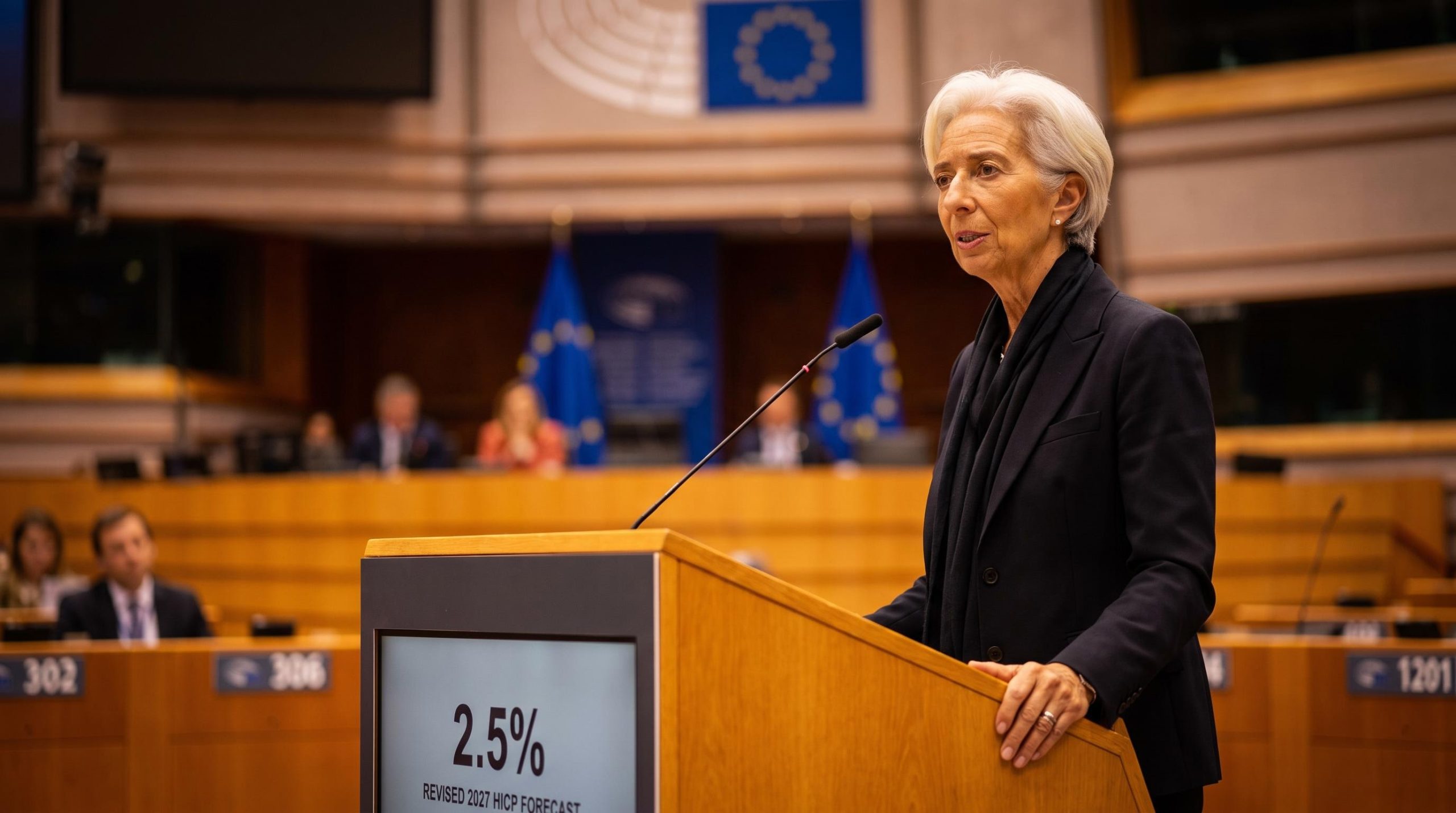
Christine Lagarde stood before the European Parliament today and confirmed what energy markets have been pricing for months: the European Central Bank no longer believes inflation will return to its 2% target on the schedule it published only three months ago.
The September 2026 staff projections, released on 10 September and now formally addressed in Lagarde’s hearing before the Committee on Economic and Monetary Affairs (ECON), put headline inflation at 2.5% in 2027 and 2.1% in 2028. Both figures sit above the June 2026 estimates of 2.3% and 2.0%.
The driver is not domestic demand running hot or wages spiralling out of control. It is an energy shock tied directly to the Middle East conflict, with severe scenario modelling pushing oil toward US$145 per barrel and European gas to €106 per MWh.
That leaves the ECB navigating a path it had hoped to avoid: holding a data-dependent, meeting-by-meeting stance while inflation stays above target well into 2027.
This piece lays out what the revised forecasts actually say, why the ECB still views the overshoot as temporary, where the real risks to that view sit, and which signals will decide whether the gradual approach holds or gives way to something more forceful.
What the revised forecasts actually show
Start with the numbers, because they carry the whole story. The September 2026 projections put headline inflation, measured by the Harmonised Index of Consumer Prices (HICP), at 3.0% for 2026, 2.5% for 2027, and 2.1% for 2028.
Core inflation, which strips out volatile energy and food prices to show the underlying trend, sits at 2.5% in 2026, 2.6% in 2027, and 2.3% in 2028.
The revision only becomes legible against the June baseline. Three months ago, the Eurosystem staff saw headline inflation at 2.3% in 2027 and back at 2.0% in 2028. The September figures push both higher.
| Indicator | June 2026 Forecast | September 2026 Forecast |
|---|---|---|
| Headline HICP 2026 | 3.0% | 3.0% |
| Headline HICP 2027 | 2.3% | 2.5% |
| Headline HICP 2028 | 2.0% | 2.1% |
| Core HICP 2026 | Above target | 2.5% |
| Core HICP 2027 | Above target | 2.6% |
| Core HICP 2028 | Above target | 2.3% |
The core figures are the detail worth sitting with. They stay above 2% across the entire 2026-2028 horizon, which tells you the upside is not confined to the energy component that everyone expects to fade. Underlying price pressures are also firmer than the ECB assumed in June, and that complicates the neat story of simply waiting for a supply shock to pass.
In percentage terms the shift is small. In policy terms it is not, because it extends the stretch of above-target inflation and delays the point at which the ECB can declare the job done.
Key finding: Headline inflation is expected to remain above the 2% target into the first half of 2027 before converging back toward it later that year.
When big ASX news breaks, our subscribers know first
How a Middle East energy shock is rewriting eurozone price projections
To understand why the forecasts moved, follow the chain from the conflict to the checkout. It begins with wholesale energy prices, and the ECB’s own scenario work gives concrete anchors for the scale involved.
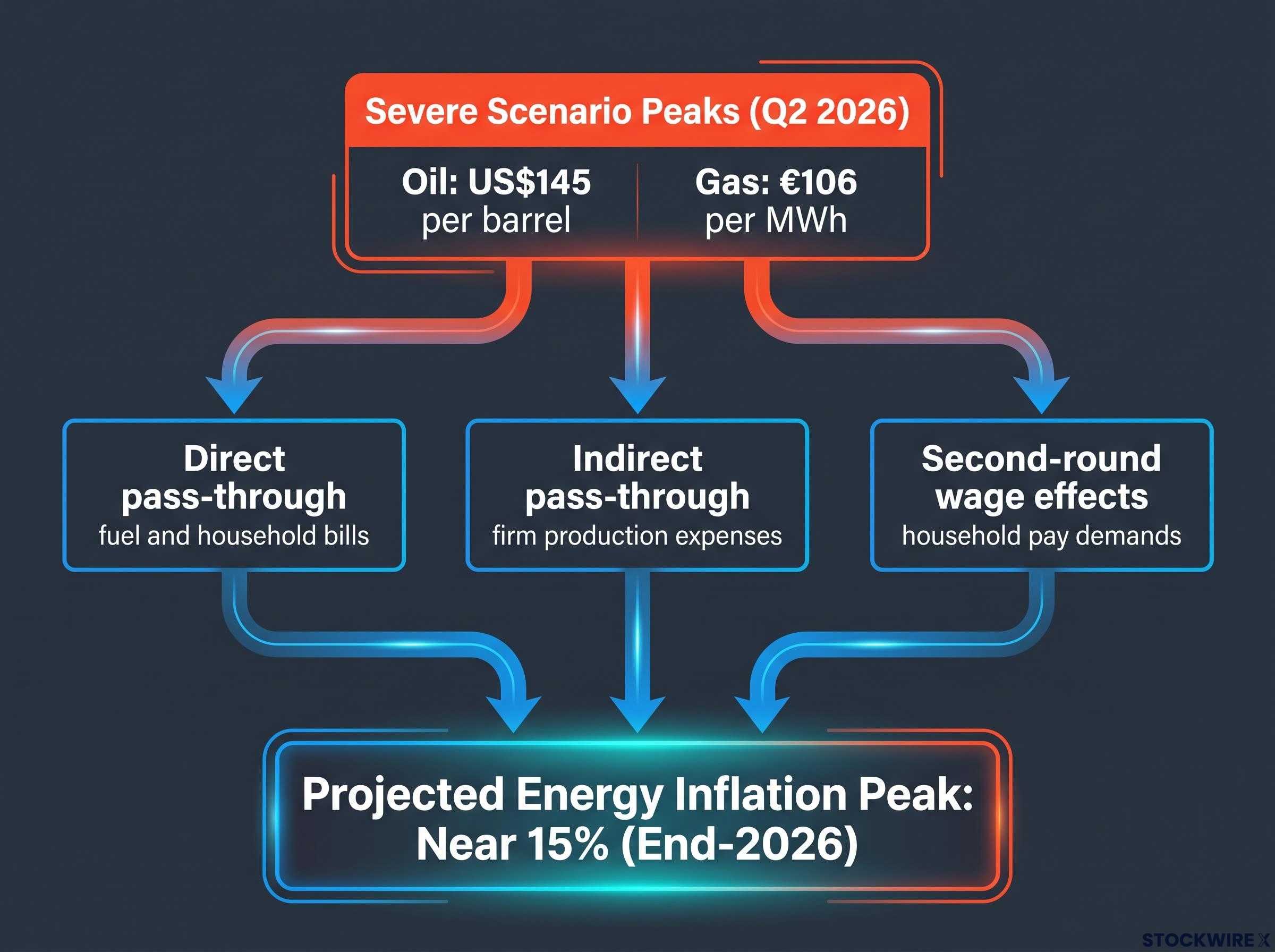
In the severe scenario set out in the ECB’s 6 May 2026 speech, “The new energy shock: economic scenarios and policy implications,” oil peaks at US$145 per barrel in Q2 2026 and European gas reaches €106 per MWh over the same period.
Those wholesale moves do not stay in commodity markets. They transmit into consumer prices through three distinct channels.
The energy shock transmission from refinery destruction to consumer prices operates through crack spreads and diesel margins before it ever appears in the HICP, which is why refining capacity data leads the headline print by several weeks.
- Direct pass-through: Higher oil lifts transport fuel costs, and higher gas raises household gas and electricity bills, both feeding straight into the energy component of the HICP.
- Indirect pass-through: Higher energy costs raise firms’ production expenses, which get passed along into a broader range of consumer prices over time.
- Second-round wage effects: As households watch real incomes erode, they push for higher pay, and those wage demands can embed the shock into the core of the inflation figure.
Why the ECB still sees this as temporary
The September projections have energy inflation peaking near 15% at the end of 2026, then falling sharply as commodity prices ease and the year-on-year base effects turn negative.
The peak: Energy inflation is projected to top out near 15% at end-2026 before dropping away as the war’s impact drops out of the annual comparison.
The Banque de France summary of the Eurosystem projections makes the mechanism plain: once most of the war’s effect on energy prices leaves the year-on-year comparison, headline inflation falls to roughly 2.3% by Q2 2027 and then hovers near 2%. The entire baseline rests on futures-based assumptions that oil and gas prices decline over the coming quarters.
That is exactly where the policy uncertainty lives. The gap between the severe scenario and the baseline is wide, and if Middle East tensions persist or broaden, the smooth return to target does not happen on schedule.
There is a structural tail risk too. The ETS2 carbon pricing scheme for buildings and road transport arrives in 2028, and it could nudge inflation back up at the very end of the horizon, well after the immediate shock is supposed to have faded. For anyone watching eurozone assets, the read is straightforward: treat the baseline as conditional, not guaranteed, and track oil and gas prices against these scenario benchmarks.
The European Parliament’s ETS2 briefing764103) confirms that the carbon pricing scheme for buildings and road transport is legislated to begin regulating emissions from 2028, giving the structural tail risk the ECB identified a firm legislative anchor rather than a speculative one.
Growth holding up, but the balancing act is getting harder
The reason the ECB is not slamming on the brakes becomes clear once you look at the growth side. This is not a stagflation scenario. Lagarde told the ECON committee that the eurozone expansion is broad-based, spanning most member countries and industry sectors, and that it carried through into the third quarter of 2026.
The September projections put real GDP growth at 0.9% in 2026, rising to 1.4% in 2027 and 1.5% in 2028.
| Year | Real GDP Growth |
|---|---|
| 2026 | 0.9% |
| 2027 | 1.4% |
| 2028 | 1.5% |
Lagarde pointed to specific engines behind that resilience:
- Manufacturing: Performing solidly, supported by higher government spending on defence and infrastructure.
- Services: Recovering as consumer confidence rebounds and AI-related activity picks up across digital services, business investment, and exports.
- Labour market: Robust, with unemployment at 6.4% in July 2026, though employment and labour force growth are slowing while productivity gradually improves.
Here is where the comfort ends. A 6.4% unemployment rate sitting alongside core inflation of 2.5% to 2.6% in 2026 and 2027 means the ECB does not have spare capacity in the labour market. That slack is what would normally make a prolonged above-target overshoot low-risk, and it is missing.
Eurostat’s July 2026 unemployment release confirmed the 6.4% rate cited in the September projections, providing the official benchmark against which the ECB is assessing whether labour market tightness is generating the wage pressures that could make the energy shock persistent.
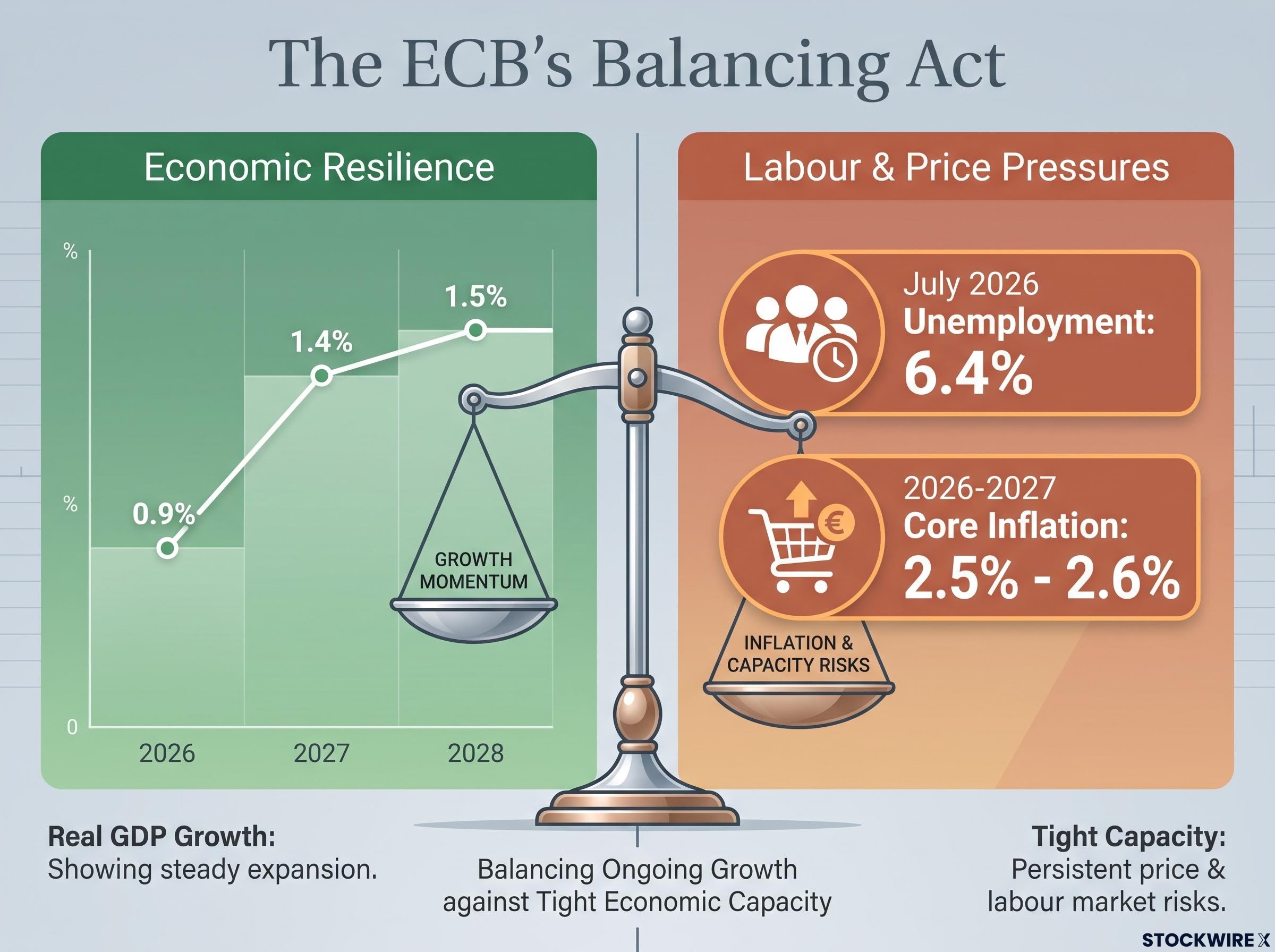
Wage dynamics are the hinge. In a tight labour market, a shock that lingers is exactly the condition that activates the second-round wage effects the ECB is currently treating as contained. That is how a temporary energy story becomes a structural inflation problem.
The growth picture is also what keeps this from being a simple tightening cycle. If GDP data softens in the coming quarters, the dilemma between supporting the expansion and containing prices gets sharper, which is why growth releases now deserve as much attention as inflation prints.
What the ECB’s data-dependent stance means in practice for markets
Lagarde reaffirmed the Governing Council’s commitment to a meeting-by-meeting, data-dependent approach. That is a deliberate refusal to pre-commit to a rate path, and it changes how each data release should be read.
When the central bank has not signalled its next move, every incoming print carries more weight than it would under a pre-announced path. For investors, that means volatility around HICP release dates and ECB communication events is structurally elevated until the data clearly validates the baseline.
The neutral rate debate sits directly beneath Lagarde’s data-dependent framing: if the deposit facility rate at 2.50% is already inside or above the neutral range, additional hikes carry a materially different risk profile than if the ECB is still accommodative.
These are the six signals that will determine whether the gradual stance holds, ordered by how directly they feed the next decision.
- Monthly HICP prints: Whether headline and core inflation track the September projection path, which keeps headline above target into the first half of 2027.
- Energy prices and Middle East developments: Spot and futures prices for oil and European gas, measured against the ECB’s scenario peaks. Any escalation or easing feeds directly into the next projection round.
- Wage growth and labour-market data: The clearest early warning of the second-round effects that would make the shock persistent.
- Inflation expectations: Market-based and survey measures checked against the projection of near-2% inflation by 2028.
- GDP and credit conditions: Weaker growth or stress in lending would argue against tightening even with an energy-driven overshoot.
- ECB scenario communications: Future Economic Bulletins and staff updates for any shift in the balance between baseline, adverse, and severe paths.
The credibility question runs underneath all of it. Lagarde stated that no evidence has emerged of inflationary pressures becoming embedded, with longer-term expectations anchored around target.
Lagarde, ECON hearing, 28 September 2026: No evidence has emerged of inflationary pressures becoming embedded in the economy, with longer-term inflation expectations anchored around the 2% target.
Not everyone reads it that way. BBVA Research, in analysis published this month and flagged as unverified in the underlying source material, expects an additional 25bp hike by year-end and warns of further upside risk if the conflict and energy shock persist. The interpretation gap is real: one camp views the measured stance as prudent restraint in the face of a fading supply shock, the other worries it understates how long energy-driven inflation could linger.
The practical takeaway is that the ECB’s posture is not complacency. It is a conditional bet that energy prices follow the declining path built into the September numbers. Knowing which signals would break that condition is what separates an informed view of ECB policy from a reactive one.
Whether the ECB’s temporary-shock thesis holds is the question that matters
The ECB has built a coherent, internally consistent case for treating this overshoot as temporary. Every part of it, though, hangs on one assumption: that energy prices follow the declining path in the baseline projections.
That leaves a clean two-way fork worth holding in mind. If the Middle East situation stabilises and energy prices ease as the baseline assumes, the gradual, data-dependent stance is likely vindicated and inflation drifts back toward target through 2027. If tensions persist or intensify, the baseline starts to look optimistic and the pressure for more forceful action rises quickly.
The inflation forecast divergence between the ECB’s 2.5% projection for 2027 and Rabobank’s 4.4-4.5% peak estimate hinges almost entirely on differing gas price assumptions, which is precisely why the TTF trajectory is the variable that separates a manageable overshoot from a structural repricing of ECB terminal rates.
The single variable to watch is not the next monthly HICP print in isolation. It is whether the ECB’s next projection update in December 2026 holds the September path or revises it upward again. A second consecutive upward revision would be a qualitatively different signal from the one Lagarde delivered today, and it would tell you the temporary-shock thesis is starting to strain.
This article is for informational purposes only and should not be considered financial advice. Investors should conduct their own research and consult with financial professionals before making investment decisions. Past performance does not guarantee future results, and financial projections are subject to market conditions and various risk factors.