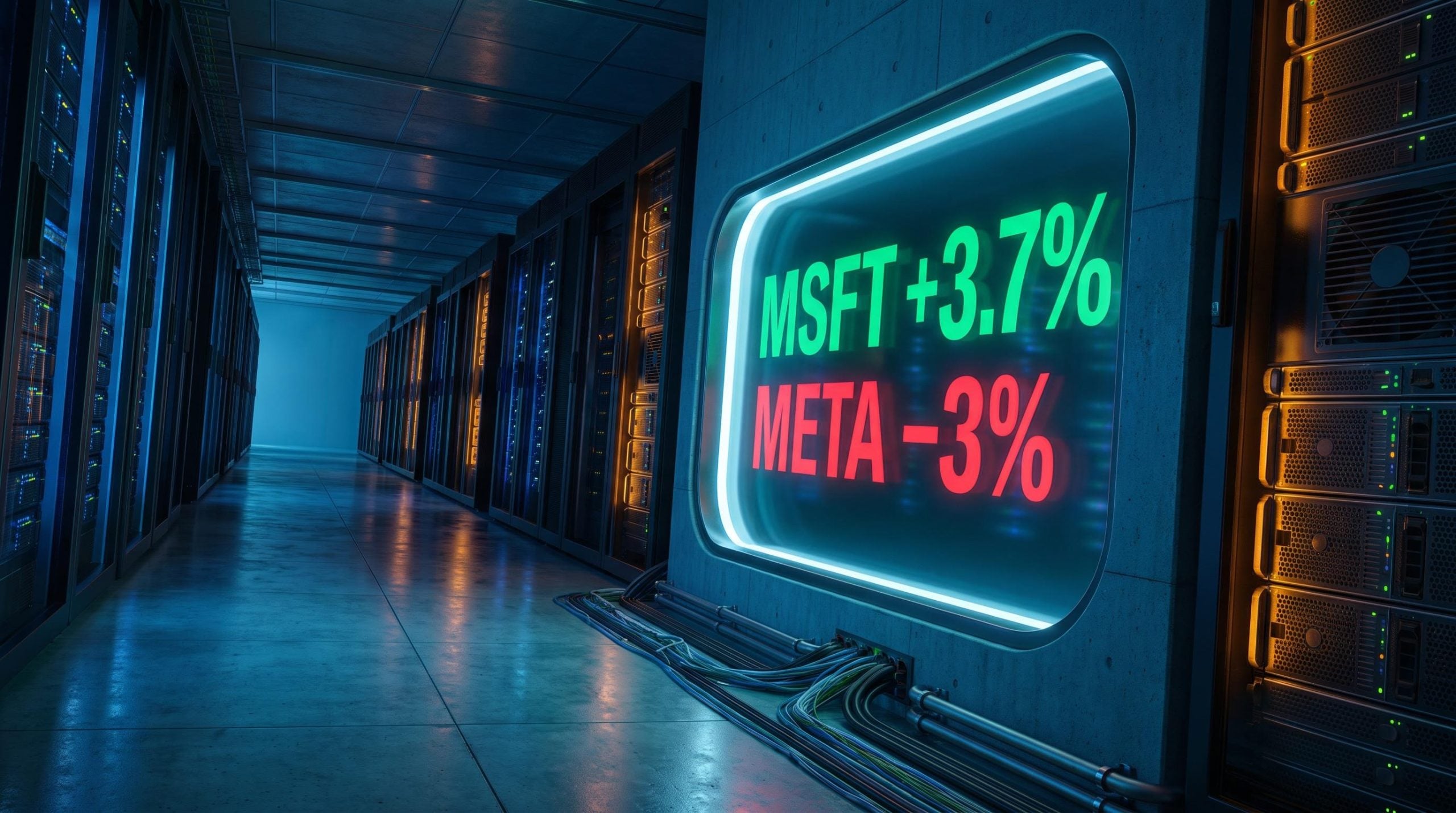
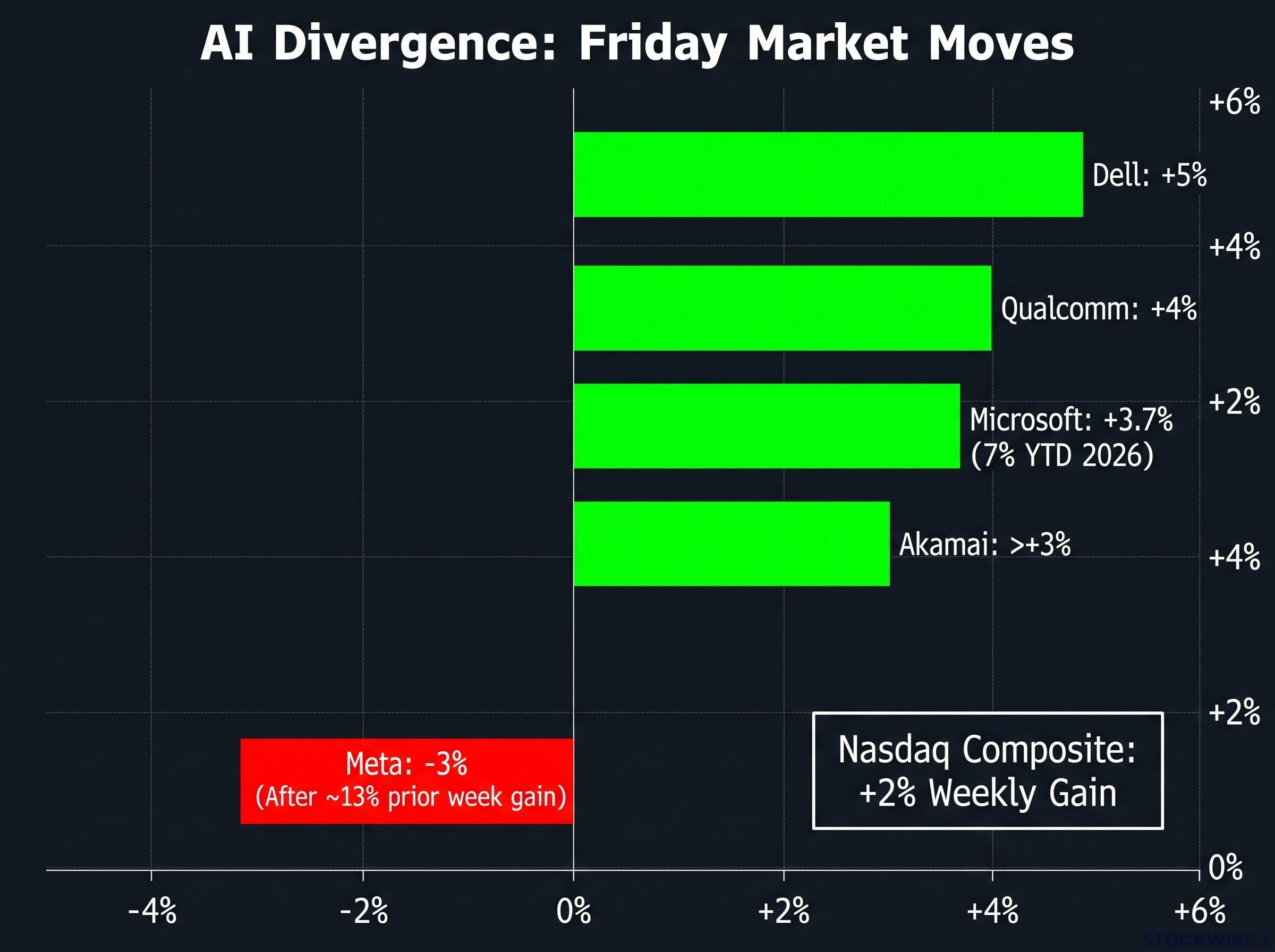
On Friday, Microsoft and Akamai posted their sharpest single-session gains in weeks. On the same afternoon, Meta fell more than 3%. All three moves traced back to one force: AI agents.
That one technology lifted infrastructure names and rattled a consumer platform on the same trading day is the tension worth examining. This was not a broad risk-on rally. These were company-specific, AI-specific moves, and they arrived against a quiet macro backdrop that gave them room to breathe.
The setup mattered. The Nasdaq Composite climbed 2% across the week and touched a record close on Tuesday. Treasury yields eased and oil pulled back. With little macro noise to fight through, the divergence between AI winners and AI casualties became the clearest signal of the week.
This piece breaks down which AI developments actually moved markets, what the Akamai-Anthropic deal reveals about how the AI infrastructure economy is being assembled, and how to think about the genuine disagreement over whether these stock moves reflect durable earnings power or sentiment. By the time you finish, you will have a framework for reading AI stocks by where value sits in the stack, not by the headline theme alone.
A supportive macro backdrop that let AI stories dominate
Macro conditions on Friday cleared the stage rather than took it. That distinction matters, because it explains why company-level news drove individual stock moves so cleanly.
Treasury yields eased across the curve. The US 10-year yield fell four basis points to 5.16%, and the US 2-year yield dropped seven basis points to 4.86%. The proximate cause was oil: Brent crude declined more than 2%, settling at $104.32 per barrel, after reports that Iran had floated a plan to end the ongoing conflict and raised hopes of a ceasefire.
The transmission mechanism runs straight into growth-stock valuations. When inflation anxiety cools, the discount rate applied to long-duration growth stocks falls, and companies whose earnings sit years out, most AI-exposed tech names, become relatively more attractive.
The 10-year at 5.16% A lower long-term yield reduces the rate used to discount future earnings, which lifts the present value of growth stocks whose profits are concentrated in later years. For AI names, that is a tailwind before any company news even lands.
The gains were not a narrow squeeze. Seven of eleven S&P 500 sectors rose on Friday, with information technology leading and industrials close behind.
- S&P 500: up 0.5% on Friday, a 0.2% weekly gain
- Dow Jones Industrial Average: up 0.9%
- Nasdaq Composite: up 0.5% on Friday, up 2% on the week
- S&P 500 information technology sector: advanced nearly 1%
- Industrials: gained 0.6%
There was even a fundamental nudge underneath the session. August data showed that US manufactured capital goods orders for non-defence, non-aircraft items came in ahead of forecasts, and the July reading was revised meaningfully upward, pointing to another quarter of solid business equipment spending tied to the AI buildout.
Here is what the macro read tells you: Friday’s environment was permissive, not generative. Falling yields and softer oil lowered the hurdle for AI-specific catalysts to register, which is why the corporate developments, not the bond market, deserve your attention as ongoing signals.
When big ASX news breaks, our subscribers know first
What the Akamai-Anthropic deal reveals about how AI infrastructure is being assembled
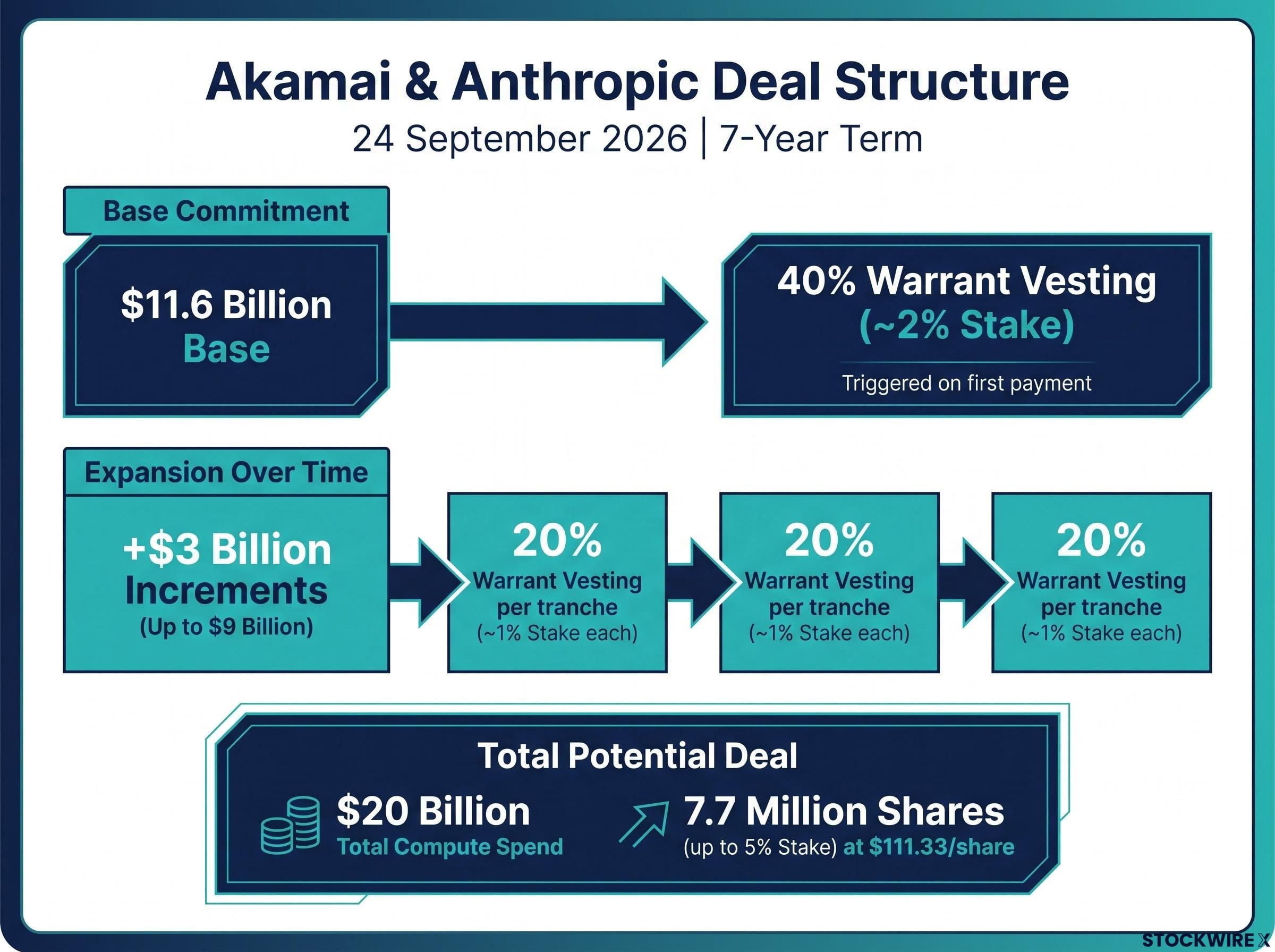
The number that grabbed headlines was $11.6 billion, expandable by up to $9 billion to roughly $20 billion over seven years. Read the structure, though, and this is not a procurement contract. It is a capacity-reservation instrument welded to an equity-alignment mechanism.
The Akamai-Anthropic commitment sits inside a much larger surge in AI capex scale: US IT hardware and software spending reached a record 4.9% of GDP in Q1 2026, surpassing both the dot-com era peak and the cloud buildout peak, with the Stargate Project adding a further $500 billion in sovereign-scale data-centre investment on top of hyperscaler commitments.
Disclosed on 24 September 2026 through Akamai’s news release, a same-day SEC Form 8-K, and a Reuters report, the agreement commits Anthropic to buy Akamai cloud and compute capacity across a seven-year term. Akamai Technologies shares gained more than 3% on Friday in response.
The warrant is where the logic becomes visible. Akamai issued Anthropic a warrant for non-voting convertible preferred stock representing 7.7 million common shares on an as-converted basis, up to roughly 5% of Akamai’s outstanding common stock, at an exercise price equivalent to $111.33 per common share.
Crucially, that equity vests against spend. Around 2% vests on the initial commitment, and the remaining 3% vests in roughly 1% increments for each additional $3 billion of purchases. The Form 8-K specifies that 40% of the warrant vests on Anthropic’s first payment under a defined project plan, with three further 20% tranches vesting as each additional $3 billion is committed.
| Commitment Tranche | Contract Value | Warrant Stake Vesting | Trigger Condition |
|---|---|---|---|
| Initial commitment | $11.6B base | ~2% (40% of warrant) | First payment under defined project plan |
| Expansion tranches | +$3B increments | ~1% per tranche (20% of warrant each) | Each additional $3B committed |
| Full expansion | Up to ~$20B total | Up to ~5% total | Full $9B expansion over seven-year term |
That vesting schedule is the point. Anthropic’s equity participation is contingent on actually spending, which means neither side can defect cheaply. For you as a reader assessing the deal, that structure makes the financial commitment more credible than the headline number alone, because the incentives are locked together across seven years rather than resting on a signature.
Why Akamai, and why now
Akamai’s edge-compute footprint is the differentiator. Its distributed network runs workloads closer to users, which cuts latency and appeals to enterprises and governments with data-residency requirements, rules that keep data inside specific jurisdictions.
That fits a structural driver: sovereign AI concerns and regional data rules are pushing AI labs to spread infrastructure beyond a small cluster of US hyperscalers. For an infrastructure provider outside the top tier, landing a named AI lab on those terms is exactly the signal that justifies a second look.
The NIST AI Risk Management Framework establishes voluntary guidance on trustworthiness, data governance, and risk controls for AI systems, giving enterprise buyers and regulated industries a reference standard that increasingly shapes procurement decisions and the data-residency requirements Akamai’s edge network is positioned to satisfy.
Which industries AI agents are reshaping, and who carries the risk
Start with the industry where the logic is most legible: banking. Customer onboarding, compliance checks, payments, savings allocation, and product comparison are rule-bound and document-heavy, precisely the tasks AI agents handle well.
McKinsey analysis has identified customer operations and risk as high-value automation targets in financial services. The reasoning is that agents can read and act on contracts, regulations, and transaction histories in real time, reducing reliance on frontline staff and disintermediating advisory channels for smaller clients.
E-commerce follows the same pattern from a different angle. AI shopping agents shift discovery from keyword search toward intent-driven flows that compare price, reviews, and availability in one pass. Andreessen Horowitz has argued these agents will sit between consumers and platforms, eroding the value of brand-level search engine optimisation while rewarding retailers with clean APIs and structured product data.
The real-world evidence is already visible in specific companies.
Banking and e-commerce are the most visible cases, but enterprise software displacement risk is unevenly distributed: platforms holding system-of-record status with deep regulatory workflow integration are structurally harder for AI agents to replace than analytical tools or point solutions without deep data dependencies.
- Klarna: its AI assistant reportedly handles work equivalent to hundreds of support agents in service and discovery
- Amazon, Shopify: AI discovery tools recommending products and building comparisons
- Expedia, Booking.com: trip-planning assistants combining flights and hotels across suppliers
- JPMorgan, Morgan Stanley: AI assistants piloted for wealth managers and clients, automating explanations and paperwork
| Industry | AI Agent Opportunity | Disruption Risk |
|---|---|---|
| Banking | Automated onboarding, compliance, product recommendations | Disintermediation of frontline staff and advisory channels |
| E-commerce | Intent-driven discovery, integrated checkout and logistics | Erosion of paid search and weakly differentiated storefronts |
| Cloud infrastructure | Continuous machine-initiated agent workloads | Concentration and capex-return uncertainty |
| Enterprise software | Agents acting on documents, CRM, workflows | Pressure on point tools that cannot integrate |
| Travel and hospitality | Multi-supplier itinerary planning and rebooking | Shift in bargaining power away from suppliers |
Meta is the live case study in this tension. Its shares fell more than 3% on Friday, even after surging roughly 13% the prior week on strong reception to its Llama AI agent. Friday’s analyst discussion centred on whether Llama’s advances stand to accelerate spending on AI infrastructure while creating headwinds for banks, consumer retail platforms, and other businesses that depend on direct customer relationships.
That single-day reversal tells you the market is trying to price both sides of the AI agent economy at once. If you hold undifferentiated consumer-platform exposure, you may be carrying disruption risk you have not yet modelled, because customer attention is increasingly mediated by software that ignores traditional marketing.
The infrastructure layer: who benefits from agent proliferation
Autonomous agents generate continuous, machine-initiated workloads. They self-deploy code, monitor systems, and remediate incidents, which lifts demand for cloud compute, observability tools, and zero-trust security, the model where no user or system is trusted by default.
Morgan Stanley and Bank of America have framed agentic AI as a tailwind for cloud infrastructure, data-centre operators, and security vendors. Akamai’s edge position illustrates who captures that demand, while traditional managed-services providers whose value rested on manual work face margin compression as agents automate it.
Fundamentals versus sentiment: the analyst debate every AI investor needs to understand
The bull case is specific. Equity strategists at Goldman Sachs and Bank of America argue that sustained AI compute demand validates elevated capex, that AI-enhanced products support higher subscription pricing and seat expansion, and that productivity gains in client industries can lift broader corporate profits over time.
The Goldman Sachs AI investment outlook, forecasting global AI capital deployment to exceed $1 trillion in 2026, underpins the bull camp’s argument that sustained compute demand validates elevated capex, and gives context for why infrastructure names like Akamai and Microsoft drew fresh institutional attention on Friday.
The bear case is equally specific. More cautious voices at Morgan Stanley, Barclays, and value-oriented asset managers warn that capex may outpace monetisation, that AI-labelled revenue remains a small share of most companies’ total sales, that model commoditisation could erode pricing power as open-source and low-cost providers undercut incumbents, and that regulatory risk on data and model training is rising.
Between them sits a two-phase view.
The bull-bear debate also runs through index concentration risk: the Magnificent Seven represent approximately 32% of S&P 500 total weight as of 2026, meaning passive investors carry a concentrated AI infrastructure and consumer-platform bet regardless of whether they sized it deliberately, a structural exposure the current valuation debate does not always make explicit.
Long-term AI potential is substantial, but current pricing embeds aggressive assumptions about growth, margins, and duration of advantage. The path may run through early winners in infrastructure and chips, followed by slower, more distributed gains in application software and end-user industries.
Friday gave the bull camp fresh ammunition. Microsoft rose 3.7%, taking its 2026 year-to-date gain to 7%; Qualcomm added 4% and Dell gained 5%.
| View | Core Argument | Key Risk to This View |
|---|---|---|
| Bull | Compute demand validates capex; AI products lift pricing and profits | Monetisation may lag the spend already priced in |
| Bear | Capex outpaces returns; AI revenue still small; commoditisation looms | Understates genuine, durable productivity gains |
| Hybrid | Real long-term uplift, but staged; infrastructure first, apps later | Requires patience and precise position sizing |
The honest read is that both camps hold legitimate evidence. That means the right posture is not to pick a side but to identify which data points, in which reporting cycle, will move the dial, and to size AI exposure accordingly rather than treating it as a binary conviction trade.
Three variables will arbitrate the debate, in order of weight:
- Capex-return data from the next major cloud earnings cycle
- Monetisation pace of AI products versus infrastructure spend
- Regulatory developments on data use and model training
Investors who treat these gains as pure momentum or pure fundamentals are both working from incomplete maps. Knowing the conditions under which each view fails is what lets you plan scenarios and hold the patience the two-phase view demands.
What the week’s moves change, and what they do not
The week confirmed patterns already in motion rather than opening new ones. The Nasdaq’s 2% weekly gain and Tuesday record close, set against the S&P 500’s slimmer 0.2% rise, show that AI tech leadership was genuine and not just broad-market drift.
Three things the session validated:
- AI infrastructure commitments are growing in scale and structural sophistication, with the Akamai-Anthropic warrant as the clearest recent example
- Agentic AI is now a named catalyst in individual stock moves, from Microsoft’s Copilot to Meta’s Llama
- The market is already attempting to price beneficiaries and casualties at the same time
What remains genuinely unresolved is whether capex returns materialise within the timeframe embedded in current valuations, which consumer-facing industries adapt versus which get disintermediated, and how regulatory pressure evolves.
Meta’s single-day loss against its prior-week 13% gain is the lesson. Markets can reprice fast once an AI product’s disruption implications become visible, which is why holding AI exposure without a thesis about where in the stack value accrues is a risk-management problem, not just an analytical one.
For readers wanting to understand how AI-mediated trading amplifies moves like Friday’s divergence into potential systemic fragility, our full explainer on AI-driven tail risk covers model convergence, reflexivity feedback loops, and how correlated automated de-risking can accelerate repricing events before human decision-makers can intervene.
Two concrete actions follow. First, stress-test any consumer-platform or bank exposure against the AI agent disruption thesis. Second, watch the next major cloud earnings cycle for capex-return signals rather than treating AI stock moves as self-validating. The practical conclusion is consistent: AI investment requires a position in the stack, not just a position in the theme.
This article is for informational purposes only and should not be considered financial advice. Investors should conduct their own research and consult with financial professionals before making investment decisions. Past performance does not guarantee future results, and financial projections are subject to market conditions and various risk factors. Forward-looking statements are speculative and subject to change based on market developments and company performance.