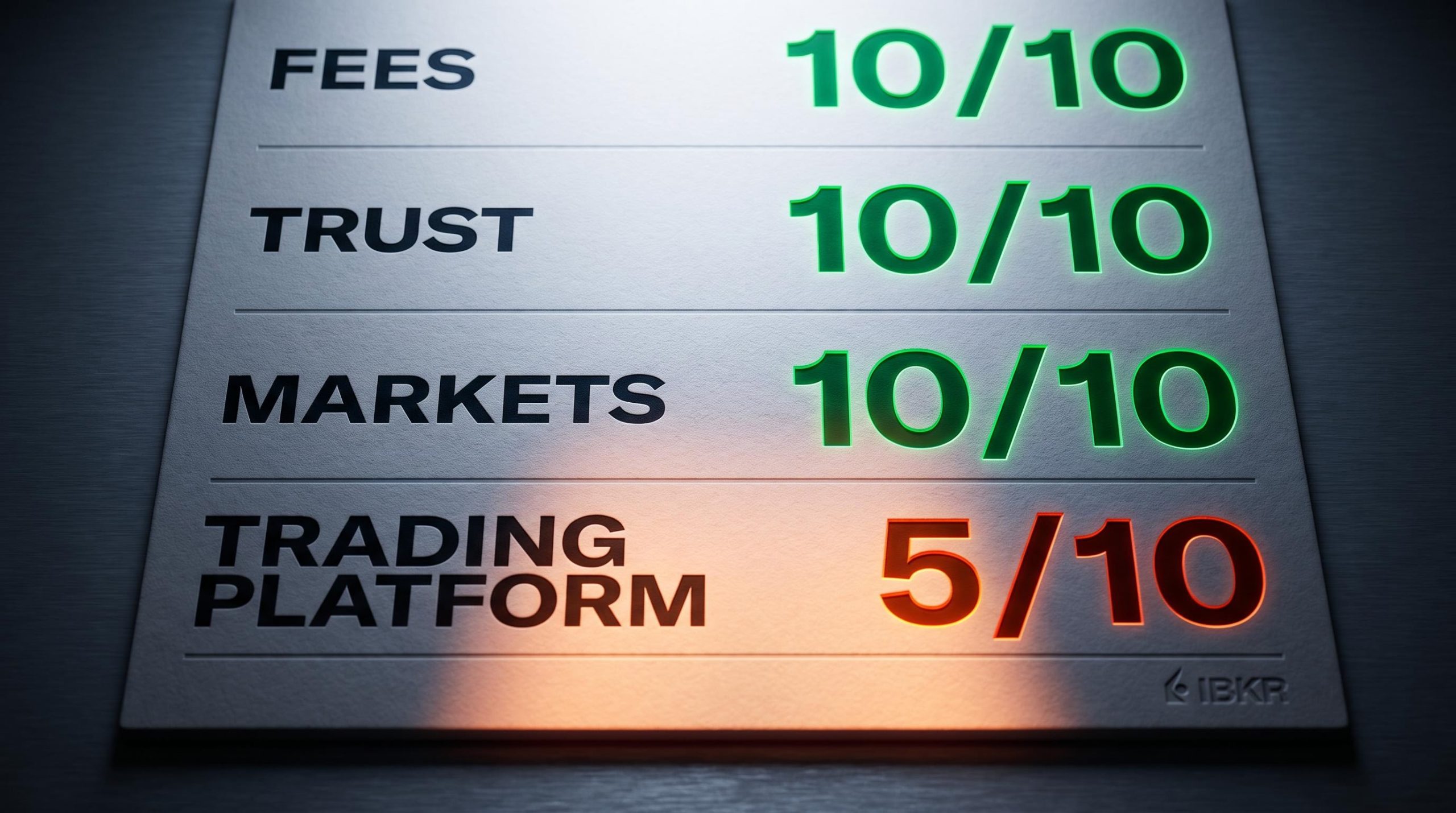
Interactive Brokers scores a near-perfect 88 out of 100 in 2026 reviews. It also scores just 5 out of 10 for its trading platform. Both numbers describe the same broker.
That contradiction is the whole story, and it matters more in 2026 than it would have a few years ago. Zero-commission apps have trained a generation of investors to expect “free” as the baseline, which makes Interactive Brokers’ institutional pricing model look almost strange on the surface. The real question is no longer whether this broker is good; the evidence says it clearly is. The question is whether it is good for you specifically.
Here is what the scores, fees, and platform evidence actually tell you: exactly which type of investor will find Interactive Brokers close to unbeatable, and which type will find it a source of daily frustration. By the time you finish, you will know which of those two people you are.
The numbers that put Interactive Brokers at the top of 2026 broker rankings
Start with the aggregate. A 2026 reviewer assessment gave Interactive Brokers an overall score of 88 out of 100, one of the highest marks handed to any broker evaluated globally that year. The reviewers behind it hold over a decade of broker comparison experience and more than five years of direct Interactive Brokers usage, so this is not a first-impression rating.
Break that number into its parts and the picture sharpens.
| Category | Score | Maximum |
|---|---|---|
| Fees and trading costs | 10 | 10 |
| Trust and regulation | 10 | 10 |
| Market range | 10 | 10 |
| Trading platforms | 5 | 10 |
Three perfect scores, and then one that falls off a cliff. The 5 out of 10 for trading platforms is not a rounding-error deduction from an otherwise clean sheet. It is the single most important thing the aggregate hides.
Read it as a warning label. A specific category of trader, the ones who need a slick, intuitive interface or third-party charting, will find this broker actively frustrating no matter how good the fees are. You need to decide early whether that is you, because everything else in this analysis flows from that one question.
The aggregate is not an outlier, either. Major independent outlets landed in the same place.
Investopedia’s dedicated Interactive Brokers review, last updated 25 September 2026, gave the broker an overall rating of 4.7. NerdWallet, updating its review around the same period, held its rating at a full 5.0 out of 5.
When three separate assessments cluster this tightly at the top, the strengths are real. The task now is understanding where those strengths actually apply to your money, and where they quietly disappear.
When big ASX news breaks, our subscribers know first
Where Interactive Brokers actually saves you money (and where the saving disappears)
The fee story is not one number; it is a series of forks in the road, and the tier you choose changes everything. This is also where a lot of readers misjudge the broker, so it is worth walking through slowly.
Start with US equities, the most common trade. On IBKR Pro, tiered pricing runs from US$0.0005 to US$0.0035 per share with a minimum of US$0.35 per order, dropping toward the lower end only at very high monthly volumes. The fixed alternative is US$0.005 per share with a minimum of roughly US$1.00 per order. Then there is IBKR Lite, which charges nothing at all for US exchange-listed stocks and ETFs for eligible US and Singapore residents.
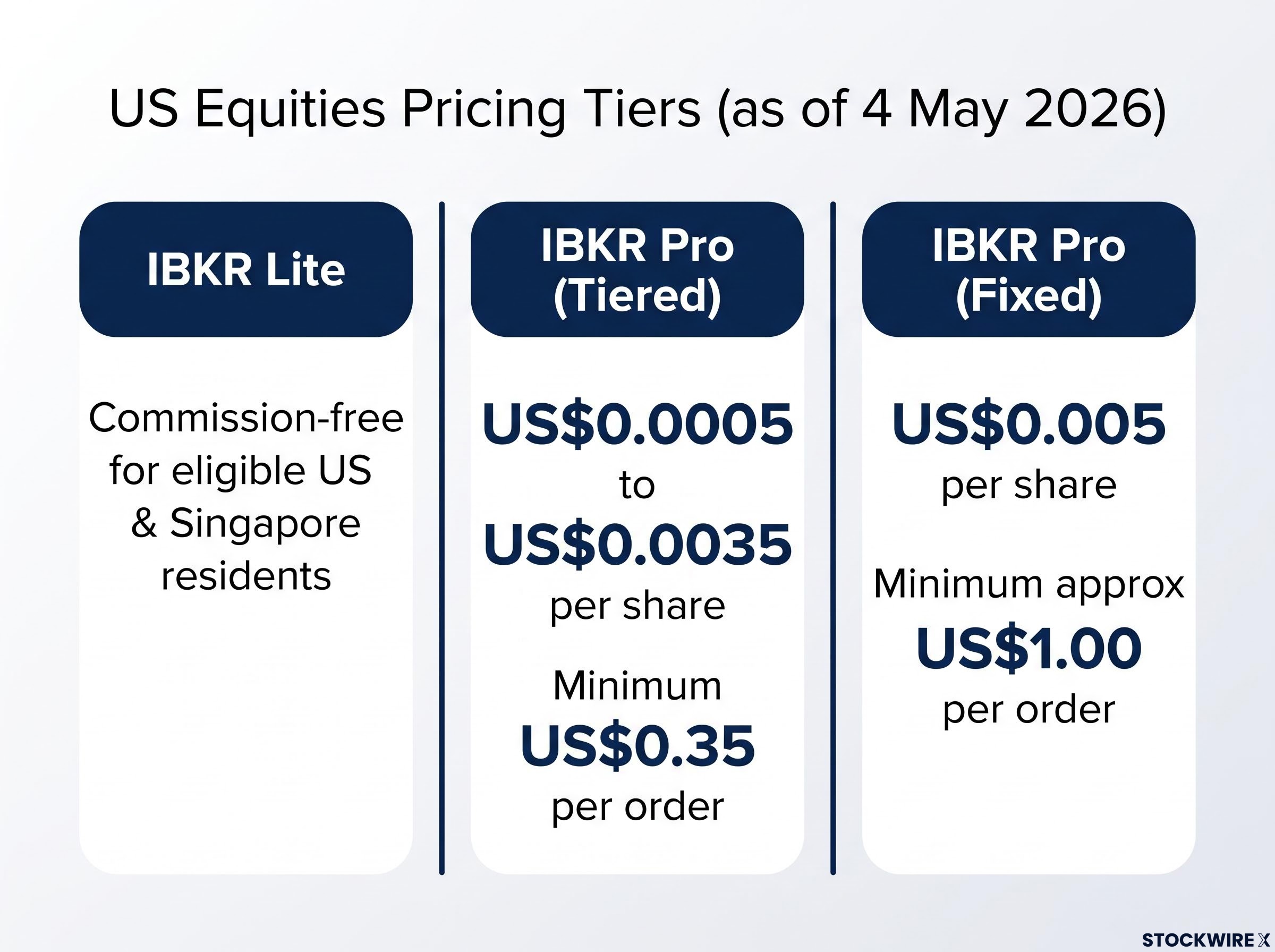
That range, from zero to fractions of a cent per share, tells you the tier decision matters far more than the headline “low cost” reputation suggests. Here is how the main asset classes break down:
- US equities (IBKR Lite): commission-free for eligible US and Singapore residents
- US equities (IBKR Pro, tiered): US$0.0005-0.0035 per share, minimum US$0.35 per order
- US equities (IBKR Pro, fixed): US$0.005 per share, minimum approximately US$1.00 per order
- Australian equities: approximately 0.08% commission, from direct reviewer trading experience
- Options (IBKR Pro): US$0.65 per contract
- Forex: as low as approximately US$2 per trade or 0.2 basis points, with near-zero spreads drawn from a deep liquidity pool
These figures reference the official IBKR Commissions and Fees schedule dated 4 May 2026, alongside the reviewers’ direct trading records. Margin borrowing is competitive too, characterised in one audit as roughly benchmark plus 0.5-1.5% on Pro accounts, though cheaper leverage also raises liquidation risk for anyone who overuses it.
Here is the honest limit of the advantage. If you are a casual investor buying US shares occasionally, the saving over a mainstream zero-commission app is thin, and IBKR Lite mostly closes even that gap. The real edge shows up when you trade actively, across multiple asset classes, or internationally.
Currency conversion: the fee most brokers hide
This is the saving almost nobody talks about, and it can dwarf the commission.
Most zero-commission brokers do not make their money on the trade. They make it on the exchange rate, quietly marking up currency conversion so that every time you buy a foreign-listed asset or receive income in another currency, you pay a hidden margin. It never appears as a “fee”.
Interactive Brokers largely avoids this. Its conversion rate sits close to the clean market rate, comparable to a service like Wise, rather than a retail markup. For any trader who holds or earns in more than one currency, that is a material and recurring difference, the kind that compounds far more quietly, and far more significantly, than a per-share commission ever will.
The hidden costs of zero-fee platforms, particularly the FX margins applied to every cross-currency trade, are the mechanism by which brokers that advertise commission-free access recover their margins invisibly, a dynamic that makes Interactive Brokers’ transparent conversion rate a structural advantage for anyone trading internationally.
What Interactive Brokers actually offers access to (and the platform you will use to trade it)
Now the exciting part. Interactive Brokers offers access to roughly 170 markets across 40 countries from a single account. Equities, indices, forex pairs, ETFs, options, futures, and bonds all live in one place, which is why the market range category earned its perfect 10 out of 10.
You can also hold the account in your own currency. Supported base currencies include:
- Australian Dollar, US Dollar, Euro, British Pound
- Japanese Yen, Canadian Dollar, Swiss Franc
- Hong Kong Dollar, Singapore Dollar
For a globally minded investor, that reach is a genuine structural advantage. No dedicated retail app comes close to trading this many markets from one login.
Then you open the platform, and the mood changes.
The flagship Trader Workstation is built for institutional and high-frequency clients, and it shows. It is powerful, deeply configurable, and steep to learn. The charting is regarded as outdated next to alternatives like CMC Markets or TradingView, and several tools traders expect simply are not there:
- MT4 (not supported)
- MT5 (not supported)
- cTrader (not supported)
- TradingView integration (not supported)
For a forex-first or charting-dependent trader, those absences are not minor annoyances. They are workflow blockers.
One reviewer has used Interactive Brokers for more than five years and still reports difficulty navigating the platform. That is not a beginner’s complaint; it is a seasoned user describing the ceiling.
To its credit, the broker is iterating. The mobile app received a significant upgrade in the twelve months before the 2026 review, making portfolio and net worth tracking noticeably easier, and simplified products like IBKR Lite and Global Trader offer gentler entry points. None of them fully solve the underlying complexity.
This is the defining trade-off. The gap between what you can access and how easily you can access it is the whole Interactive Brokers experience in one sentence. You have to be honest with yourself about whether your trading is complex enough to justify the interface that comes with it.
Who Interactive Brokers is actually built for (and who should look elsewhere)
All of the evidence so far points toward a clean split, so here it is without hedging.
Interactive Brokers is a strong fit if you are:
- A long-term global investor wanting broad equity and ETF access across international exchanges
- A multi-asset active trader needing stocks, options, futures, bonds, and forex from one account
- A cost-sensitive, high-volume trader for whom total trading costs across asset classes are the priority
- A multi-currency holder who receives or holds income in several currencies and wants to avoid conversion costs
Consider alternatives if you are:
- An absolute beginner, where the platform’s learning curve will work against you
- A forex or CFD-focused trader, given the absence of MT4, MT5, cTrader, TradingView, and any CFD-native interface
- A user who wants social trading or copy-trading features, which are absent
- A trader who wants a simple, plug-and-play retail interface, or native charting on par with CMC Markets or TradingView
For that second group, the fix is usually a different broker rather than a compromise. Pepperstone, for one, is specifically cited as offering more specialised services for CFD-focused needs, and beginners are better served by platforms designed around onboarding rather than institutional depth.
For beginner investors still working out where to start, platform complexity and long-term costs are two distinct decision variables; the evidence on fee drag suggests that getting the cost layer right from the first account is one of the highest-impact choices a new investor makes, which explains why a broker optimised for cost rather than simplicity can still be the wrong fit.
The trust case for the first group is unusually solid, and it is built on regulation rather than marketing. Interactive Brokers was founded in 1978, is listed on the Nasdaq, and extends negative balance protection to all retail clients globally. Its licensing runs across six Tier-1 jurisdictions:
The regulatory tier of a broker determines more than licensing paperwork: it sets leverage ceilings, dictates how client funds are held during insolvency, and controls whether any statutory compensation scheme applies at all, which is why Interactive Brokers’ six-jurisdiction Tier-1 footprint is a substantive protection rather than a marketing credential.
United States (FINRA, SIPC), United Kingdom (FCA, Register Number 208159), Australia (ASIC, AFSL 453554), Canada (CIRO), Ireland (Central Bank of Ireland, ICS), and Singapore (MAS, Licence CMS100917).
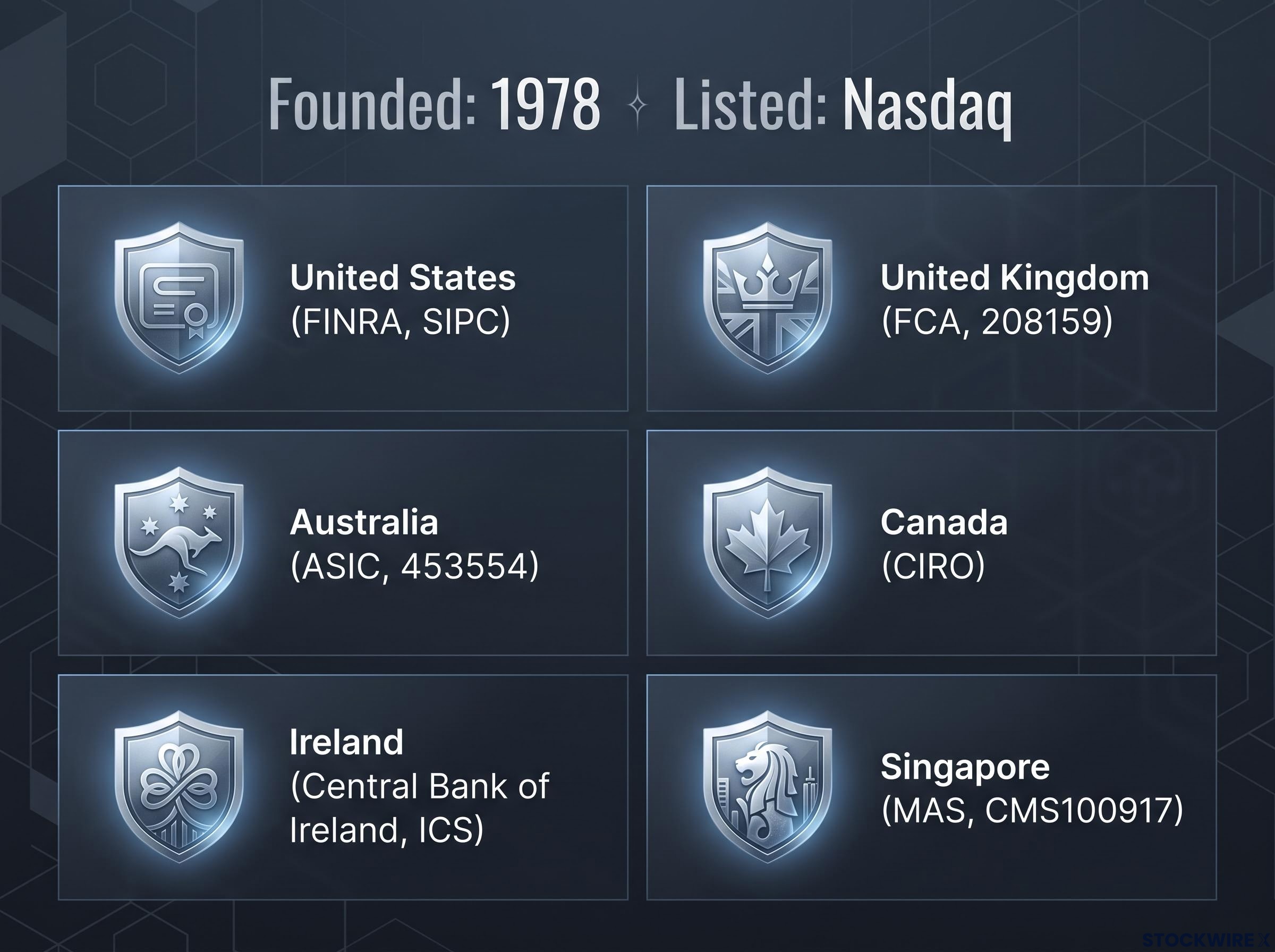
That breadth tells you something specific about the client this broker wants. It is not competing for casual account opens with a friendly app. It is built for people who treat their trading infrastructure seriously, which is exactly the profile that will find the depth worth the effort.
Making your broker decision with the 2026 evidence in front of you
The 88 out of 100 is earned. The fees, the trust, and the market access are genuinely exceptional, and the 5 out of 10 platform score is a deliberate trade-off rather than a quality failure. Interactive Brokers chose depth and control over simplicity, and it delivers both ends of that choice honestly.
So the aggregate is accurate for the right trader and quietly misleading for the wrong one. The only figure that matters for you is the one that maps your own situation onto the broker’s strengths or its single weakness.
That reduces the entire decision to one test.
Does your trading complexity match the platform’s complexity? If it does, the costs, access, and regulatory standing across six Tier-1 jurisdictions are close to unmatched. If it does not, that complexity extracts a real price in daily friction and the risk of costly errors.
There is a forward-looking note worth holding onto. The mobile upgrades and IBKR Lite show a broker iterating toward accessibility, and a prior institutional brokerage firm even relied on Interactive Brokers as a low-fee back-end, a quiet signal of how it is regarded at the professional level. These moves ease the on-ramp for cost-conscious retail investors, but they do not yet close the platform gap for the profiles where it bites hardest.
This article is for informational purposes only and should not be considered financial advice. Investors should conduct their own research and consult with financial professionals before making investment decisions. All trading involves risk of loss, which is amplified when leverage is involved.